
Sharjah Free Zone Company Formation (2026): Costs, Requirements and What to Expect

Recent Insights
Table of Contents
Introduction
Dubai is overpriced. If you’re actually trying to build a business and not just buy a fancy business card, you go to Sharjah. You get the same tax breaks and the same UAE access, but you aren’t lighting money on fire just to say you have an office on Sheikh Zayed Road.
But it’s 2026, and the new rules are strict. If you did’nt follow the new tax filings or pick the wrong zone, the fines will eat your savings anyway. Here’s the actual cost and the steps to get it done without the headache.
What “Cheap and Tax-Free” Really Means
The starting price for a Sharjah free zone licence is around AED 5,750. That price is real. But it is only the beginning.
You also need a visa, an immigration card, a medical test, an Emirates ID, a flexi-desk address, and e-channel registration. Add first-year compliance on top of that. By the time you total it all up, a single-person operation is looking at AED 15,000 to AED 25,000 in year one. Sometimes more.
The “tax-free” part also needs a closer look. The UAE introduced Corporate Tax in 2023. Free zone companies can still pay 0% tax, but only if they qualify. The official term is Qualifying Free Zone Person, or QFZP. To get that status, your business must meet a set of specific conditions. In 2026, a large number of free zone businesses do not qualify, simply because nobody told them what was required.
VAT is another thing to know about. The rate is 5%. Once your turnover crosses AED 375,000, you must register for VAT. Being in a free zone does not change that.
What a Sharjah Free Zone Company Actually Gives You
100% Foreign Ownership
The UAE now allows 100% foreign ownership across many mainland business categories too. So the ownership advantage of a free zone is less unique than it used to be. What a free zone does offer is a simpler path. Everything runs through one authority. There is no local partner, no sponsor, and no profit-sharing arrangement.
What 100% ownership does not change is where you can legally trade.
Where You Can Do Business
A Sharjah free zone company can invoice clients anywhere in the world. It can trade with other free zone companies. It can import and export goods through UAE ports, subject to the right approvals.
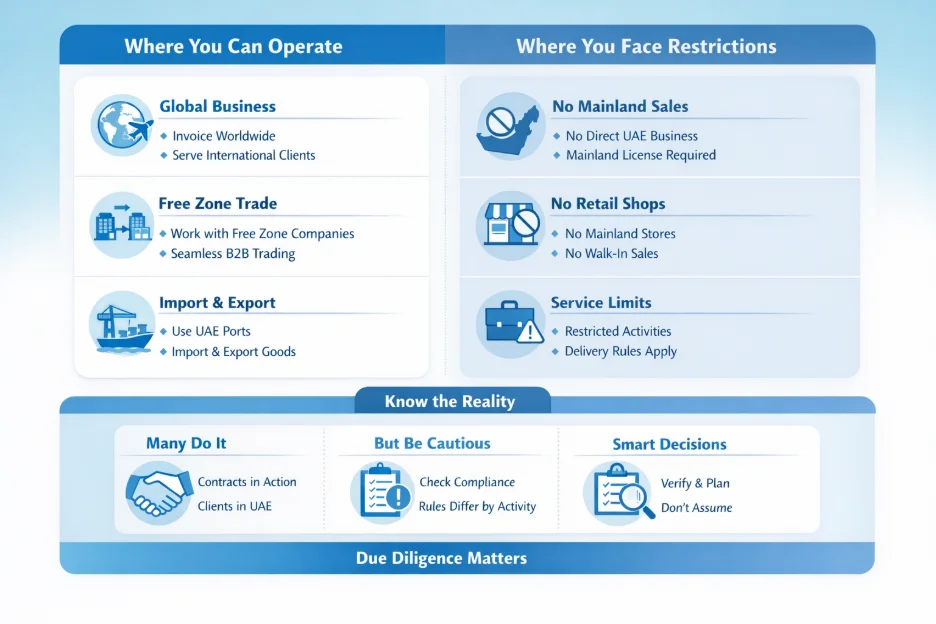
What it generally cannot do is sell directly to UAE mainland businesses or consumers without a mainland licence. It cannot open retail premises on the UAE mainland. For certain professional services, mainland delivery may also be restricted depending on how the activity is classified.
Many consultants and digital service businesses do invoice UAE clients from free zone entities, and it often works in practice. But whether it is fully compliant depends on the specific activity and contract structure. Do not assume. Do not ask the free zone authority either, because their remit ends at the zone boundary.
A Licence Is Not a Running Business
A trade licence gives you the legal right to exist as a company. It does not mean you are operational.
To run your business, you need a corporate bank account, an active office or flexi-desk, VAT registration if turnover qualifies, and Corporate Tax registration with the Federal Tax Authority. That last one is mandatory for all free zone companies, regardless of income level. Economic Substance Regulation (ESR) filings may also apply depending on your activity.
Each of these steps takes time and costs money. A company with a licence and no bank account cannot invoice anyone.
The Real Cost Breakdown for 2026
What the Advertised Price Leaves Out
Here are the typical costs that formation agencies rarely highlight upfront.
Visa and immigration:
- Investor or employment visa: AED 3,000 to AED 5,000 per visa.
- Medical fitness test: AED 300 to AED 700.
- Emirates ID: AED 370.
- Immigration card (e-channel): AED 2,000 to AED 3,000, paid once per company.
Office and address:
- Flexi-desk or virtual office: AED 1,500 to AED 5,000 per year.
- Physical office: priced per square foot and varies by free zone.
Bank account: No formation fee at most banks, but many require a minimum balance of AED 10,000 to AED 50,000 for business accounts.
For a single-shareholder consulting business with one visa and a flexi-desk, the realistic first-year total across most Sharjah free zones is AED 18,000 to AED 28,000, before any accounting or advisory fees.
Costs by Business Type
Consulting and professional services: The most affordable setup. One licence, one or two visas, no physical goods. First-year cost typically AED 18,000 to AED 25,000.
Trading company: Higher cost. Trading licences need extra approvals, customs registration, and often a physical office. First-year costs often reach AED 30,000 to AED 50,000.
Industrial and manufacturing: The most expensive tier. Hamriyah Free Zone and SAIF Zone handle these setups. Both require factory or warehouse space leased from the authority. Costs are not comparable to service or trading businesses.
Year 1 vs Year 2 Costs
Year 1 is the most expensive because it includes all one-off setup fees. From Year 2 onwards, you are paying licence renewal, visa renewal, and office fees only. For a single-person consulting business, Year 2 renewal costs typically fall around AED 10,000 to AED 15,000.
Costs Most Agencies Do Not Mention
These are regularly missed: FTA Corporate Tax registration fees when using a tax agent, ESR filing fees, NOC fees for visa transfers, document notarisation and attestation costs for overseas shareholders, and bank minimum balance requirements that lock up capital from day one.
DBTA’s company formation advisors provide a full three-year cost plan so you are not surprised at any stage.
The Setup Process: Step by Step
Step 1: Pick the Right Free Zone
Sharjah has four main free zones: SPC Free Zone, Sharjah Media City (SHAMS), SAIF Zone, and Hamriyah Free Zone. Each has a different activity focus, a different visa quota, and a different relationship with UAE banks.
Do not choose based on price alone. The right question is: which free zone supports your activity, provides enough visas for your team, and will banks accept your company as a result? That last point matters before you apply, not after.
Step 2: Select Your Licence Activity
Each free zone has its own approved activity list. You must choose from it. Activities outside the list cannot be added in most cases.
For consultants and service businesses, this is usually straightforward. For tech companies or businesses with mixed income streams, it takes more thought. Over-specifying activities can create tax problems. Under-specifying means you may not be able to legally invoice for all your work.
SPC Free Zone and SHAMS typically approve applications within 3 to 7 working days. SAIF Zone and Hamriyah may take longer depending on the activity.
A business licence consultant can help you choose the right activity codes from the start, which avoids the cost of amendments later.
Step 3: Immigration Card and Visa Processing
After the licence is issued, the next steps run in this order:
- Establishment card (immigration card) from the free zone authority. This must come first.
- Visa application submitted through the free zone.
- Medical fitness test at an approved UAE centre.
- Emirates ID biometrics at an ICP centre.
- Visa stamping, either inside the UAE or via a short trip abroad.
This full process takes 3 to 6 weeks from the date of licence issue, assuming no document issues.
Step 4: Bank Account Opening
This is covered in detail below. It is the step most people underestimate and the one that most commonly delays operations.
How Long Does It Really Take?
| Milestone | Typical Timeline |
|---|---|
| Licence issued | 3 to 7 working days |
| Establishment card | 1 to 3 working days after licence |
| Visa stamped | 3 to 6 weeks after licence |
| Bank account opened | 4 to 12 weeks (variable) |
| FTA registration done | 2 to 4 weeks after application |
| Fully operational | 3 to 4 months from start |
The “ready in 3 to 5 days” claim you see advertised refers to the licence only. Full operational readiness is a different timeline entirely.
Free Zone vs Mainland: Which Do You Need?
This is the most important structural question. Most investors raise it too late.
When a Free Zone Works
A free zone is the right fit for businesses that work internationally or digitally. Consultants with overseas clients, software companies, e-commerce businesses selling outside the UAE, trading companies importing for re-export, and media businesses with non-UAE customers all fit the free zone model well.
When most of your revenue comes from outside the UAE, the structure is clean and cost-effective.
When You Need a Mainland Licence
If your business depends on signing contracts with Dubai-based companies, selling to UAE consumers through retail, or delivering services directly to mainland clients, you need a mainland licence. Sometimes you need both.
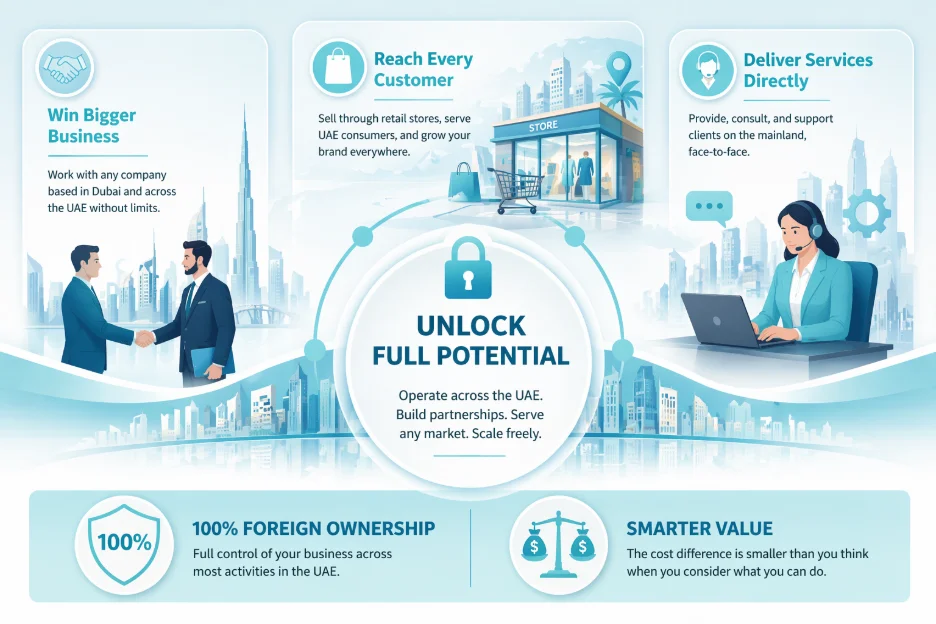
Mainland licensing in the UAE now permits 100% foreign ownership across most sectors. The cost gap between mainland and free zone is smaller than most investors expect, once you factor in what a free zone cannot do.
The Grey Area: Mainland UAE Clients
Many free zone businesses invoice UAE mainland clients for consulting and digital services without problems in practice. The legal risk is real. Enforcement varies by activity and contract structure.
If mainland revenue is a core part of your model and not an occasional transaction, build the right structure for it. A free zone and mainland company formation adviser can tell you which approach fits your business before you commit.
Which Sharjah Free Zone Is Best?
There is no single right answer. The best free zone depends on your activity, visa needs, and banking situation.
- SPC Free Zone has the lowest entry prices and suits a wide range of service businesses. The trade-off is that it is less established than SAIF Zone in terms of banking recognition.
- SHAMS works well for digital, media, consulting, and professional service businesses. It has a solid track record with UAE banks and is often the better choice when banking is a priority.
- SAIF Zone is the strongest option for trading and logistics. It sits near Sharjah International Airport with established customs handling. It is more expensive than SHAMS or SPC, but better suited to physical goods businesses.
- Hamriyah Free Zone is built for industrial, manufacturing, and heavy trading businesses with access to Hamriyah Port. It is not suitable for service or digital businesses.
One important note: some free zones have a stronger relationship with UAE banks than others. A slightly more expensive free zone can save you money overall if it makes bank account opening easier and faster.
Corporate Tax in 2026: What Free Zone Companies Must Know
What Is a Qualifying Free Zone Person?
A QFZP is a free zone company that meets the conditions set out in UAE Corporate Tax Law. Meeting QFZP status gives the company a 0% Corporate Tax rate on qualifying income. The conditions include:
- Maintaining real economic substance in the UAE.
- Earning income that qualifies under the legislation.
- Not electing into the standard tax regime.
- Keeping audited financial records to the required standard.
When the 9% Rate Applies
The 0% rate is not automatic. It applies only to qualifying income. Non-qualifying income is subject to a de minimis limit: the lower of AED 5,000,000 or 5% of total revenue. If you exceed that limit, the 9% rate applies to your entire taxable income, not just the excess.
Free zone businesses commonly trigger the 9% rate by winning too much mainland UAE business, failing to maintain substance in the UAE, or structuring activities in a way that falls outside the qualifying income definition.
“I have a free zone company so I pay 0% tax” is not an accurate or complete statement of the position. Ongoing tax advisory support ensures the conditions are being met throughout the year, not identified as a problem after the fact.
Registration Is Mandatory
Every free zone company in the UAE must register for Corporate Tax with the FTA. This applies regardless of income level. Registration is mandatory even if no tax will ever be due. Missing the deadline triggers financial penalties.
This is the compliance step most newly formed companies miss. Ongoing accounting and compliance support keeps these obligations on track so penalties do not catch you off guard.
Banking: The Real Struggle
Why Bank Account Opening Is Harder Than Company Setup
The free zone authority approves the licence. The bank approves the account. These are two separate processes run by two separate organisations with different criteria. A valid UAE licence does not guarantee a bank account.
What Banks Actually Ask For
Beyond the standard company documents, UAE banks typically require:
- A business plan describing your expected transactions.
- Six months of personal or existing business bank statements.
- Invoices, contracts, or other evidence of actual or expected business activity.
- A CV for each shareholder.
- Source of funds documentation.
- Details of expected transaction volumes and counterparty countries.
Some banks visit your registered office address. Requirements vary between banks and change over time.
Business Types That Face More Difficulty
Some categories face consistent difficulty regardless of which free zone is chosen: cryptocurrency or digital asset businesses, payment processing or money services, import and export involving high-risk countries, and companies with complex multi-jurisdiction ownership structures.
A rejection at one bank does not mean rejection everywhere. But going through multiple rejections wastes weeks or months. Knowing which bank to approach for which business profile, before applying, is one of the most practical things a formation adviser can provide.
The Three Mistakes That Cost the Most
Choosing the cheapest free zone without checking the limitations.
The cheapest licence has specific activity restrictions, a capped visa quota, and a specific standing with UAE banks. If any of these does not fit your business, the savings at formation will cost more to unwind later than the better option would have cost upfront.
Treating bank account opening as an afterthought.
The banking process should be assessed before the licence is chosen, not after it arrives. The free zone you pick directly affects your chances of getting an account approved.
Assuming 0% tax means zero compliance.
The FTA requires registration from all free zone companies, with or without taxable income. Penalties apply for late registration and missed filings. For businesses maintaining QFZP status, statutory audit readiness is part of staying compliant, not an optional extra.
How DBTA Approaches Sharjah Free Zone Setup
At DBTA, every engagement starts with the business model, not the licence list. Before any free zone is discussed, the key questions come first: Where are your clients? How do you invoice? What are you selling? Who will your counterparties be in two or three years?
Those answers shape the right structure. The licence follows from that.
A proper cost plan covers three years. Year 1 setup, Year 2 renewal, and the full ongoing compliance cost including FTA filings, ESR reporting, and any restructuring needed as the business grows. Investors who plan the full lifecycle spend less in total than those who focus on Year 1 cost alone.
For clients where QFZP status is achievable, keeping it is an active management task. And the banking landscape is assessed for each client before any licence application goes in. In some cases, that assessment changes the free zone selection entirely.
If you want a cost-honest, structure-first assessment before you commit, speak to the DBTA team before you apply.
Conclusion
Sharjah is the move if you want to keep your overhead low. There is no point in overpaying for a license in Dubai just to have a specific name on your letterhead. You get the same UAE residency and the same tax breaks in Sharjah, but for a lot less money.
Just make sure you actually do the work on the compliance side. The new corporate tax rules are strict, and if you miss a filing or an audit, the penalties are expensive. If you get the structure right from the start and stay on top of your books, you’ll save a massive amount of money. Use those savings to grow the business instead of giving it to a landlord or a free zone.
FAQs
The AED 5,750 price is just for the license paper. For a real setup with a visa, medical tests, and your ID card, you will actually spend between AED 18,000 and AED 28,000. If you are moving physical goods, budget at least AED 50,000 for the first year.
You only need your passport, a digital photo, and a recent utility bill or bank statement to prove where you live. If you are registering as a branch of another company, you will need that company’s legal papers stamped and cleared from your home country first.
The license takes a week, but you won’t be ready to trade that fast. Between the visa paperwork and the long wait to open a business bank account, it usually takes three to four months before you are actually up and running.
Yes. You own 100% of the shares. You do not need a local partner or a sponsor to hold any part of your business. You make all the decisions and keep all the profit yourself.
The number of visas you get depends on your office size. A basic “flexi-desk” setup usually gives you 1 to 3 visas. Once you finish your medical test, expect to wait about a month for the visa to be fully stamped and finished.
Every zone has a specialty. Some are for media and tech, while others are built for shipping or factories. You have to pick your activities when you apply because trying to add or change them later is a total headache.
Year two is much cheaper because you aren’t paying for the initial setup or immigration files again. For a one-person business, it usually costs between AED 10,000 and AED 15,000 per year to keep everything active.
It comes down to who pays you. Free zones are for international work or online business. If you want to sell products directly to people or shops on the street inside the UAE, you need a mainland license instead.
Latest news & articles
About the Author:
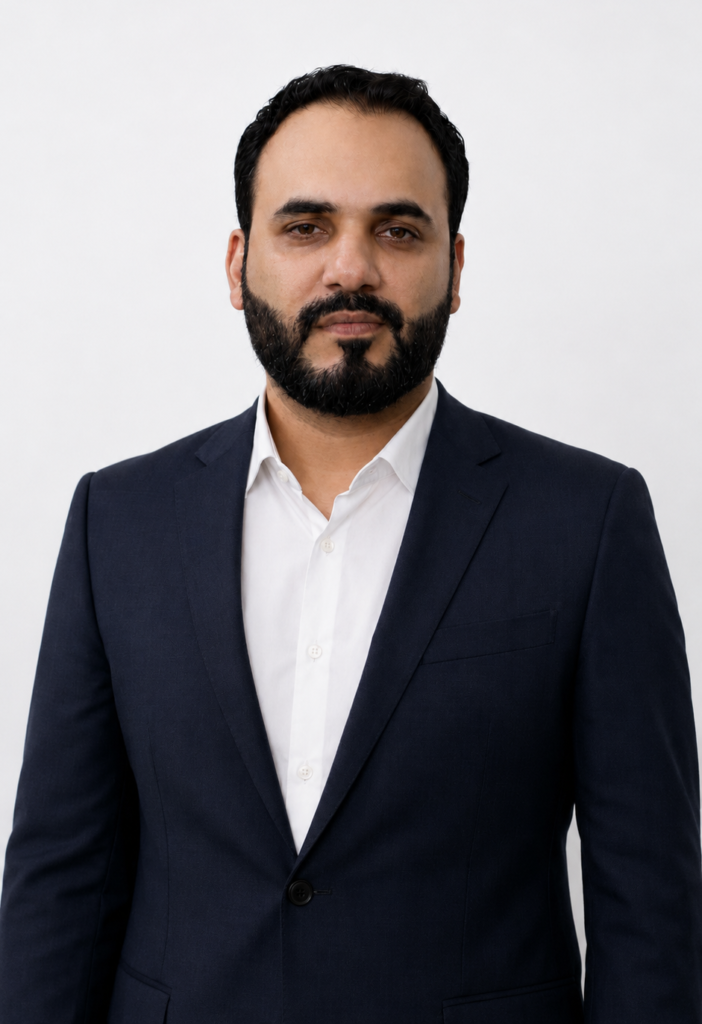
AURANGZAIB CHAWLA
As CEO of DBTA, Aurangzaib Chawla advises globally mobile businesses and individuals on cross-border tax planning and structuring. With expertise spanning the UK, UAE, and wider GCC, Zaib helps clients minimise double taxation, protect assets, and achieve long-term financial efficiency while staying fully compliant.
Planning to launch in Dubai or the UAE?
Let’s talk about how to structure your business for growth the smart, compliant, and tax-efficient way

About the Author:
AURANGZAIB CHAWLA
As CEO of DBTA, Aurangzaib Chawla advises globally mobile businesses and individuals on cross-border tax planning and structuring. With expertise spanning the UK, UAE, and wider GCC, Zaib helps clients minimise double taxation, protect assets, and achieve long-term financial efficiency while staying fully compliant.
Planning to launch in Dubai or the UAE?
Let’s talk about how to structure your business for growth the smart, compliant, and tax-efficient way
About the Author:
AURANGZAIB CHAWLA
As CEO of DBTA, Aurangzaib Chawla advises globally mobile businesses
and individuals on cross-border tax planning and structuring. With expertise spanning the UK, UAE, and wider GCC, Zaib helps clients minimise double taxation, protect assets, and achieve long-term financial efficiency while staying fully compliant.
Planning to launch in Dubai or the UAE?
Let’s talk about how to structure your business for growth the smart, compliant, and tax-efficient way.
Connect with Reliable Dubai Business Consultants
Get in Touch