

Introduction
Dubai gives small business owners speed, low tax pressure, and global access. You can launch faster here than in most major markets. You can also reach clients across Europe, Asia, and the Gulf from one base.
Still, the business setup in Dubai has changed a lot over the last few years. Banks now review firms more closely. Corporate tax rules affect most businesses. Free zone companies face stricter compliance checks. Even small firms need proper bookkeeping from the start.
That does not make Dubai harder for founders. It simply means you need a smarter setup from day one.
Why Dubai Still Works for Small Firms
Dubai keeps one clear edge: the city rewards speed and international reach. You can meet clients fast here. You can reach Asia, Europe, and Africa within hours. The UAE tax system also remains far more competitive than most major markets.
Under the current UAE corporate tax framework, taxable income up to AED 375,000 is taxed at 0%, and income above that threshold is taxed at 9%. For many early-stage businesses, that creates a real cost advantage compared to Western markets.
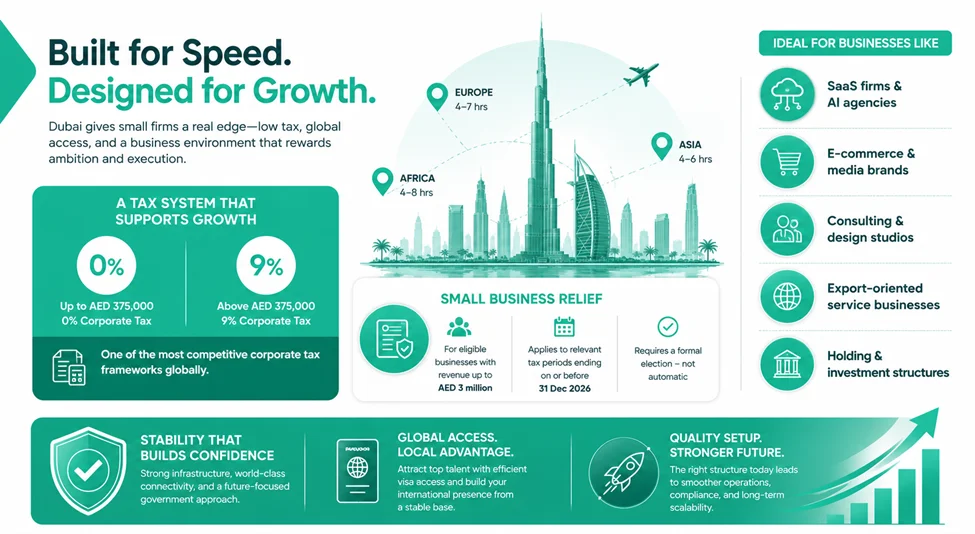
Smaller firms may also qualify for Small Business Relief. This relief is available to eligible resident taxable persons with revenue at or below AED 3 million, for relevant tax periods ending on or before 31 December 2026. It is a formal election, not an automatic entitlement.
The UAE also draws founders who want strong visa access and a stable base for international operations. The environment tends to work well for:
- SaaS firms and AI agencies
- E-commerce and media brands
- Consulting and design studios
- Export-oriented service businesses
- Holding and investment structures
Setup quality matters far more now than it did in previous years.
The Biggest Mistake New Founders Make
Most new founders focus only on price.
They search for the cheapest business license or the lowest-cost free zone. That impulse is understandable, but the setup price should never be the primary decision factor.
Cheap setups create long-term problems. Some low-cost licenses limit banking support. Some create tax confusion later. Others restrict growth once the firm scales.
Banks review business models carefully in 2026. Compliance teams want clean ownership structures and clear activity matches. A weak setup creates risk quickly, often at the worst possible time.
Mainland vs Free Zone: The Decision That Shapes Everything
This is the most important structural choice a founder makes. Your jurisdiction shapes tax treatment, banking access, visa limits, and growth flexibility.
Side-by-Side Comparison
| Factor | Mainland | Free Zone |
| Local UAE market access | Direct, unrestricted | Limited without a distributor or mainland branch |
| Corporate tax treatment | Standard CT rates apply | 0% possible, but only with QFZP qualifying status |
| Office requirement | Required in most cases | Flexi-desk often sufficient at the start |
| Setup cost | Generally higher | Often lower at launch |
| Banking profile | Strong, well-established | May require more documentation |
| Visa quota | Typically larger | Linked to office size |
| Best suited for | Retail, construction, local services, larger teams | Consultants, digital firms, export businesses, holding structures |
| Future expansion | Flexible | May require restructuring if serving the UAE market directly |
Mainland Setup
A mainland company formation in Dubai gives direct access to the UAE local market. You can trade inside Dubai without major restrictions. This route fits retail firms, restaurants, local service businesses, construction companies, and firms planning to hire larger teams.
Costs may run higher, and office requirements can be stricter in some sectors, but the trade-off is broader market access and a stronger banking profile.
Free Zone Setup
Free zone company formation remains popular for online and international firms. Setup moves faster and costs stay lower at the start. It suits consultants, SaaS founders, AI firms, export businesses, holding companies, and online stores.
One point that catches many founders off guard: a free zone company does not automatically receive 0% corporate tax treatment. To qualify as a Qualifying Free Zone Person (QFZP), firms must meet specific conditions:
- Generate qualifying income from permitted activities
- Maintain adequate economic substance in the UAE
- Hold audited financial statements
- Stay within de minimis limits on non-qualifying income
- Meet ongoing compliance and filing requirements
A poorly structured free zone setup may create unexpected tax exposure. Get the structure right before you launch.
Step-by-Step: How to Start a Small Business in Dubai
Here is the full process in order, from first decision to operational readiness.
Step 1: Define Your Business Activity
This is the most important step and the one most founders rush.
Your activity selection determines which license type you need, which zones are available to you, and how your business will appear to banks during compliance review. Vague or mismatched activities are one of the most common causes of bank rejection.
Be specific. Match your activity wording to what you actually do.
Step 2: Choose Mainland or Free Zone
Use the comparison table above to make this decision based on your client base, market, and long-term plans.
Key questions to ask yourself:
- Will you sell directly to UAE customers?
- Do you need a physical office or retail space?
- Are your clients outside the UAE?
- Do you need a large visa quota?
Choosing based on setup price alone is how founders end up restructuring within two years.
Step 3: Select Your Legal Structure
Three main options exist:
- Sole Establishment works for solo consultants and freelancers. Setup is simple and costs stay lower, but personal liability remains high. Your own assets may face exposure if claims arise.
- LLC Structure is what most serious founders choose. It provides stronger legal shielding, banks tend to prefer it, and investors expect it. It scales well across agencies, e-commerce firms, SaaS companies, trade businesses, and marketing firms.
- Holding Company Structure suits founders building multi-entity or multi-jurisdiction frameworks. One company owns assets while another runs operations. This limits risk exposure across the group and became more relevant after the UAE corporate tax arrived. If this applies to you, offshore company formation may also be worth exploring as part of the overall structure.
Step 4: Reserve Your Trade Name
Dubai applies naming rules. Some words are restricted. Some names require additional approval from government authorities. Check availability early and have alternative names ready.
Step 5: Apply for Your Business License
Dubai groups licenses into three main categories: commercial, professional, and industrial. Your activity type determines which category applies.
Some sectors require additional approvals before a license is issued. Food businesses face health checks. Finance firms face heavier regulations. Medical businesses require specific licensing support.
DBTA’s business license guidance covers the options by activity type and jurisdiction.
Step 6: Submit Documents and Get Initial Approval
Core documents for most applicants include:
- Passport copy
- Visa copy (if applicable)
- Proof of address
- Passport photo
- Completed license application forms
Authorities review the structure and activities during this stage. Approval timelines vary by zone and activity type.
Step 7: Set Up Your Office or Flexi-Desk
Mainland companies need a registered office address. Many free zones allow a flexi-desk arrangement, which reduces cost significantly at the start. Some zones also offer virtual office options for eligible activities.
Your office setup affects your visa quota, so plan this in line with your hiring plans.
Step 8: Apply for Residence Visa and Emirates ID
Once your license is approved, you can apply for a UAE residence visa and an Emirates ID. This is also when you can begin sponsoring visas for employees.
Visa processing timelines vary, but the process is well-established for most standard applications.
Step 9: Register for Corporate Tax
Corporate tax registration is required for all UAE businesses, even those that earn little or no revenue in each period. Late registration may trigger penalties.
The UAE corporate tax works in a simple way. If your profit is up to AED 375,000, you pay 0% tax on it. Once your profit goes above that level, the extra amount is taxed at 9%. There is also some relief for small firms. If your revenue stays under AED 3 million, you may qualify for Small Business Relief for tax periods ending on or before 31 December 2026.
See DBTA’s corporate tax advisory services for registration support and structuring guidance.
Step 10: Register for VAT (If required)
VAT applies at 5% across the UAE.
- Mandatory registration: taxable turnover above AED 375,000
- Voluntary registration: taxable turnover above AED 187,500
If your clients are VAT-registered businesses, voluntary registration can make sense even below the mandatory threshold. A free zone company does not automatically operate VAT-free. Many service firms fall under standard VAT rules regardless of their zone location.
DBTA’s VAT and indirect tax guidance covers registration, filing obligations, and what applies inside free zones.
Step 11: Open a Corporate Bank Account
This stage now takes the longest step in the process. Banks in 2026 will review businesses carefully before opening accounts.
Expect questions about:
- Ownership structure and ultimate beneficial owners
- Source of funds and wealth
- Revenue projections and business model
- Client types and geographies
- Nature of transactions
Keep a clean business plan ready. If you have clients or contracts, show them proof. Be clear about where your funds come from. Banks check this closely. Crypto firms, trading companies, and complex ownership setups face stricter review.
Many founders make the mistake of completing the license before checking whether banks are comfortable with their setup. Speak to a bank or banking advisor early in the process, ideally before you commit to a jurisdiction.
Step 12: Set Up Accounting and Bookkeeping
Clean records from day one are no longer optional.
Your accounting system needs to handle invoicing, VAT filings, expense tracking, payroll, and bank reconciliation. Some free zones require audited accounts at renewal. Corporate tax filing depends entirely on the quality of your books.
Bookkeeping set up early is far cheaper than reconstructing records later under audit pressure. Financial statement preparation also matters once your business moves past the early stage.
UAE Corporate Tax: Two Things Founders Confuse
The UAE corporate tax system creates two areas of consistent confusion worth addressing directly.
The AED 375,000 profit threshold and the AED 3 million revenue threshold are not the same thing.
The 375,000 figure is the taxable income level below which the 0% rate applies. The 3 million figure is the revenue ceiling for Small Business Relief eligibility. These are two separate calculations with different implications.
Free zone companies do not receive automatic 0% treatment.
To maintain favorable tax treatment as a Qualifying Free Zone Person, a firm must meet substance requirements, generate qualifying income, maintain audited accounts, and stay within de minimis limits on non-qualifying income.
Founders who assume their free zone structure automatically means zero tax are often surprised when they review their actual position.
Setup Risks That Cost Founders Later
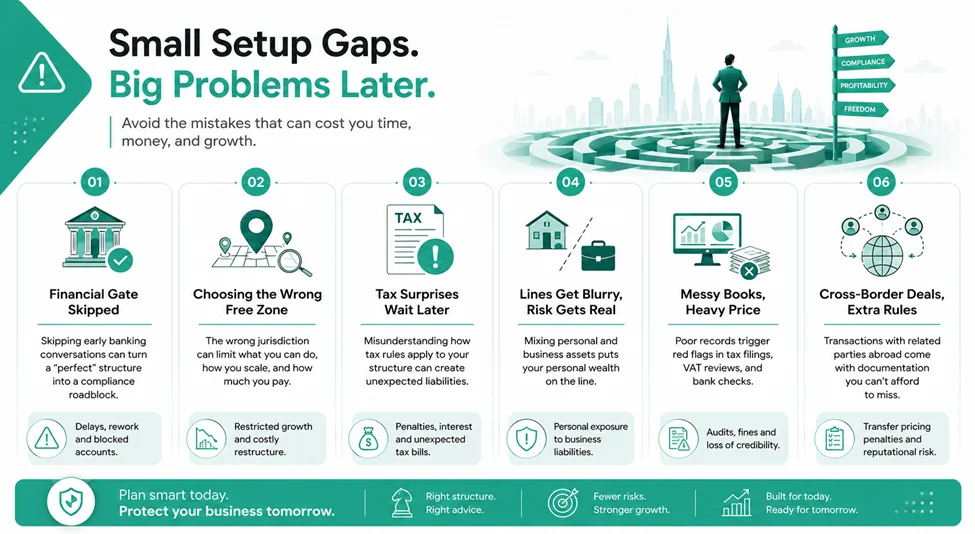
Weak banking planning.
Many founders buy licenses before speaking with banks. A structure that looks fine on paper may fail a compliance review. Talk to a bank or advisor early.
Wrong free zone selection.
Not every zone fits every business model. Some work better for trade firms. Others fit digital businesses. A poor fit limits future growth and often requires costly restructuring.
Misunderstood tax exposure.
Founders who do not understand how corporate tax applies to their specific structure tend to discover the problem after it has already created a liability.
Mixing personal and business assets.
Keeping operational risk separate from personal wealth matters more as the business grows. Establish this separation from the start.
Poor accounting systems.
Messy records create real exposure. Tax filings, VAT checks, and bank reviews all depend on clean documentation. The cost of fixing this later is always higher than doing it right from the beginning.
If your UAE entity transacts with related parties in other countries, transfer pricing documentation requirements also apply and are frequently overlooked by growing firms.
How DBTA Helps Business Owners Build Proper Structures
DBTA works with entrepreneurs, family offices, and global business owners who need more than basic company formation support.
The firm helps clients build stronger cross-border structures while reducing long-term tax and compliance risk.
Cross-Border Company Structures
Many global founders now operate across several jurisdictions. Proper structuring helps reduce operational risk and improve long-term control.
Asset Protection Planning
Wealth protection becomes more important once businesses scale internationally.
UAE Compliance Support
Corporate tax, VAT, and regulatory obligations now require stronger compliance systems than before.
Family Office Structures
High-net-worth founders often require more advanced ownership frameworks as wealth grows.
Final Thoughts
Dubai still offers founders one of the most accessible and internationally connected markets available today. The tax system remains competitive. The infrastructure works. The city rewards founders who plan well early.
But business setup changed. A cheap license is not a strategy.
The founders who succeed focus on five things from the start:
- Banking access and compliance readiness
- Tax clarity, including corporate tax and VAT registration
- Legal structure and asset protection
- Clean accounting and bookkeeping from day one
- A scalable setup matched to their actual business model
Plan those five areas before launch week. Build systems that still work three years later. Work with advisors who understand compliance, tax exposure, and cross-border growth from a practical standpoint.
That single decision often shapes the long-term value of the business itself.
Frequently Asked Questions
You’re usually looking at AED 12,000 to AED 15,000 for a basic free zone setup. Mainland setups often start near AED 20,000. That is only the entry cost. You still need extra cash for visas, small admin fees, and bank setup delays that often come later.
It depends on your customers. If you want to sell inside the UAE and meet clients directly, the mainland fits better. If you work online or serve global clients, a free zone is usually easier and lighter to manage.
Simple service businesses work best at the start. Digital marketing, e-commerce, consulting, and small online services are common picks. They are easy to launch, low risk, and don’t need heavy setup or big teams.
It stays simple. You mainly need a passport copy and a passport photo. If you already have a visa, they may ask for that too. Sometimes they request address proof, but not always. Nothing heavy at the start.
Free zone setup is fast, often just 2 to 3 days if your documents are clean. Mainland setups take about 1 to 2 weeks. The longer wait usually comes later when you open a bank account, which can take even more time.
Not directly in most cases. Free zone companies are built for international trade or zone-based work. If you want to sell directly in the UAE market, you usually need a mainland license or a local partner setup.
You may pay 9% corporate tax if your profit goes above AED 375,000. VAT is 5% if your business crosses the required threshold. Even if you owe nothing, you still need to file returns and keep proper records.
This is often the toughest step. Banks don’t just check your license. They dig into your business model, clients, and money flow. If things look unclear, they delay or reject the application. A clean and simple setup makes this much easier.