
Dubai Company Formation and Registration: A Practical Guide for 2026

Recent Insights
Table of Contents
Dubai has grown into one of the best places in the world to start a business. It offers low taxes. It offers fast paperwork. And it gives you easy access to markets across the Middle East.
But speed alone is not enough. If you skip proper planning around compliance and banking, you can end up with a license that looks good on paper. It just won’t actually work for you.
In 2026, a smart launch means finding the right balance. You want quick licensing. But you also need a setup that can hold up under the UAE’s tax rules and money-laundering checks. This guide walks you through what that looks like, step by step.
What Company Formation in Dubai Actually Includes
Setting up a company in Dubai is not just about picking up a piece of paper. That paper comes from the Department of Economy and Tourism, or from a free zone authority. But a full setup covers much more than that.
You need the trade license. This gives you the legal right to operate. You also need an establishment card. This opens your immigration file. On top of that, you need residence visas, both for yourself and for any staff. And you need a working corporate bank account.
There’s one more piece people often forget. You need to plan for VAT registration and corporate tax registration from day one. Leave these for later, and you risk fines that could have been easily avoided.
Who Needs This Guide
This guide is for a wide range of people. Maybe you’re a solo consultant. You want a free zone base so you can serve clients abroad. Or maybe you run a bigger company. You want a mainland entity so you can bid on government contracts.
Either way, this guide is for you. It’s especially useful if you’re new to the UAE system. It gives you a clear path. And it helps you avoid the trap of “cheap” packages that never lead anywhere real, no proper office, no working bank account.
How Fast Can You Really Move
Here’s the good news. Some digital activities in certain free zones can get you a license in just 24 to 48 hours. Sounds great, right?
But that’s not the whole picture. Being truly ready to operate is a different story. That means you can sign contracts. You can send invoices. You can move money. Getting there usually takes 4 to 8 weeks.
Why the gap? A few steps get forgotten along the way. You need to notarise foreign documents. You need to sign a lease, called an Ejari. And you need to pass the bank’s identity checks. These steps take time.
Mainland, Free Zone, or Branch: A Quick Way to Decide
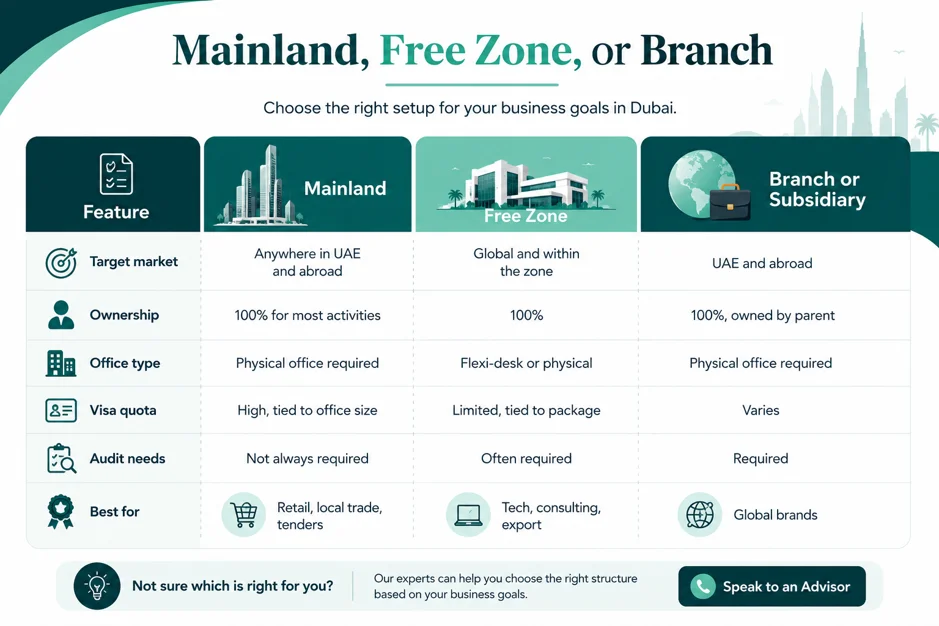
Picking the right structure is the biggest decision you’ll make. Here’s a common mistake. Many founders choose based on price alone. Then they find out they can’t legally serve the market they actually wanted.
When Mainland Is the Right Choice
A mainland company is the standard pick if you plan to trade directly with the local UAE market. It’s also the right choice if you want to bid for government contracts.
Do you need a shop? A warehouse? Do you serve local people or government bodies? If so, mainland is likely your only real option.
Make sure the business activity you choose actually matches the market you plan to serve. This one choice affects your license approval. It also affects later steps, like opening a bank account.
When a Free Zone Makes More Sense
A free zone works well if you run an online-first business. It also suits consultants and traders who don’t need a physical base on the mainland.
Here’s the appeal. Free zones let you keep 100% of your profits. You can send them abroad freely, no restrictions. Many zones also offer bundled “flexi-desk” packages. These keep your costs low when you’re just getting started.
Do most of your clients live outside the UAE? If so, a free zone is often your simplest, cheapest route. Just remember, you’ll still need to meet tax and banking rules. Build that into your plan from the very start.
When a Branch or Subsidiary Fits Better
Already run an established company abroad? Opening a branch in Dubai lets your parent company keep full control. You get to use the same brand, too. A branch isn’t its own legal entity. It’s simply an extension of the parent company.
A subsidiary works a little differently. It’s a separate legal entity. The parent company owns it. This setup gives the parent better protection from liability. And you still get to keep full ownership.
A Closer Look at Mainland Company Formation
The rules here have changed a lot in recent years. Good news for founders. A mainland company no longer needs a local partner holding 51% ownership. This applies to most commercial and industrial activities.
What a Mainland License Lets You Do
A mainland license gives you real freedom across the city. You can open branches in different Emirates. You can work with any local client. You can invoice any UAE business directly, no middleman needed.
Planning to grow across the wider Gulf region? A mainland company is often seen as the stronger, more credible option for that kind of growth.
Office Space and What It Means for Visas
Mainland companies must have a real, physical office. How does the government confirm this? Through an Ejari, a registered tenancy contract.
Here’s something important to know. The size of your office decides how many visas you can apply for. As a rough guide, every 8 to 10 square metres of office space gives you one visa.
Do You Need a Local Partner
Since 2021, the UAE has allowed 100% foreign ownership for most LLCs. That’s a big shift from the old rules. Still, a small number of sectors need a local partner. Think oil and gas. Think defence.
Some professional licenses need something else instead. If you’re an individual consultant or a doctor, you may need a Local Service Agent. This person acts as a go-between with government departments. They charge a fixed yearly fee. But here’s the key part, they hold no equity in your business.
Who Should Choose Mainland
Picture a few examples. Someone opening a café in Jumeirah. An engineering firm bidding for transport authority projects. A real estate agency chasing local buyers. All of these need mainland. It gives you the legal footing to operate fully within the city.
A Closer Look at Free Zone Company Formation
Dubai has more than 20 free zones. Each one is built around a specific industry. Dubai Internet City focuses on tech. DMCC is built for commodities trading.
What Free Zones Allow
Think of free zones as business parks. Each has its own rules and its own regulator. They allow full foreign ownership. They skip customs duties entirely.
This setup works well if you don’t need to move physical goods onto the mainland. Many zones bundle everything together, a license, shared workspace, and one or two visas, all for a single fixed price.
Where the Limits Are
Here’s a mistake people make often. They think a free zone company can sell products directly to a shop in a mainland mall. It can’t, not without extra steps.
You’d need a local distributor with a mainland license. Or you’d need your own separate mainland branch. Service businesses get a bit more flexibility. Generally, your work should happen within the zone. Or it should go to clients outside the UAE.
How Visa Quotas Work
In a free zone, your visa quota usually comes bundled into your package. A “zero-visa” package is the cheapest option. But it comes with a catch, you can’t get an Emirates ID.
A “two-visa” package lets the founder and one partner live in the UAE. Need to hire more people? You’ll have to upgrade your package. Or move to a larger office within the same zone.
Who Should Choose a Free Zone
Are you a programmer? A marketing consultant with international clients? A dropshipper? For all of these, a free zone is usually the most cost-effective option.
Choosing the Right Legal Structure and Business Activity
Your choice of activity shapes everything that follows. It sets your license cost. It decides which approvals you’ll need. It even affects whether a bank agrees to open an account for you.
Why Activity Selection Matters So Much
Dubai has a standard list of over 2,000 business activities. Choose “Investment of Own Funds,” and you’ll face heavy banking scrutiny. Choose “General Trading,” and expect a higher license fee, since the scope is so broad. Choose something like “Medical Services,” and you’ll need separate approval from the Dubai Health Authority.
The Main License Types
- Commercial: for buying and selling goods
- Professional: for service-based work such as consulting, design, or law
- Industrial: for manufacturing and packaging, which needs a physical factory
- E-commerce: for selling goods or services through an online platform
Combining Activities Under One License
Can you group several activities under one license? Sometimes, yes. This works if they sit within the same category, say, three types of consulting.
Mixing categories is a different story. Combine consulting with general trading, for example, and you’ll usually need a second license. That means a higher fee. And separate approvals, too.
A Common Mistake to Avoid
Here’s how it often plays out. Founders pick a “Consulting” activity because it’s cheap. Then they try to sell physical products anyway. This breaks the rules.
It can lead to fines during inspections. It can also cause your bank to freeze your account, all because of an activity mismatch. Getting the activity right the first time saves a lot of stress later.
What You Need to Register a Company in Dubai
Good news here. The paperwork is fairly simple. Just know that it gets checked closely.
Documents for Foreign Owners
- A passport copy, valid for at least six months
- Proof of home address, such as a recent utility bill
- A copy of your UAE entry stamp or visa page, if you’ve visited before
- A No Objection Certificate, if you’re currently employed in the UAE
What Banks Expect from Shareholders
You need at least one manager and one director. They can even be the same person. Banks will ask for a detailed CV for the manager. They’ll also want six months of personal bank statements from shareholders. This helps them check where the money is coming from.
Rules Around Naming Your Company
A few naming rules to keep in mind. Your company name can’t include words like “Global,” “International,” or “Middle East.” Not unless you meet certain capital requirements.
Names also can’t start with “Dubai” or “UAE” without special approval. And skip any name that’s already trademarked. Or one that’s too close to an existing government body’s name.
When You Need Extra Approvals
Certain activities need sign-off from a specific regulator. A travel agency, for instance, needs approval from the tourism division of the Department of Economy and Tourism. A school needs approval from the Knowledge and Human Development Authority.
These extra steps add time. They add cost, too. So, it helps to plan for them early.
Why the MOA Matters to Your Bank
The Memorandum of Association sets out how capital, profits, and decision-making get shared between owners. Banks read this document closely. They want to know exactly who has signing authority.
Here’s the catch. If the MOA doesn’t clearly say the manager can open and operate bank accounts, the bank may simply reject your application.
The Company Formation Process, Step by Step
Setting Up a Mainland Company
- Choose your activity and reserve a trade name with the Department of Economy and Tourism
- Apply for initial approval, sometimes called the preliminary no objection
- Draft and notarise the Memorandum of Association. This can now often be done digitally
- Sign a commercial lease and get your Ejari certificate
- Submit the Ejari and MOA and pay for your license
- Apply for the establishment card, then the investor visa
Setting Up a Free Zone Company
- Pick a zone that matches your business, such as IFZA, DMCC, or Meydan
- Submit your passport and business plan to the free zone authority
- Pay the package fee, which usually covers license, office, and visa allocation
- Receive your electronic license and MOA
- Apply for E-Channel registration and your entry permit
Registering a Branch or Subsidiary
This route needs more paperwork. You’ll need the parent company’s certificate of incorporation. You’ll need its MOA. You’ll need a board resolution, too.
Here’s an extra step to plan for. All of these documents must get attested. First by the UAE embassy in your home country. Then by the Ministry of Foreign Affairs in the UAE.
Steps People Often Miss After Getting the License
Getting your license is only the halfway point. You still need to register for E-Channel services. You still need to apply for your establishment card. And you need to register for corporate tax, within the required deadline, to avoid penalties.
How Long Company Registration Really Takes
The Full Timeline
- License issuance: 2 to 7 working days
- Establishment card: 3 to 5 working days
- Residency visa, including medical and biometrics: 7 to 10 working days
- Corporate bank account: 4 to 8 weeks. This is usually the real bottleneck
Best Case Versus Typical Case
The fastest route can get you a license in 48 hours. But becoming fully operational is a longer story, that typically takes around 6 weeks.
What causes the delay? Usually, it comes down to two things. Foreign documents that weren’t attested correctly. Or a bank asking for more proof of business activity.
What Causes the Biggest Delays
The most common holdup has a name; people call it the attestation loop. Say you’re opening a branch of a foreign company. Getting documents stamped abroad, and then again in Dubai, can take several weeks all on its own.
Company Registration Costs in 2026
Costs go well beyond the low “teaser” prices you might see advertised online.
Registration Cost vs Total Setup Cost
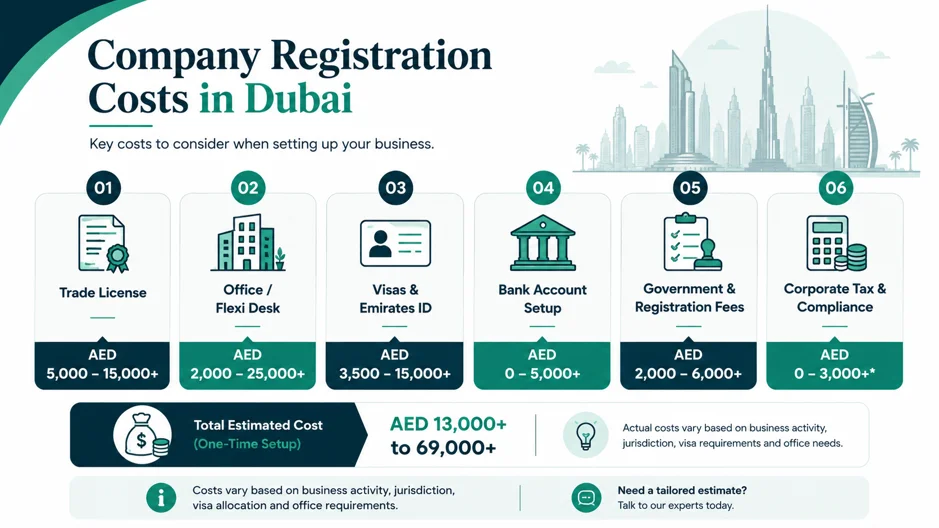
The “registration cost” usually means just one thing, the government license fee. The full “setup cost” is a bigger number. It includes visas, medical tests, your Emirates ID, office rent, and any fees you pay an advisor.
Government Fees vs Advisor Fees
Government fees are fixed, though they vary by activity. Advisor fees cover the legwork. Think drafting documents, standing in queues, and giving expert guidance.
Here’s a warning worth remembering. A cheap advisor often leaves you to handle the harder visa and banking steps entirely on your own.
What Drives Your Costs
Mainland fees usually sit around AED 15,000 to 30,000 for the license. Add office rent on top, starting from AED 20,000. Free zone packages range from around AED 12,000 to AED 50,000. The final number depends on how many visas you need.
First Year vs Renewal Costs
Here’s some good news for year two. Costs usually drop by 20 to 30%. Why? You no longer pay for name reservation, initial approvals, or one-time visa costs (most visas last two years).
Just remember to budget for the ongoing costs. That means your annual license renewal. And your office lease.
Getting a Visa Through Your Dubai Company
Does a License Automatically Give You a Visa
No, it doesn’t. The license only gives you the right to apply for a visa. The visa itself is a separate step, one that follows your license.
Owner Visas vs Employee Visas
An investor or partner visa is valid for two years. Under the Golden Visa scheme, it can stretch up to ten years. And it doesn’t need a work permit from the Ministry of Human Resources and Emiratisation.
Employee visas work differently. They need a labour contract. And they fall under standard UAE labour law. Working with a specialist for visa processing can help you avoid the delays that come from incomplete labour files or missing medicals.
Opening a Corporate Bank Account
What Banks Ask For
Banks want proof that your business is real. That means signed contracts. Invoices from previous work. Or a solid business plan.
They’ll also want a physical office address. A PO box won’t do the trick here.
A Simple Readiness Checklist
- A professional website that clearly shows what you do
- Draft or signed contracts with suppliers or clients
- Personal bank statements showing where your starting capital came from
Tax and Compliance After You Register
Is Dubai Still Tax-Free
Not quite anymore. The UAE has shifted. It used to be a tax-free base. Now it’s a low-tax one. Once you form a company, you also need to register it for corporate tax.
Corporate Tax Basics
Since June 2023, a 9% corporate tax applies to profits above AED 375,000. Some free zone companies can still qualify for a 0% rate. These are called “Qualifying Free Zone Persons.”
But the conditions are strict. You need real substance in the zone. And your income needs to count as “qualifying income.”
When VAT Applies
VAT sits at 5%. Registration becomes mandatory once your taxable turnover passes AED 375,000 in a 12-month period. You can also register voluntarily. That kicks in once you cross AED 187,500.
Ongoing Rules You Cannot Ignore
Every company must keep an Ultimate Beneficial Owner register. You need to submit it to the authorities. Skip this step, and you could face fines of up to AED 100,000.
Expert Guidance for Your Dubai Business Setup
DBTA provides independent advice on jurisdiction selection, company structuring, and regulatory requirements. Beyond registration, we help you prepare for corporate banking, tax compliance, and ongoing obligations, giving you a practical foundation for operating in the UAE.
Conclusion
Setting up a business in Dubai takes more than filling out a few forms. It takes real understanding, of how the local banking system works, and of how strict the tax rules have become.
A setup that’s both fast and built to last? That’s always worth the extra planning it takes to get there.
Ready to register your company the right way? DBTA’s ACCA-qualified advisors handle mainland and free zone formation, licensing, visas, banking, and corporate tax and VAT registration under one roof, so nothing falls through the cracks. Contact DBTA today for a consultation.
FAQ's:
It’s the legal process of registering a company. You do this with either the Department of Economy and Tourism, for mainland setups, or a free zone authority. It gives you a trade license. That license lets you hire staff, trade legally, and live in the UAE.
Mainland lets you trade anywhere in the UAE. You can also bid for government contracts. But you’ll need a physical office. Free zones suit international or zone-based trade. You get easier full ownership and bundled office packages.
A basic free zone package usually starts around AED 12,000. A mainland setup with a small office typically starts from AED 35,000 upward. Your total cost depends on how many visas you need and where your office is located.
The license itself can take 2 to 7 days. Becoming fully operational, that includes visas and a working bank account, usually takes 6 to 8 weeks.
You need a passport copy. You need proof of address, like a utility bill. And sometimes a short CV, along with personal bank statements for identity checks.
Since 2021, most mainland activities allow 100% foreign ownership. A small number of sectors still need a local partner. Think oil and gas. Think defence.
The license gives you the right to apply for visas. Each visa is a separate cost. And it needs an establishment card issued first.
Match your activity to what you actually do. Trading needs a commercial license. Consulting needs a professional one. Whether you choose an LLC or a branch depends on your liability and ownership needs.
Match your activity to your actual operations. If you trade, you need a Commercial license; if you consult, a Professional one. Your structure (LLC vs. Branch) depends on liability and ownership needs.
Latest news & articles
About the Author:
AURANGZAIB CHAWLA
As CEO of DBTA, Aurangzaib Chawla advises globally mobile businesses and individuals on cross-border tax planning and structuring. With expertise spanning the UK, UAE, and wider GCC, Zaib helps clients minimise double taxation, protect assets, and achieve long-term financial efficiency while staying fully compliant.
Planning to launch in Dubai or the UAE?
Let’s talk about how to structure your business for growth the smart, compliant, and tax-efficient way

About the Author:
AURANGZAIB CHAWLA
As CEO of DBTA, Aurangzaib Chawla advises globally mobile businesses and individuals on cross-border tax planning and structuring. With expertise spanning the UK, UAE, and wider GCC, Zaib helps clients minimise double taxation, protect assets, and achieve long-term financial efficiency while staying fully compliant.
Planning to launch in Dubai or the UAE?
Let’s talk about how to structure your business for growth the smart, compliant, and tax-efficient way
About the Author:
AURANGZAIB CHAWLA

As CEO of DBTA, Aurangzaib Chawla advises globally mobile businesses
and individuals on cross-border tax planning and structuring. With expertise spanning the UK, UAE, and wider GCC, Zaib helps clients minimise double taxation, protect assets, and achieve long-term financial efficiency while staying fully compliant.
Planning to launch in Dubai or the UAE?
Let’s talk about how to structure your business for growth the smart, compliant, and tax-efficient way.
Connect with Reliable Dubai Business Consultants
Get in Touch