

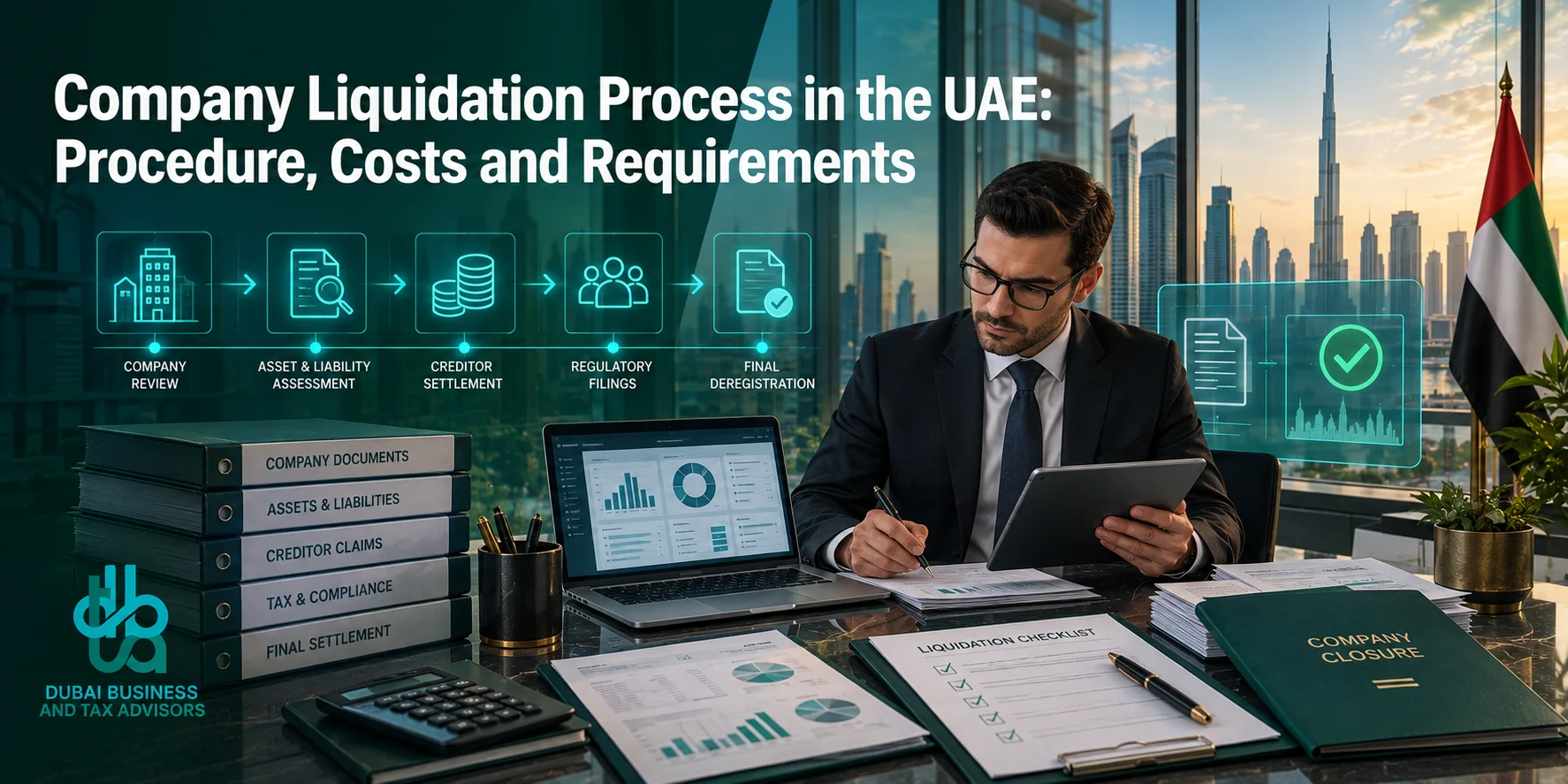
Liquidating a company in the UAE means closing it down the right way. You pay off what you owe. You cancel your licence. And you close your tax file with the government too.
Here’s something a lot of owners miss. A licence expiring on its own does not close your company. The steps you need to follow depend on your legal setup, which authority issued your licence, and your tax status.
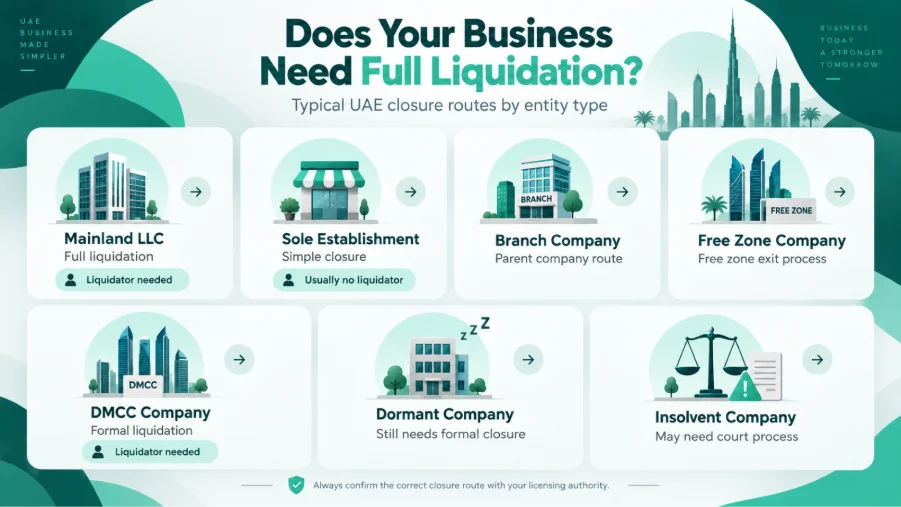
Mainland firms, free zone firms, and DMCC firms each follow their own path.
If your UAE business needs to close, you probably have a few questions on your mind. What rules apply to me? What will this cost? What might slow it down? Where do I even start?
This guide walks through all of it, covering mainland, free zone, DMCC, and Abu Dhabi companies, updated for how things work in 2026.
What Company Liquidation Actually Means
Liquidation is the legal way to wind down a business in the UAE. It means settling everything the company owes, then formally removing it from the register for good.
Federal Decree-Law No. 32 of 2021 on Commercial Companies sets out how this works.
It’s worth being clear on one thing. Shutting your office or stopping invoices is not the same as liquidating. Your company still carries legal duties. That stays true right up until an official body confirms, in writing, that it no longer exists.
What Happens During Liquidation
A liquidator is appointed to run the wind-down. They list out the assets, check what’s owed, notify creditors, and pull together the final accounts.
Shareholders vote to approve the closure first. Once that’s done, the liquidator pays off debts. Only after that does anything left over go back to the owners.
Every clearance must be in place before the process can finish. Once it is, the licensing authority issues a final deregistration certificate. That certificate is your real proof the company is closed.
Liquidation, Cancellation, Dissolution and Bankruptcy Are Not the Same Thing
People often use these words as if they mean the same thing. They don’t.
| Term | What it means |
|---|---|
| Liquidation | The full wind-down of assets, debts and legal status |
| Licence cancellation | One step in the process, not the whole thing |
| Dissolution | The end point once the wind-down is finished |
| Bankruptcy | A court process for companies that cannot pay their debts |
A company under liquidation still exists in the eyes of the law. It only stops existing once the authority confirms the closure.
The Company Liquidation Process, Step by Step
The order below is how most mainland and free zone cases run. Some steps can shift depending on your authority, and a few can happen side by side.
Step 1: Check Where Things Stand
Start with an honest look at your position.
- Your licence status, and whether the owners agree to close
- Any staff still employed, and their visa status
- Bank balances and assets on the books
- Any unpaid creditors
- Your VAT and Corporate Tax filing history
- Any open contracts or disputes
Skip this step and the whole process tends to stall halfway through.
Step 2: Approve the Liquidation and Appoint a Liquidator
Owners who hold the right voting share pass a resolution to close the company. For an LLC, this means a signed and notarised special resolution.
That same resolution names a liquidator. Free zones and DMCC usually want this person to come from their approved list, not just any accounting firm you pick.
Step 3: Get Initial Approval from the Authority
The resolution, along with the liquidator’s signed acceptance, goes to the right authority. That could be DET, DED, a free zone, or DMCC.
Once it’s accepted, the authority issues a first-stage certificate. This confirms the process has officially started.
Step 4: Notify Creditors
Most mainland cases require a notice placed in two newspapers, with at least one in Arabic.
This opens a creditor notice period. For mainland companies, it usually runs around 45 days.
Free zones set their own timelines here, and DMCC follows its own notice process. It’s worth checking the exact period with whichever authority is handling your file, since it isn’t the same everywhere.
Step 5: Settle Debts, Staff and Government Records
During the notice period, your liquidator works through several tasks at once.
- Paying suppliers and any confirmed creditor claims
- Settling staff dues, including end-of-service pay
- Cancelling visas and labour cards
- Closing the lease and utility accounts
- Clearing any outstanding government fines
Miss even one clearance, especially on the labour or tax side, and the whole file can grind to a halt.
Step 6: Prepare the Final Accounts
Your liquidator puts together the final accounts. These show how the assets were distributed and how debts got paid.
Most mainland and DMCC companies need sign-off from a licensed auditor at this stage, typically as part of a formal statutory audit. The authority reviews this report before it will close your file.
Step 7: Cancel the Licence and Deregister for Tax
Once every clearance is done and the report is ready, the authority cancels your trade licence and issues a deregistration certificate.
Here’s where a lot of owners trip up. Cancelling your licence does not cancel your VAT or Corporate Tax registration. Those need separate steps with the Federal Tax Authority, which we’ll cover next.
How Liquidation Differs by Emirate and Free Zone
The rules shift quite a bit depending on where your licence is registered.
Liquidating a Company in Dubai
For mainland LLCs in Dubai, the whole process typically runs three to six months. Most of that time goes on the notice period, DED checks, and clearances.
Free zone companies in Dubai often move faster. Some close in four to six weeks if nothing is owed.
Liquidating a Company in Abu Dhabi
For LLCs in Abu Dhabi, the process runs in two stages. The first is the liquidator-led wind-down and creditor notice.
The second is final clearance from labour and immigration authorities, with licence cancellation through ADDED coming last. Sole establishments and branches usually skip the first stage entirely.
Liquidating a DMCC Company
DMCC liquidation follows the DMCC Company Regulations, which were amended in October 2024 and continue to apply through 2026. DMCC offers three main routes.
A solvent wind-up is when directors confirm the company can pay its debts within roughly twelve months. An insolvent voluntary wind-up gives creditors a say in the process. An involuntary wind-up gets ordered by the Registrar or a court.
You’ll need a DMCC-approved liquidator either way. The process runs through an online DMCC form, visa cancellations, and a public notice period. DMCC also updates its fee schedule from time to time, so check current costs directly with DMCC or your liquidator rather than relying on an old figure.
Other UAE Free Zones
The UAE has more than 40 free zones, and there’s no single shared process between them. JAFZA, IFZA, RAKEZ and others each set their own steps, paperwork, and fees.
Always check the specific portal for your zone first. Don’t assume rules from one free zone carry over to another.
Documents You’ll Need
| Category | Typical documents |
|---|---|
| Corporate | Trade licence, Memorandum of Association, shareholder resolution |
| Financial | Bank statements, final accounts |
| Tax | VAT records, Corporate Tax filings, FTA clearance |
| Employee and immigration | Visa cancellations, MOHRE clearance |
| Liquidator | Appointment letter, final report |
| Final closure | Deregistration certificate, utility and landlord clearances |
A lot of people search for a “company liquidation letter,” expecting one standard form. In practice, this can mean several different documents: a shareholder vote, a liquidator’s letter, a creditor notice, or a final closure note. No single paper carries that exact name across every UAE authority.
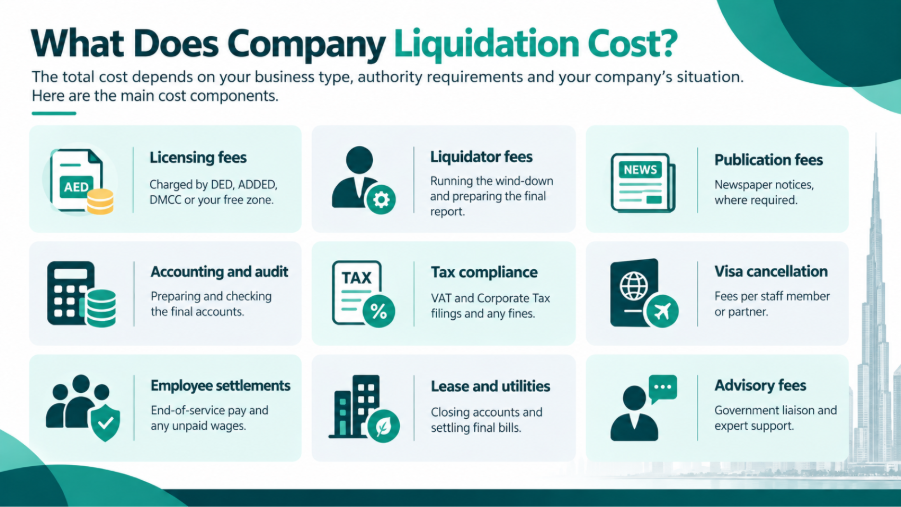
As a rough guide, a straightforward mainland case often starts somewhere around AED 10,000 to 25,000, covering both government fees and expert support. Free zone cases can start lower, from around AED 4,000. These are only starting points though. A company with debts, several staff, or years of unfiled tax returns should expect a much higher bill.
Why Costs Vary So Much Between Companies
A company with clean books, no staff, and no debts closes for far less. One with disputes, unpaid tax, or an expired licence will pay a lot more.
Missing paperwork adds to the cost too, since someone has to rebuild the records before a liquidator can even sign off, which is exactly where clean, ongoing bookkeeping pays for itself.
Government Fees Versus Agent Fees
Before agreeing to any quote, ask for a clear breakdown covering:
- The government’s own fee
- The liquidator’s fee
- Accounting and audit charges
- Tax-related work
- Any advisory or agent charges
Asking this one question clears up most of the confusion around high closure quotes. It shows you what’s fixed and what’s negotiable.
How Long Does It Take?
There’s no single timeframe that fits every case. A mainland LLC usually needs at least 60 to 90 days, with most of that time taken up by the creditor notice period.
Free zone cases with no complications often finish faster, in around 30 to 45 working days.
What Can Slow Things Down
A handful of issues reliably cause delays:
- Missing financial records
- Open creditor claims
- Unresolved staff disputes
- Unfiled VAT or Corporate Tax returns
- Owners who disagree
- An expired licence
- Missing sign-off from landlords or utility providers
Tax and labour clearances cause more delays than anything else, so it’s worth starting those early.
Corporate Tax and VAT After You Close
Does Cancelling Your Licence Also Cancel Corporate Tax?
No, it doesn’t. Cancelling your trade licence does not end your Corporate Tax registration.
Under Federal Decree-Law No. 47 of 2022, you also need to deregister separately with the Federal Tax Authority through the Emara Tax portal. You have three months from the date your company ceases to exist, or from the liquidation resolution, to do this.
Before that deadline, you’ll need to file every outstanding return and settle any tax and fines owed. Miss the window and you’ll face a fine of AED 1,000, which grows by AED 1,000 each month you’re late, up to a cap of AED 10,000.
Does Cancelling Your Licence Also Deregister VAT?
No, and this catches out even experienced owners. VAT deregistration is a separate step with the FTA too.
It’s due within 20 business days of the date you stop making taxable sales, or if your turnover drops below the required threshold. Late filings carry the same growing fine, from AED 1,000 up to AED 10,000, and you stay bound by VAT rules until the FTA confirms your exit.
What If Your Company Made No Revenue?
Zero income doesn’t clear your duties. A dormant company can still owe Corporate Tax registration fees, VAT deregistration, and outstanding returns.
Fines apply no matter how little the company earned, so check your exact obligations through Emara Tax rather than assuming idle time wipes the slate clean.
Accounting Work During Liquidation
Liquidation accounting covers a few key tasks:
- Updating the books to the closure date
- Fully reconciling the bank accounts
- Valuing whatever assets are left
- Logging every unpaid bill
- Settling what’s owed to and by the company
- Preparing the final financial statements
- Drafting the final report for the authority
Liquidation Report Versus Audit Report
A liquidation report explains how the wind-down went, and how debts and assets were settled. An audit report is different. It’s an independent check of the financial statements.
Some authorities, DMCC included, want the liquidation report signed off by an approved auditor. Not every free zone requires a full audit, so it’s worth checking what your own authority needs.
What Happens to Staff, Visas and Bank Accounts
Final pay and end-of-service dues get settled first, before any staff files are closed. Staff visas and the company’s own card are then cancelled through MOHRE and immigration.
Keep bank accounts open until debts are fully cleared. Any money left in them may still be owed to creditors or owners, and closing the account too early, before the legal status is settled, is a common mistake.
What Happens to Debts and Leftover Assets
A company can be wound down with debt still on the books, as long as its assets can cover what’s owed. That’s very different from a company that genuinely cannot pay.
When the assets fall short of what’s owed, a standard wind-down may not be the right fit. Insolvency or restructuring rules can apply instead, so it’s worth getting proper legal advice at this point.
Once creditors are paid, any remaining value goes to the owners, split according to their share as set out in the final accounts.
Can You Liquidate a Company with an Expired Licence?
An expired licence doesn’t mean your company is already closed. In most cases it needs renewing first, or you’ll need a specific route back in before the wind-down can begin.
An expired licence also builds up late fines on top of your wind-down costs. Your tax registrations stay active no matter your trading status, so your VAT and Corporate Tax duties carry on regardless.
If your licence has been expired for years, it’s worth speaking to the authority directly, since older cases sometimes need a different path back in.
Closing a Company That Never Traded
A company with no income, no invoices, and no staff still needs a proper exit. Sitting idle doesn’t cancel the licence, the legal entity, or your tax registrations, and your immigration records stay open too.
It helps to work through this in order: licence status first, then tax registrations, then staff and visa records, then bank accounts, then any unpaid debts, then the right exit route for your setup.
If You’re Worried About Affording Liquidation
Start by asking for a clear, line-by-line quote that separates the fixed government fee from the expert fee.
For simple cases, some owners can go straight to the licensing or free zone authority themselves, cutting out the need for a third-party agent. Getting a clear picture of any fines upfront also helps you avoid surprises partway through.
One thing worth saying clearly: letting your licence expire is not a shortcut. It leaves the company, the tax registrations, and any debts unresolved, and it tends to add fines rather than save money.
What Happens If You Just Abandon a Company
Walking away without a proper closure leaves a lot hanging. The company’s registration stays active, along with its VAT and Corporate Tax duties.
Immigration files tied to visas stay open too, along with any contracts, debts, and fines. None of these resolves on its own, and it tends to resurface later, often when owners try to start a new company or renew their own personal documents.
Liquidating a UAE Company from Abroad
Owners living outside the UAE can usually run the process through a named representative, under a signed and stamped Power of Attorney.
That said, some steps still need an original signature, or an in-person visit, depending on the authority involved. Remote closure is common, but it isn’t always completely paperwork-free.
What If a Shareholder Refuses to Liquidate?
Your company’s own rules set the voting share needed to approve a closure. A plain majority might be enough in some setups, while others need a higher threshold.
A split 50:50 vote, or an owner who can’t be reached, often needs legal help to resolve, and in some cases a court has to step in.
Conclusion
No single company liquidation procedure fits every UAE firm. A firm closing by choice needs a different path than one that never traded. The same goes for a firm with an expired licence, or one with VAT or Corporate Tax exposure. A firm with staff or debts, or one facing an owner dispute, needs its own fit too. The right route for your firm rests on a few things. Its legal form. Its licensing body. Its money position. Its tax status. Its staff. Its debts.
Check each of these before you pay any fee or start a cancellation. It saves time. It also stops you paying twice for the same work.
Not sure whether your firm needs full liquidation, plain licence cancellation, tax close-out, or more accounting work first? Dubai Business & Tax Advisors can help. We review your position and check your exit needs, covering your accounting records, final accounts, and VAT and Corporate Tax duties, along with your FTA status and any gaps in your compliance. Contact DBTA today for a consultation to get started.
Frequently Asked Questions
Not usually. Most authorities want the licence sorted first, and the route depends on how long it’s been expired.
Yes, often through a named representative under a stamped Power of Attorney, though some steps may still need original paperwork.
Yes. Not having a bank account doesn’t clear your tax, licence, or immigration duties.
It depends on the voting share required. An owner you can’t reach can slow things down, and it may need legal help to resolve.
You need three things in hand: a deregistration certificate, a VAT close-out, and a Corporate Tax close-out. Each comes from a different authority.