
UAE Company: Tax-Free or not? A Clear Guide to Economic Substance and Tax Residency

Recent Insights
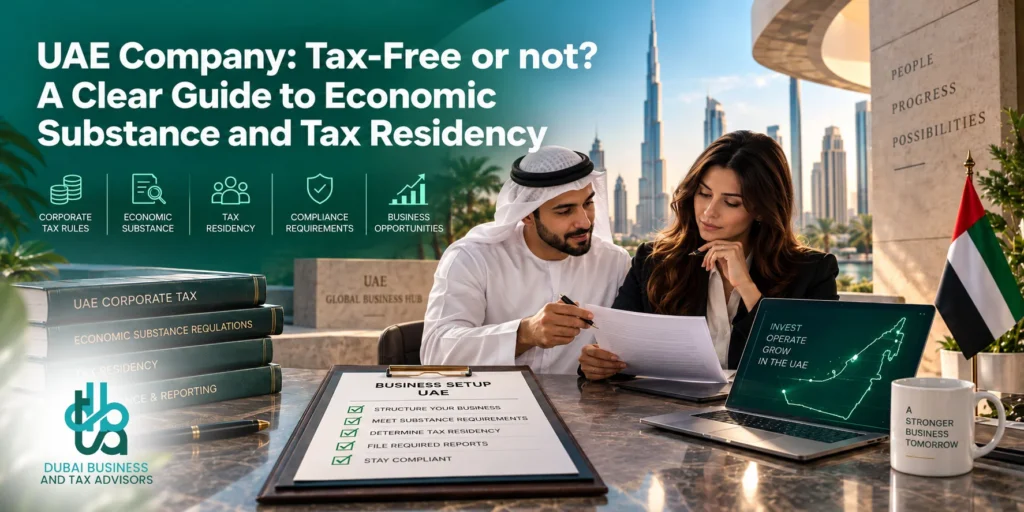
Table of Contents
Worried About ESR or Residency Risk?
Book a free 15-minute strategy call with our international tax advisors.

For many years, people saw the UAE as the easy place to set up a tax-free company. It sits between Asia, Europe, and Africa, which makes it handy for trade. The government is stable. And for a long time, businesses paid little to no tax at all.
That picture has changed now. The UAE has its own federal Corporate Tax. It also has clear rules on what counts as real business activity. These changes bring the country in line with global tax standards set by the OECD.
This shift is not about scaring investors away. It is about proving that UAE companies do real work here. Not just exist on paper. If you run a company in the UAE, you need to understand a few things. These include tax residency, economic substance, and the split between mainland and free zone rules. None of this is optional anymore. It is simply part of doing business the right way.
This guide walks you through what has changed. It explains what it means for your company. And it shows you how to stay on the right side of the rules.
The UAE Tax Story Has Changed, Not Ended
Let’s be clear about one thing first. The UAE’s tax reforms are not a step backward. They are a smart move. The goal is to keep the country trusted by global investors and regulators alike.
How does the UAE do this? It follows economic substance rules. It has also joined the OECD’s Base Erosion and Profit Shifting plan, known as BEPS for short. Together, these steps show the world that UAE companies do real business here. Not just sit in empty offices. Not just use mailbox addresses.
People often call this idea “substance over form.” It sounds technical, but it is simple. It just means your paperwork must match what happens in your business.
These changes protect the UAE’s name on the world stage. They also lower the risk that other countries will label the UAE as uncooperative on tax matters. And they give investors more confidence too. When profits get paid out as dividends or salaries, those payments now sit on solid, compliant ground.
Moving Past the Old “No Tax” Idea
For a long time, people believed one simple thing. A UAE company meant zero tax, always. That is no longer fully true today.
Yes, the UAE still offers real advantages. It still beats many higher-tax countries by a wide margin. But the old idea of a totally tax-free setup? That is outdated now.
The big change came with Federal Decree-Law No. 60 of 2023. This law brought in a federal Corporate Tax. It started on June 1, 2023. From that date on, companies pay tax on their net profits. This single change reshaped how every UAE business should think about its structure.
So, what matters now? Not whether tax exists. It is how well you manage it. Filing correctly matters. Keeping proof of real activity matters. Holding a valid tax residency certificate matters too. All of this is now part of daily business life. Get it wrong, and you risk fines. You could also lose access to tax treaties. Those treaties protect you from being taxed twice on the same income.
How the Corporate Tax Rates Work
The UAE built its tax system in tiers. The main goal was to protect small and medium businesses from a heavy tax burden. Here is how it breaks down, in plain terms.
Income up to AED 375,000 gets taxed at 0%. Anything above that gets taxed at 9%. This applies to most companies operating in the UAE, whether local or foreign owned.
Large multinational groups face one more layer on top. Since January 1, 2025, the UAE applies an extra tax to the biggest players. It is called the Domestic Minimum Top-Up Tax, and it sits at 15%. This applies to multinational groups with global revenues of €750 million or more. It lines up with the OECD’s global minimum tax plan. People often call this Pillar Two.
Why did the UAE do this? Think of it this way. Without its own minimum tax, profits made here could still get taxed somewhere else. Other countries have “top-up” rules that catch low-taxed profits. By setting its own 15% rate, the UAE keeps that tax money at home instead of losing it abroad. It also shows the world that the UAE is a serious, modern tax jurisdiction. Not a loophole to exploit.
Why Substance and Residency Now Matter So Much
Two ideas now sit at the heart of UAE tax compliance. One is economic substance. The other is tax residency. They work closely together, but they are not the same thing. Let’s look at each one.

Economic Substance Rules, Then and Now
Back in 2019, the UAE brought in Economic Substance Regulations. The goal was simple. Stop so-called “letterbox companies.” These are businesses that exist only on paper. Their real purpose was to shift profits around for tax reasons. This rule came as a direct response to pressure from the OECD and other global bodies.
The original substance test looked at three main things. First, was the company genuinely run from the UAE? This meant real board meetings, with directors present. Second, did the company’s core money-making activities happen here? Third, did the business have enough staff, office space, and spending to match its size?
Here is some good news for most businesses today. Cabinet Decision No. 98 of 2024 changed the game. Companies no longer need to file Economic Substance Reports or notifications. This applies to financial years starting on or after January 1, 2023. That rule change removed a major compliance task for thousands of UAE businesses.
But don’t relax just yet. The idea of “real substance” has not gone away at all. It has simply moved into the Corporate Tax law itself. Free zone companies must still show adequate substance to keep their 0% tax rate. Lose that, and you lose the tax benefit. That is a much bigger cost than any old ESR fine ever was.
What Counts as Tax Residency
Tax residency decides two important things. Who owes tax where. And who gets to use international tax treaties. The rules differ a little for companies compared to individuals.
A company automatically counts as a UAE “Resident Person” for tax purposes in one clear case. If it was formed under UAE law, whether on the mainland or in a free zone, it qualifies. A foreign company can also count as a resident sometimes. This happens if it is genuinely managed and controlled from inside the UAE.
For individuals, residency usually comes down to time spent in the country. Spend 183 days or more here within 12 months, and you qualify. Or spend at least 90 days here, as long as you also have a permanent home or run a business in the country.
Getting a Tax Residency Certificate
The Tax Residency Certificate, or TRC for short, is your official proof. The Federal Tax Authority issues this document. And it opens a big door once you have it. It gives you access to the UAE’s network of more than 130 double taxation agreements. These agreements exist for one main reason. They stop the same income from being taxed twice in two different countries.
Getting a TRC is not automatic, though. Your company usually needs at least a year of UAE operations behind it first. You will also need several documents. Audited financial statements. A certified office lease. Six months of bank statements. There is more paperwork too, but these are the essentials.
Here’s an important detail that many business owners miss. Being a “Resident Person” for Corporate Tax is not the same thing as being a “Tax Resident” for treaty purposes. Confusing, right? Here’s an example. A foreign company’s branch in a free zone might count as a UAE Resident Person under tax law. Yet it might still not qualify for a TRC. Why? Because its true tax home remains with its foreign parent company. This distinction matters a lot if you want to avoid extra property or income tax back in your home country.
Mainland or Free Zone? The Tax Question Has Changed
Choosing between a mainland and a free zone company used to be fairly simple. It was mostly about ownership rules and customs perks. Now, it has become largely a tax decision instead.
How Mainland Tax Works
A mainland company counts as a Resident Person. It pays the standard 9% Corporate Tax on profits above AED 375,000. And here’s the key part: this applies to income earned anywhere in the world. Not just inside the UAE.
How Free Zone Tax Works
A free zone company can still enjoy a 0% tax rate. But this is not automatic anymore. To qualify, the business must become a “Qualifying Free Zone Person.” It must also earn what the law calls “Qualifying Income.” One more thing applies to everyone too. Every free zone business must register with the tax authority and file annual returns, whether it owes tax or not.
So how does a company keep its Qualifying Free Zone Person status? A few boxes need ticking. It must maintain real substance in the UAE. Its income must come mainly from other free zone businesses or certain passive sources. It must not have chosen to opt into the standard 9% rate. And it must follow transfer pricing rules. This means deals with related companies should reflect fair market terms, not inflated or discounted ones.
Here is the key shift you need to understand. Tax treatment now gets judged transaction by transaction. Say a free zone company sells to a mainland client. That income usually counts as “non-qualifying.” It then gets taxed at 9%. So a free zone licence no longer guarantees tax-free income across the board. Your actual customer base now decides your tax bill.
What This Means for Dividends
Shareholders often ask about dividends, and there is good news here. Dividends paid out by a UAE company generally do not get taxed again at the corporate level. So, profits that have already been taxed can still reach shareholders. No extra tax charge lands on the payout itself.
What about a UAE company that receives dividends from a foreign business? It may qualify for an exemption too. This falls under the “participation exemption” rule. It usually applies if the UAE company owns at least 5% of the foreign company. And it must hold that stake for a minimum of 12 months. Why does this rule exist? To stop the same profit being taxed twice. Once at the subsidiary level, and again at the parent company level.
What Happens If You Get It Wrong
Ignoring these rules can cost you, both in money and in reputation. Let’s break down the risks.
Missing an ESR filing during the old reporting period could bring fines of up to AED 20,000. Failing to submit a required report could push that even higher, up to AED 50,000. A repeated failure to show economic substance gets much worse. Fines there could reach as high as AED 400,000. Most ESR obligations have now ended, so this mainly affects older filings. But if your business was active between 2019 and 2022, double check that your old filings are complete.
Non-compliance can hurt your reputation too, not just your wallet. Authorities can revoke a business licence. They can also share information about company ownership internationally. Both outcomes tend to make banks and business partners nervous.
The biggest risk, though? Losing your 0% tax status entirely. Say a free zone company fails to prove real substance. It can then get taxed at 9% on all its profits. And this applies retroactively, all the way back to the start of the tax period. That single change can cost far more than any fine ever could.

Tax Residency & ESR Essentials for UAE Companies
Understand what qualifies you for zero tax, how to meet ESR tests, and the residency certificate process.

Why Work with a Tax Advisor Now
Running a UAE business today takes more than just opening a trade licence and hoping for zero tax. With Corporate Tax now in place, and substance rules built into the law, companies need to prove real activity. Not just once, but year after year.
A good advisor does more than hand you generic tips. They walk you through exactly what regulators expect from your business. They help you file correctly. And they make sure you never miss a deadline that could cost you your tax status.
Tax residency matters just as much as substance does. The right guidance helps you gather the correct paperwork for a Tax Residency Certificate. That way, you can actually use the UAE’s treaty network, not just qualify for it on paper without ever benefiting from it.
Choosing between mainland and free zone is now a real strategic decision. It ties closely to your supply chain, your customers, and your growth plans. Good advice looks at your specific business model, drawing on ongoing tax and compliance support rather than a one-time answer. It does not just offer the same answer to everyone who walks through the door.
Frequently Asked Questions
Not anymore, not fully. Some free zones still offer incentives, sure. But the 2023 Corporate Tax law changed things. Most companies now pay tax on profits above AED 375,000, unless they qualify for an exemption. Tax is still low compared to many countries. But “completely tax-free” is no longer an accurate description.
Yes, it does. Corporate Tax applies to local and foreign companies alike, if they earn income in the UAE. A foreign business may also become liable in another way too. This happens if it sets up tax residency here, or runs a permanent establishment in the country. Tax treaties can still reduce the overall tax burden in many cases.
The reputation grew over decades. Companies paid low or no tax on profits, especially in free zones. As global tax rules evolved, the UAE had to keep pace. It brought in Corporate Tax and substance requirements to match OECD standards. Lower taxes still exist here today. But real compliance is now part of the deal too.
Companies need to show genuine business activity in the UAE. This means local management, real staff, and spending that matches the size of the business. Many businesses go one step further too. They apply for a Tax Residency Certificate to confirm their status officially. This also unlocks treaty benefits along the way.
Yes, every business does. This applies under Corporate Tax rules, and it includes free zone companies that pay no tax at all. Filing on time protects you from penalties. It also keeps your standing solid with both local and international authorities.
Not in the traditional sense anymore. The UAE still offers real tax advantages in certain zones, that much is true. But strict reporting and substance rules now apply across the board. Paper-only companies with no real presence simply do not fit into the system anymore.
Conclusion
The UAE has grown up, tax-wise. It moved from a low-tax destination into a well-regulated, globally respected tax jurisdiction. These changes are not about squeezing every business for extra revenue. They are about protecting the UAE’s name and building a fair, transparent place to do business.
The old idea of a blanket tax-free company? That is gone now. In its place stands a system that rewards real substance and genuine compliance instead.
The UAE remains one of the best places in the world to build a company. Success now depends on a few key things. Understanding the rules. Keeping good records. And getting expert guidance whenever you need it. Careful planning today protects your business, and your tax status, for years to come.
Not sure whether your business meets the substance and residency requirements? DBTA’s tax advisors can review your structure, prepare your Tax Residency Certificate application, and keep your filings compliant year after year. Contact DBTA today for a consultation to get started.
UAE Tax Residency & ESR Guide
Get the 2025 factsheet on ESR compliance and residency tests

Latest news & articles

About the Author:
AURANGZAIB CHAWLA
As CEO of DBTA, Aurangzaib Chawla advises globally mobile businesses and individuals on cross-border tax planning and structuring. With expertise spanning the UK, UAE, and wider GCC, Zaib helps clients minimise double taxation, protect assets, and achieve long-term financial efficiency while staying fully compliant.
Planning to launch in Dubai or the UAE?
Let’s talk about how to structure your business for growth the smart, compliant, and tax-efficient way

About the Author:
AURANGZAIB CHAWLA
As CEO of DBTA, Aurangzaib Chawla advises globally mobile businesses and individuals on cross-border tax planning and structuring. With expertise spanning the UK, UAE, and wider GCC, Zaib helps clients minimise double taxation, protect assets, and achieve long-term financial efficiency while staying fully compliant.
Planning to launch in Dubai or the UAE?
Let’s talk about how to structure your business for growth the smart, compliant, and tax-efficient way
About the Author:
AURANGZAIB CHAWLA

As CEO of DBTA, Aurangzaib Chawla advises globally mobile businesses
and individuals on cross-border tax planning and structuring. With expertise spanning the UK, UAE, and wider GCC, Zaib helps clients minimise double taxation, protect assets, and achieve long-term financial efficiency while staying fully compliant.
Planning to launch in Dubai or the UAE?
Let’s talk about how to structure your business for growth the smart, compliant, and tax-efficient way.
Connect with Reliable Dubai Business Consultants
Get in Touch