
Introduction
Think of VAT registration like a gym membership.
You signed up because you had to. Or maybe you wanted to. But now your situation has changed. You are not going anymore. So, you need to cancel before they keep charging you.
VAT deregistration in the UAE works the same way. If you stay registered when you should not be, it costs you. Time, money, and headaches you do not need.
This guide breaks down everything. When to deregister. How to do it. What does it cost? And exactly how to handle the UAE VAT deregistration process online.
Let’s get into it.
What Is VAT Deregistration in the UAE?
VAT deregistration is the official method to cancel your tax status with the Federal Tax Authority (FTA). It is the legal exit path from the tax system. When you register, you become a “taxable person” in the eyes of the law. To stop being that person, you must follow a specific process.
When the FTA approves your request, your Tax Registration Number (TRN) becomes inactive. This means you stop collecting for the government. You no longer add 5 percent to your sales prices. You also lose the ability to claim back the tax you pay on your business costs. You are effectively stepping back into the world of non-registered businesses.
However, you cannot just walk away. You cannot simply stop filing returns and hope the FTA forgets about you. That is a dangerous mistake. You must formally apply through the digital portal. The FTA will look at your history and your current numbers. They need to be sure that you are actually allowed to leave. If you stop charging tax while your TRN is still active, you are breaking the law. Deregistration is the only way to close the door properly.
If you need expert guidance navigating this process, DBTA’s VAT and indirect tax advisory services cover the full scope of VAT compliance in the UAE.
When to Deregister for VAT, The Two Main Triggers
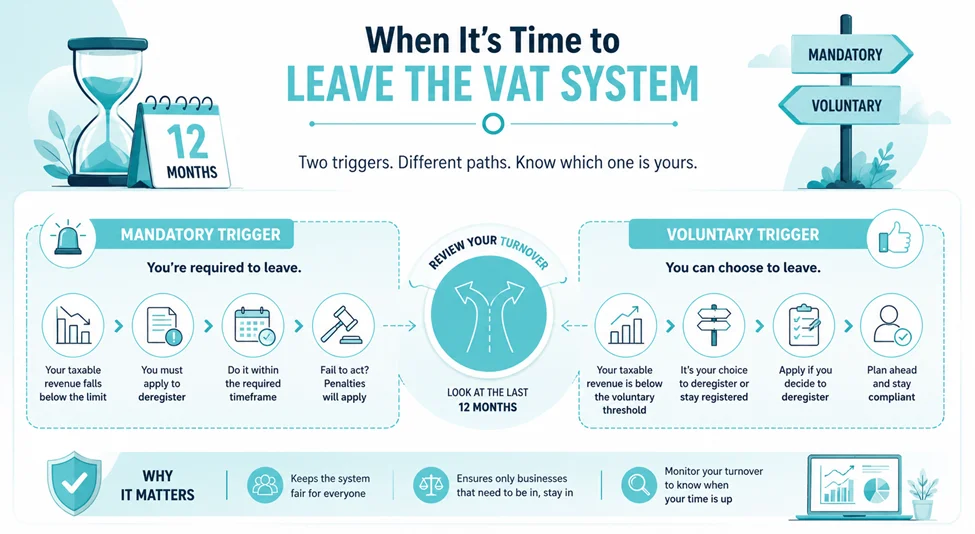
There are two main reasons why a business leaves the VAT system. One is mandatory, and the other is voluntary. It is vital to know which one applies to you because the rules for each person are very different.
Mandatory deregistration is a legal obligation. If you hit the trigger and do not act, the government will fine you. Voluntary deregistration is a choice. You can stay in the system if you want, but you may leave if you meet certain criteria. Both paths require you to review your revenue over the last 12 months.
The FTA uses these triggers to keep the system fair. They only want businesses in the system that truly need to be there. If your business has shrunk or closed, they expect you to move out of the way. Monitoring your turnover is the only way to know when your time is up.
Mandatory VAT Deregistration in the UAE
This is not optional. The law sets two clear triggers. If either one applies to you, you must act.
The first trigger is simple. You stop making taxable supplies completely. Your shop closes. Your services end. Your company is sold. Once trading stops, you cannot stay in the VAT system. You must leave.
The second trigger is about your revenue. Add up your total taxable supplies for the last 12 months. If that number has dropped below AED 187,500, you must deregister. This is the hard floor. Go below it, and you have no choice.
What if your revenue is between AED 187,500 and AED 375,000? That is a different situation. You are not required to leave. But you are allowed to. That falls under voluntary deregistration, which is covered in the next section.
Know your numbers. The threshold that forces you out is AED 187,500, not AED 375,000. Many business owners confuse the two. That confusion leads to missed deadlines and unnecessary fines.
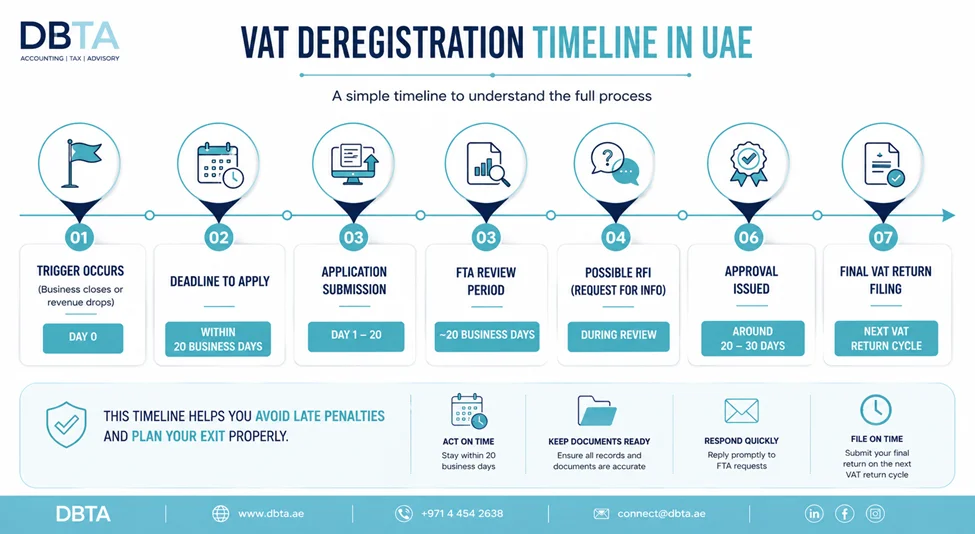
Once you cross either trigger, the clock starts. You have 20 business days to submit your application. Not 20 calendar days. Business days. That window is short. Do not wait for a letter from the FTA. They will not send one. It is your responsibility to track your own numbers and act on time.
Voluntary VAT Deregistration in the UAE
You can choose to leave the VAT system even if your business is still active. This is common for small businesses that find paperwork too heavy.
You qualify for voluntary deregistration if your taxable supplies or expenses are below the AED 375,000 limit. However, they must still be above the voluntary registration limit of AED 187,500. If you are in this middle zone, you have a choice. You can keep your TRN looking more professional, or you can cancel it to save on accounting costs.
There is one major rule for this path. You must have been registered for at least 12 months. The FTA does not allow businesses to jump in and out of the system every few months. You have to finish a full year before they will consider your request to leave voluntarily. If you try to apply after only six months, the portal will likely block your request.
Speaking with a tax advisory specialist in Dubai before making this decision can save you from costly errors.
Business License Cancellation as a Deregistration Trigger
In the UAE, cancelling your trade license or liquidating your company is a direct trigger for VAT deregistration.
Once your license is cancelled:
- Your business is legally no longer allowed to operate
- You must apply for VAT deregistration immediately
- Supporting documents, such as license cancellation certificates, may be required
Failing to deregister after liquidation can result in penalties, even if your business is no longer active.
VAT Deregistration Eligibility Criteria in the UAE
Eligibility is the first thing the FTA will check. You must prove that you have a right to leave the system.
You qualify if your business has stopped trading or if your revenue for the last year is under AED 375,000. For those going on the voluntary route, you must have reached the first anniversary of your registration. These are the hard rules.
You do not qualify if your revenue is still over the limit. You also do not qualify if you are trying to leave the system while still having a large amount of stock or assets that you haven’t accounted for. The FTA wants to make sure all tax due is settled before they let you go.
Another big factor is your compliance. Have your past returns been filed? Is your balance zero? If you have outstanding issues, you are not eligible to leave yet. You must be a “clean” taxpayer. The FTA will not let you walk away if you still owe them money or provide them with information. Fix your old problems first, then apply to leave.
Documents Required for VAT Deregistration in the UAE
Do not log into the portal until your paperwork is ready. Having everything on your desktop will save you from a lot of stress.
You will need a clear, digital copy of your trade license. If you are closing the business, you need the cancellation document. You also need your TRN certificate. This is the document you received when you first joined. You will also need your bank account details. The FTA needs this to pay back any money they might owe you.
The most important documents are your financial records. You need a summary of your sales and expenses for the last 12 months. This could be a report from your accounting software, such as Xero or QuickBooks. It could even be a simple Excel sheet, if it is accurate.
You should also have your bank statements ready in case the FTA asks for proof of your low revenue. Businesses that use professional bookkeeping services in Dubai typically find this step far quicker, since their records are already organised and audit-ready.
If you are a company, you might also need a board resolution. This is a simple letter signed by the owners. It states that the company has officially decided to deregister. Save all these files as PDFs. Make sure the files are small and easy to read. If a tax officer cannot read your documents, they will reject your application instantly.
VAT Deregistration Checklist UAE
Use this checklist to make sure your account is in perfect shape. This is the best way to avoid rejection.
- Review Every Return: Every tax period since you started must have a filed return. If you missed one two years ago, you must fix it now.
- Clear the Balance: Your account balance should be zero. If you owe 10 dirhams, pay for it now. If you have credit, that is fine.
- Check Capital Assets: Did you buy a car or a machine for over 500,000 dirhams? You might need to pay back some of the taxes you claimed.
- Issue Final Invoices: Make sure every job you finish has an invoice. You cannot issue tax invoices after you deregister.
- Verify Contact Details: Make sure your phone number and email on the portal are correct. The FTA will use these to talk to you.
If you can check all these boxes, you are ready to go. A clean account is the key to fast approval. Most people who get rejected fail because they ignored one of these simple steps.
How to Cancel VAT Registration in UAE (Step-by-Step FTA Process)
The process happens entirely online through the EmaraTax portal. It is a logical system, but you must be careful with every click.
Step 1: Log into the EmaraTax Portal
Go to the official website at emaratax.gov.ae. This is the only place to handle your taxes in the UAE. You can log in with your email and password. Many people now use UAE PASS because it is more secure and faster.
Once you log in, you will see your dashboard. It will show your business name and your active VAT registration. Click the “View” or “Manage” button next to your VAT account. This will take you into the specific area for your tax details.
Step 2: Find the Deregistration Option
Look at the menu on the left or at the top of the screen. You are looking for a section called “Taxable Person Services.” Under the VAT tab, you will see several choices.
You need to click on “De-Registration.” The system will then start a new application for you. It will pull in some of your basic info automatically. This makes the form shorter and easier to fill out.
Step 3: Fill in the Reason for Deregistration
The system will ask you why you want to leave. This is a critical part of the form. There is a dropdown menu with options such as “Business ceased trading” or “Turnover below threshold.”
Pick the reason that is truly happening in your business. If you are closing, pick up the “ceased trading” option. If you are still open but your revenue is low, pick up the “below threshold” option. Your choice here determines which documents the FTA will ask for later. Be honest and consistent.
Step 4: Enter Your Financial Details
Now you must type in your revenue numbers. The system will ask for your total taxable supplies for the last 12 months. It will also ask for your expected supplies for the next 30 days.
Take these numbers directly from your accounting reports. Do not guess. The numbers you enter must align with the VAT returns you have filed in the past. If you enter 100,000 dirhams but your returns show 500,000, the FTA will see the mistake immediately. Accuracy is your best friend here.
Step 5: Upload Your Supporting Documents
This is where you attach the files you gathered earlier. There will be specific boxes for each document.
Click the upload button and select your files. Make sure you put the right document in the right box. Put your trade license in the license box and your financial report in the revenue box. After you upload, check the file to make sure it is not blurry. Clear documents lead to clear approvals.
Step 6: Settle Any Outstanding VAT
Before you can finish, the system checks your money. If you owe any tax or fines, the portal will show a warning. You must pay this debt before you submit the form.
You can pay by credit card or bank transfer through the portal. Once the payment is made, the warning will go away. If you have a credit balance, you do not need to do anything yet. You can apply for a refund of that money after your TRN is officially cancelled.
Step 7: Submit the Application
Go through each page of the form one last time. Check your dates. Check your numbers. There is a declaration box at the end. By ticking it, you are saying everything is true.
Click the “Submit” button. You will get a confirmation message and an application reference number. Save this number. It is your only way to track your progress. You will also receive an email from the FTA within a few minutes.
Step 8: Wait for FTA Approval
The FTA usually takes about 20 business days to review your request. During this time, they might send you a “Request for Information” (RFI). This is very common.
An RFI means they need a clearer copy of the document or a bit more detail on your numbers. If you get one, answer it as fast as you can. Every day you wait to answer is an extra day you stay in the system. Once the FTA is happy, they will send you a final approval email. Your TRN is now officially dead.
Final VAT Return and Effective Deregistration Date
As part of the VAT deregistration process, you have to file a final return. This is your final tax return to the Federal Tax Authority (FTA).
The final return includes:
- All sales and expenses up to your deregistration date
- Any VAT on remaining stock and assets
- Capital assets scheme adjustments
This return is due within the normal VAT filing period following deregistration.
The date of registration ceases to be effective is the date your TRN is no longer in force.
- This is generally the date approved by the FTA, and not the date you apply
- From this date, you should no longer charge your customers with VAT
It is important to note:
You could be liable to penalties if you continue to issue tax invoices after this date.
VAT Deregistration Cost in the UAE
One of the best things about this process is that the application is free. The FTA does not charge you a fee to submit the deregistration form.
However, you must be careful. You still must pay all the taxes you collected. You also have to pay any fines that are already on your account. If you are deregistering because you missed the mandatory deadline, you will have to pay a penalty.
The real cost of deregistration is being late or messy. If you follow the rules, it is free. If you wait too long, it will cost you 1,000-10,000 dirhams. This is why you should never delay your application once you know you qualify.
FTA Penalties for Late VAT Deregistration in the UAE
The FTA is strict about deadlines. Once you qualify for mandatory deregistration, you have 20 business days to apply. Miss that window and the fines begin immediately.
Here is exactly how the penalty works.
The first fine is AED 1,000. It hits the moment your 20-day window closes, and you have not applied. Then, for each month you delay, another AED 1,000 is added. The total keeps climbing until it reaches AED 10,000. That is the cap. But AED 10,000 is not an instant fine. It is the worst-case total after months of ignoring the deadline.
This matters. If you catch the issue quickly and apply one month late, you pay AED 1,000. Wait five months, and you pay AED 5,000. Wait ten months or more, and you hit the ceiling of AED 10,000.
The lesson is simple. The sooner you act after missing the deadline, the less you pay. Good tax and compliance habits mean you never have to learn this lesson the hard way.
There are also fines for giving false information. If you understate your revenue to avoid charging tax, the FTA will find out during an audit. The consequences in that case go far beyond AED 10,000.
The FTA can treat deliberate misreporting as tax evasion. Always report your real numbers. Short-term savings are never worth the long-term risk.
VAT Deregistration Refund in UAE
Many businesses have a credit balance when they leave the system. This happens if you spend more on your startup costs than you make in sales.
You can definitely get this money back. After your deregistration is approved, you can log back into the portal. There is a specific section for “Refunds.” You file a request and provide your bank details.
The FTA will review your final return to verify the credit is valid. They might ask to see some of your purchase invoices. If everything is in order, the money will be sent to your bank. It can take a few months, so do not expect it the next day. But the money is yours, and the FTA is very good about paying it back once they verify the numbers.
Capital Assets Rules During VAT Deregistration
This is a technical part of the law that surprises many people. When you deregister, you must look at your “assets” on hand.
The FTA treats your final day as a sale day. If you have stock in your warehouse or expensive equipment in your office, the law says you “sold” those items to yourself. You must account for the 5 per cent VAT on the value of those items.
This is part of the Capital Assets Scheme. It applies to items such as cars, machinery, and property. If you claim tax back when you buy them, you must pay some of it back now. For smaller items, you just look at their current market value. This ensures that you do not get a “free” tax break on items you keep after the business closes. Speak to an accountant if you have a lot of equipment. It can change your final tax bill significantly.
Businesses with complex asset structures often benefit from a formal compliance audit in Dubai before submitting the deregistration application.
Common Mistakes to Avoid When Deregistering VAT
Errors led to fines and wasted time. Here are the biggest ones to avoid.
First, do not wait. The 20-day rule for mandatory deregistration is the number one trap. The moment your business closes or your revenue drops, start the form.
Second, do not ignore old returns. The FTA will not let you leave if your history is incomplete. You must file every single return from day one until the day you leave.
Third, do not throw away your records. UAE law is clear. You must keep your tax records for at least 5 years after you deregister. The FTA can still audit you long after your TRN is gone. Keep your folders safe.
Fourth, do not charge VAT after you apply. Once your deregistration date hits, you must stop adding tax to your bills. If you keep collecting taxes, you are basically stealing from the government.
Fifth, do not forget to update your email. If the FTA asks a question and you do not answer, they will reject your application. This can lead to even more fines.
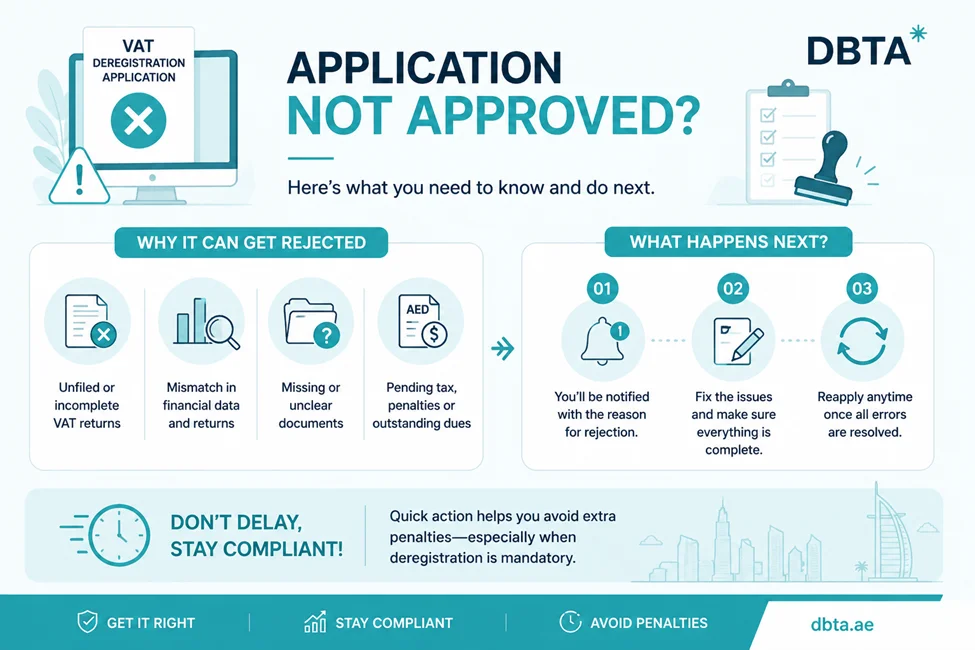
VAT Deregistration Rejection and Reapplication
In the event your application is denied, be sure to read the reason for the denial, address the problem, and resubmit as soon as possible to avoid further expense.
What Happens After VAT Deregistration Is Approved?
When the approval email arrives, you are officially out. You should stop using your TRN on your invoices immediately.
Your invoices will go back to simple receipts. You no longer need a “Tax Invoice” title. You also stop filing returns every three months. This saves you a lot of time and usually reduces your accounting fees.
But stay alert. If your business grows again and you reach AED 375,000, you must register again. Deregistration is a snapshot of today. It does not mean you are exempt forever. Keep an eye on your revenue each month to ensure you stay on the right side of the law.
DBTA’s VAT and indirect tax advisory services can monitor your thresholds on an ongoing basis, so you are never caught off guard. Voluntary vs Mandatory VAT Deregistration
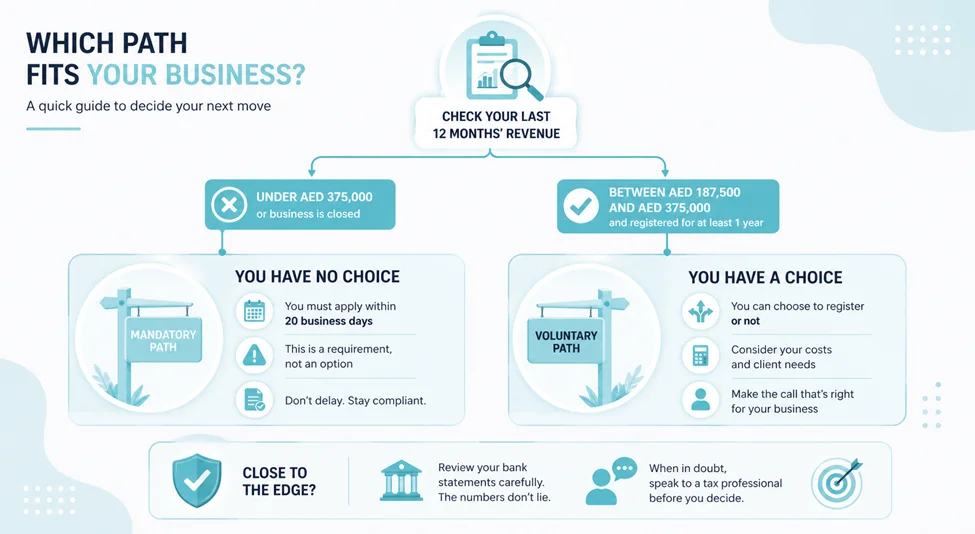
Let’s make this simple, so you know what to do.
You are on the mandatory path if your business is closed or if your revenue for the last year has dropped below AED 187,500. You have no choice. You must apply within 20 business days.
You are on the voluntary path if your revenue is between AED 187,500 and AED 375,000. You have been registered for at least a year. You can choose to leave or stay. This is a business decision based on your costs and your clients.
Check your bank statements for the last 12 months. That data will give you your answer. If you are close to the edge, it is always safer to talk to a tax agent before you hit submit.
VAT Deregistration Timeline in the UAE
The VAT deregistration process has a specific timeline, from the event to FTA approval. Know this can help avoid delays and fines.
VAT Deregistration Process Checklist
Here is the whole process of ten clear points.
- Calculate your total sales for the last 12 months.
- Prepare your trade license and bank account info.
- Make sure every past tax return is filed.
- Pay any debt on your EmaraTax dashboard.
- Log into the portal using UAE PASS or your email.
- Start the “De-Registration” form from the VAT menu.
- Type in your revenue and upload your files.
- Submit and save your application reference number.
- Wait for the FTA to approve or ask questions.
- Keep your business records in a safe place for 5 years.
This summary is your final guide. Follow it, and you will have no problems with the FTA.
Final Thoughts
VAT deregistration in the UAE is a logical process. It is the final step in your business’s tax journey. It is not something to be afraid of, but it is something you must respect.
If you are organised, the process is fast and free. If you are messy, it can be slow and expensive. The key is to act quickly. Do not let the 20-day window close on you. Use the steps in this guide to gather your documents and submit your application.
The EmaraTax portal is built to help you. It guides you through the steps. Just be honest with your numbers and clear with your paperwork. Once you have that final approval, you can focus on the next chapter of your business. Good luck with your application. You have all the information you need to get it right.
And if you want professional support every step of the way, DBTA’s VAT and indirect tax advisory team is ready to help.