
Dubai is one of the best places in the world for foreign investors. It sits between Europe, Asia, and Africa. That makes it easy to reach key markets fast. The tax rules are low. The banks are strong. The setup process is clear and fast. But setting up a company in Dubai can still be tricky.
Many investors worry about hidden costs. Others pick the wrong structure. Some get stuck on banking. And quite a few people have heard that banks reject new accounts. This guide covers all of it. You will learn about costs, tax rules, banking, and how to pick the right structure.
By the end, you will understand what to plan for.
Can Foreigners Register a Company in Dubai?
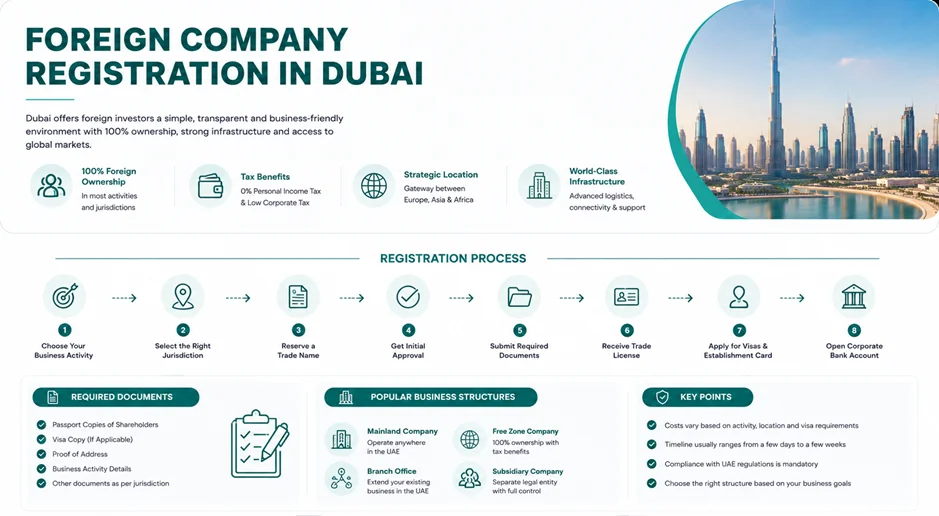
Can Non-Residents Open a Company in Dubai?
Yes. You do not need to live in the UAE to set up a company there. Most steps can be done from home. You can use an approved agent or a power of attorney. Some steps still need you in person. Visa stamping and medical tests are two examples.
Can Foreigners Own 100% of a Dubai Company?
Yes. The UAE changed its ownership laws in 2021. Foreign investors can now own 100% of a mainland company in most sectors. You no longer need a UAE partner or local sponsor. Free Zone and offshore companies have always allowed full foreign ownership.
Industries That May Require Extra Approvals
Not every sector is fully open to foreigners. Some still need special approval.
• Oil and gas
• Defence and military
• Some media and publishing
• Security services
• Some health and pharma sectors
Always check your business type before you choose a structure. This is a key step many investors skip.
Benefits of Registering a Company in Dubai as a Foreign Investor
• 100% foreign ownership in most sectors
• 0% personal income tax
• 9% corporate tax only on profits above AED 375,000
• 0% tax for Free Zone firms on qualifying income
• Access to the UAE’s wide tax treaty network
• Strong banks and financial services
• Access to GCC, Africa, Asia, and European markets
• Residency visas for investors and staff
Types of Business Structures for Foreign Companies in Dubai
Mainland Company
A Dubai mainland company is licensed by the Department of Economic Development (DED). It gives full access to the UAE market. You can trade across all emirates. Since 2021, most mainland firms can be 100% foreign-owned. A few sectors still need UAE national involvement.
Free Zone Company
Free Zones are special economic areas. Each one has its own rules. They are built around specific sectors: tech, media, finance, or logistics. Free Zone firms enjoy full foreign ownership and low tax rates. But they cannot sell directly to UAE customers. They need a local agent for that.
Offshore Company
An offshore company in Dubai cannot trade inside the UAE. It works well for holding assets, global trade, IP ownership, and wealth planning. Popular choices are JAFZA Offshore and RAK ICC. Offshore firms do not give UAE residency visas. Opening a UAE bank account is also harder.
Branch Office
A foreign company can open a branch in Dubai. The branch is not a separate legal entity. It is part of the parent company. Mainland branches need a UAE national as a local service agent. They work well for short projects or temporary work in the UAE.
Subsidiary Company
A subsidiary is a separate legal entity. A foreign parent owns all or most of it. It protects the parent company’s assets. It also lets the business run on its own in the UAE.
Many global firms use this route to enter the UAE market.
Mainland vs Free Zone vs Offshore: Key Differences
Comparison Table: Mainland, Free Zone, and Offshore
| Factor | Mainland | Free Zone | Offshore |
|---|---|---|---|
| Foreign Ownership | 100% (most sectors) | 100% | 100% |
| UAE Market Access | Full access | Needs local agent | Not allowed |
| Visa Eligibility | Yes | Yes | No |
| Office Need | Physical office | Flexi desk OK | Registered agent only |
| Banking | High flexibility | Medium to High | Low to Medium |
| Corporate Tax | 9% above AED 375K | 0% on qualifying income | Usually, 0% |
| Setup Cost (approx.) | AED 15,000–30,000+ | AED 10,000–25,000+ | AED 8,000–15,000+ |
| Local Trading | Yes | No (direct) | No |
Step-by-Step: Dubai Company Registration Process for Foreigners
Step 1: Choose Your Business Activity
Every Dubai company needs a licensed activity. The DED and Free Zones each have their own approved lists. Pick the wrong one or miss a key one, and you will face problems later.
This is the most common error foreign investors make.
Step 2: Pick the Right Zone or Area
Decide between mainland, Free Zone, or offshore. If you go to the Free Zone, pick one that fits your sector.
Check visa limits, costs, and office options before you commit.
Step 3: Reserve a Trade Name
Your company name must follow UAE naming rules. Names that use religion, politics, or offensive words are rejected. The name must also be unique.
Step 4: Apply for Initial Approval
This is a green light from the government on your business activity. It is not a license yet. It is a required first step.
Step 5: Prepare Your Company Papers
You need a Memorandum of Association (MOA) and share structure details. Some business types need extra approvals from other bodies. Some papers must be notarised and stamped.
Step 6: Secure Office Space or Flexi Desk
You need a business address to move forward. Free Zone firms can often use a flexi desk. Mainland companies usually need a real physical space.
Step 7: Get Your Dubai Trade License
Once your papers are approved, you get your trade license. This is the main document that lets your company operate legally in the UAE.
Step 8: Apply for Investor Visa and Card
The establishment card lets you hire staff and process visas. The investor visa lets you live and work in the UAE. Each visa needs a medical test and biometric scan.
Step 9: Open a UAE Business Bank Account
This step trips up many investors. UAE banks run strict checks on all new accounts. It can take two weeks to three months or longer.
We cover this in full below.
Documents Required for Foreign Company Registration in Dubai
Basic Documents for Foreign Investors
• Valid passport copies for all owners and directors
• Recent passport-size photos
• Completed forms specific to each authority
• Proposed trade name and list of business activities
• Proof of home address utility bill or bank statement
Extra Documents for Non-Residents
• Bank reference letters or 6–12 months of bank statements
• Business profile or company summary
• CV or work background of each owner
• Source of funds statement
• No objection letter if you are employed elsewhere
Documents for Branch Offices and Subsidiaries
• Stamped and attested certificate of incorporation
• Board resolution to open the UAE branch or subsidiary
• Audited accounts from the parent company
• Power of attorney for the UAE agent
• Parent company MOA and Articles of Association (attested)
Do Documents Need to Be Attested?
Yes. Foreign papers must be attested in your home country first. Then they go through the UAE Embassy. After that, MOFA in the UAE stamps them.
Branch and subsidiary setups often need Arabic translations too. Use a certified legal translator for these.
Foreign Company Registration Costs in Dubai
Dubai Trade License Costs
Dubai DED mainland licenses start from about AED 10,000 to AED 15,000. Free Zone licenses range from AED 8,000 to AED 20,000.
The price depends on the zone and the package you choose.
Full Cost Breakdown Table
| Cost Type | Range (AED) | Notes |
|---|---|---|
| Trade License Fee | 8,000 – 20,000 | Varies by zone and activity |
| Setup / Registration Fee | 2,000 – 8,000 | Each authority sets its own fee |
| Investor Visa | 3,500 – 6,000 per visa | Includes medical and Emirates ID |
| Establishment Card | 1,500 – 3,000 | Needed before you hire staff |
| Office / Flexi Desk | 5,000 – 20,000+ p.a. | Wide range depending on size |
| Business Bank Account | 0 – 10,000 | Some banks charge setup fees |
| MOA and Notary Fees | 1,500 – 5,000 | Notary and typing centre costs |
| Document Attestation | 1,000 – 5,000+ | Per document; varies by country |
| Setup Agent Fees | 3,000 – 10,000 | If you use a setup firm |
| VAT Registration | 500 – 2,000 | If your revenue hits the threshold |
| Year 1 Annual Renewal | 8,000 – 18,000 | License plus visa renewals |
| Accounting / Books | 5,000 – 20,000 p.a. | Based on transaction volume |
A basic Free Zone setup with one visa costs about AED 25,000 to AED 50,000 in Year 1. A mainland setup with an office can reach AED 35,000 to AED 80,000 or more.
Hidden Costs Most Foreign Investors Overlook
License Change Fees
Want to add or change a business activity after setup? That triggers a change fee. Each change can cost AED 1,000 to AED 5,000 or more.
Extra Visa Charges
Each Free Zone ties your visa limit to your office plan. More visas mean you must upgrade your plan. That costs more. Mainland firms face the same rule based on office size.
Tax and VAT Costs
UAE corporate tax has been active since June 2023. You must register, file returns, and keep clean financial records. That means books, accounting tools, and an annual audit.
Translation and Stamp Costs
Arabic translations of contracts and MOAs are often required. A certified translator can charge AED 100 to AED 500 per page.
Fines for Late Renewals
Late license renewal in Dubai DED costs about AED 250 per month. Expired visas bring overstay fines.
Missing a tax deadline brings fines from the Federal Tax Authority.
How Long Does Dubai Company Registration Take?
Average Timeline Table
| Stage | How Long |
|---|---|
| Choose activity and zone | 1–3 days |
| Trade name and initial approval | 1–3 business days |
| Get documents ready and attested | 1–4 weeks (varies by country) |
| MOA drafting and notary | 2–5 business days |
| Trade license issued | 3–7 business days |
| Establishment card | 3–5 business days |
| Investor visa — entry to stamp | 2–4 weeks |
| Business bank account | 2–12 weeks or more |
| Total (without banking) | 3–6 weeks |
| Total (with banking) | 6–16 weeks or more |
What Can Delay the Process?
• Attestation backlogs in your home country
• Wrong or missing items on your forms
• Bank compliance review delays
• Queue times at specific authorities
• Medical test scheduling for visas
Why Bank Accounts Take So Long
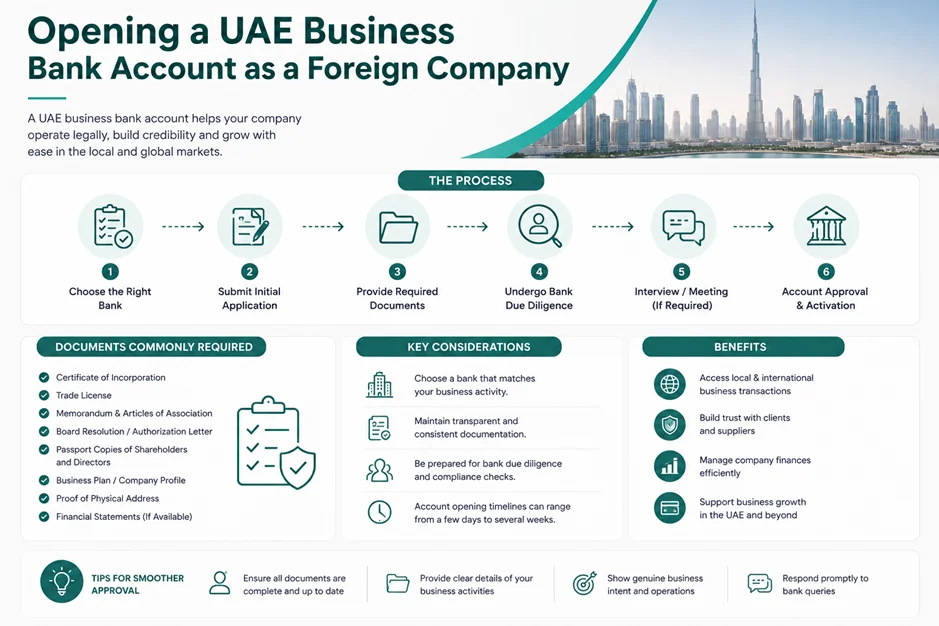
Banks run full KYC checks on all directors, owners, and shareholders. Links to high-risk countries, weak papers, or complex ownership all slow things down. Banking is a separate process from your company setup. Plan for it early.
Why UAE Banks Reject Foreign-Owned Companies
UAE banks follow strict Central Bank rules and global AML standards. They reject any account that raises a compliance concern. Even a legal, clean business can be turned away with the wrong paperwork.
Common reasons: unclear source of funds, weak business plan, or missing docs.
Documents Needed for a UAE Business Bank Account
• Valid trade license
• Certificate of incorporation
• MOA and Articles of Association
• Passport copies all owners and signatories
• 6–12 months of personal bank statements all owners
• A clear business plan or company profile
• Source of funds statement
• Expected payment details volume, frequency, key partners
• Contracts or invoices to show business activity (if you have them)
Common Banking Problems for Non-Residents
• Owners from certain countries face extra checks
• New firms with no trade history get turned away more often
• No UAE physical presence raises red flags
• Virtual office addresses worry some banks
• Complex ownership across many countries slows checks
How to Improve Your Chances of Getting Approved
• Write a clear and detailed business plan before you apply
• Have at least one owner or director who is a UAE resident
• Show signed contracts or live business deals
• Keep your personal bank history clean
• Do not apply to many banks at the same time
• Work with an advisory firm that has strong bank relationships
UAE Corporate Tax Rules for Foreign Companies
Is Dubai Still Tax-Free for Foreign Companies?
Partly but not fully. The UAE launched corporate tax in June 2023.
Here is how the rates work:
• 0% on taxable income up to AED 375,000
• 9% on taxable income above AED 375,000
• 0% for Free Zone firms on qualifying income conditions apply
• No personal income tax this has not changed
• No capital gains tax on personal assets also unchanged
Understanding the UAE 9% Corporate Tax
The 9% rate applies to net profit after allowed deductions. Small businesses with low profits will still pay very little tax. But larger firms need proper tax advisory planning. All firms with revenue above AED 1 million must register for corporate tax.
This applies even if you make no taxable profit.
Corporate Tax Rules for Free Zone Companies
Free Zone firms can access a 0% tax rate on qualifying income.
But it is not automatic. To qualify, your firm must:
• Have real staff and activity in the Free Zone
• Earn income from qualifying activities as set by the Ministry of Finance
• Not opt in to the standard tax rules
• Follow transfer pricing and record-keeping rules
Income from UAE mainland deals may be taxed at 9%.
VAT Rules in the UAE
UAE VAT is set at 5%. You must register if your taxable sales exceed AED 375,000 per year. You can register early if sales pass AED 187,500. VAT returns are due each quarter in most cases.
Late filing or no registration brings heavy fines.
Accounting and Audit Rules for Dubai Companies
All UAE firms must keep financial records for at least five years. Free Zone firms must file audited accounts with their authority each year. Mainland firms are not all required to audit.
But corporate tax rules make proper books a must in practice.
Transfer Pricing Rules
UAE tax law follows OECD transfer pricing rules. If your firm deals with related parties such as a parent or sister company, all deals must be at fair market value.
You must also keep proper records. This matters a lot for foreign subsidiaries and global groups.
Risks of Foreign Company Setup in Dubai
Choosing the Wrong Structure
A Free Zone firm that later needs to sell in the UAE faces real limits. You can change your setup, but it costs time and money. Get this right from the start.
Underestimating Banking Rules
Many investors think a trade license means a bank account follows. It does not. Banking is a separate process. If you cannot open an account, your company cannot function.
Hidden Renewal and Running Costs
Year 1 often has promo deals and lower fees.
Year 2 shows the real cost of license renewal, visa renewal, office, accounts, and tax.
Tax Confusion
Thinking that Dubai is fully tax-free leads to missed steps. Tax registration, VAT, and audit rules all have associated costs and time.
Risks of Cheap Setup Packages
Very cheap packages often come with a catch. Limited business activities. Few visa slots. Poor support. Cutting corners at setup creates bigger problems down the line.
Problems With Inactive Companies
Some investors set up a firm and then wait to use it. UAE rules still require annual renewals even with no trading. Inactive firms also face trouble opening bank accounts.
Common Mistakes Foreign Investors Make in Dubai
Picking an Activity That Does Not Match Your Work
If your license says general trading but you do software work, you have a problem. Fixing it later means fees and delays.
Picking a Free Zone Based Only on Price
The cheapest Free Zone may not fit your sector. It may have few visa slots, weak banking, or poor facilities. Price alone is not a good reason to choose.
Thinking a Bank Account Is a Sure Thing
Treat banking as a separate challenge. Plan for it. Never assume a trade license means the bank will say yes.
Ignoring Tax Registration Rules
All firms above AED 1 million in revenue must register for corporate tax. Missing the deadline brings fines. Register early.
Not Planning for Long-Term Costs
Many investors only look at Year 1 costs. Build a three-year cost model. Include all renewals, visas, accounts, and tax fees.
Using Weak Business Papers
A thin business plan or unclear ownership leads to banking refusals. Strong papers from Day 1 protect you at every step.
Can You Register a Dubai Company Online?
Online Company Registration Options in Dubai
Most UAE Free Zones have online setup portals. Some mainland bodies also accept digital forms.
The basic setup can often be done from home.
Can Foreigners Complete the Process Remotely?
Yes, for most steps. You can handle setup, submit papers, and get approvals remotely. Use an approved agent or a power of attorney to act on your behalf.
When You May Need to Be There in Person
• Visa stamping and Emirates ID biometrics in UAE or at a UAE embassy
• Medical tests for residency visas
• Some bank account meetings though many banks now offer remote options
• Document notarisation at UAE embassies
Using Power of Attorney for UAE Setup
A valid power of attorney lets your UAE agent act for you. This is a legal and widely used way to set up a company from abroad.
What Happens After Your Dubai Company Is Registered?
Corporate Tax Registration
Register with the Federal Tax Authority as soon as your company is set up. If your revenue hits AED 1 million, you must register. Do not wait, late registration brings fines.
VAT Registration
If your expected sales exceed AED 375,000 per year, register for VAT. Do this before you start trading.
Visa Processing and Renewals
Process all visas without delay. Track renewal dates closely. Expired visas bring fines.
Ongoing Accounting and Books
Set up a proper accounting system from Day 1. Monthly books, quarterly VAT returns, and annual tax filing are all required.
Annual Trade License Renewals
UAE trade licenses must be renewed every year. Start the renewal one month before your expiry date. Late renewal costs money and can hold up your visa renewals.
Bank Compliance Reviews
UAE banks run regular compliance checks on all business accounts. They will ask for updated papers from time to time. If you do not respond, your account can be frozen or closed.
Keeping Real Business Substance
Free Zone firms that claim the 0% tax rate must show real activity. That means real staff, a real office, and real operations.
A letterbox address alone will not be enough.
Best Dubai Company Structure by Business Type
| Business Type | Best Structure | Why |
|---|---|---|
| Ecommerce | Free Zone (e.g. SHAMS, DMCC) | Low cost, global reach, flexi desk OK |
| Consultants / Agencies | Free Zone or Mainland | Depends on UAE client base |
| Import and Export | Mainland or JAFZA Free Zone | Market access and port links |
| SaaS and Tech | Free Zone (e.g. DTEC, DIFC) | Tax rates, ecosystem, global scope |
| Holding Companies | DIFC, ADGM, or Offshore | Asset cover, treaty access |
| Retail and UAE Trading | Mainland | Direct UAE market access needed |
Frequently Asked Questions
Yes. The UAE updated its laws in 2021 to allow 100% foreign ownership in most sectors. A few restricted activities still need UAE national involvement.
Most Free Zones have no minimum capital or set a small nominal figure. This is often between AED 1,000 and AED 50,000. Regulated sectors like banking or insurance have their own capital rules.
Two weeks to three months is typical. It depends on the bank, your ownership structure, and the quality of your papers.
They can access a 0% rate on qualifying income. But income from mainland UAE deals may be taxed at 9%. Good structure and real substance in the Free Zone are both needed.
Yes, in most cases. Incorporation can be done remotely. Visa stamping and some banking steps may still need in-person visits.
Offshore firms (AED 8,000–15,000) and budget Free Zone deals (from AED 10,000) are cheapest. But cheap deals often have limited visas, few activities, and weak support. Always look at the full three-year cost not just Year 1.
License renewal alone can cost AED 10,000–25,000 per year. Add visa renewals, office fees, accounting, and tax costs for the full picture.
Yes. The 9% rate only applies above AED 375,000 in net profit. Personal income stays tax-free. Free Zone qualifying income can stay at 0%. Compared to global standards, the tax burden is still very low.
Final Thoughts on Foreign Company Registration in Dubai
Dubai is still one of the best places for foreign investors. The location, tax rules, and global access are all strong. But the process has real challenges. Banking trips up many investors. Hidden renewal costs catch others off guard. Wrong structure choices create limits that cost a lot to fix.
Dubai Business and Tax Advisors work with foreign investors every day. We help with structure choice, licensing, banking, tax, and ongoing rules. Our team knows these challenges well. We deal with them daily for clients across the globe.
Ready to move forward? Talk to one of our advisors today. We will tell you what structure, costs, and timeline apply to your exact situation.