


A double taxation agreement helps two countries share their rights to tax income. UAE tax treaties can reduce double taxation for qualifying residents and companies. Relief depends on the income, the treaty, and the conditions you meet.
These rules can reduce tax costs and support cross-border investment. The Ministry of Finance currently reports 137 concluded DTAs and 193 agreements when bilateral investment treaties are included. These totals do not mean every agreement is currently effective.
Maybe you will earn income abroad and worry about a second tax bill soon. This article explains how UAE double tax treaties cut foreign tax for you. Moreover, you’ll learn about DBTA and how it helps clients review cross-border tax matters with clear, practical guidance now.
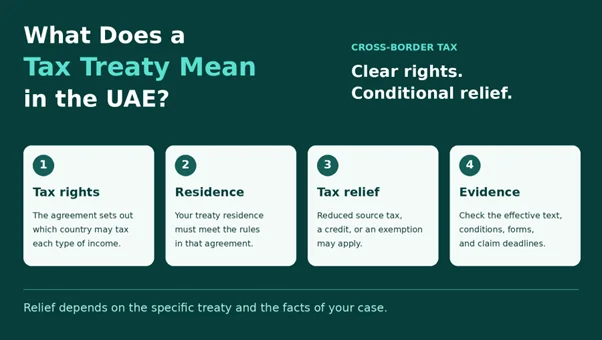
What Does a Tax Treaty Mean in the UAE?
A tax treaty is a written deal that sets out which country may tax income. Many experts call it a DTA or a DTAA. OECD model concepts appear in many treaties, but each agreement has its own wording.
Think of double tax avoidance UAE rules as a fair split of tax rights. Say your Dubai firm earns AED 100,000 in ordinary service fees from a UK client. Under the business profits article, the UK generally cannot tax those profits unless the firm has a UK permanent establishment. Other income categories can follow different rules.
Where both countries may tax the income, credit or exemption, rules can provide relief. Treaties can also allow tax authorities to exchange information. The UAE joined the Global Forum on tax transparency in 2010.
5 Key UAE Tax Treaty Facts You Should Know
This quick table highlights five facts to check before making a treaty claim.
| Fact | Current position |
| UAE treaty network | 137 concluded DTAs; 193 including BITs. Check effectiveness. |
| Standard corporate tax rates | 0% to AED 375,000 taxable income; 9% on the excess. Free zone rules differ. |
| Personal income tax | No general tax on wages or personal investment income; business tax may apply. |
| Treaty residence | Conditions depend on the relevant agreement; no universal 183-day test. |
| Electronic TRC fees | AED 50 plus AED 500, AED 1,000, or AED 1,750, depending on applicant status. |
Which Countries Signed Tax Treaties With the UAE?
The Ministry of Finance reports 137 concluded DTAs and 193 combined DTAs and investment treaties. The network includes partners across Europe, Asia, Africa, and Latin America. Before claiming relief, check that the relevant agreement is in force and applies to the income period.
| Region | Example partners |
| Europe | UK, France, Austria, Finland |
| Asia | India, China, Singapore, Pakistan, Kazakhstan |
| Africa | Kenya, Nigeria, Ethiopia, Algeria |
| Latin America | Uruguay |
There is no comprehensive US–UAE income tax treaty. US citizens generally remain subject to US tax on worldwide income, with domestic relief available where eligible. Germany’s UAE treaty expired on 31 December 2021, so it should not be listed as a current treaty partner. Always check current official treaty records.
How Do Treaties Protect Your Business from Paying Tax Twice?
UAE DTAs for businesses can reduce tax on cross-border income. Under the standard corporate tax rules, taxable income up to AED 375,000 is taxed at 0%, with 9% on the excess. These are taxable profit thresholds, not revenue thresholds. Qualifying Free Zone Persons have separate rules: 0% on qualifying income and 9% on non-qualifying taxable income.
- Reduced source-country tax on qualifying dividends, interest, and royalties.
- Rules on when business activities create a permanent establishment abroad.
- Credit or exemption relief where the same income is taxed in both countries.
A UAE foreign tax credit cannot exceed UAE corporate tax on the relevant foreign income. Excess credit cannot be carried forward or back. In-scope multinational groups also face UAE Domestic Minimum Top-up Tax from financial years starting on or after 1 January 2025. The rules target a 15% minimum effective rate and generally cover groups with revenue of at least €750 million in two of the preceding four financial years.
How Do UAE DTAs for Businesses Reduce Tax Risk?
UAE DTAs for businesses set rules for a permanent establishment, or PE. A PE can arise from a fixed place, certain agent activities, or other treaty-defined circumstances. Ordinary business profits are generally taxable only in the residence country unless a PE exists in the other country. Separate treaty articles may apply to other income. Treaties improve clarity but do not freeze foreign tax laws.
How Do Residents and Investors Gain from These Treaties?
UAE double tax treaty benefits can make cross-border tax costs clearer. The UAE does not levy a general personal income tax on wages or personal investment income. Individuals conducting business may fall within corporate tax rules. Foreign tax can still apply, and a UAE residency certificate does not automatically remove it. The treaty and the facts must support relief.
- Qualifying investors may obtain reduced source-country tax on dividends and interest.
- Capital gains from some assets may face tax in one country only.
- Tie-breaker rules help resolve cases where both countries claim tax residence.
Lower foreign tax can improve an investor’s returns. The outcome depends on the specific treaty, ownership conditions, and the income involved.
How Much Withholding Tax Can a Treaty Save You?
A treaty may reduce or remove foreign withholding tax, depending on the income and conditions. The UAE corporate tax withholding rate is currently 0% for income within that regime. Savings therefore often arise from foreign-source tax relief. There is no single rate schedule for all UAE treaties.
| Income type | Possible treaty treatment | What to check |
| Dividends | Reduced source tax or exemption | Ownership, recipient status, and treaty rate |
| Interest | Reduced source tax or exemption | Beneficial ownership and specific conditions |
| Royalties | Reduced source tax or exemption | Income definition and exact treaty article |
| Business profits | Generally residence-country tax unless a foreign PE exists | PE rules and profits attributable to the PE |
Read the exact treaty, including applicable protocols and Multilateral Instrument changes. A domestic exemption may already be more favourable than the treaty rate.
Can You See a Simple Example with Numbers?
Consider this hypothetical example, using assumed rates rather than a named treaty. A Dubai firm earns AED 200,000 in royalties from abroad. Assume the payer’s country imposes 20% withholding tax under domestic law.
Without relief, withholding tax is AED 40,000. Assume an applicable treaty limits it to 10% and the firm meets every condition. Withholding falls to AED 20,000, leaving AED 20,000 more cash. The figures show foreign withholding only; they do not calculate the firm’s final UAE tax liability.
| Item | Without treaty relief | With assumed treaty relief |
| Royalty earned | AED 200,000 | AED 200,000 |
| Assumed withholding rate | 20% | 10% |
| Foreign withholding tax | AED 40,000 | AED 20,000 |
| Cash after withholding | AED 160,000 | AED 180,000 |
UAE Tax Treaty vs Domestic Law: Which Rule Applies?
Domestic law sets the tax charge, while a treaty can limit the countries’ taxing rights. In the UAE, an applicable DTA takes precedence over conflicting corporate tax provisions. The legal effect in the partner country depends on its own laws. A treaty does not automatically grant relief for every taxpayer or tax.
| Point | Domestic law | Treaty |
| Who writes it | One jurisdiction | Agreement between jurisdictions |
| Main role | Sets domestic tax charges and relief | Allocates or limits tax rights |
| Withholding tax | Domestic rate or exemption | Treaty limit or exemption, where eligible |
| Proof needed | Depends on domestic requirements | Residence and other treaty/claim evidence |
| Foreign tax paid | UAE credit subject to statutory limits | Treaty relief subject to its terms |
Check domestic law first, then test the relevant treaty restrictions and relief. UAE foreign tax credit rules can also apply without a treaty, subject to the corporate tax conditions.
Who Can Claim Treaty Relief in the UAE?
UAE double tax treaty eligibility depends on the agreement and the facts. Three important areas to review are:
- Residency: Meet the tax residence definition in the relevant treaty. There is no general two-year UAE experience requirement.
- Ownership: Meet beneficial ownership conditions where the relevant income article requires them.
- Substance anti-abuse checks: Support residence, management, and anti-abuse checks with evidence. Offices and staff are not a universal treaty test.
Under domestic residence rules, individuals may qualify through 183 days of presence, a conditional 90-day test, or their usual residence and centre of interest. The 90-day route also requires a qualifying nationality or residence permit and a permanent home, employment, or business in the UAE. Treaty of residence follows the relevant agreement, so 183 days is not a universal requirement. Free zone status alone does not establish entitlement.
Who Is Eligible for UAE Double Tax Treaty Benefits?
UAE double tax treaty eligibility depends on several important conditions. Being based in Dubai does not automatically guarantee treaty relief. The relevant agreement decides who qualifies and under which conditions. Tax residence is often one of the most important requirements.
A qualifying applicant may include a UAE resident individual. It may also include a UAE company meeting treaty requirements. Some agreements contain special rules for companies and other entities. Other rules can apply to government bodies or exempt persons.
Eligibility may depend upon these key factors:
- You must meet the relevant tax residence requirements.
- The income must fall within the treaty’s covered categories.
- You may need proof showing your UAE tax residence status.
- Beneficial ownership rules may apply to certain investment income.
- Anti-abuse rules may restrict artificial treaty benefit claims.
- Foreign procedures may require specific forms or supporting evidence.
- The exact treaty wording must support your requested relief.
A professional review can identify problems before the claim reaches authorities. This can save time and reduce avoidable cross-border tax disputes.

How Do You Claim Tax Relief Step by Step?
Use these eight steps to prepare your treaty claim. Foreign procedures may require further action:
- Confirm that the treaty is effective for your income and claim period.
- Check residence, income, ownership, and anti-abuse conditions before requesting a TRC.
- Use EmaraTax, select Other Services, and request a Tax Residency Certificate for treaty purposes.
- Individuals should supply identity documents, an entry/exit report, and treaty-specific evidence.
- Companies should supply their licence, incorporation documents, lease, and management evidence where required.
- Pay AED 50 plus AED 500 with a Corporate Tax TRN, AED 1,000 for unregistered individuals, or AED 1,750 for unregistered companies. Hard copies cost AED 250 each.
- Allow 10 business days after the FTA receives a complete application.
- Complete the foreign country’s relief-at-source or refund procedure, using the TRC and required forms.
Keep evidence for the correct country and period. A TRC cannot cover more than 12 months or a future period that has not started. Newly incorporated companies that have not yet filed a Corporate Tax Return must generally be established for 12 months before applying. Check the current FTA service card and any treaty-specific requirements.
What Do Most Guides Miss About UAE Tax Treaties?
Most guides stop at the country list and skip the real work.
- No comprehensive US–UAE income tax treaty applies, and the Germany–UAE treaty expired in 2021.
- A TRC supports residence evidence; the actual treaty conditions still control entitlement.
- UAE corporate tax applies to tax periods starting on or after 1 June 2023. Cross-border tax planning should take this into account.
- Free zone corporate tax treatment and treaty eligibility require separate checks.
- Check effective dates, protocols, and Multilateral Instrument changes before relying on older guidance.
Common Mistakes When Claiming DTA Relief UAE Companies Make
Treaty relief claims can be delayed or rejected because of avoidable errors:
- Applying without meeting the relevant treaty residence conditions.
- Using residence evidence that does not cover the required country or income period.
- Failing to support management, control, or other treaty conditions with suitable evidence.
- Assuming all treaties have the same rates for dividends or royalty income.
- Forgetting foreign filing deadlines to apply reduced withholding tax rates.
Why Trust Dubai Business and Tax Advisors with Your Treaty Claim?
Strong treaty files require careful preparation, clear evidence, and attention to current rules. A review should cover the relevant agreement, official guidance, and the foreign country’s claim procedures.
Dubai Business and Tax Advisors can help clients understand the issues that need to review. The starting point is the income, the country involved, and the client’s residence position.
Clear explanations help investors and firms prepare the right evidence. Speak with DBTA about the scope of support available for your cross-border tax position.
Frequently Asked Questions
A DTAA sets rules for allocating tax rights between the UAE and another country. It can reduce double taxation through exemptions, credits, or limits on source-country tax. The Ministry of Finance currently reports 137 concluded DTAs, but each agreement’s current status must be checked.
Partners include the UK, India, China, France, Singapore, Pakistan, and Kenya. Check the Ministry of Finance dashboard for the applicable text and status. Germany’s treaty expired at the end of 2021, and there is no comprehensive US–UAE income tax treaty.
It allocates tax rights and may reduce foreign withholding or provide credit or exemption relief. Both countries may still tax an item of income. Relief is subject to treaty conditions and domestic rules, including the UAE foreign tax credit limit.
Qualifying residents may receive reduced tax on foreign income or other treaty relief. A TRC can support the claim, but residence conditions depend on the relevant agreement. There is no universal 183-day requirement for all treaty claims.
Treaties can make tax costs easier to assess and reduce qualifying foreign tax. Their PE rules help businesses assess taxable presence abroad. Actual relief depends on the treaty, the income, and the conditions met.
Check the treaty conditions and request a TRC through EmaraTax where required. Then follow the foreign country’s procedure and deadlines. Some claims need approval before payment; others use a refund application after withholding. The certificate alone does not guarantee relief.
They may reduce or remove tax on qualifying dividends, interest, and royalties. Rates and conditions vary by treaty. The UAE corporate tax withholding rate is currently 0%, but foreign tax may still apply.
Conclusion
A UAE treaty can reduce double taxation on qualifying income. It can also provide clearer rules for international investors and businesses. Benefits depend on residence, income, the effective treaty, and supporting evidence. Check the current rules before relying on a reduced rate.
Unsure which treaty applies to your income or company? Dubai Business and Tax Advisors can help you review the key questions. Speak with DBTA before expanding or investing across international markets.