


The UAE Pillar Two tax reporting rules ask big groups to share UAE profit and tax data. The UAE uses them to apply a 15% minimum tax. Does your group earn €750 million or more in global revenue? Then you may need to file two returns with the Federal Tax Authority (FTA). These are the Top-up Tax Return and the Pillar Two Information Return.
At Dubai Business & Tax Advisors (DBTA), we help you understand the rules. We also prepare your data and handle your filings with ease. Our ACCA-qualified team will check this with you step by step. This guide shows who must comply and what to file. It also covers when to file and how to cut Pillar Two tax risks.
What Are the UAE Pillar Two Tax Rules?
Pillar Two is a global tax plan from the OECD. It sets a 15% minimum tax rate for big groups. The UAE adopted it through Cabinet Decision No. 142 of 2024. That law created the Domestic Minimum Top-up Tax (DMTT).
Here is the idea in simple words. A group may pay less than 15% tax on its UAE profit. The UAE then collects the gap. This keeps the tax money inside the country.
The UAE corporate tax rate is 9% on profit above AED 375,000. Some free zone firms pay 0% on certain income. This is why the UAE Pillar Two tax rules matter to so many groups. A low rate can now trigger additional tax.

Which Businesses in the UAE Must Follow Pillar Two Rules?
The Pillar Two rules for multinationals in the UAE apply when a group passes two tests:
- The group runs businesses in more than one country.
- Its yearly revenue was at least €750 million in 2 of the last 4 years.
This is the UAE global minimum tax threshold. It uses combined group revenue. It does not use the revenue of one UAE company.
Three points often surprise groups:
- Small or held-for-sale entities still count in the group.
- Revenue of excluded entities counts toward the €750 million test.
- One company with a foreign branch can form a group.
UAE entities that may need to file include:
- Group member companies based in the UAE
- Joint ventures and their subsidiaries in the UAE
- Certain reverse hybrid entities set up under UAE law
The filing duty is not limited to the parent company. Several UAE entities in one group may fall in scope.
When is the UAE Pillar Two Effective Date?
The UAE Pillar Two effective date is 1 January 2025. The rules apply to fiscal years that start on or after that day. For a calendar-year group, the first year is 2025.
Many people ask if a group can skip 2025. It cannot. The first year counts. The 2025 return is simply due later than usual.
Does a Free Zone Company Need to Comply?
Yes. A free zone company can be a UAE constituent entity if it belongs to a large multinational group. Free zone status does not automatically remove Pillar Two duties.
How Is the Pillar Two Effective Tax Rate Calculated for UAE Entities?
You divide the taxes by the profit. The taxes are called adjusted covered taxes. The profit is called net Pillar Two income. This is not the same as your corporate tax profit. The rules use group accounting data with set changes.
If the result is under 15%, the UAE minimum top-up tax applies. Here is a simple example:
| Item | Amount |
| Net Pillar Two income of UAE entities | AED 100 million |
| Adjusted covered taxes | AED 6 million |
| Effective tax rate | 6% |
| Gap to the 15% minimum | 9% |
| Top-up tax before any relief | AED 9 million |
Some profit can be left out for real activity such as staff and assets. That can lower the bill. Your adviser should model this before you file.
What Are the UAE Pillar Two Reporting Requirements?
The UAE Pillar Two reporting requirements have 4 parts.
- Registration. Each in-scope entity registers on EmaraTax. Free zone status does not remove this duty. It is also needed if you expect zero top-up tax under a safe harbour or the de minimis rule. A Domestic Designated Filing Entity can register all UAE group members.
- Top-up tax return. This return shows the calculation and the tax due. You pay the tax with the return.
- Pillar Two information return. It follows the OECD GloBE template. It holds entity data and tax details.
- Notices to the FTA. You send one when someone abroad files the information return for the group. You also notify the FTA when an entity comes into or falls out of scope.
Two rules decide who files. Cabinet Decision No. 142 of 2024 allows one UAE entity to file the top-up return for the group. Ministerial Decision No. 133 of 2026 sets who files the information return. Here is how it works:
| Filing route | What it means |
| Designated Filing Entity (domestic) | One UAE entity registers and files the top-up return for the group |
| Designated Local Entity | One UAE entity files the information return for the others |
| Foreign filing | The parent or a designated filing entity abroad files the information return for the group |
The foreign route has one big condition. The other country must have a Qualifying Competent Authority Agreement (QCAA) with the UAE. This agreement lets tax authorities exchange data. Without it, UAE filing is still needed. Even with it, you must tell the FTA who filed and where.
What Are the UAE Pillar Two Tax Deadlines?
The UAE Pillar Two tax deadlines depend on your year-end. Here is the main timeline:
| Task | Deadline | Note |
| Registration | On or before 30 November 2026 if the fiscal year ended before 30 April 2026 | Otherwise within 7 months of the end of the first in-scope year |
| Top-up tax return and payment | 15 months after year end | First year gets 18 months |
| Pillar Two information return | 15 months after year end | Confirm any first-year extension with the FTA |
| Notice of foreign filing | No date set in Ministerial Decision No. 133 of 2026 | Confirm the date with the FTA |
A group with a 31 December 2025 year end must file its first top-up return by 30 June 2027. Registration comes much sooner. Under FTA Decision No. 12 of 2026, it must register on or before 30 November 2026.
Do not wait for the filing date. Data work takes months. Many groups need to pull numbers from many countries.
How Does the UAE Pillar Two Reporting Process Work?
The UAE Pillar Two reporting process has 6 clear steps:
- Test your scope. Check group revenue against the €750 million line.
- Map your entities. List every UAE company and branch. Mark each one.
- Pick a filing route. Decide between a UAE filer and a foreign filer.
- Register on Emara Tax. Do this by the set date.
- Collect data and run the numbers. Work out the effective tax rate.
- File and pay. Then keep every record for review.
Branches need care. The rules treat each branch (permanent establishment) as a separate entity. Each one may need its own top-up tax registration number. A group can end up with more top-up tax numbers than corporate tax numbers.
What Are the Safe Harbour Rules in the UAE?
Pillar Two safe harbour rules in the UAE can cut your workload. A safe harbour is a shortcut. If you pass tests, you may skip the full calculations.
| Safe Harbour | What it does | Timing |
| Transitional CbCR safe harbour | Let’s some groups skip the full calculation if country-by-country data passes set tests | Years starting on or before 31 December 2026 and ending on or before 30 June 2028 |
| Simplified calculation safe harbour | Gives a lighter way to do the math when tests are met | Permanent |
| De minimis exclusion | Treats top-up tax as zero when average UAE revenue is under €10 million and average UAE profit is under €1 million | Each year by election |
Safe harbours are not automatic. You must prepare the data first. The country-by-country report data must be ready and correct. Entities that use a safe harbour must still register.
Which Entities Are Exempt?
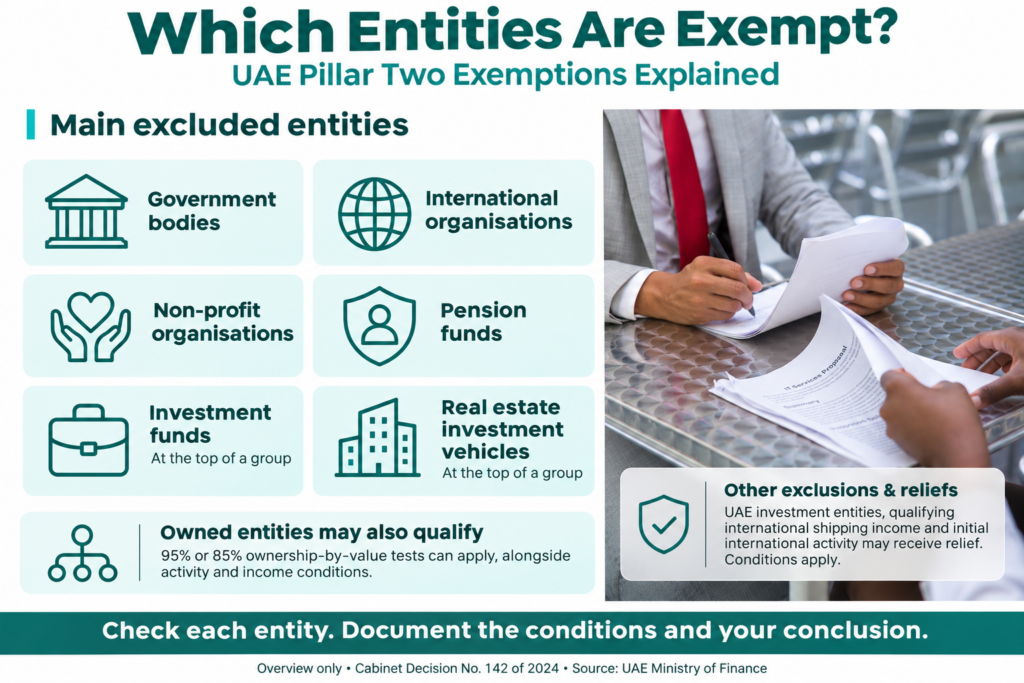
The UAE Pillar Two exemptions cover groups and entities that the rules leave out. These include:
- Government bodies
- International organisations
- Non-profit organisations
- Pension funds
- Investment funds that sit at the top of a group
- Real estate investment vehicles that sit at the top of a group
Some entities owned by these bodies can also qualify. Strict ownership tests apply. Usually, 95% or 85% ownership by value is needed. This depends on what the entity does.
Investment entities based in the UAE pay no top-up tax. International shipping income can also be left out. The strategic or commercial management of the ships must be carried out in the UAE.
Excluded entities and investment entities generally do not register or file returns. The group still reports them in its information return.
There is also early-stage relief. A group in the initial phase of international activity may treat UAE top-up tax as zero for up to 5 years. The group must operate in no more than 6 countries. Its tangible assets outside its main country must not exceed €50 million. No parent entity applying an Income Inclusion Rule may hold an interest in the UAE entities.
Do not treat an exemption as a free pass. Check the rules for each entity. Then record how you reached the result.
What Are the Penalties for Non-Compliance with UAE Pillar Two Rules?
UAE Pillar Two penalties follow the corporate tax penalty system under Cabinet Decision No. 142 of 2024. The FTA’s Top-up Tax Guide on Scope and Registration sets a fine of AED 10,000 per entity for late registration. If a domestic filing entity fails to register the group, the fine applies to each entity it missed. Late taxes can also bring other charges.
There is some relief. The UAE gives a grace window. No penalty applies to the top-up return or the information return for periods that begin on or before 31 December 2026. The period must also not end after 30 June 2028. One condition applies. The group must show it took reasonable steps to apply the rules correctly. This relief covers the two returns only. It does not cover late registration.
This relief is not a reason to relax. You still need proof of effort. Notes and models help prove it.
What Are the Biggest Pillar Two Tax Risks in the UAE?
Pillar Two tax risks in the UAE often come from poor data, late planning, or wrong assumptions. Common risks include:
- Missing the registration date. Even entities with zero top-up tax must register.
- Wrong scope. Excluded entities still add to revenue.
- Free zone assumptions. A 0% rate can still lead to top-up tax.
- Currency of mistakes. The rules set which exchange rates you may use.
- Foreign filing without a QCAA. You may still owe a UAE filing.
- Data gaps. Group data often sits in many systems.
- Mixed positions. Your UAE view must match your views in other countries.
Why Get Pillar Two Tax Advisory in the UAE?Why Get Pillar Two Tax Advisory in the UAE?
Pillar Two mixes UAE law with global rules. Few teams have both skills in-house. DBTA is a team of ACCA-qualified accountants and tax consultants based in Dubai. We know the local rules and the global ones.
Good pillar two tax advisory in the UAE should give you:
- A clear scope test
- A map of your entities
- A filing plan with dates
- Support with the numbers
We link this work to your corporate tax and transfer pricing files. Our tax advisory team keeps the whole picture in view. We never promise a set result. We give honest advice based on your facts.
Frequently Asked Questions
Penalties follow the corporate tax system. The FTA sets AED 10,000 per entity for late registration. A grace period may remove penalties on the returns for early years. You must show you took reasonable steps. The grace period does not cover late registration.
You must register on EmaraTax first. The deadline is 30 November 2026 if your fiscal year ended before 30 April 2026. Otherwise, it is 7 months after the year-end. The top-up return and payment are due 15 months after year-end. The first year is 18 months. The information return is due 15 months after the year-end.
The minimum rate is 15%. It applies to groups with revenue of €750 million or more. Any UAE profit taxed below that rate can face top-up tax.
Large groups with UAE entities must comply. The group needs at least €750 million in revenue in two of the last four years. Exempt bodies like pension funds and government entities are left out.
Final Thoughts
The UAE Pillar Two tax reporting rules hit big global groups. They apply when group revenue is €750 million or more. The rules set a 15% minimum tax rate. They also require clean data and on-time filing with the FTA.
Does your business work in the UAE as part of a global group? Then do not wait for the deadline. DBTA can review your group setup and work out what you may owe. We also prepare your filings and guide you at every step. Contact Dubai Business & Tax Advisors today for clear Pillar Two tax advisory in the UAE.