
Crypto licensing in the UAE means getting approval before you offer crypto services. Dubai firms usually need a VARA license; ADGM firms need an FSRA license, and DIFC firms need DFSA approval. Mainland firms may need approval from the federal securities regulator.
However, there is no single UAE crypto license because each area has its own rules. Choosing the wrong authority is the most common and costly mistake.
This all depends on the location of your business and what type of crypto service you would like to provide. At DBTA, we will assist you with choosing the best business structure and preparing your application. We also support you with company registration, banking, tax, and audit after approval.
What Is Crypto Licensing in the UAE and Why Does It Matter?
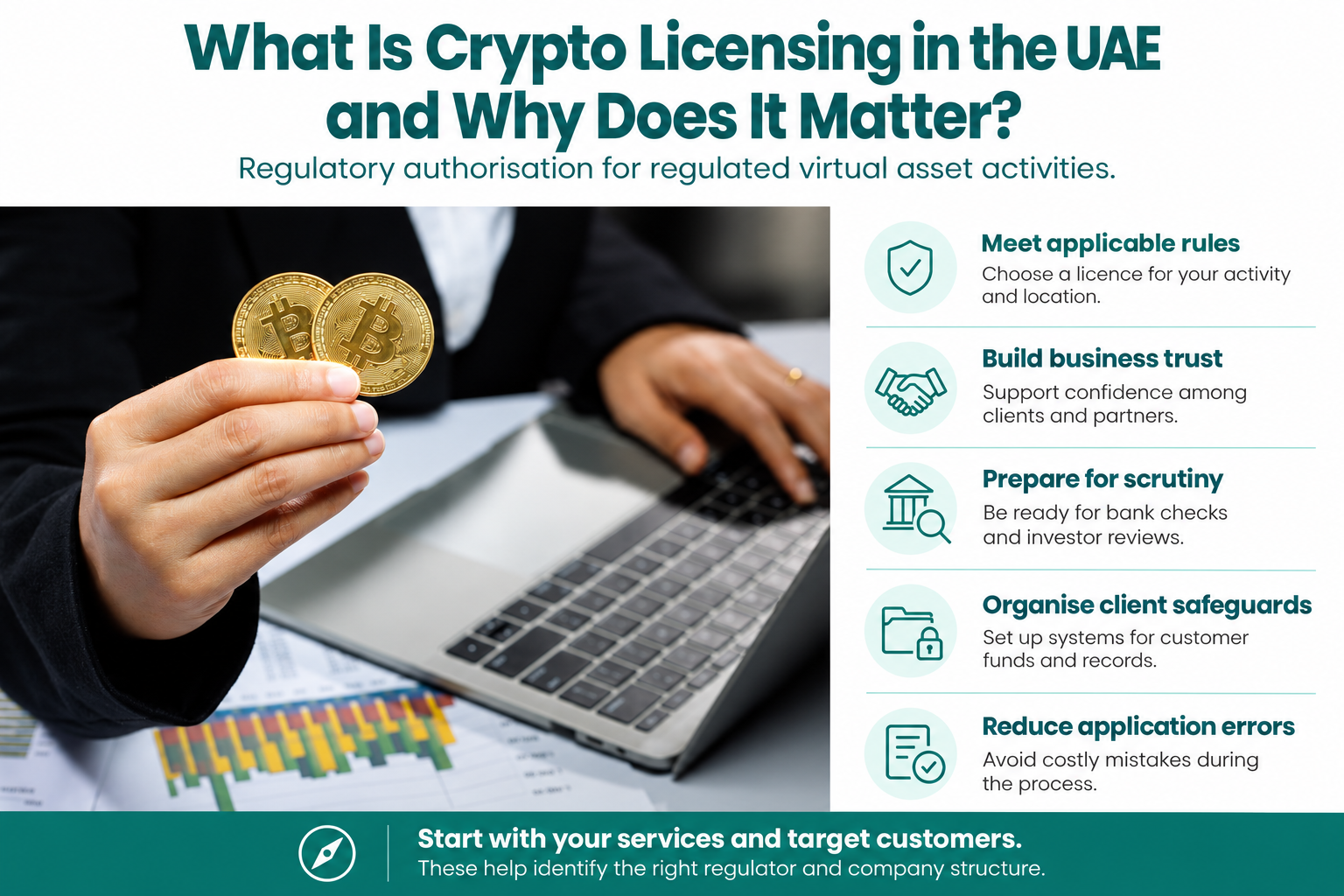
Crypto Licensing is the regulator’s authorization of a business dealing with virtual currency on behalf of its customers. Crypto licensing UAE regulations govern all businesses dealing with their clients who possess virtual currencies. The license depends on your activity and your location.
The correct license helps you:
- Meet the rules that apply to your business.
- Build trust with customers and business partners.
- Prepare for bank checks and investor reviews.
- Set up proper systems for customer funds and records.
- Reduce the risk of costly application mistakes.
The initial step is to recognize your services and target customers. Your answers will help determine which regulator, and company structure may fit your plans.
Which UAE Regulator Licenses Crypto Businesses?
The right regulator depends on your geographic location and the kind of service you offer. A crypto exchange, wallet provider, custody firm, broker, or token issuer may be regulated differently.
| Regulator | Area covered | Common crypto activities |
| VARA | Dubai mainland and most Dubai free zones, except DIFC | Exchange, brokerage, custody, transfer and settlement, advisory, lending, token issuance. |
| ADGM FSRA | Abu Dhabi Global Market | Crypto exchanges, custody, brokers, asset managers, OTC trading, derivatives, and payment platforms. |
| DFSA | Dubai International Financial Centre | Crypto token dealing, custody, trading platforms, advisory, fund management, token issuance. |
| SCA | UAE mainland outside financial free zones | Crypto exchanges, brokers, custodians, wallet providers, token platforms, and investment services. |
Many people still search for a UAE SCA crypto license. The Securities and Commodities Authority became the Capital Market Authority in January 2026. So, the CMA is now the federal name to know.
Why does location matter so much?
A Dubai free zone company is not automatically free from regulation. Most Dubai free zones fall under VARA for virtual asset services. Only businesses inside the DIFC are regulated by the DFSA.
What Is VARA and Who Needs a VARA License?
VARA stands for the Dubai Virtual Assets Regulatory Authority. It is the lead regulator for any virtual asset activities carried out in Dubai apart from the DIFC.
You may need a VARA crypto license if your business offers services such as:
- Crypto exchange services
- Broker-dealer services
- Crypto custody or wallet services
- Virtual asset transfer and settlement
- Crypto advisory or investment management
- Lending and borrowing services
- Virtual asset issuance
What Are the VARA License Requirements for Crypto Firms in Dubai?
The Virtual Asset Regulatory Authority for Dubai regulates crypto activity in Dubai. DIFC is the only exception. Here are the VARA license requirements in short:
- A clear licensed activity such as exchange, custody, or advice
- A full business plan
- Governance papers with key people, succession, and wind-down plans
- Written AML, risk, and cybersecurity policies
- Net liquid assets of at least 1.2 times your monthly running costs
Capital depends on the activity. These figures come from the VARA.
| Activity | Minimum paid-up capital |
| Advisory | AED 100,000 |
| Broker-dealer | AED 400,000 to 600,000 or 15% to 25% of yearly overheads |
| Custody | AED 600,000 or 25% of yearly overheads |
| Exchange | AED 1.5 million or 25% of yearly overheads (the higher amount) |
What is the cost for a VARA license?
VARA fees depend on the activity. The official fee schedule shows different application and yearly supervision fees.
| VARA activity | License application fee | Annual supervision fee |
| Advisory services | AED 40,000 | AED 80,000 |
| Broker-dealer services | AED 100,000 | AED 200,000 |
| Category 1 VA issuance | AED 100,000 | AED 200,000 |
| Custody services | AED 100,000 | AED 200,000 |
| Exchange services | AED 100,000 | AED 200,000 |
| Lending and borrowing | AED 100,000 | AED 200,000 |
| Transfer and settlement | AED 40,000 | AED 80,000 |
VARA vs ADGM vs DIFC: Which Is Best for Your Crypto Business?
There is no ideal license. It all depends on your business strategy and customers.
| Factor | VARA | ADGM FSRA | DIFC DFSA |
| Location | Dubai, excluding DIFC | Abu Dhabi Global Market | Dubai International Financial Centre |
| Best suited for | Dubai-based crypto service providers | Institutional and professional-facing firms | Firms combining crypto with financial services |
| Common activities | Exchange, custody, brokerage, transfer, advisory | Exchange, custody, OTC, asset management | Crypto token dealing, custody, funds, advisory |
| Fee starting point | AED 40,000 application fee for some activities | USD 20,000 initial authorization fee for many activities | Activity-specific DFSA fees |
| Key benefit | Clear Dubai-focused virtual asset regime | Mature digital asset framework | Strong international financial centre position |
VARA is often the natural route for a crypto exchange license for a UAE business based in Dubai. ADGM may suit firms seeking an established financial free zone. DIFC may suit businesses that need a traditional financial-services environment.
Which License Do You Need: Exchange, Custody or Startup?
Your service decides the license. Below are straightforward guidelines.
- Crypto exchange license UAE: You match buyers and sellers. This has the highest capital and the strictest checks.
- Crypto custody license UAE: You hold client assets. Custody needs strong security and segregated accounts.
- Crypto license for startups UAE: Start with one narrow activity. Advisory has the lowest amount of capital of AED 100,000. You can add more activities later on with 50% of the application fee.
Plan your cash for the full first year. Fees, capital, and staff all arrive early. Our corporate finance team can build that plan with you.
How Much Does a Crypto License Cost in the UAE?
The full cost is more than the government fee. In many cases, business owners have planned solely for their license fees without considering additional expenses.
Your budget may include:
- Company formation and trade license fees
- Regulator application fees
- Annual supervision fees
- Office or flexi-desk costs
- Investor and employee visas
- Compliance officer and MLRO costs
- AML and KYC software
- Legal and advisory fees
- Cybersecurity testing
- Technology development
- Audit and accounting fees
It is possible to establish a regular firm in the UAE for about 12,000 dirhams, while a licensed cryptocurrency one will cost way more. Special permits, premises requirements, visas, etc., add to the expenses.
How Do You Apply for a VARA Crypto License in Dubai?
The VARA crypto license application process is detailed. It is best treated as a business readiness project, not just a form submission.
Step 1: Define your crypto activity
State your company’s action plan. Each service may need its own approval.
Step 2: Choose the right UAE structure
Decide whether Dubai, ADGM, DIFC, or the UAE mainland fits your model. Your target customers and plans should guide this choice.
Step 3: Set up the company
Register the firm in the proper jurisdiction. The information that you require includes the data of the shareholders, company papers, business location, and business activity approval. DBTA can assist with firm registration, licensing, visas, and PRO services.
Step 4: Build compliance systems
Prepare practical AML, KYC, risk, cybersecurity, and client asset policies. The regulator will want to see how your team will employ them.
Step 5: Submit the application
Send your application, documents, and fees to VARA. Fees are payable when the application is submitted.
Step 6: Respond to regulator questions
VARA may ask for more information. It may review your ownership, staff, systems, financial plans, and operational controls.
Step 7: Receive approval and stay compliant
After approval, you must follow ongoing rules. These include reporting, AML monitoring, audits, record-keeping, and annual supervision fees.
How Long Does It Take to Get a Crypto License in the UAE?
The crypto license timeline UAE regulators allow is not fixed. VARA does not publish a set time. Advisers report anything from three to twelve months.
| Regulator | Typical time |
| VARA | About 3 to 12 months based on adviser reports |
| ADGM FSRA | About 6 to 10 weeks for approval after a complete file |
Can a Crypto Company Operate in the UAE Without a VARA License?
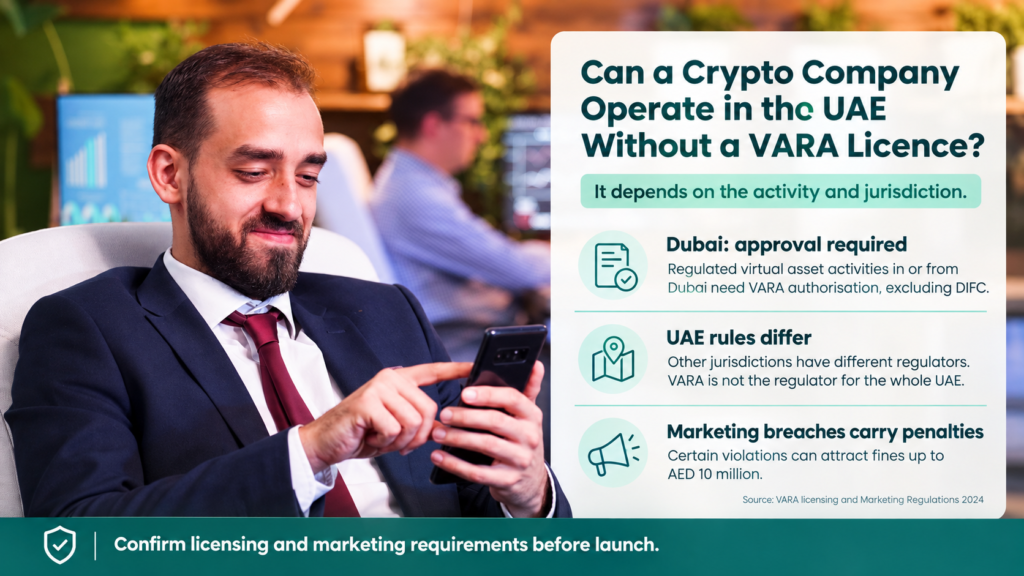
No. You need a VARA license if you serve Dubai clients. Operating without one risk fine and stop orders. VARA can also remove licenses. Fines up to AED 10 million are being reported by legal firms in case of marketing without proper licensing. Do not start or market until approved.
What Are the UAE Crypto Regulations for 2026?
UAE crypto regulations 2026 brought four big changes:
- The SCA became the CMA on 1 January 2026.
- The DFSA dropped its pre-approved token list on 12 January 2026.
- VARA added rules for crypto derivatives on 31 March 2026. Retail leverage is capped at 5 to 1.
- VARA issued new risk assessment guidance in June 2026.
Rules move fast. Check out each regulator site before you file.
What AML Rules Must Crypto Firms Follow?
UAE AML compliance for crypto firms is a core test for every regulator. You must prove you can spot and stop dirty money. Key duties include:
- Know your customer checks at onboarding
- Ongoing transaction monitoring
- Suspicious activity reports through go AML
- A named money laundering reporting officer
- Sanctions screening
- Travel Rule data sharing for transfers
- Record keeping for at least five years
- Regular staff training
According to VARA 2026, the frequency of risk assessments should be at least every 3 months. Risk assessments must be based on your firm’s data rather than templates. Collaboration with crypto compliance consultants from Dubai can assist you with this process. Our compliance audit team checks that your controls hold up.
How Do UAE Crypto Tax and Licensing Rules Work Together?
A license does not remove tax duties. UAE crypto tax and licensing are separate topics. You need to handle both.
- Corporate tax: The rate is 9% on profit above AED 375,000. Some free zone firms can enjoy 0% on qualifying income. They must meet the conditions.
- VAT: The transfer and conversion of virtual assets is VAT-exempt under Cabinet Decision No. 100 of 2024. Exempt status can limit how much input VAT you recover.
- Separate rules: VAT exemption does not mean corporate tax exemption.
Our corporate tax advisers can map your position before you file.
How Do You Set Up a Crypto Company in a Dubai Free Zone?
Many founders ask about a crypto free zone Dubai offers. The route is simple. You pick a Dubai free zone or the Department of Economy and Tourism as your licensor. VARA then licenses the crypto activity. DIFC works under its own system.
For crypto company setup in Dubai, founders should follow this order:
- Choose the zone and the activity
- Form the company under the Approval to Incorporate
- Open a bank account
- Complete the VARA license file
Banks ask hard questions about crypto firms. Start that talk early. Our Dubai free zone company formation service covers the setup side. We also guide business license and PRO work.
Common Mistakes to Avoid
Many delays start before an application reaches the regulator. Businesses may choose the wrong route or underestimate what approval requires.
Avoid these common mistakes:
- Choosing a regulator too early: Check the location and activities first.
- Using generic AML policies: Write controls for your real business model.
- Underestimate costs: Account for staff, security, office, and continued compliance costs.
- Neglecting banking requirements: Communicate with banks at an early stage – it’s not a guarantee that an account will be approved.
- Providing confusing documents: Ensure consistency in ownership, finances, and business plans.
- Starting too early: Don’t provide regulated services until you’re authorized.
Frequently Asked Questions
You need a business plan and strong AML policies. In addition, you will need to have governance documentation and minimum capital. The precise list depends upon your regulator and your activity.
VARA regulates virtual asset activities in Dubai outside DIFC. ADGM uses the FSRA framework in Abu Dhabi. DIFC follows the DFSA framework for financial services involving crypto tokens.
VARA application fees run about AED 40,000 to 100,000. Yearly fees run about AED 80,000 to 200,000. Add capital and running costs on top.
You apply for the Approval to Incorporate first. Then you file the full license application. VARA reviews it and may add conditions.
ADGM asks for a proposal, formal forms, and fees. DIFC asks for a business plan and controls and AML policies. Both want strong risk systems.
VARA cases usually take between 3 and 12 months, based on adviser reports. The ADGM approval process generally takes between 6 and 10 weeks from complete file submission.
Final Thoughts
Crypto licensing in the UAE is a big opportunity for your business. The right route depends on your location and your service. Your clients and your budget matter too. VARA is the main route for most Dubai crypto firms. ADGM and DIFC suit firms that want their own financial-centre rules.
To start a crypto exchange, custodian, broker, token issuance, and advisory business in the UAE, you need an expert advisor. DBTA can assist you in selecting the appropriate location and creating a robust structure. We provide services related to formation, licensing, and banking. Our services include AML readiness, account opening, and audit. VAT and corporate tax are also included in the range of our services.
Get in touch with us at DBTA for a detailed crypto licensing roadmap. We will guide you on costs, documentation, process, and compliance before you invest your time and money.