
Most people expect a short list. Passport, visa, done. But it’s not that simple.
The real problem shows up at the branch. You arrive with your forms. The bank asks for something nobody told you to bring. Or you wait three weeks for a business account. Then you get turned down with no clear reason.
This guide covers what banks actually want. Not just the official list. It covers where people go wrong. It also covers what to do when things don’t work out.
First: What Type of Account Do You Need?
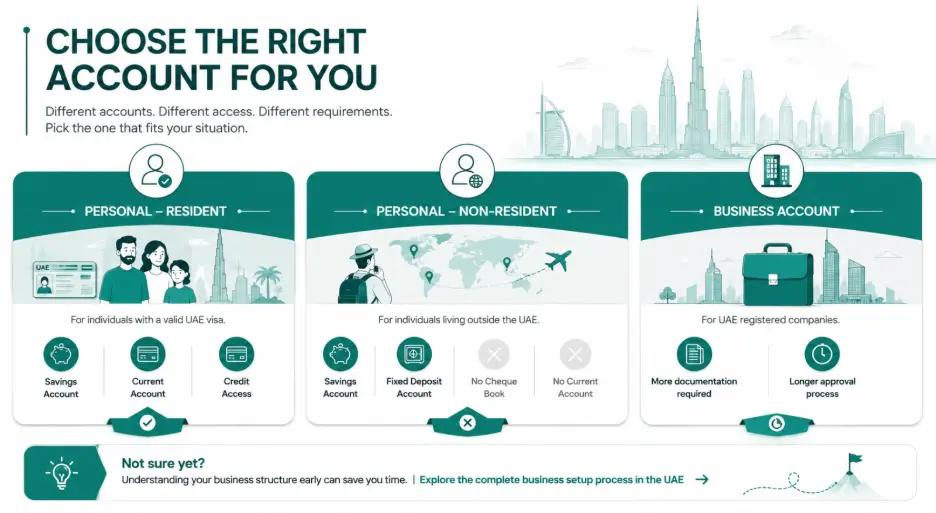
The forms you need depend on your case. There are three main types.
- Resident personal accounts are for people with a valid UAE visa. You get savings, current accounts, and credit access.
- Non-resident personal accounts are limited. You can only open a savings or fixed deposit account. No cheque book. No current account. No overdraft.
- Business accounts are for UAE companies. They need more forms. They also take much longer to process.
Know which type applies to you before you start. The rules are very different for each one. If you’re still deciding on your company structure, the full business setup process in the UAE is worth reading first.
Bank Account Opening Rules for UAE Residents
If you hold a valid UAE visa, here’s what you need.
Core Forms and ID
You’ll need a valid passport. It should have at least six months left on it. You’ll also need your UAE residence visa. Bring your Emirates ID too. If the card hasn’t arrived yet, your Emirates ID receipt will work at most banks. You’ll also need proof of address. A tenancy contract, Ejari, or utility bill all work.
Proof of Income
This depends on how you earn.
- Employed? Bring a salary letter from your employer. It should show your job title and monthly pay. Some banks also want three months of bank statements. Banks expect a specific format for this. You can check a UAE salary certificate template with the exact fields banks require before you ask HR for yours.
- Self-employed? You need a valid trade licence. You also need six months of bank statements.
- No income from work? Banks may ask for proof of where your money comes from. Investment or savings papers usually work.
Which Bank Should You Choose?
If your employer transfers your salary to a specific bank, start there. Salary transfer accounts often come with better terms: no minimum balance, lower fees, and easier credit access. Compare minimum balance rules and monthly fees before you commit. Switching banks later is possible, but takes time.
Some employers in the UAE run salaries through Emirates NBD, FAB, or ADCB. Ask your HR team which bank they use before you apply anywhere.
Age Rules
Most UAE banks need you to be at least 21. An 18-year-old can only open an account if they work for a government body.
Bank Account in UAE: Rules for Non-Residents
Non-residents can open accounts in the UAE. But the options are limited.
You must visit a branch in person. Remote opening isn’t available for standard accounts.
Which Banks Accept Non-Residents?
Not all do. Banks that often take non-resident cases include Emirates NBD, Mashreq, FAB, ADCB, RAKBANK, HSBC UAE, and Dubai Islamic Bank.
Forms Non-Residents Need
You’ll need your valid passport. Make sure it has your UAE entry stamp or visit visa. Bring six months of bank statements from your home bank. They should be in English. You’ll also need a reference letter from your home bank.
Bring proof of your home address, too. A utility bill or bank statement dated within three months of both work. You’ll need to show where your money comes from. Payslips, tax returns, or investment papers all help. You also need a written statement explaining why you need a UAE account.
Some banks also ask for a CV or a tax residency letter.
What a Non-Resident Account Can and Can’t Do
You’ll get a debit card. You’ll also get online banking and global transfers. You won’t get a cheque book or a personal loan. Credit cards are only available if secured against a fixed deposit.
Non-Resident Minimum Balances
Non-resident balances are higher than for residents. Basic savings accounts start from AED 3,000. Many banks ask for AED 25,000 or more. Priority tiers can reach AED 100,000 to AED 500,000.
Expat Bank Account UAE: Tips for New Residents
If you’ve just arrived on a work visa, timing matters.
Don’t wait for your physical Emirates ID card. Most banks accept the Emirates ID receipt. That alone can save weeks.
Your salary letter is your most useful form. Ask HR for it on company letterhead. It needs your job title, start date, and monthly pay. Ask the bank if they have their own template first. That way you won’t need to go back to HR for a second version.
Some salary accounts have zero minimum balance. Others need AED 3,000 to AED 5,000. Check the account terms before you apply.
One more tip: avoid walk-ins during peak hours. Early mornings on weekdays is the fastest. Bring originals and copies of every document. Banks won’t always tell you to bring copies, but they’ll ask for them anyway. If you’re still sorting your visa processing in the UAE at the same time, handle both in parallel to avoid delays on either end.
Business Bank Account UAE: What Companies Need
Business accounts take much longer than personal ones. Plan for two to four weeks. Complex cases with foreign owners can take up to two months.
Forms Required to Open a Business Account
You’ll need a valid UAE business licence. Bring your company Articles and Memorandum. You also need your company’s setup papers. Provide passport copies of all owners, directors, and real beneficial owners. If any owners live in the UAE, their Emirates ID is required. Bring proof of your office address, too.
A tenancy contract or utility bill both work. If the company is already trading, bring six months of bank statements. You also need a business plan. It should cover what the company does, who its clients are, and expected payment volumes. Bring an ownership chart showing the full company structure.
If any owner is a foreign company, you need to attest papers from that entity. This adds time and cost.
Lowest Balance Rules for Business Accounts
Most banks need a minimum balance for business accounts. Startup packages can start at AED 25,000. Most accounts need AED 50,000 to AED 100,000. Some tiers go higher.
Falling below the threshold means a monthly fee. Some digital banks offer zero or low-balance accounts with fewer features.
What Banks Actually Look At
Beyond documents, banks assess how the business looks on paper. They want to see a real purpose, real clients, and a realistic flow of money. A company formed last month with no website and no client contracts looks thin. Banks have tightened their checks in recent years. Even companies that meet all the formal rules can get rejected if compliance isn’t satisfied with the overall picture.
Corporate Bank Account UAE: Timelines
Standard cases take two to four weeks. Companies with foreign owners or complex structures should allow six to eight weeks. Some banks take two months or more.
UBL Bank Account Opening Rules in the UAE
UBL (United Bank Limited) has branches in Dubai, Abu Dhabi, and Sharjah. It’s popular with Pakistani expats and businesses with South Asia ties.
Personal UBL Accounts
You must be at least 21. Bring your passport and UAE visa. You also need your Emirates ID, proof of address, and proof of pay.
Business UBL Accounts
You need valid ID for all owners and signers. Bring proof of company filing. Also bring your office address details and a list of all owners and directors.
The minimum balance at UBL for business accounts is around AED 50,000. Business accounts often take two to three weeks to open.
UBL offers savings accounts, current accounts, and Islamic banking. Always check with UBL directly for current fees and forms needed. Things change.
UAE Bank Account Process: How Long Does It Take?
Timelines vary by account type.
Personal accounts usually open in two to five working days. This assumes your forms are complete.
Non-resident accounts take a few extra days. Stricter checks are required.
Business accounts take two to four weeks in standard cases. Complex structures with foreign owners can take six to eight weeks or more.
Digital banks like Mashreq Neo, Liv, Wio, and Zand are faster. Some personal accounts open within minutes via a mobile app.
Who Struggles With the Standard Process
Some cases are harder than others.
- Freelancers need a valid freelance permit or trade licence. They also need bank statements s
- s are a barrier.
- New companies with no trading history face extra checks. Banks want a business plan. Ideally, they also want some client contracts. These help show the business is real.
- Offshore companies face the most difficulty. Banks are cautious about foreign entities with no UAE presence and all non-resident owners. If your structure involves a UAE offshore company formation, it’s worth understanding the banking implications before you incorporate.
- High-risk sectors including crypto, money exchange, and real estate brokerage face extra review. Some banks won’t take these at all.
- Anyone whose account was blocked elsewhere will find it hard. UAE banks can see if another bank has flagged your account. Showing regular pay. Some banks are more flexible than others.
Non-residents with thin bank histories can struggle. Low home balances and the high UAE minimum balance rule.
UAE Bank Account Rejection Reasons
Rejection is more common than people expect, especially for business accounts. Here are the main reasons banks say no.
Incomplete or different documents
A name spelled one way on your passport and another on your MOA can pause a review. Banks check all forms against each other.
No clear source of funds
Banks need to know where your money comes from. Vague answers raise flags straight away.
Vague account purpose
“I may make some payments” isn’t enough. Banks want specifics. Who are your clients? What volumes do you expect? Why do you need a UAE account?
Unclear ownership
If your company ownership runs through several layers, banks will pause. UAE rules need full clarity on who really owns the business.
High-risk sectors on the trade licence
Even if you don’t trade crypto or precious metals, having those listed on your licence can cause a rejection. The company formation and trade licence management process matters here. The activity codes you register at the start follow you directly into the banking application.
No local presence
Banks want to see a real, active UAE business. A company with no office and no staff looks risky.
A previous rejection
A rejection at one bank can be seen by others. Sending the same file to another bank without fixing the problem usually gets the same result.
A poor interview
Many banks require a meeting. If you can’t explain what your business does, where the money comes from, or who your clients are, that’s a problem. Even a clean file can be rejected if the interview goes badly.
Digital Banking Options in the UAE
You don’t have to use a regular branch bank.
Licensed digital banks in the UAE include Mashreq Neo, Liv, Zand, and Wio. They offer full accounts with IBANs and debit cards. Onboarding is faster and paperwork is lighter.
These work well for most residents and some business types. For trade finance or a dedicated relationship manager, a standard bank is still the better option.
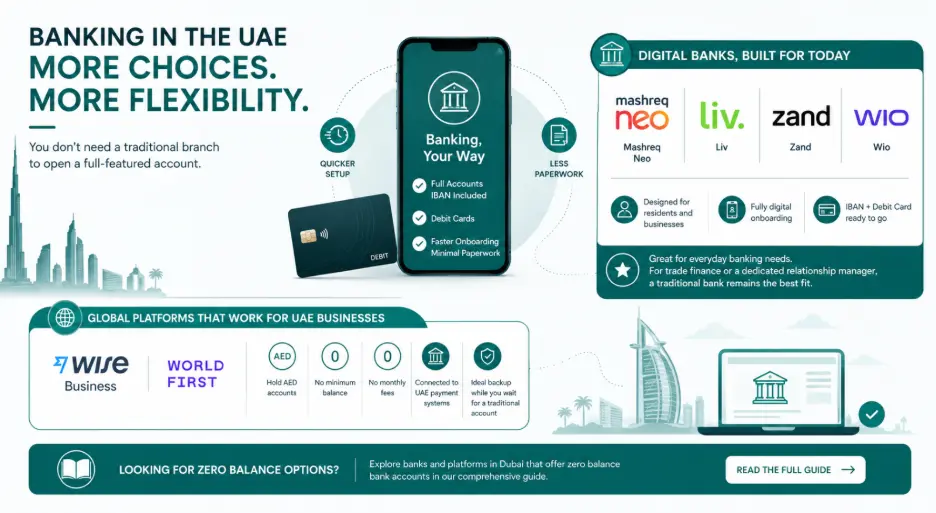
Some global platforms like Wise Business and WorldFirst let UAE businesses hold AED accounts with no minimum balance and no monthly fees. They connect to UAE payment systems and work well as a backup while you wait for a traditional account.
If avoiding a minimum balance is your main concern, there’s also a full guide on zero balance bank account opening options in Dubai covering which banks and platforms offer this.
Frequently Asked Questions
Almost all banks need you there in person. Some banks let you start remotely. But you still need a branch visit to finish the process.
There’s no fixed rule across all banks. Some account types need a minimum salary of AED 3,000 to AED 5,000. Basic savings accounts usually don’t. Check the terms of the specific account.
No. The UAE Central Bank doesn’t allow it. Running business payments through a personal account can get your account suspended.
Yes. The UAE follows the OECD Common Reporting Standard. Banks share account data with the tax bodies of account holders’ home countries automatically.
Most banks charge monthly fees. Typical costs range from AED 150 to AED 500 per month, depending on the account type.
Stop before applying elsewhere. Find out why first. Sending the same file to another bank almost always gets another rejection. Get help to fix the problem before you try again.
Yes. Most banks require proof of a physical UAE office address. A registered agent address or flexi-desk in a free zone often works. A P.O. box alone is not enough.