
Introduction
Most people look up one fee. The visa fee. That’s the mistake.
The real cost is a bundle of six or seven charges. Pay one and more follow. Some come from MOHRE. Some from ICA. Some people from medical clinics. Some from typing offices.
By the end, one employee visa can run AED 3,500 to AED 7,000. Mainland and free zone companies pay different rates. Skilled and unskilled workers fall into different brackets.
Nobody spells this out upfront. This guide does.
What Is an Employee Visa in UAE?
An employment visa lets a foreign worker live and work legally in the UAE. The company sponsors it, not the employee.
The visa ties to a job offer. If employment ends, the visa ends with it.
Both mainland and free zone companies can sponsor staff. The costs differ slightly between them, but the steps are mostly the same.
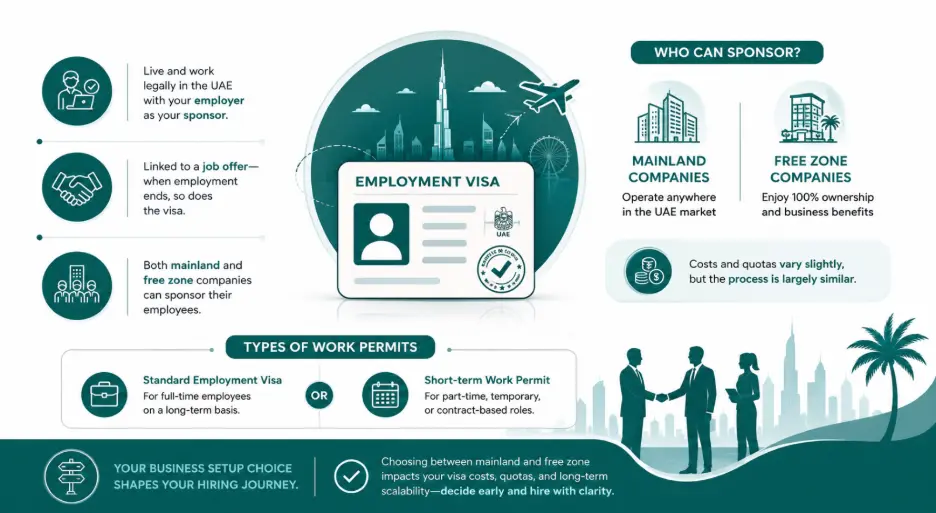
There are two types of work permits. The standard employment visa covers full-time staff. Short-term work permits handle part-time and contract roles. This guide covers the standard full-time visa.
If you are still deciding between a Dubai mainland company and a Dubai free zone company, that choice directly affects your visa costs and quota… so it is worth sorting out before you hire anyone.
UAE Employee Visa Cost Breakdown 2026
So, what are you really paying? Here’s each layer, broken out.
MOHRE Fees
MOHRE is the Ministry of Human Resources. They handle the work permit side. The amount you pay depends on what kind of worker you’re sponsoring.
Skilled workers (degree holders, specialists):
- Work permit: AED 300 to AED 500
- Labour card: AED 100
- Contract fee: AED 100 to AED 200
Semi-skilled or unskilled workers:
- Work permit: AED 500 to AED 1,000
- Labour card: AED 100
MOHRE fees come to AED 600 and AED 1,200. And that’s before you’ve touched anything else.
ICA Fees
ICA stamps the visa and issues the Emirates ID. Their fees are set by the federal government, so they don’t change by emirate.
- Entry permit (for a hire coming from overseas): AED 200 to AED 440
- Visa stamping (for someone already inside the UAE): AED 640 to AED 1,360
- Emirates ID ( 2 or 3 year visa): AED 100 to AED 370
Medical Test
Every single employee needs this. No exception. It’s done at a government-approved clinic after they arrive in the UAE.
You’re looking at AED 320 to AED 620. Private clinics sit at the higher end, but they turn results faster. Most busy companies just go private to avoid waiting.
Typing and Admin
Typing centres handle form submissions and document prep. Budget AED 150 to AED 300.
If you’re using a PRO service, that’s a separate line. PRO support costs AED 500 to AED 2,000, depending on who you use and how much work they’re doing.
A lot of companies find it worth every dirham once they’ve tried the portals themselves. DBTA’s licensing and PRO services cover this end to end.
Health Cover
UAE law requires health cover for all staff. Dubai is strict about this. Cover has to be active before the visa gets stamped. Not after.
Basic plans run AED 600 to AED 1,200 per year. If you’re hiring in Dubai, sort this early. It blocks stamping if it’s missing.
Dubai Employee Visa Cost vs Other Emirates
Dubai runs strict health cover rules through DHA. All staff need active cover before stamping. Dubai also has more approved clinics, so work gets done faster in most cases.
Abu Dhabi follows similar rules under DOH. Cover must be active before stamping, and the emirate runs its own approved clinic list.
Sharjah, Ajman, and Ras Al Khaimah follow federal rules from MOHRE and ICA. Health cover is required, but checks at the visa stage tend to be less rigid than in Dubai.
Core government fees are the same across all seven emirates. MOHRE and ICA rates are federal; they do not change by location. The gap between emirates comes from health plans, typing costs, and local admin rates.
Total Employee Visa Cost in UAE: Real Budget Numbers
Here is what to budget for one full employment visa in 2026:
| Cost Item | Range (AED) |
|---|---|
| MOHRE Work Permit | AED 600 to AED 1,200 |
| ICA Entry Permit or Stamping | AED 200 to AED 1,360 |
| Medical Test | AED 320 to AED 620 |
| Emirates ID | AED 100 to AED 370 |
| Typing or PRO Fees | AED 150 to AED 2,000 |
| Health Cover (Year 1) | AED 600 to AED 1,200 |
| Total | AED 2,000 to AED 6,800 |
Mainland companies spend more money. PRO costs are the main reason. Free zones often include visa admin in their packages, which brings the number down.
Budget AED 5,000 per person as a safe planning figure for mainland setups. It covers most cases without surprises.
Employment Visa Cost UAE: Free Zone vs Mainland
Mainland Employee Visa
Mainland companies get licences through DED or an emirate body and apply for visas via MOHRE and ICA directly.
- Good points: No hard cap on staff numbers. You can trade anywhere in the UAE.
- Watch out for: More steps. PRO costs add up. Government portals can be hard to navigate without expert help.
- Mainland total: around AED 3,500 to AED 6,500 per staff member.
Free Zone Employee Visa
Free zones like DMCC, JAFZA, DIC, IFZA, Meydan, and RAKEZ run their own visa units. Many bundle visa fees into annual licence costs, which makes the per-staff cost look lower on paper.
- Good points: Faster steps. Less paperwork. Admin is often built into the package.
- Watch out for: Staff cannot work directly for mainland clients. The visa ties to the free zone company.
- Free zone total: AED 2,000 to AED 4,500 per staff member.
Not sure which structure suits your team size and hiring plans? DBTA’s team answers this question every day, company formation and trade licence management are good starting points.
UAE Employee Visa Process: Step by Step
Knowing each step helps you spot where delays and extra costs show up.
Step 1: Get a Work Permit
Apply to MOHRE via Tasheel or an approved typing office. You need a passport copy, a photo, degree papers, and a signed job offer letter.
Step 2: Get an Entry Permit (if staff are overseas)
ICA issues a two-month entry permit. Staff use it to fly into the UAE. The remaining steps happen after arrival.
Step 3: Medical Test
Done at an approved clinic after the employee arrives. Results come back in 24 to 48 hours in most cases.
Step 4: Emirates ID
The application goes in at the same time as the medical. Staff provide fingerprints and photos at an ICA service point.
Step 5: Visa Stamping
ICA stamps the visa in the passport…Standard time is just 3 to 5 working days. There is also express service, which costs around AED 500 to AED 1,000 or more and cuts the wait to 2 to 3 days.
Step 6: Labour Card
MOHRE issues the labour card and confirms the contract. This completes the process.
DBTA handles all six steps under one roof through its visa processing service, which covers new hires, renewals, and status changes.
Employee Visa Timeline UAE
Standard timing runs 2 to 4 weeks from start to finish.
- Work permit: 2 to 5 days
- Entry permit: 1 to 3 days
- Medical and results: 1 to 2 days
- Emirates ID appointment: 1 to 3 days
- Visa stamping: 3 to 7 days
Total: 10 to 20 working days, assuming papers are ready and no issues arise.
Express options cut stamping to 2 to 3 days. Same-day medical results cost AED 100 to AED 200 more.
Need degree papers verified from a foreign country? Add 1 to 3 weeks. That is the most common cause of delays.
Employee Visa Documents UAE
Get these ready before you start. Missing papers causes most delays.
For the employee:
The passport must have 6 months or more remaining. Less than that and the application fails…check before you begin.
Photos must be passport size with a white background.
Degree papers must be verified through the home country first, then at the UAE Embassy, and then at the UAE Foreign Affairs in the UAE. This can take 2 to 4 weeks if papers are not already done.
If the employee has worked in the UAE before, include old visa copies.
For the company:
The trade licence must be valid and current. MOHRE checks it.
The MOHRE Establishment Card must be active. New companies must obtain this before sponsoring anyone.
A signed offer letter and employment contract are required.
For renewals:
Also include the current Emirates ID, the existing visa copy, and an updated contract.
Employee Visa Renewal Cost
Renewals happen every 2 or 3 years, depending on the visa type issued at the start.
Renewal fees are close to new-issue fees. The main saving is skipping the entry permit, which avoids AED 200 to AED 440 if the staff member stays in the UAE throughout.
| Item | Cost (AED) |
|---|---|
| MOHRE Renewal | AED 500 to AED 900 |
| ICA Visa Renewal | AED 500 to AED 1,000 |
| Medical (Required Again) | AED 320 to AED 500 |
| Emirates ID Renewal | AED 100 to AED 370 |
| Typing or Admin | AED 150 to AED 300 |
| Total | AED 1,600 to AED 3,100 |
Health cover renewal is a separate ongoing cost. Budget AED 600 to AED 1,200 per person per year on top of the above.
Start renewal work 30 to 60 days before the visa expires. Overstay fines begin at AED 25 per day after expiry.
Company Visa Cost UAE: What Employers Often Forget
Beyond the direct fees, there are extra costs that pile up fast.
- Visa quota fees. Mainland companies need a quota for sponsoring staff. Raising it costs AED 500 to AED 2,000 in admin fees. This is covered under DBTA’s business licence support.
- Bank guarantee for home staff. MOHRE requires a bank guarantee of AED 3,000 per domestic worker…covering cleaners, drivers, and nannies.
- Overstay fines. If a visa expires before renewal, ICA charges AED 25 per day. Two months of delay costs AED 1,500. These add up quickly. Don’t let them slip through.
- Status change fees. Moving an employee from a visit visa to a residence visa inside the UAE costs AED 640 to AED 1,360.
- Re-entry bans. Some visa cancellations trigger a 30-day or 6-month ban on return. This matters if you want to rehire someone quickly.
Who Struggles with the Standard Process
The standard path is not smooth for everyone.
New companies without a MOHRE Establishment Card
You cannot sponsor staff until MOHRE issues this card. New companies typically wait 1 to 3 weeks. There is no shortcut.
Employees with unverified degree papers
Papers need checking in the home country, then at the UAE Embassy, then at the UAE Foreign Affairs. This takes 2 to 6 weeks and can cost AED 500 to AED 2,000 depending on the country.
Employees on visit visas
A status change inside the UAE is possible, but it costs more and is not always approved. Some nationalities must leave and re-enter.
Companies with open MOHRE disputes
Any active complaint blocks all new visa work. Resolve disputes before attempting to hire.
Small companies under the quota limit
New mainland companies start with a limited number of visa slots. Expanding the quota depends on office size and UAE national staffing ratios, and requires time plus extra fees.
What Can Actually Go Wrong
These are real problems, not invented ones.
Failed medical tests
Certain health conditions, such as TB, HIV, and some liver conditions, trigger an automatic visa refusal. The employee must leave, and all fees paid are lost. There is no appealing process.
Paper rejections at MOHRE
Degree papers without the correct chain of stamps get rejected. If a school is not on MOHRE’s approved list, extra steps are required, adding weeks to the process.
ICA system delays
The ICA portal goes offline at times. Backlogs build around Eid and UAE National Day. Plan around these dates; they are the same every year.
Wrong work permit type
Applying for a skilled permit when the employee does not qualify results in rejection. A new application in the right category costs more time and additional fees.
Passport running out mid-process
A visa cannot be stamped in an expired passport. The entire process stops until a new passport is issued.
Mismatched company details
If your trade licence shows a different name from your MOHRE card, a common issue after company name changes, applications get rejected. Update both before you apply.
Salary mismatch in the contract
MOHRE flags contracts where the stated salary looks too low for the role. If the contract gets rejected on these grounds, you revise and resubmit, which adds delays.
Employee Visa Approval Time: Realistic Expectations
Standard total time is 2 to 4 weeks. Here is what changes that:
Faster when: Papers are all in order. Express stamping is paid for.
Slower when: The employee is coming from overseas (add 2 to 5 days). You apply in September to November or after Eid (add 1 to 2 weeks). Degree papers need overseas verification (add 2 to 4 weeks).
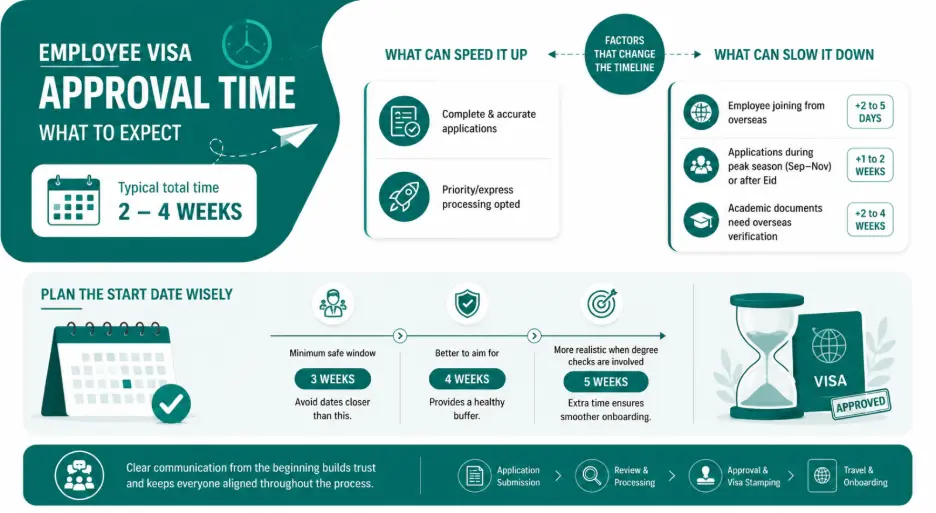
Don’t give a new hire a start date less than 3 weeks away. Four weeks is safer. Five is more realistic when overseas degree checks are part of the picture.
Communicating the timeline clearly from the start saves stress. Most people understand when you explain the stages early.
Employee Visa Requirements UAE: Quick Check
Before you apply, run through this list:
- Is your trade licence active and not expired? Lapsed licence blocks MOHRE work.
- Do you have an active MOHRE Establishment Card? New companies must get this first.
- Do you have open visa quota slots? If the quota is full, raise it before hiring.
- Does the employee’s passport have 6 or more months remaining? If not, passport renewal comes first.
- Are all degree papers verified? If not, start now, it takes weeks.
- Is the offer letter ready and signed? MOHRE will ask for it.
- Is health cover confirmed? Dubai requires an active cover before stamping.
If you are a new business, getting your business licence and MOHRE setup right from the start is the single best way to avoid delays at the hiring stage.
Getting Set Up the Right Way
If you are setting up a new company and plan to sponsor staff, the licence structure matters before you hire your first person. The type of licence, the emirate, and whether you go to the mainland or a free zone all affect your visa costs, quota size, and processing speed.
For businesses managing UAE corporate tax and compliance obligations alongside hiring, it also helps to have these areas handled together. Uncoordinated admin across tax, payroll, and visas is one of the most common causes of avoidable penalties.
Dubai Business and Tax Advisors (DBTA) helps companies get this right from day one. The team handles MOHRE registration, Establishment Card work, visa processing, and ongoing PRO support.
For businesses with more complex needs, including corporate tax advisory and VAT compliance , DBTA operates as a single point of contact across all of it.
Frequently Asked Questions
The employer pays all visa fees. This is the law. Deducting visa costs from an employee’s salary is not permitted.
Yes. Both are common. A 3-year visa costs more upfront but reduces how often you go through the renewal process.
Your company must be registered in the UAE. The employee can be overseas. The company manages the MOHRE steps from inside the UAE.
The employer must cancel the visa within 30 days. The employee then receives a grace period of 30 to 180 days to find a new role, transfer their visa, or leave the country.
No, it is a separate ICA charge. But it is processed at the same time, so it often gets grouped into one visit.
No, UAE law does not allow this. Any contract clause attempting to claim it back will not be held in court.
The entry permit is short-term and lets the employee enter the UAE for two months. The residence visa is the long-term document stamped after the medical check, lasting 2 or 3 years.