
The landscape in the United Arab Emirates has evolved into a sophisticated global hub where speed and discretion often run headlong into stringent regulatory scrutiny. For businesses with the Middle East in their sights, Dubai Company Formation and Registration is the gateway to a low-tax, high-growth environment.
However, the “fastest” setup is rarely the most sustainable if compliance and banking readiness are treated as afterthoughts. In 2026, a successful launch requires a balance between rapid licensing and the robust structural integrity needed for the UAE’s evolving tax and AML (Anti-Money Laundering) frameworks.
Modern company formation and trade license management is a multi-layered process that extends far beyond receiving a piece of paper from the Department of Economy and Tourism (DET) or a Free Zone Authority. A complete setup encompasses the trade license (the legal right to operate), the establishment card (which opens your immigration file), the residence visas for investors and staff, and the activation of a corporate bank account.
Furthermore, post-registration compliance, including VAT registration thresholds and Corporate Tax registration, must be mapped out from day one to avoid administrative penalties. If you want compliance tracks handled appropriately from the start, align the build with UAE Corporate Tax advisory and compliance, as well as VAT & indirect tax advisory.
This guide is designed for diverse stakeholders: from the solo consultant seeking a Free Zone sanctuary for international digital services, to the multinational corporation establishing a Mainland LLC to bid on government contracts.
It is particularly relevant for foreign owners who may be navigating the UAE legal system for the first time and require a clear roadmap that avoids the common pitfalls of “low-cost” packages that offer no path to a physical office or a functional bank account.
In the current market, “instant” licenses can be issued in as little as 24 to 48 hours for certain digital activities in specific Free Zones. However, the realistic path to full operational status means you can sign contracts, invoice clients, and move funds, typically spanning 4 to 8 weeks.
This timeline accounts for the “hidden” steps: notarizing foreign documents, securing an Ejari (lease), and the rigorous KYC (Know Your Customer) process required by UAE banks. If you want a benchmark timeline that includes the “real bottleneck” steps (immigration + banking), use the operational sequencing in DBTA’s low-cost setup timeline guide.
Deciding on a jurisdiction is the most critical hurdle in Dubai Company Formation and Registration. Founders often make the mistake of choosing based solely on price, only to find they are legally restricted from their primary target market. If you want the clean comparison first, use Free Zone vs Mainland: UAE business setup differences.
Dubai mainland company formation is the gold standard for businesses that need to trade directly with the local UAE market or bid for government tenders. If your business model involves a retail storefront, a physical warehouse on the “street side,” or providing services to local individuals and government entities, Mainland is usually your only compliant option.
For licensing decisions and approvals, anchor this step to business licensing in Dubai so your activity and approvals match the market you will actually serve.
Company registration in the Dubai free zone is ideal for “online-first” businesses, consultants, and international traders who do not require a physical presence on the UAE mainland.
Free Zones offer the advantage of 100% profit repatriation and often provide bundled “flexi-desk” packages that keep overheads low for startups. If 90% of your clients are outside the UAE, a Free Zone setup is likely to be your most efficient route, provided you still build the structure to meet tax and banking standards outlined in the UAE Corporate Tax advisory and compliance.
For established international brands, foreign company registration in Dubai via a branch office allows the parent company to retain complete control while operating under the same brand identity. A branch is not a separate legal entity; it is an extension of the parent.
Alternatively, a subsidiary is a separate legal entity owned by the parent company, offering better liability protection for the headquarters while still allowing for 100% ownership.
| Feature | Mainland | Free Zone | Branch/Subsidiary |
|---|---|---|---|
| Target Market | Anywhere in UAE & Global | Global & within Free Zone | UAE & Global |
| Ownership | 100% (most activities) | 100% | 100% (Parent owned) |
| Office Type | Physical (Ejari) Required | Flexi-desk or Physical | Physical Required |
| Visa Quota | High (linked to office size) | Limited (linked to package) | Varies |
| Audit Needs | Not always mandatory | Often mandatory | Mandatory |
| Best For | Retail, Local Trade, Tenders | Tech, Consulting, Export | Global Brands |

The “onshore” landscape has changed dramatically. Dubai mainland company formation no longer requires a mandatory 51% local partner for most commercial and industrial activities.
A mainland license gives you the “freedom of the city.” You can open multiple branches across different Emirates, take on any local client, and invoice any UAE-based business without needing a distributor or an intermediary. For companies looking to grow into the wider GCC, a Dubai mainland entity is often seen as a more prestigious and robust vehicle.
If you want a practical risk checklist before you commit to the mainland, review UAE mainland company setup: avoid top mistakes.
Unlike Free Zones that offer virtual desks, Mainland companies must have physical office space. This is verified through an Ejari, a registered tenancy contract. The size of this office directly determines your visa quota. Typically, for every 8–10 square meters of office space, you are entitled to a visa.
As of 2021 , the UAE permits 100% foreign ownership of LLCs. But some “strategic” sectors (such as oil and gas or defense) still require a local partner.
Professional licenses (for individual consultants or doctors) may require a Local Service Agent (LSA), who acts as a liaison with government departments for a fixed annual fee but holds 0% equity in the business.
Founders opening a coffee shop in Jumeirah, an engineering firm bidding for RTA projects, or a real estate agency targeting local buyers must choose the Mainland. It provides the legal infrastructure to operate in the “real world” of Dubai.
With over 20 zones in Dubai alone, Dubai free zone company formation offers specialized ecosystems, such as Dubai Internet City for tech or DMCC for commodities.
Free zones are essentially “business parks” with their own regulators. They allow 100% foreign ownership and are exempt from customs duties. They are highly efficient for those who do not need to move physical goods into the Dubai mainland. Many zones offer “all-in-one” packages that include the license, a shared workspace, and one or two visas for a fixed price.
If you are still unsure whether Free Zone restrictions will limit your sales model, start with Free Zone vs Mainland: UAE business setup differences.
A common mistake is thinking that a Free Zone company can sell goods directly to a shop in the Dubai Mall. Legally, they cannot. They must either appoint a local distributor (who has a mainland license) or establish a separate mainland branch. For service-based companies, the lines are slightly blurrier, but generally, the work should be performed “within the zone” or for clients outside the UAE.
In a Free Zone, your visa quota is usually “pre-bought” as part of your package. A “zero-visa” package is the cheapest but prevents you from getting an Emirates ID. A “two-visa” package allows the founder and one partner to reside in the UAE. If you need more staff, you must upgrade your package or rent a larger physical office within that specific Free Zone.
If visas are part of your plan, pair your formation path with Dubai visa processing and PRO services to avoid the avoidable delays and document issues that block stamping.
A Free Zone is typically the best and most cost-effective Dubai company formation option, whether you’re a programmer, a marketing consultant with international customers, or a drop shipper.
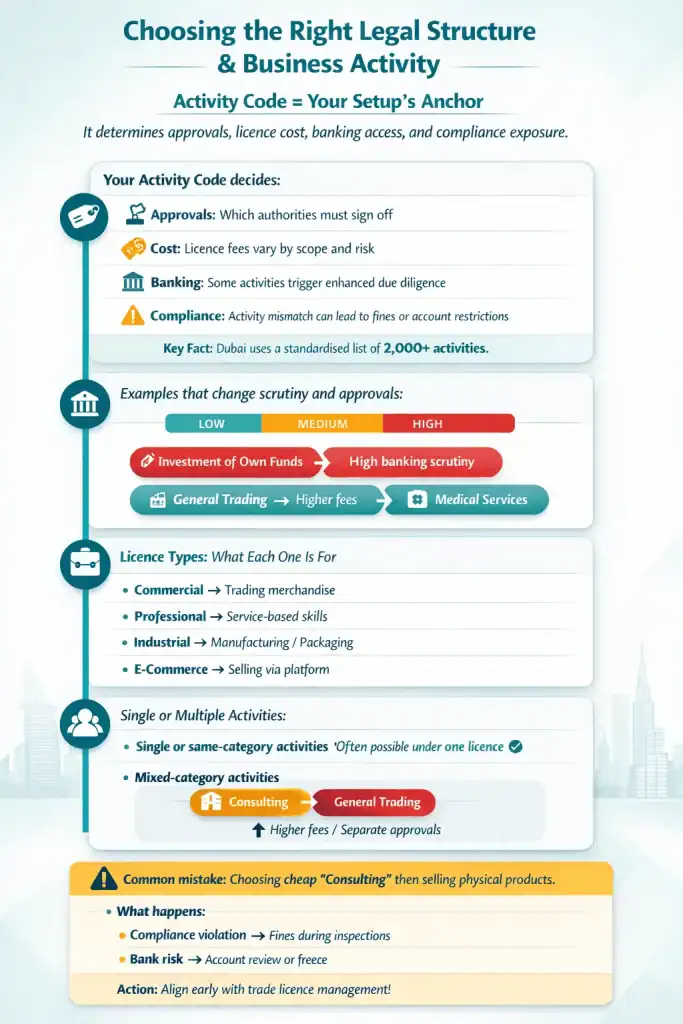
Activity selection is the anchor of your entire setup. In Dubai company formation, your “Activity Code” determines your license cost, which the authorities must approve, and whether a bank will even open your door. This is where most founders should align early with trade license management in Dubai, rather than guessing an activity because it “looks cheaper.”
Dubai has a standardized list of over 2,000 activities. If you choose “Investment of Own Funds,” expect high banking scrutiny. If you select “General Trading,” your license fee will be higher because the scope is broad. If you choose “Medical Services,” for example, you’ll need external approval from the Dubai Health Authority (DHA).
You can often combine multiple activities under one license if they fall within the same category (e.g., three types of consulting). However, mixing categories, such as “Consulting” and “General Trading”, usually requires a second license, a significantly higher fee, and separate approvals.
Founders often pick up a “Consulting” activity because it’s cheap, but then try to sell physical products. This is a compliance violation that leads to fines during inspections and can cause a bank to freeze your account for “activity mismatch.” If you want an operational blueprint that ties licensing, immigration, and banking together, follow the sequencing explained in Dubai business licensing setup, compliance, and tax advisory.
The requirements for registering a company in Dubai are straightforward but strictly enforced.
You must appoint at least one Manager and one Director (who may be the same person). Banks will require a detailed CV of the Manager and a 6-month personal bank statement from the shareholders’ home country to verify the source of wealth. If you want to reduce bank friction, use the banking readiness realities outlined in Best UAE business setup consultants for mainland and free zones.
Names cannot include “Global,” “International,” or “Middle East” unless they meet specific capital requirements. They also cannot start with “Dubai” or “UAE” without high-level approval. Do not use one that is already trademarked or is too similar to existing government organizations.
If your activity involves finance, education, health, or transport, you will need “External Approvals.” For example, a travel agency needs approval from the Department of Economy and Tourism (Tourism division), while a school needs approval from the KHDA. This adds time and cost to the Dubai company formation process.
The Memorandum of Association (MOA) sets out the ratios of capital contributions, profit sharing, and decision-making powers. Banks scrutinize these to see who has the “Signing Authority.” If the MOA doesn’t clearly state that the Manager can “Open and Operate Bank Accounts,” the bank will reject your application.
For first-time founders, the path often involves registering a new company in Dubai using a “Starter Package.” These packages usually bundle the name reservation, one-year license, and a virtual office. It is the most linear path for those testing the market.
If you want a broader launch framework beyond Dubai only, usethe ” How to Start a Business in the UAE.
This requires heavier lifting. You must provide the parent company’s Certificate of Incorporation, MOA, and a Board Resolution, all of which must be attested by the UAE Embassy in the home country and the Ministry of Foreign Affairs (MOFA) in the UAE.
Getting the license is only the midpoint. You must register for E-Channel services, apply for your Establishment Card, and, crucially, register for Corporate Taxwithin the prescribed deadline to avoid administrative penalties. The deadline framework is explained in Corporate Tax registration deadlines in the UAE, and the penalty exposure is detailed in the AED 10,000 corporate tax penalty explanation.
A UK software consultant needed a residency visa and a business bank account to serve global clients from Dubai. DBTA identified a tech-focused Free Zone with a “zero-paperwork” digital setup. We secured their entry permit before they even landed, allowing them to complete their medical and biometrics within 48 hours of arrival.
“I landed on Monday and had my business license by Wednesday. DBTA’s choice of the right zone made the entire bank opening process seem seamless.”
— David S., IT Consultant.
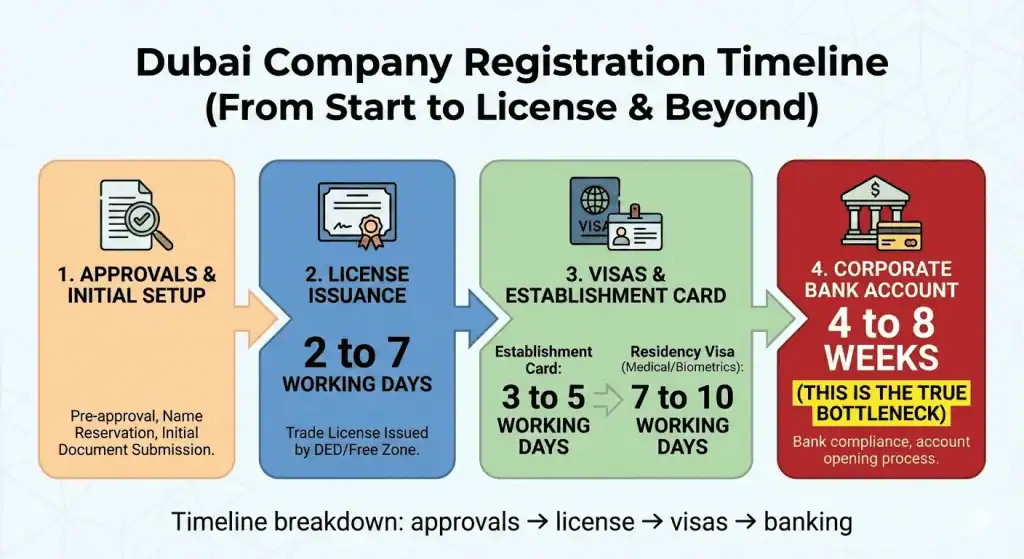
The fastest company formation in Dubai might take 48 hours for the license, but a “typical” timeframe to be fully operational is 6 weeks. Delays occur when documents from abroad aren’t attested correctly or when the bank requests additional proof of business.
The most common delay is the “Attestation Loop.” If you are a foreign company opening a branch, getting documents stamped in London or New York and then in Dubai can take weeks.
Understanding the cost of Dubai company registration requires looking beyond the “teaser” prices seen in social media ads.
“Registration cost” usually refers only to the government license fee. The “Dubai company setup cost” is a comprehensive figure that includes visas, medical tests, Emirates ID, office rent, and professional consultancy fees.
Government fees are fixed but vary by activity. Service provider fees cover the “legwork, the drafting, the queues, and the expert advice. A “cheap” provider often leaves you to handle the complex visa and banking processes on your own.
Expect Year 2 to be roughly 20-30% cheaper because you won’t pay for name reservation, initial approvals, or the one-time visa costs (visas usually last 2 years). However, you must budget for the annual renewal fees of the license and the office lease.
Many quotes ignore the cost of the medical test (AED 800), the Emirates ID (AED 400), or the mandatory health insurance required for visa stamping in Dubai.
A UK-based digital marketing agency wanted to move to Dubai. They saw an ad for an “AED 6,000 license.” After contacting DBTA, they realised that the price didn’t include a visa, an establishment card, or the “virtual office” required for a bank account. DBTA provided a transparent breakdown of AED 22,000 for a total 1-visa setup.
The license itself does not “include” a visa, but it gives you the right to apply for one. Dubai company formation with a visa is a separate administrative track following the license issuance.
The Investor/Partner visa is valid for 2 years (10 years with the Golden Visa) and does not require a work permit from MOHRE. Employee visas require a labour contract and are subject to the UAE’s labour laws.
On the Mainland, it’s one visa per 100 sq. ft. of office. In a Free Zone, it’s determined by the package you buy. If you plan to hire 10 people, you cannot stay on a “flexi-desk” package.
Banks need to see “Proof of Business.” This includes signed contracts, invoices from a previous company, or a solid business plan. They also need to see a physical office address (not a PO Box).
The UAE is no longer a “tax-free” haven, but a “low tax” one. Company formation in Dubai now requires registering for Corporate Tax.
As of 2024, a 9% Corporate Tax applies to profits above AED 375,000. While some Free Zone companies can enjoy a 0% rate as “Qualifying Free Zone Persons,” the conditions are strict (e.g., maintaining adequate substance and earning “Qualifying Income”).
VAT is 5%. It is mandatory to register once your taxable turnover exceeds AED 375,000 in 12 months. Voluntary registration is possible at AED 187,500. If you want the step-by-step process, use VAT registration UAE: process, cost and requirements, and for ongoing compliance execution, use VAT & indirect tax advisory.
All companies must maintain a UBO Register (Ultimate Beneficial Owner) and submit it to the authorities. Failure to do so can result in fines up to AED 100,000.
Dubai Business and Tax Advisors (DBTA) move beyond mere “document processing.” We act as your SEO content strategist and legal architect.
A fintech startup needed a “Fastest company formation in Dubai” to meet a VC funding deadline. DBTA secured its license and establishment card in 5 days and utilised our banking relationships to fast-track its account pre-approval.
“DBTA didn’t just give us a license; they gave us a functional business. Their compliance-first approach meant we were ready for our first audit before we even made our first sale.” Sarah L., CEO.
Setting up a business in Dubai is a strategic move that requires more than just filling out forms. It requires a partner who understands the nuance of the local banking system and the strictness of the new tax regime. At DBTA, we specialise in Dubai Company Formation and Registration that stands the test of time.
Would you like me to provide a custom document checklist and a preliminary cost breakdown for your specific business activity? Contact us today for a compliance-first consultation to secure your future in the UAE.
It is the legal process of registering an entity with either the Department of Economy and Tourism (Mainland) or a Free Zone Authority. It grants you a trade license, allowing you to legally hire, trade, and reside in the UAE.
Mainland allows you to trade anywhere in the UAE and bid for government contracts, but requires a physical office. Free Zones are for international/specified zone trade, offering easier 100% ownership and bundled office packages.
A basic Free Zone package starts around AED 12,000, while a Mainland setup with a small office usually begins at AED 35,000+. Total costs depend on the number of visas and the office location.
The license itself can take 2–7 days. However, becoming fully operational, including visas and a corporate bank account, typically takes 6 to 8 weeks.
You need a passport copy, proof of address (a utility bill), and, sometimes, a brief CV and personal bank statements for KYC.
What are the main legal requirements for company registration in Dubai and the UAE?
You must have a registered trade name, an approved business activity, a legal structure (like an LLC), and a physical office lease (Ejari).
The license gives you the right to apply for visas. Each visa is a separate cost and requires an establishment card to be issued first.
Match your activity to your actual operations. If you trade, you need a Commercial license; if you consult, a Professional one. Your structure (LLC vs. Branch) depends on liability and ownership needs.
You must renew your license and office lease annually. Compliance includes Corporate Tax registration, VAT filings (if over the threshold), and keeping UBO records up to date.
Yes, we provide “Bank Readiness” services to help you draft a business plan and gather the source-of-wealth documents that UAE banks require.
The most significant errors are choosing the wrong activity (blocking bank accounts), picking a jurisdiction that limits your clients, and ignoring the Corporate Tax registration deadline.
Absolutely. Dubai is a logistics hub. Free zones are particularly cost-effective for these models, as they offer easy integration with global shipping and payment providers.
A consultant like DBTA prevents “dead-end” setups. We ensure your activity is bankable, your office meets visa requirements, and your tax registrations are completed on time.

As CEO of DBTA, Aurangzaib Chawla advises globally mobile businesses and individuals on cross-border tax planning and structuring. With expertise spanning the UK, UAE, and wider GCC, Zaib helps clients minimise double taxation, protect assets, and achieve long-term financial efficiency while staying fully compliant.
Let’s talk about how to structure your business for growth the smart, compliant, and tax-efficient way

As CEO of DBTA, Aurangzaib Chawla advises globally mobile businesses
and individuals on cross-border tax planning and structuring. With expertise spanning the UK, UAE, and wider GCC, Zaib helps clients minimise double taxation, protect assets, and achieve long-term financial efficiency while staying fully compliant.
Let’s talk about how to structure your business for growth the smart, compliant, and tax-efficient way.
Get in Touch