
Business Setup in the UAE 2026: Costs, Steps & Mainland vs Free Zone Guide

Recent Insights
Table of Contents
Introduction
Navigating the tax landscape in the Middle East requires more than a passing glance at the law; it demands a surgical understanding of how the Federal Tax Authority (FTA) distinguishes between different types of transactions. For businesses operating in Dubai, Abu Dhabi, or the Northern Emirates, misinterpreting UAE vat exemptions is one of the most common and expensive errors we encounter at Dubai Business and Tax Advisors (DBTA). If you need hands-on support, start with our UAE VAT & indirect tax advisory services.
Misclassification doesn’t just result in an incorrect tax return. It triggers a domino effect of blocked input VAT recovery, pricing strategy failures, and significant administrative penalties. Whether you’re the CFO of a multinational corporation or an entrepreneur who has just launched their startup company in the UAE, knowing how VAT exemptions in the UAE and zero-rated supplies work in terms of mechanics could spell out life and death for your financial well-being.
This is the ultimate guide, in which you will find a detailed breakdown of these types of content, the need to report them, and their practical implications for your compliance program.
Key VAT Concepts You Must Understand First
Before diving into the specific lists of goods and services, we must establish a baseline of terminology used within the UAE VAT rules and compliance framework.
What “Supply” Means Under UAE VAT
Under the Decree-Law, a supply is essentially any transfer of goods or the right to dispose of them, or the provision of services. This definition is intentionally broad. If your business does something for a consideration (payment), you are likely making a supply.
Taxable Supplies vs Exempt Supplies vs Out-of-Scope
Taxable supplies are those subject to VAT at either 5% (Standard Rate) or 0% (Zero Rate). VAT-exempt supplies, conversely, are not subject to VAT at all, but they come up with a “cost”: the inability to reclaim the tax paid on related business expenses. Reason: Fixed a missing quotation mark and added a colon for better sentence structure. “Out-of-scope” items fall entirely outside the UAE VAT system, such as transactions between two entities outside the UAE or specific intra-GCC movements.
Output VAT vs Input VAT
- Output VAT: The tax you charge (or calculate at 0%) on your sales.
- Input VAT: The tax you pay on your purchases (rent, utilities, stock).
The core tension in UAE VAT lies here: if you make VAT-exempt supplies, you lose the right to recover your Input VAT. This is one of the most common areas we address through VAT classification and recovery advisory.
Why “0% VAT” is Not the Same as “No VAT System Impact.”
A common misconception is that a 0% rate is the same as being “exempt.” This is incorrect. A zero-rated supply is a taxable supply. This means you are still “in the system,” you must report the transaction, and, crucially, you can still reclaim the VAT on your costs.
Exempt vs Zero-Rated vs Out-of-Scope
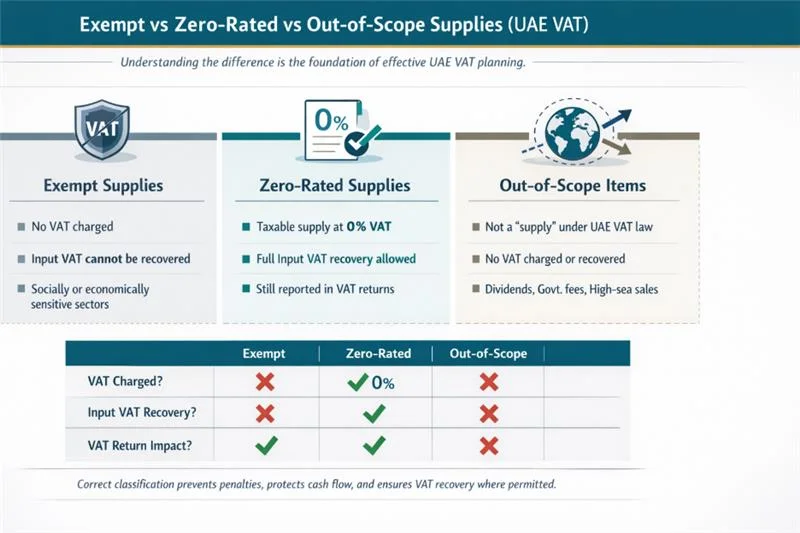
Understanding the difference between zero-rated and exempt supplies is the cornerstone of UAE tax planning.
Exempt Supplies
An exempt supply is a supply where no VAT is charged, and the supplier cannot recover the Input VAT incurred on the costs related to that supply. These are typically “socially” or “economically” sensitive areas where the government chooses not to apply tax, but also does not want to subsidise the industry via tax refunds.
Zero-Rated Supplies
Zero-rated supplies in the UAE are taxable supplies, but the Rate of tax is precisely 0%. Because it is technically a taxable supply, the business retains the full right to recover any Input VAT paid to its own suppliers.
Out-of-Scope Items
These are transactions that do not meet the criteria of a supply under the law. Examples include dividends, statutory fees paid to the government, or “high-sea” sales where the goods never enter the UAE.
Difference Between Exempt and Zero-Rated VAT in the UAE
In simple language, Zero-rated is “good” for the business because you can get money back from the FTA. Exempt is “neutral” for the customer but “bad” for the company because it becomes a “sticky tax” that increases your overhead costs.
Quick Comparison Table
| Bank | Account Type Example | Minimum Monthly Average Balance (AED) | Non-Maintenance Fee (AED) |
|---|---|---|---|
| Emirates NBD | Prime | 50,000 | 150 |
| Mashreq Bank | Business Accounts (Low Tier) | 25,000 | Varies |
| ADCB | Business Accounts | 25,000 – 1,000,000 | Varies |
VAT Registration Implications
The core tension in UAE VAT lies here: if you make VAT-exempt supplies, you lose the right to recover your Input VAT. This is one of the most common areas we address through VAT classification and recovery advisory.
Do Exempt Supplies Count Towards VAT Registration Threshold?
No. When determining if you are over the mandatory (AED 375,000) or voluntary registration threshold (AED 187,500), you should exclude VAT-exempt supplies. If all you do is supply exempt residential tenancies, then you will not be able to register, even if your turnover tops the millions. Reason: Under FTA rules, if a person makes ONLY exempt supplies, they are not actually allowed to register for VAT, even if their turnover tops the millions.
Do Zero-Rated Supplies Count Towards VAT Registration Threshold?
Yes. Zero-rated supplies in the UAE VAT are considered taxable turnover. Reason: Typos in capitalization. If you export AED 400,000 worth of services to Europe, you must register for VAT in the UAE, even though you will never actually collect a dirham of tax from your clients.
The “Registration Exception” Confusion
Under the UAE VAT compliance framework, a business that makes only zero-rated supplies can apply for an “exception” from registration. This is designed to save the company and the FTA the administrative burden of filing “nil” returns or constant refund claims. However, if you take this exception, you cannot reclaim any VAT on your startup costs or overheads. This is precisely where structured VAT registration and ongoing compliance support prevent expensive decisions made “for convenience.”
We often advise startups in the export sector against applying for a registration exception. While it saves on paperwork, the loss of Input VAT recovery on office rent, equipment, and marketing often far outweighs the cost of compliance.
Practical Classification Framework (Decision System)
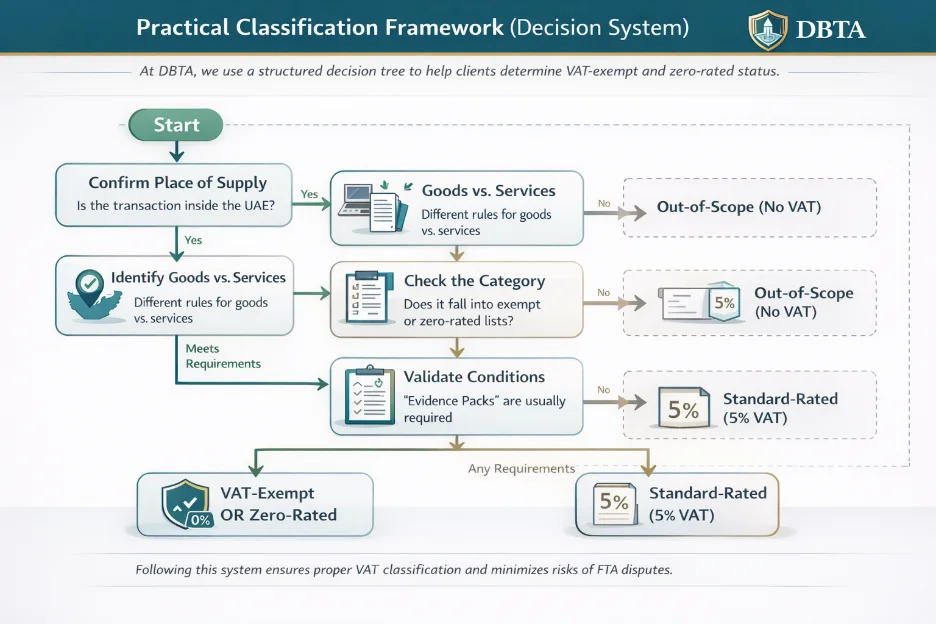
At DBTA, we use a structured decision tree to help clients determine their VAT-exempt and zero-rated status.
- Confirm Place of Supply: Is the transaction legally happening inside the UAE? If not, it may be out of scope.
- Identify Goods vs. Services: Different rules apply to the export of a physical laptop versus a consulting report.
- Check the Category: Does the supply fall into the specific lists for UAE vat exemptions (like life insurance) or zero-rated supplies for UAE (like international flights)?
- Validate Conditions: Zero-rating often requires specific “Evidence Packs.” If you don’t have the commercial export document, the FTA will default the transaction to 5%.
- Audit the Invoice: Ensure the invoice reflects the correct legal citations.
Case Study: The Cross-Border Consultant
A Dubai-based software consultancy is treating all services to US clients as “out of scope.” During a DBTA health check, we identified these as zero-rated supplies in the UAE vat under Article 31 of the Executive Regulations. By correctly classifying them, the firm was able to reclaim AED 120,000 in previously “lost” Input VAT on their high-end DIFC office rent.

UAE VAT Exemptions (What’s Typically Exempt)
VAT exemptions in the UAE are defined explicitly in the Executive Regulations. If it isn’t on this list, it’s likely taxable.
Financial Services
Most basic financial services are VAT-exempt.
- VAT on financial services is exempt: This includes interest on loans, life insurance, and the exchange of currency.
- Are bank charges VAT exempt? Generally, no. If a bank charges a fixed fee (e.g., AED 25 for a wire transfer or an annual credit card fee), that fee is standard rated at 5%. Only the “margin-based” income is typically exempt.
- Investment management fees VAT exemption: This is a complex area. Recent updates have clarified that certain fund management services may qualify for vat UAE exemptions if they meet strict criteria regarding the nature of the fund and the regulatory status of the manager.
Residential Real Estate
The VAT on the real estate in the UAE landscape is split.
- VAT on residential rent: The lease of a residential unit is vat exempt.
- Sale of residential property: The first supply (sale) within 3 years of completion is zero-rated. Any subsequent sale is vat exempt.
- Bare land: The sale or lease of bare land (land without buildings or engineering works) is generally exempt.
Local Passenger Transport
Local transport (taxis, buses, metro within the UAE) is VAT-exempt. This is why your Uber or Careem receipt usually doesn’t show a 5% VAT line item for the fare itself.
UAE Zero-Rated Supplies (What You Must Prove)
The list of zero-rated supplies is the “gold mine” for VAT recovery, but it is also the most heavily audited. Building your documentation and controls early is a core part of our VAT compliance and evidence support.
Exports of Goods and Services
- Goods: To qualify for 0%, you must have official and commercial evidence of export (Customs exit certificates).
- Services: The recipient must be outside the UAE, and the “use and enjoyment” must happen outside the UAE. If the client has a branch in Dubai that benefits from the service, the FTA may challenge the 0% rate.
International Transportation
Are flights VAT exempt? No, they are zero-rated. This includes the transport of passengers and goods that start or end outside the UAE, as well as related supplies like aircraft maintenance.
Healthcare and Education
Only “eligible” healthcare and education services are zero-rated. For example, medically necessary surgery is 0%, but elective plastic surgery is 5%. Similarly, a school curriculum is 0%, but extracurricular school trips might be 5%.
Exempt Items vs Zero-Rated Items
Many businesses search for a definitive list of zero-rated supplies or VAT-exempt items in the UAE. While the law provides the framework, the application is situational.
- VAT exempt items in UAE: Life insurance, residential leases (including first supply), local transport, and specific financial interest.
- VAT exempt services UAE: Specific categories of financial brokerage. Educational services provided by unrecognized institutions are standard-rated (5%), not exempt
- Zero-rated VAT goods UAE: Exports, certain precious metals (99% purity), and newly built residential properties.
Knowing the distinction between VAT-exempt and zero-rated isn’t merely an academic one; it dictates your margins. For instance, say you sell an exempt good for AED 100 and to produce it costs you AED 50 + 5% VAT (AED 2.50), meaning your…household bills, etc.
If you sell a zero-rated item for AED 100, your cost is only AED 50, because the government refunds the AED 2.50.
Free Zones and the “Exemption” Misconception
One of the most dangerous myths in the market is the answer to: Are free zone companies exempt from vat?
The answer is a firm No. Being in a Free Zone (even a “Designated Zone” like JAFZA or KIZAD) does not grant an automatic vat exemption in UAE. If you want the practical rulebook, read our VAT compliance guide, including Free Zone rules.
- Services: Services provided by Free Zone companies are almost always subject to standard 5% VAT if the place of supply is in the UAE.
- Goods: Only “Designated Zones” have special rules for goods, allowing for the suspension of VAT until the goods enter the “mainland.”
VAT on Real Estate UAE
Real estate represents the highest value transactions in the UAE, making the UAE vat exemptions in this sector a high-risk area for developers and landlords.
- Commercial Property: Always 5% (Sale or Lease).
- Residential Property:
- First Supply (within 3 years): Zero-rated. This allows developers to reclaim the VAT on construction costs.
- Subsequent Supplies: Any sale after that 3-year window becomes VAT-exempt.
- Mixed-Use: If a building has a retail ground floor (commercial) and apartments above (residential), the VAT must be apportioned. This is where many firms fail an FTA audit.
Input VAT Recovery and Partial Exemption
If your business makes both taxable (5% or 0%) and VAT-exempt supplies, you enter the world of “Partial Exemption.”
Why Exempt Supplies Restrict Recovery
The FTA logic is simple: if you aren’t charging tax on the way out, you shouldn’t get tax back on the way in.
Direct Attribution vs Apportionment
You must first “directly attribute” costs. If you buy furniture for an office that only manages residential (exempt) properties, you cannot reclaim that VAT. If the price is “overhead” (like an audit fee for the whole group), you must use an apportionment formula (unless you have specific FTA approval for a special method).
The goal is to determine the Recoverable Percentage, which is then applied to your total residual VAT:
Recoverable % = (Taxable Supplies + Zero-Rated Supplies) / (Total Supplies) x 100
Case Study: The Mixed-Use Developer
A developer in Dubai Silicon Oasis was reclaiming 100% of their VAT on a project that was 40% commercial and 60% residential (second supply). DBTA conducted a forensic audit and implemented a partial exemption workflow, preventing a potential AED 2.1 million penalty before the FTA arrived for a routine inspection.
Invoicing, Contracts, and Evidence Packs
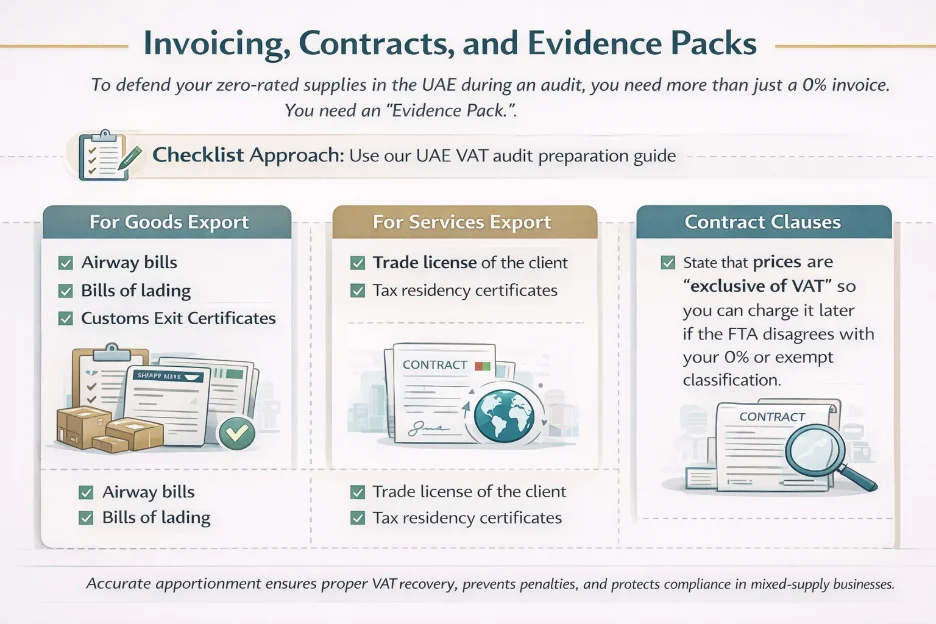
To defend your zero-rated supplies in the UAE during an audit, you need more than just a 0% invoice. You need an “Evidence Pack.” If you want a practical checklist approach, use our UAE VAT audit preparation guide.
- For Goods Export: Airway bills, bills of lading, and Customs Exit Certificates.
- For Services Export: Proof that the recipient is outside the UAE (Trade license of the client, tax residency certificates).
- Contract Clauses: Ensure your contracts state that prices are “exclusive of VAT” so you can charge it later if the FTA disagrees with your 0% or exempt classification.
VAT Return Reporting
Accuracy in Box 1 and Box 10 of your VAT return is non-negotiable.
- Box 1: Standard-rated supplies.
- All zero-rated supplies.
- Box 10 (on the Input side) / Box 5 (on the Output side)
Errors here are “red flags” for the FTA’s automated risk-scoring systems. If your Box 10 (Exempt) is high, the FTA will look for a corresponding reduction in your Box 10 (Input VAT) recovery.
Penalties, Risk Triggers, and How to Stay Compliant
The FTA does not accept “ignorance of the law” as a defiance. Common risk triggers include:
- Unexpected Refunds: A sudden claim for a large refund often triggers a request for evidence of zero-rated supplies.
- Inconsistency: Differences between Customs data and VAT returns.
- High Exempt Turnover: Reclaiming 100% Input VAT while reporting high vat exempt income.
If you operate across multiple tax and compliance obligations (VAT, Corporate Tax, ESR/UBO, AML), align your approach under a single governance umbrella: UAE tax and compliance advisory.
Internal Controls Checklist
- Do we have Customs Exit Certificates for every export?
- Is our apportionment formula for partial exemption compliant with the standard method or approved by the FTA?
- Are we charging 5% on “administrative fees” in financial transactions?
- Have we reviewed the “3-year rule” for our residential properties?
How DBTA Can Help
Dubai Business and Tax Advisors (DBTA) provides specialised, high-stakes VAT consultancy for businesses navigating the complexities of the UAE tax regime. Our services include:
- VAT Classification Audits: Ensuring every SKU and service line is correctly categorised as standard, zero-rated, or exempt.
- Partial Exemption Calculations: Designing and implementing FTA-compliant apportionment methods.
- FTA Audit Representation: Defending your tax positions with senior-level expertise.
- Voluntary Disclosures: Correcting past errors in UAE vat exemptions reporting to minimise penalties.
- Customs & VAT Integration: Ensuring your logistics documentation supports your 0% tax claims.
Conclusion
The distinction between UAE vat exemptions and zero-rated supplies is the difference between a tax-efficient operation and a business at risk of insolvency through penalties. While the “0%” rate offers the benefits of the VAT system without the cost to the consumer, “exempt” status requires careful management of non-recoverable tax.
As the UAE’s tax environment matures, the FTA’s scrutiny of these classifications only intensifies. Businesses must move beyond basic bookkeeping and embrace a rigorous, specialist-led tax strategy.
Would you like us to conduct a preliminary VAT classification review of your top five revenue streams to ensure you aren’t missing out on Input VAT recovery?
FAQ's:
The primary UAE vat exemptions include certain financial services, residential real estate leases (and sales after 3 years), bare land, and local passenger transport.
Zero-rated supplies in the UAE are taxable supplies where the Rate is 0%. Includes exports of goods/services, international transport, eligible healthcare, education, and the first supply of residential buildings.
The difference between zero-rated and exempt supplies is recovery. You can reclaim Input VAT on zero-rated supplies; you cannot exempt supplies.
Leasing is vat exempt. Sales are zero-rated if they are the first supply within 3 years of completion; otherwise, they are exempt.
No. Most free zone companies must register and charge VAT if they exceed the thresholds, especially for services.
No. Are bank charges VAT exempt? Standard fees for services are 5%. Only the margin/interest component of banking is exempt.
Generally, not. Most safety equipment is standard-rated at 5% unless it falls under a specific zero-rated healthcare category or is being exported.
Exporters, international airlines, and healthcare providers benefit from zero-rating. Financial institutions and residential landlords must manage the costs of UAE vat exemptions.
They create “hidden costs“ because Input VAT cannot be reclaimed, often leading to higher prices for the end consumer or lower margins for the business.
Yes. Zero-rated supplies UAE VAT contribute to the registration threshold and must be reported on every VAT return.
Latest news & articles
About the Author:
AURANGZAIB CHAWLA
As CEO of DBTA, Aurangzaib Chawla advises globally mobile businesses and individuals on cross-border tax planning and structuring. With expertise spanning the UK, UAE, and wider GCC, Zaib helps clients minimise double taxation, protect assets, and achieve long-term financial efficiency while staying fully compliant.
Planning to launch in Dubai or the UAE?
Let’s talk about how to structure your business for growth the smart, compliant, and tax-efficient way

About the Author:
AURANGZAIB CHAWLA
As CEO of DBTA, Aurangzaib Chawla advises globally mobile businesses and individuals on cross-border tax planning and structuring. With expertise spanning the UK, UAE, and wider GCC, Zaib helps clients minimise double taxation, protect assets, and achieve long-term financial efficiency while staying fully compliant.
Planning to launch in Dubai or the UAE?
Let’s talk about how to structure your business for growth the smart, compliant, and tax-efficient way
About the Author:
AURANGZAIB CHAWLA

As CEO of DBTA, Aurangzaib Chawla advises globally mobile businesses
and individuals on cross-border tax planning and structuring. With expertise spanning the UK, UAE, and wider GCC, Zaib helps clients minimise double taxation, protect assets, and achieve long-term financial efficiency while staying fully compliant.
Planning to launch in Dubai or the UAE?
Let’s talk about how to structure your business for growth the smart, compliant, and tax-efficient way.
Connect with Reliable Dubai Business Consultants
Get in Touch