
Introduction
You’ve seen the ads. “Start your Dubai free zone company from AED 5,999.” It sounds simple. It sounds cheap.
Then you start the actual process.
By the time you add visas, office fees, company cards, health cover, and bank setup, AED 5,999 can jump to AED 25,000 or more. Sometimes much more.
Most guides won’t tell you this upfront. The advertised price is almost always just the licence fee, not the full free zone business setup cost. It doesn’t include everything you need to legally run a business, so if you budget based on that figure alone, you’re likely to face unexpected expenses.
This guide breaks down the full cost. Every layer, every hidden fee, and every zone worth looking at.
Why the Advertised Price Isn’t the Real Price
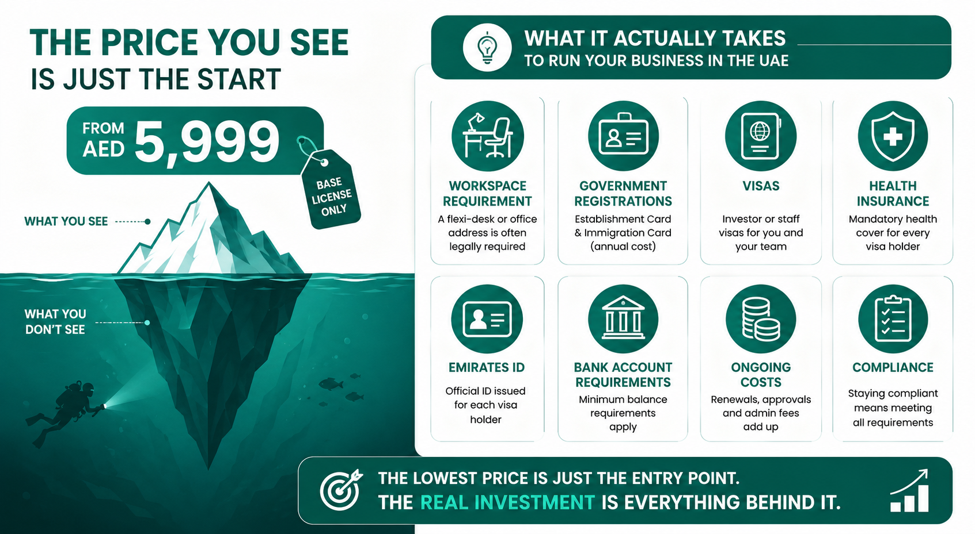
Free zones compete for business. So, they show the lowest price they can. That number usually covers one thing: the base trade license for zero visas and no desk.
But you need more than that. Here’s what most packages leave out:
- A flexi-desk or office address (often required by law)
- An establishment card and immigration card (about AED 3,000 per year)
- Investor or staff visa fees
- Health cover for each visa holder
- Emirates ID fees
- Bank account minimum balances
None of these are extras. They’re part of doing business in the UAE.
So, treat “from AED 5,999” as the floor, not the total.
Dubai Free Zone Business Setup Cost: Full Breakdown
Here are the real cost layers. These figures are based on current market data. Always check with your chosen zone before you commit.
License Fee
This is the main annual fee that makes up a significant part of your free zone business setup cost, giving you the legal right to operate your business within the free zone.
Service firms pay roughly AED 14,000 to AED 18,000 per year. Trading firms pay AED 20,000 to AED 40,000. Premium zones like DMCC start higher.
On a tight budget? Some northern UAE zones start from AED 4,888 for a zero-visa license.
Free Zone Office Cost Dubai
Every free zone needs you to have a registered address. Your main choices are:
Virtual or smart office: AED 3,000 to AED 7,000 per year. Gives you a mailing address but no physical desk. Some zones won’t let you get visas under this option.
Flexi-desk: AED 5,000 to AED 15,000 per year. A shared desk you can use in business hours. Most zones allow one to three visas with this option.
Private office: AED 25,000 to AED 50,000+ per year. Gives you your own space and a higher visa quota.
Start with a flexi-desk. Upgrade only when you need more visas or staff on-site.
Free Zone Visa Cost Dubai
Each visa adds real cost. A standard two-year investor or staff visa in Dubai runs AED 4,500 to AED 7,000. That includes the entry permit, medical test, Emirates ID, health cover, and visa stamp.
Two visas means AED 9,000 to AED 14,000 on top of your other costs.
See the full employee visa cost in UAE to know what each step costs.
Establishment Card and E-Channel Fees
Before you can sponsor any visa, your company needs an establishment card (about AED 1,500 per year) and an immigration card (about AED 1,500 per year). That’s around AED 3,000 per year in total. It applies no matter how many visas you have.
Health Insurance
Health cover is not optional in Dubai. Every visa holder must have it. Basic plans start at AED 1,000 to AED 2,000 per year. If you’re over 45 or want good hospital coverage, expect AED 3,000 to AED 6,000 per year per person.
Bank Account Costs
Opening a business bank account in a UAE free zone is harder than most people think. Banks don’t charge a big setup fee. The hidden cost is the minimum balance rule.
You may need to keep AED 25,000 to AED 250,000 sitting in the account. That money is locked up and not free to use. Some digital banks have lower limits.
Picking a zone with formal bank tie-ins (IFZA and Meydan both have these) gives you a better shot at quick approval.
Read the full guide on UAE bank account opening requirements before you pick your zone.
What Does a Realistic Total Look Like?
Here’s a working estimate of the total Dubai free zone business setup cost for one founder running a service business with one visa:
| Cost Item | Estimated Range (AED) |
|---|---|
| Trade license fee | 12,900 to 20,000 |
| Flexi-desk / office | 7,000 to 15,000 |
| Investor visa (one person) | 4,500 to 7,000 |
| Establishment and immigration cards | 3,000 |
| Health insurance | 1,500 to 3,000 |
| Total Year 1 | 28,900 to 48,000 |
Two founders with a small office and two visas? The total can hit AED 50,000 or more in year one.
That’s not a scam. It’s just what it actually costs when you count every item. See the detailed company registration cost in Dubai breakdown for more.
Cheapest Free Zone UAE: A Side-by-Side Look
Not every zone charges the same. Here are the top budget picks.
Ajman Free Zone (AFZ)
License from about AED 4,888 to AED 5,000 (no visa). One of the lowest starting prices in the UAE. Good for low-budget setups. Bank account approval can be harder than with Dubai zones.
Sharjah Media City (SHAMS)
Freelancer permits from AED 5,750. Supports 1,500+ business types. No desk needed for some packages. Great for digital and solo businesses.
RAKEZ (Ras Al Khaimah Economic Zone)
License from AED 6,000. Strong for trade, making goods, and logistics. Lower cost than most Dubai zones. Good port access.
Meydan Free Zone
License from AED 12,500. Based in Dubai. Fast to set up. Has direct links with certain banks, which makes account opening easier. Good for startups that want a Dubai address.
IFZA (International Free Zone Authority)
License from AED 12,900. Supports 800+ activities. Sits in Dubai Silicon Oasis. From September 2025, IFZA requires annual audited accounts. That adds AED 3,000 to AED 8,000 per year.
Dubai South
Between Al Maktoum Airport and Jebel Ali Port. A “pay-as-you-grow” model. Suits logistics and online retail firms.
Want a Dubai address on a smaller budget? Go with Meydan or IFZA. Want the lowest possible cost and don’t need a Dubai address? Look at Ajman, SHAMS, and RAKEZ first.
One thing to note in any free zone license comparison: the lowest license fee does not always mean the lowest total cost. A zone that’s AED 3,000 cheaper on the license but lacks bank ties can end up costing you more in time and stress.
Explore your full set of options through our Dubai free zone company formation service page.
Free Zone vs Mainland: Which Costs More?
Mainland setup in Dubai used to need a local sponsor with 51% shares. Many activities now allow full foreign ownership on the mainland too.
Mainland costs in year one often run AED 30,000 to AED 40,000 or higher. Free zones tend to be cheaper to start. But free zone firms have had limits on direct sales to UAE mainland clients. That rule has been partly relaxed, but some limits still apply.
If your clients are mostly abroad or your business runs online, a free zone is often the smarter and cheaper pick. Read more on Dubai mainland company formation to compare.
Free Zone Bank Account Requirements
This is where most setup plans fall apart.
Banks in the UAE check your business type, your zone, your home country, your planned deals, and your business plan. They reject a lot of first-time applicants.
Common reasons banks say no:
- Vague or broad activity codes like “general trading”
- No clear business plan or real invoices
- Zones with weak bank ties
- Activities that look risky to bank compliance teams
To lift your chances:
- Pick a zone with named bank partners
- Write a clear business plan with real projected deals
- Keep your activity codes tight and specific
- Have proof of where your funds come from
Allow four to twelve weeks for bank approval. It can be quicker, but don’t rely on it.
Free Zone Business Setup Checklist
Before you apply, make sure you have all of this ready:
- Passport copy (at least six months valid)
- Passport-size photos
- Proof of home address
- Business plan (needed for the bank and often for the license)
- Chosen business activity and license type
- Three company name choices
- Budget for license, office, visas, and banking
- Clear idea of how many visas you need in year one
Missing any of these slows things down. Licensing and PRO services support helps you catch gaps before they cost you time and money.
Free Zone Business Setup Timeline
Here’s what a normal setup looks like day by day:
- Days 1 to 3: Send in your form and documents to the free zone.
- Days 3 to 7: Name and initial approvals come back. Some zones do this in a day.
- Days 7 to 14: License issued. You get your trade license and company card.
- Weeks 2 to 4: Apply for your investor visa. Entry permit, medical, Emirates ID, and stamp each happen in turn.
- Weeks 4 to 12: Bank account applied for and approved.
Most founders are up and running within four to eight weeks of their first document. Banking is the one part that can stretch it to three months.
Free Zone License Renewal Cost
Your license needs to be renewed each year. The good news: renewal is less than setup because you skip the one-time fees like MOA drafting.
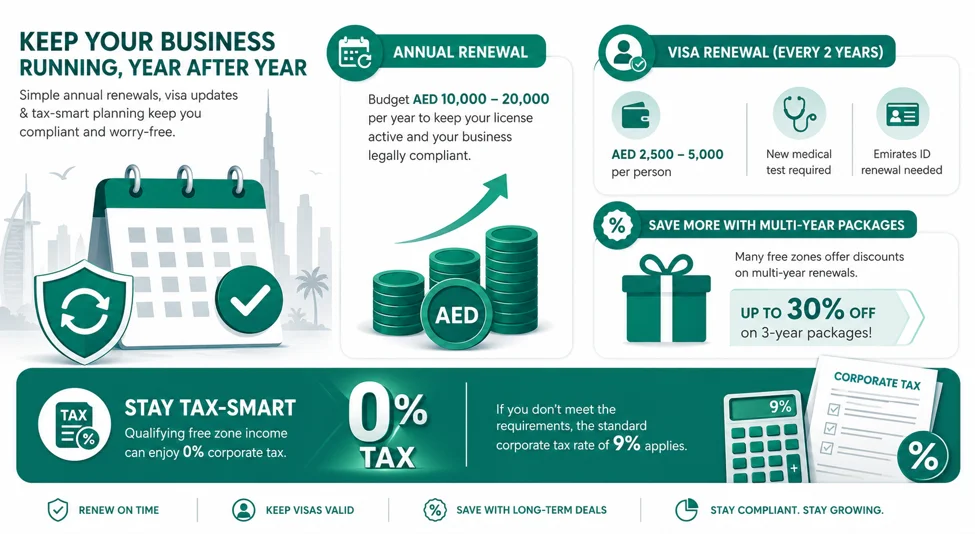
Expect to pay AED 10,000 to AED 20,000 per year for renewal. Visa renewal (every two years) costs AED 2,500 to AED 5,000 per person and needs a new medical test and Emirates ID.
Many zones offer multi-year deals. IFZA has offered up to 30% off for three-year packages. If you’re sure about your zone, it may be worth locking in.
Also plan for UAE corporate tax rules. Free zone firms can pay 0% tax on income that meets the criteria. But if you don’t meet the rules, the 9% rate kicks in.
Who Has a Harder Time With the Standard Path
Free zone setup isn’t equally smooth for everyone. These are the groups that face the most friction.
New owners with no trading history.
Banks want to see past deals, invoices, or some kind of track record. A brand-new firm with no revenue faces more checks.
Founders from certain countries.
Some home countries trigger extra review steps. This doesn’t block your setup, but it takes longer.
Businesses with wide activity codes.
“General trading” sounds flexible. Banks see it as a red flag.
Those who pick the cheapest zone without checking banking.
Ajman and some Sharjah zones are fully legal but can be tough for mainstream UAE bank approvals.
Freelancers who think a permit equals a trade license.
It doesn’t. A freelancer permit lets you bill as a person. A trade license lets you run a company, hire staff, and trade under a business name. Know which one you’re getting.
Where Most Founders Trip Up
These are real issues, not made-up ones.
- Surprise fees after you’ve paid. Founders sign up based on a quote, then find out that approvals or extra steps cost more. Always ask for a full itemized quote. Every line.
- Wrong activity code. Picking an activity that doesn’t match your real work creates issues when you bill clients or open a bank account. Each fix costs AED 2,000 to AED 3,000.
- Banking delays that block your business. No bank account means no payments in or out. Some founders wait two to three months. Have a backup plan for the first few months.
- Year two renewal costs that catch you off guard. Many founders only budget for year one. Year two brings license renewal, visa renewal, company card renewal, and health cover renewal. Plan for these from day one.
- Mixing up a freelancer permit and a trade license. They look similar but work very differently. Make sure you know what you’re buying before you pay.
Conclusion
Choosing the wrong free zone, business activity code, or office package can significantly increase your free zone business setup cost, often costing far more to fix than getting expert advice from the start.
Dubai Business and Tax Advisors (DBTA) is an ACCA-qualified team that helps founders with free zone setup, visa processing, bank account opening, and ongoing tax and compliance support.
If you’re also weighing free zone against offshore company formation or a mainland entity, they can map out which structure fits your business model and keeps your costs in check long-term.
Frequently Asked Questions
Ajman Free Zone (NuVentures) starts from about AED 4,888 for a no-visa license. SHAMS starts from AED 5,750 and RAKEZ from AED 6,000.
Some zones offer virtual or smart office options with no physical desk. Not all allow this. Check with your chosen zone first.
The license usually takes five to fourteen working days. Add two to four weeks for the investor visa. Bank approval can take four to twelve weeks.
It can be. Free zone firms that meet the right criteria pay 0% corporate tax on qualifying income. Income that doesn’t qualify is taxed at 9%. See how VAT registration in the UAE works alongside tax planning.
Rules have been updated, but some limits still apply depending on your activity type. Always confirm with your free zone before you assume you can.
Most banks ask for your trade license, passport, Emirates ID, business plan, source of funds proof, and details of your planned deals.
No. Free zones allow full foreign ownership with no local sponsor needed. That’s one of the main reasons founders choose them.