
UAE Free Zone 0% Corporate Tax: Myth vs Reality | QFZP & Qualifying Income Explained

Recent Insights

Table of Contents
UAE Free Zone 0% Corporate Tax: Myth vs Reality
For many years, establishing a company in a UAE Free Zone was widely viewed as a direct pathway to a tax-free operating environment. This assumption attracted multinational groups, regional trading houses, and emerging businesses that relied on the perceived certainty of zero corporate tax as part of their commercial strategy. That landscape has now evolved. With the introduction of Federal Decree-Law No. 47 of 2022, the UAE has transitioned from a broad tax exemption model to a framework where the 0% corporate tax rate must be earned. The Free Zone regime is no longer automatic; it is conditional, compliance-driven, and aligned with the standards of the OECD and global transparency requirements.
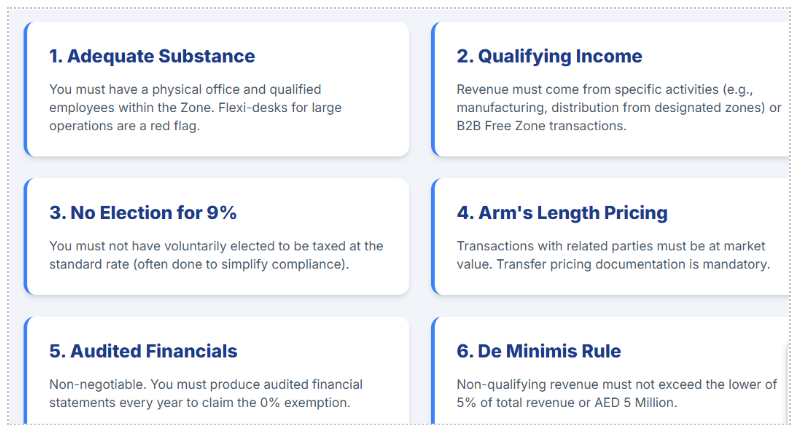
Under this structure, the critical distinction is between a standard Free Zone Person (FZP) and a Qualifying Free Zone Person (QFZP). Only the latter may benefit from the 0% rate, and only where specific criteria are met, including:
- Conducting Qualifying Activities,
- maintaining adequate Economic Substance in the Free Zone,
- remaining within the De Minimis threshold for non-qualifying income, and
- Complying with mandatory audit and documentation obligations.
In effect, the UAE has replaced the concept of an unconditional tax holiday with a model that rewards businesses demonstrating legitimate economic activity and disciplined compliance. The Federal Tax Authority (FTA) now plays an active oversight role, and errors in classification or revenue structure can result in the loss of QFZP status for the current period plus four subsequent years.
For business owners and advisors, the practical question has therefore shifted from “Are we in a Free Zone?” to “Are we operating in a way that qualifies for the 0% Free Zone regime?” This blog examines the current rules, clarifies common misconceptions, and outlines the operational requirements for maintaining QFZP status in 2025–2026.
The Architecture of the New Fiscal Framework
The legislative backbone of the current regime is founded upon the primary Decree-Law, supported by a series of Cabinet and Ministerial Decisions that clarify the application of tax to Free Zone entities. Cabinet Decision No. 55 of 2023 serves as the foundational text defining Qualifying Income, while Ministerial Decision No. 139 of 2023 and the subsequent Ministerial Decision No. 265 of 2023 (which amended Decision 139) delineate the boundaries of Qualifying Activities and Excluded Activities.” This tiered regulatory structure ensures that the UAE Free Zone Corporate Tax incentives are explicitly targeted toward sectors that the government seeks to bolster, such as manufacturing, logistics, and regulated financial services, while preventing the erosion of the tax base from activities that are naturally mainland oriented.
The myth of automatic 0% tax is often the first casualty of an initial consultation. The reality is that every juridical person incorporated in a Free Zone is a “Taxable Person” under the law, regardless of their eventual tax liability. This status mandates an immediate obligation for Corporate Tax Registration, the maintenance of robust accounting records, and the annual filing of tax returns. The 0% rate is not an exemption from the law, but a preferential rate within the law, available only to those who satisfy the cumulative conditions of Article 18 of the CT Law.
| Entity Type | Standard Tax Rate | Applicability of 0% Rate | Compliance Obligations |
|---|---|---|---|
| Mainland LLC | 9% on Profit > AED 375,000 | Only up to the threshold | Registration, Filing, Transfer Pricing |
| Non-Qualifying FZ Person | 9% on Profit > AED 375,000 | Only up to the threshold | Registration, Filing, Transfer Pricing |
| Qualifying Free Zone Person | 0% on Qualifying Income | Unlimited on Qualifying Income | Registration, Audited Financial Statements, Substance |
| Natural Person (Freelancer) | 9% on Net Profit > AED 375,000 (provided turnover exceeds AED 1,000,000) | N/A for Free Zone Benefits | Registration, Record Keeping |
The distinction between the different tiers of taxable persons is essential because the benefits are not uniform. For instance, a QFZP is explicitly denied the benefit of the AED 375,000 tax-free threshold for their non-qualifying income, a benefit that is otherwise available to both mainland companies and Free Zone companies that do not qualify for the preferential regime. This creates a high-stakes environment where a single misstep in income categorization could lead to a significant tax liability that a comparable mainland firm would not face.
The Mandatory Path to QFZP Status
To secure the status of a Qualifying Free Zone Person, an entity must navigate a rigorous set of cumulative conditions. The failure to meet even one of these criteria results in the immediate disqualification of the entity for that tax period and for the subsequent four years, creating a five-year “lock-out” that can be financially devastating.
Economic Substance: Beyond the Virtual Office
The requirement for Economic Substance is perhaps the most misunderstood aspect of the new regime. The FTA requires that a QFZP maintain an adequate local presence, which is evaluated through the lens of Core Income-Generating Activities (CIGAs). This means that the entity must demonstrate that it has enough qualified employees located in the Free Zone and incurs an adequate amount of operating expenditure within the same jurisdiction. The era of the “paper company” or the “shelf entity” used solely for tax shielding is effectively over.
Substance is not a static concept but must be proportionate to the scale and nature of the business. A global trading firm operating out of DMCC or JAFZA will be held to a significantly higher standard of evidence regarding its local payroll and office utility than a specialised holding company. While the law permits the outsourcing of specific activities to a related party or a third party, this is only permissible if the outsourcing takes place within the Free Zone, and the QFZP maintains complete oversight and control over the outsourced functions. The Federal Tax Authority will scrutinise these arrangements during an audit to ensure that the “mind and management” of the business truly reside within the Free Zone.
The Universal Audit Mandate
A significant development in the UAE Free Zone Corporate Tax landscape is the issuance of Ministerial Decision No. 98 of 2023, which mandates that all Qualifying Free Zone Persons must prepare and maintain Audited Financial Statements. This is a critical divergence from the rules governing mainland SMEs, which are generally exempt from audits if their annual revenue falls below the AED 50 million threshold. For a QFZP, the audit is an absolute prerequisite for the 0% rate, serving as the official verification that income has been correctly categorized as “Qualifying” and that the De Minimis Rule has been respected.
The implications for cost and administration are significant. Founders must now budget for external auditors and ensure that their internal bookkeeping is of a standard that can withstand professional scrutiny. The audit is not merely a financial check but a compliance tool that the FTA uses to validate the segregation of revenue streams, particularly when a company has mixed activities involving both Free Zone and mainland clients.
Case Study: How DBTA Helped a DMCC SaaS Start-Up Qualify for 0% in 2025
In early 2025, DBTA was approached by a SaaS firm based in DMCC that assumed its Free Zone license automatically secured the 0% tax rate. After reviewing operations, it became clear that:
- 68% of revenue came from services to mainland UAE customers
- No De Minimis tracking was in place.
- No substance documentation or employee nexus existed.
DBTA Intervention:
| Issue Identified | DBTA Solution | Result |
|---|---|---|
| Mainland revenue was breaching compliance | Structured mainland revenues through a Domestic PE | Parent retained QFZP status |
| No substance evidence | Staff relocation + board meeting schedule implemented | Passed substance review |
| Mixed revenue categories | Monthly De Minimis Monitoring dashboard built | Reduced non-qualifying income from 68% → 3.4% |
Outcome:
The client achieved full QFZP status for 2025 and 2026, securing the 0% rate on qualifying revenue while remaining compliant on mainland sales at 9%.
Deciphering Qualifying Income
The centrepiece of the 0% tax regime is the technical definition of Qualifying Income. Under the guidelines provided by the Ministry of Finance, income is generally classified based on the nature of the transaction and the identity of the counterparty.
- Free Zone to Free Zone Transactions: Revenue derived from transactions with other Free Zone Persons is considered qualifying income, provided that the income does not stem from an “Excluded Activity”. This is the most straightforward pathway to the 0% rate, designed to foster a closed-loop economy within the Free Zone ecosystem.
- Transactions with Non-Free Zone Persons: When a Free Zone entity deals with a mainland UAE company or an international client, the income is qualifying only if it arises from a specific list of Qualifying Activities. If the activity is not on the approved list, the revenue is classified as non-qualifying and is subject to the standard 9% rate.
- Passive and Incidental Income: Certain types of passive income, such as dividends and capital gains from qualifying shareholdings, are exempt or qualifying under specific conditions. Other miscellaneous income can be brought under the 0% rate only if the total non-qualifying revenue remains within the limits of the De Minimis Rule.
The concept of the “Beneficial Recipient” is a vital nuance in these calculations. For a transaction to be considered a “Free Zone to Free Zone” deal, the goods or services must be intended for the use of the Free Zone Person itself, rather than for its branch or permanent establishment on the mainland. A conduit or intermediary arrangement will not pass the FTA’s scrutiny, emphasising that the economic reality of the transaction must match its legal form.
The 2026 Evolution of Qualifying Activities
As of 2026, the UAE has refined the definition of what qualifies for the 0% corporate tax rate in Free Zones. The latest updates (building on Ministerial Decision No. 229 of 2025) target sectors that contribute to high-value economic activity, not passive or low-substance business models.
Only activities that directly support the UAE’s strategic economy can retain the 0% rate, and the rules now focus on proof of value creation, not just licensing.
Core Qualifying Activities in 2026 (with Scope & Conditions)
| Qualifying Activity (2026) | What Now Counts as Qualifying |
|---|---|
| Manufacturing & Processing | Production, conversion, assembly, or component integration inside a Free Zone (e.g., JAFZA, RAKEZ). Must show economic value created locally. |
| Trading of Qualifying Commodities | Metals, energy products, industrial chemicals, and environmental commodities (e.g., carbon credits) with pricing based on a Recognised Price Reporting Agency. Repackaging alone does not qualify. |
| Headquarters Services | Centralised group direction, strategy, and governance. Decision-making must be documented in the Free Zone. |
| Treasury & Intra-Group Financing | Cash pooling, liquidity management, and corporate financing where risk control and decision-making occur within the Free Zone. |
| Regulated Fund / Wealth Management | Supervised by SCA, DFSA, or FSRA. Offshore portfolio management must still demonstrate operational nexus in the UAE. |
| Designated Zone Distribution | Movement of goods from Designated Zones to wholesale/end-users. Incidental retail allowed below operational threshold. |
| Logistics & Supply Chain Services | Storage, consolidation, cold chain, last-mile delivery if centrally directed from the Free Zone. Outsourcing to mainland vendors allowed if control remains within the zone. |
| Aircraft / Asset Leasing | Dry leasing or hybrid structures if economic ownership and risk management sit with the Free Zone entity. |
Key 2026 Change: Commodity Trading Restrictions
To stop companies from disguising normal distribution as commodity trading, the FTA introduced the 51% revenue composition test:
- If more than 51% of revenue comes from distribution, retail handling, or warehousing → loses its qualifying status.
- If most value comes from price-based trading or hedging, → may remain eligible.
This rule directly affects DMCC traders, energy desks, and chemical traders who previously relied on broad classification.
What This Means for Free Zone Businesses in 2026
Holding a license is not enough. To maintain the 0% rate, a business must prove:
- Operational substance in the Free Zone
- Actual decision-making and governance occur there.
- Revenue aligns with the list of qualifying activities.
- Substance matches scale (employees, expenditure, assets)
- Documentation can survive an FTA audit.
The Boundaries: Excluded Activities
While Qualifying Activities provide a path to tax efficiency, Excluded Activities serve as the boundaries that protect the integrity of the mainland tax base. Any income derived from these activities is automatically non-qualifying and, if the de minimis threshold is breached, results in the loss of QFZP status.
- Transactions with Natural Persons: Generally, any B2C transaction is excluded. The UAE government intends for retail sales to individuals to be taxed at the standard rate, with only narrow exceptions for shipping, aircraft leasing, and wealth management. This poses a challenge for e-commerce entities that may have built their model on the assumption of a tax-free environment.
- Banking and Standard Insurance: Regulated banking activities and general life/non-life insurance are excluded to ensure parity with mainland financial institutions, and only regulated reinsurance and specific related-party financing fall under the qualifying list.
- Ownership of Intellectual Property (IP): General exploitation of IP is an excluded activity unless it meets the specific criteria for “Qualifying Intellectual Property” under the Nexus Approach. This is to prevent the simple shifting of intangible assets to Free Zones for tax avoidance purposes.
- Immovable Property (Real Estate): Income from real estate is largely excluded. An entity can only benefit from the 0% rate on income from commercial property located within a Free Zone if the tenant is another Free Zone Person. Residential property income is always excluded and taxed at 9%.
The Mathematics of the De Minimis Rule
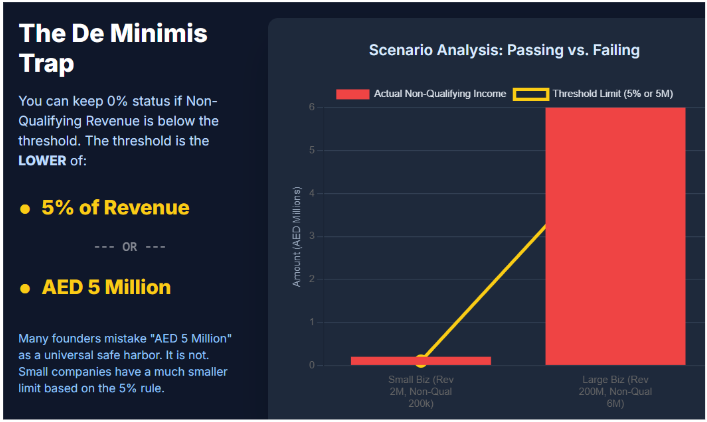
The De Minimis Rule is the most critical calculation for any Qualifying Free Zone Person with mixed income streams. It provides a small tolerance for non-qualifying revenue, but the limits are absolute and unforgiving. To satisfy the requirements, the total non-qualifying revenue earned in a tax period must not exceed the lower of:
- 5% of the total revenue of the entity.
- AED 5,000,000 (Five Million Dirhams).
The “Cliff-Edge” Calculation
For an SME, the 5% threshold is often the limiting factor. For example, a consulting firm in Dubai Silicon Oasis (DSO) with a total revenue of AED 4,000,000 would lose its QFZP status if it earned just AED 200,001 (5%) from mainland clients. Conversely, a massive logistics firm with AED 200,000,000 in revenue is not allowed to have 5% (which would be AED 10 million) of non-qualifying revenue; it is strictly capped at the AED 5,000,000 limit.
| Total Revenue | 5% Threshold | Absolute Cap | Final De Minimis Limit | Status Impact |
|---|---|---|---|---|
| AED 4,000,000 | AED 200,000 | AED 5,000,000 | AED 200,000 | Breach = 5-year 9% tax |
| AED 100,000,000 | AED 5,000,000 | AED 5,000,000 | AED 5,000,000 | Safe if NQR <= 5M |
| AED 500,000,000 | AED 25,000,000 | AED 5,000,000 | AED 5,000,000 | Breach if NQR > 5M |
The “non-qualifying revenue” for this calculation includes income from all Excluded Activities and any revenue from dealing with mainland entities that does not fall under a qualifying activity. However, the law provides a “carve-out” for certain income that is “disregarded” in the de minimis test. This includes income attributable to a Domestic Permanent Establishment (DPE) such as a mainland branch and income from certain immovable property. This segregation is designed to allow a Free Zone entity to operate a mainland branch without that branch’s revenue automatically disqualifying the parent company’s 0% status on its Free Zone-based activities.
The Nexus Approach for Intellectual Property
Under the UAE Free Zone Corporate Tax regime, income from Intellectual Property (IP) can only qualify for the 0 percent rate if it meets the standards of the Nexus Approach, which links tax benefits to genuine research and development activity. This rule aligns the UAE with global BEPS requirements and prevents the use of free zones solely for passive IP holding.
Only Qualifying Intellectual Property (QIP) is eligible, and the definition is narrow: typically, patents, copyrighted software, and similar assets created through real R&D. Simply owning or licensing IP is not sufficient. The free zone entity must prove that it funded or performed the development work or outsourced it to unrelated third parties in a compliant manner.
The portion of income that can stay at 0 per cent depends on how much qualifying R&D the business undertakes. Acquired IP, work outsourced to related parties, or minimal R&D activity generally reduces the benefit and may result in the income being taxed at the standard 9 percent rate.
For tech businesses in free zones like Dubai Internet City or Sharjah Research Technology and Innovation Park, the message is clear: Free Zone entity must prove that it funded… the 0% rate is tied to real development 9% rate, not passive ownership. If the link between the IP and R&D cannot be demonstrated, the preferential rate is lost.
Case Study: DBTA Reclassified a Trading Company’s Structure to Avoid Losing QFZP Status
A commodity trading company operating in RAKEZ faced imminent disqualification after its auditors flagged a De Minimis breach. 54% of its revenue came from warehousing and retail-style distribution, triggering the 51% rule for commodity traders.
What We Discovered:
- The firm’s license was qualified, but its operational behaviour was not.
- Revenue tagging didn’t separate trading vs distribution income.
- triggering the de minimis threshold for commodity traders
- They were unknowingly breaching the non-qualifying revenue limit.
DBTA Corrective Action:
- Re-engineered invoicing to separate qualifying & non-qualifying streams
- Implemented the High Seas Sales routing model for foreign-to-foreign trades
- Registered a regulated branch for mainland distribution to isolate risk
Results in 90 Days:
- Distribution income moved to DPE (taxed at 9%)
- Free Zone entity restored to 97% qualifying revenue
- QFZP status preserved with written confirmation post-audit
Dubai Business and Tax Advisors prevented a 4-year lockout from the 0% regime, saving the business an estimated AED 2.3M in corporate tax exposure.
Strategic Challenges for Distribution and Logistics
The rules for Designated Zones create unique logistical challenges for trading firms. To benefit from the 0% rate on the distribution of income, the goods must physically pass through the Designated Zone if they are being imported into the UAE. If a company based in JAFZA (a Designated Zone) arranges for goods to be imported via a non-designated port (such as a standard airport or a different Emirate’s port) and delivered directly to a mainland customer, that income will likely be non-qualifying.
However, the “High Seas Sales” model is a welcome inclusion. If a Free Zone company buys goods in one foreign country and sells them to another foreign country without the goods ever entering the UAE, this is considered a qualifying distribution activity. This provides a significant advantage for UAE-based global trading hubs that manage cross-border flows that never touch domestic soil.
The Impact of the Domestic Permanent Establishment (DPE)
Many Free Zone companies operate mainland branches to serve local customers. Under the UAE Free Zone Corporate Tax Law, this branch is treated as a Domestic Permanent Establishment. The income of the DPE is calculated as if it were a separate and independent person and is subject to the standard 9% tax rate.
The critical takeaway for SMEs is that while the branch’s income is taxed at 9%, it does not “taint” the 0% status of the parent Free Zone entity for its other qualifying activities, provided separate books of accounts are maintained. This allows businesses to use a “dual-zone” model: keeping international and Free Zone-to-Free Zone trade in the parent entity at 0%, while funneling mainland sales through the DPE at 9%.
Compliance Deadlines and Administrative Penalties
The Federal Tax Authority has established a strict timeline for Corporate Tax Registration and filing. For companies licensed before March 1, 2024, the registration deadlines were staggered throughout 2024 based on the month of license issuance.
For new entities incorporated on or after March 1, 2024, the registration deadline is strictly three months from the date of incorporation. Once registered, the first tax return must be filed within nine months of the end of the financial year. For companies following the standard calendar year (ending December 31, 2024), the first tax return is due by September 30, 2025. The penalties for non-compliance are severe. In addition to the AED 10,000 late registration fine, the FTA can impose substantial penalties for late filing and late payment. For a QFZP, the most significant penalty remains the loss of the 0% rate for five years, which can turn a high-margin business into a struggling one overnight.
Strategic Decision-Making: QFZP or Not to QFZP?
For many SMEs, the path to 0% may not be the most tax-efficient route. The high cost of Audited Financial Statements, combined with the inability to benefit from the AED 375,000 tax-free threshold or the Small Business Relief (SBR) may make the standard 9% regime more advantageous.
The Small Business Relief (SBR) Alternative
Under Article 21 of the CT Law, a UAE resident business with an annual revenue of less than AED 3 million can elect to be treated as having “no taxable income” until the end of 2026. This is a more straightforward, non-audit-required pathway to 0% tax. However, a QFZP is explicitly disqualified from SBR.
A Free Zone SME must therefore choose:
- Maintain QFZP Status: Beneficial if profits are high and activities are strictly qualifying. Requires an audit and a physical substance.
- Elect for Standard 9% Taxation: This allows the business to claim SBR (0% tax on revenue up to AED 3 million) or the AED 375,000 profit threshold. This is often the more brilliant play for small consultancies or e-commerce traders that do not want to incur audit costs or risk the de minimis cliff.
Practical Compliance Checklist for 2026
For businesses aiming to maintain QFZP status, tax compliance is no longer reactive; it must be continuous and documented. The following checklist reflects the requirements as of 2026, based on the current Corporate Tax Law and the latest guidance building on Ministerial Decision No. 265 of 2023.
Revenue Mapping
Map every revenue stream against the list of qualifying, non-qualifying, and excluded activities, ensuring classification aligns with the latest 2026 guidance.
Substance Audit
Maintain evidence of operational substance: full-time staff in the Free Zone, active lease agreements that reflect real operations, and documented oversight of outsourced functions.
Transfer Pricing Documentation
Apply the Arm’s Length Principle for cross-border or related-party transactions, preparing Local and Master File documentation if turnover thresholds are met.
Audit Engagement
Appoint an FTA-registered auditor early in the financial year. Audited Financial Statements are mandatory for QFZPs; they verify income classification and De Minimis compliance.
De Minimis Monitoring
Track non-qualifying revenue monthly, ensuring it does not exceed the lower of 5% of total revenue or AED 5,000,000.
Corporate Tax Administration
Register with the FTA (if not already), file annual returns within 9 months of the financial year-end and maintain supporting documents for 7 years.
How DBTA Helps Free Zone Businesses Qualify for the 0% Rate
The UAE’s 0% Free Zone Corporate Tax regime is achievable, but only for businesses that structure, classify, and operate correctly. Dubai Business and Tax Advisors Support founders and SMEs by building compliance systems that protect the benefit rather than risking accidental disqualification.
What DBTA Does
QFZP Eligibility Check
We review your license, revenue sources, activities, and substance to confirm if you can realistically qualify for the 0% rate before you commit.
Structure That Works in Practice
If needed, we design a compliant setup (Free Zone + Domestic PE / high-seas routing/qualifying activity alignment) to support the 0% regime without triggering the De Minimis breach.
Revenue Classification & De Minimis Control
We tag revenue as qualifying vs non-qualifying, set monthly thresholds, and build controls so you never cross the 5% or AED 5M rule by accident.
Audit & Filing Ready
We manage the mandatory audit, prepare the tax return, and create documentation that can withstand FTA review.
Client testimonial:
“DBTA dismantled our assumption that a Free Zone license equals automatic 0% tax. Their restructuring avoided a De Minimis breach that would have cost us four years of preferential status. We now have a compliant setup, monthly monitoring, and clear confidence going into 2026. Easily the most pragmatic tax advisors we’ve worked with.”
— CFO, Commodity Trading Firm (DMCC)
Conclusion
The “Myth vs Reality” of the UAE Free Zone Corporate Tax is a journey from the simplicity of the past to the complexity of a modern, regulated global economy. The UAE continues to offer one of the most attractive tax environments in the world, but the 0% rate is now a reward for excellence in compliance and transparency. For founders and SMEs, the message is clear: the status of a Qualifying Free Zone Person is a valuable asset that must be protected through meticulous record-keeping and strategic planning. By understanding the interaction between Qualifying Income, De Minimis Rules, and the universal audit mandate, businesses can ensure that their operations remain sustainable and profitable in the new fiscal era. The “reality” may be more challenging than the “myth,” but for those who navigate it correctly, the benefits remain unparalleled on the global stage.
FAQ's:
Not automatically. You must meet the legal criteria under Article 18, perform a Qualifying Activity, maintain substance in the Free Zone, stay within the De Minimis limits, and avoid Excluded Activities. Licensing alone is not enough.
A QFZP must:
- Perform qualifying activities
- Maintain operational substances in the Free Zone.
- Keep non-qualifying income within the De Minimis Rule.
- Prepare audited financial statements.
- Comply with transfer pricing requirements (if applicable)
The calculation is strictly based on gross revenue (turnover). Expenses and net profit margins do not influence the 5% or AED 5M thresholds.
Qualifying income is revenue that meets the legal criteria for the 0% Free Zone corporate tax rate. In practice, this usually includes:
- Income from Qualifying Activities carried out in the Free Zone.
- Transactions with other Free Zone Persons provided that the activity is not excluded.
- Certain foreign-source income, such as income from the ownership or exploitation of Qualifying Intellectual Property (subject to Nexus Approach) or services provided to non-residents that constitute Qualifying Activities.
- Passive income like dividends, capital gains, and royalties from qualifying shareholdings or compliant IP structures
Income from mainland UAE or excluded activities is generally taxed at 9%, unless it meets specific qualifying conditions or falls within the De Minimis limits.
Excluded activities include retail to individuals (B2C), banking, most insurance, non-qualifying IP income, and income from UAE real estate. These are taxed at 9% and count toward the De Minimis limit.
Yes, but only for qualifying activities and under specific structures. If the income relates to non-qualifying activities, it is taxed at 9%, and too much mainland revenue can breach the De Minimis Rule.
A QFZP can earn some non-qualifying income, but it must not exceed the De Minimis threshold, which is the lower of:
- 5% of total revenue, or
- AED 5,000,000 in a tax period.
If non-qualifying income goes above this limit, the business immediately loses QFZP status for that tax period and the next four consecutive years, meaning all income becomes taxable at 9% during that time.
Yes. A breach triggers a 5-year lockout from the preferential regime. The company moves entirely to 9% taxation during that period.
Yes. Audited financial statements are mandatory for QFZPs, even if turnover is low. They validate income classification, De Minimis compliance, and substance.
Yes. If related-party transactions exist, the Arm’s Length Principle applies. Documentation, such as Local Files and Master Files, may be required depending on thresholds.
A Domestic PE is a mainland branch or activity of a Free Zone entity. The PE’s income is taxed at 9%, but it does not automatically disqualify the Free Zone parent from keeping 0% on qualifying income.
Yes, if the branch’s income is isolated, its books are separate, and the Free Zone entity still meets all QFZP requirements.
Foreign branch income may be exempt or qualifying depending on structure and source, but supporting documentation is required. Classification depends on operational and jurisdictional conditions.
Yes. It is common for Free Zone companies to have a mix of qualifying (0%) and non-qualifying (9%) income, provided revenue is correctly categorised and reported.
Yes. This can be beneficial for SMEs who need access to Small Business Relief, want to avoid audit costs, or whose activity mix makes QFZP status impractical.
Maintain:
- Audited financial statements
- Revenue classification schedules
- Substance evidence (staff, leases, governance records)
- Transfer pricing files (where relevant)
- Contracts and invoices are segregated by activity type.
- De Minimis monitoring reports
Yes. This can be beneficial for SMEs who need access to Small Business Relief, want to avoid audit costs, or whose activity mix makes QFZP status impractical.
Latest news & articles


About the Author:
AURANGZAIB CHAWLA
As CEO of DBTA, Aurangzaib Chawla advises globally mobile businesses and individuals on cross-border tax planning and structuring. With expertise spanning the UK, UAE, and wider GCC, Zaib helps clients minimise double taxation, protect assets, and achieve long-term financial efficiency while staying fully compliant.
Planning to launch in Dubai or the UAE?
Let’s talk about how to structure your business for growth the smart, compliant, and tax-efficient way

About the Author:
AURANGZAIB CHAWLA
As CEO of DBTA, Aurangzaib Chawla advises globally mobile businesses and individuals on cross-border tax planning and structuring. With expertise spanning the UK, UAE, and wider GCC, Zaib helps clients minimise double taxation, protect assets, and achieve long-term financial efficiency while staying fully compliant.
Planning to launch in Dubai or the UAE?
Let’s talk about how to structure your business for growth the smart, compliant, and tax-efficient way
About the Author:
AURANGZAIB CHAWLA

As CEO of DBTA, Aurangzaib Chawla advises globally mobile businesses
and individuals on cross-border tax planning and structuring. With expertise spanning the UK, UAE, and wider GCC, Zaib helps clients minimise double taxation, protect assets, and achieve long-term financial efficiency while staying fully compliant.
Planning to launch in Dubai or the UAE?
Let’s talk about how to structure your business for growth the smart, compliant, and tax-efficient way.
Connect with Reliable Dubai Business Consultants
Get in Touch