
Offshore Company Registration in Dubai: Tax-Efficient Structures for Global Owners

Recent Insights

Table of Contents
International trade and wealth management have changed a lot in the last few years. It is no longer enough to just find a low-tax country. You need a place with real legitimacy, strong infrastructure, and a legal system you can trust. For many business owners, offshore company registration in Dubai has become a top choice for protecting assets while keeping global freedom of movement.
The UAE has moved well past its old image as a simple tax haven. It is now a well-regulated financial hub that sits between a strict onshore system and a pure offshore one. You can still get the core tax benefits, but setting up and staying compliant now takes more care and more professional support than it used to. Setting up an offshore company in Dubai is not just about filing some forms. It is a decision that should match your business goals with UAE federal rules.
Who offshore companies are for
Offshore setups in the UAE are built for non-resident activity. Say you are an international consultant. Your clients are spread across London, Singapore, and New York. Or maybe you are an investor who wants a holding company for a global portfolio. If so, this option is usually a good fit.
It gives you a presence in a stable, dollar-pegged economy. And you get this without the cost of renting a physical office.
But this setup is not right for everyone. If you plan to do any physical business inside the UAE, skip it. Maybe you want to sell goods to shops in Dubai. Or hire a team to work from a local office. In either case, an offshore company will not work for you.
One more thing to know. These entities do not come with UAE residency visas. If you want to live in the country, look at a Free Zone or Mainland setup instead.
Benefits and limits
There is a clear trade-off here. You save on setup costs. But you give up the right to trade locally.
The benefits are real. You get a tax-free company structure. You also get full ownership as a foreign national, with no local partner needed. On top of that, you get strong privacy protection for your assets.
The limits are just as real, though. You cannot rent a physical office, only a registered address. You cannot get a residency visa for yourself or your staff. And opening a UAE bank account is harder for an offshore company than for a mainland one.
Offshore vs Free Zone vs Mainland vs SPV
When picking a structure, ask yourself one simple question. Where does my value come from?
- Your value is created outside the UAE. You just need a safe place to hold it.
- Free Zone. Your income is global, but you want to live in Dubai and have office space.
- Your income comes from selling directly to people living in the UAE.
- SPV in ADGM or DIFC. You hold high-value assets or property, and you prefer the English common law system.
What an offshore company can and cannot do
An offshore company in Dubai is a UAE entity. But it cannot do business inside the UAE. It can sign contracts with international partners. It can open bank accounts at home and abroad. It can also hold shares in other firms.
What it cannot do matters just as much. It cannot rent an office. It cannot bring goods into the local market. And it cannot offer services to UAE residents.
When a Free Zone company fits better
Think of a Free Zone company as the middle ground. You keep full ownership, just like offshore. But you also get the right to rent office space. You can apply for residency visas too.
Do you plan to spend more than half the year in Dubai running your business? If so, a Free Zone setup usually works better. It brings you into the UAE tax residency system.
When a Mainland company is required
Some businesses happen on the ground. Think restaurants, construction, or local delivery. If that sounds like you, you need a Mainland license.
Offshore setup costs are lower, sure. But only a Mainland license lets you trade anywhere in the country. It is also the only one that lets you bid on government contracts, since other structures are closed off from those.
When an SPV beats offshore for holding assets
Special Purpose Vehicles, or SPVs, are set up in financial centres like ADGM in Abu Dhabi and DIFC in Dubai. Many see them as the gold standard for holding assets.
Unlike a standard offshore company, an SPV runs under common law. This makes it popular for estate planning. Investors from the UK or US often like it too, since they feel more comfortable with a legal system they already know.
A simple way to choose
- Want residency? Go Free Zone or Mainland.
- Want to trade locally? Go Mainland.
- Want to hold assets or invoice clients around the world? Go offshore.
- Want to plan an estate or hold complex property? Go with an ADGM or DIFC SPV.
Best Jurisdiction for an Offshore Company
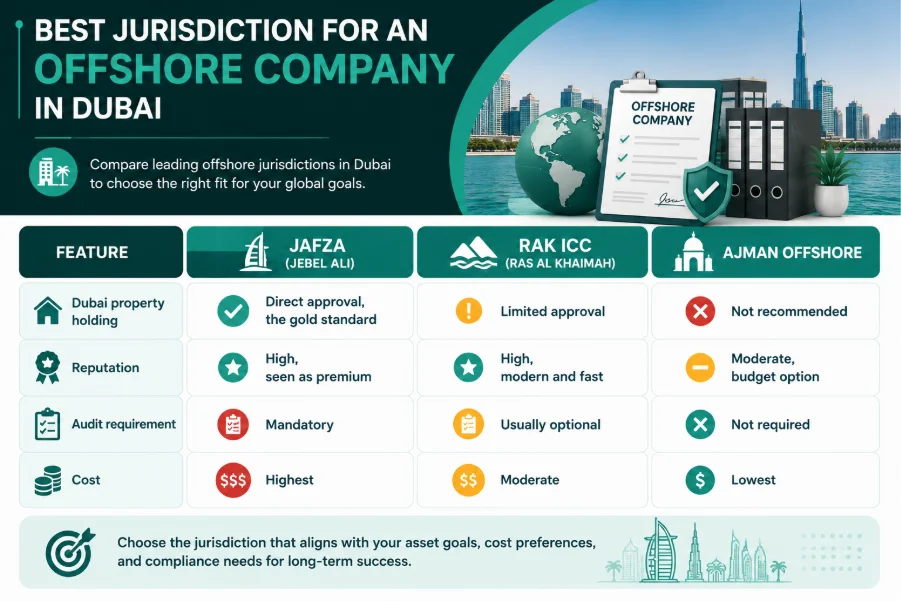
Comparing JAFZA, RAK ICC, and Ajman offshore
Picking the right jurisdiction comes down to one thing. What kind of assets do you plan to hold?
Requirements by jurisdiction
Most jurisdictions ask for similar paperwork. You must use a registered agent. The registries do not deal directly with the public.
You will need a clear business profile. You will also need a passport copy and a recent utility bill. Here is something worth knowing. The cheapest jurisdiction often turns out to be the costliest choice later, if it does not meet your banking needs.
JAFZA runs deeper background checks. It often asks for a bank reference too. RAK ICC, on the other hand, tends to be faster and more digital.
Picking a jurisdiction by use case
For property holding, JAFZA is still your best bet. It is the only offshore option fully recognised by the Dubai Land Department for owning property in freehold areas.
For a holding company, RAK ICC is usually the most flexible pick. It allows different share classes. It also makes it simple to move an existing offshore company into the UAE.
For general international business, many people choose Ajman. It works well for a basic, low-cost setup, especially when you just need a legal entity for consulting work abroad.
What Tax-Efficient Really Means
The practical outcome for global owners
A tax-efficient offshore company in Dubai is not about hiding money. It is about smart, legal planning.
It lets you gather your global income in a 0% tax setting. You only pay tax in the countries where your business has a real operating presence. Or where you personally count as a tax resident.
What the Tax Benefits Cover
The tax benefits are straightforward. You get 0% corporate tax. You get 0% capital gains tax. And there is no withholding tax on dividends.
That said, some marketing skips over one key detail: the Common Reporting Standard. The UAE does share financial data with your home country’s tax authorities. So, the tax benefit inside the UAE is real. But your reporting duties back home do not just disappear.
Zero tax versus the corporate tax rules
The UAE introduced a 9% federal corporate tax. It took effect for financial years starting on or after 1 June 2023.
Even so, a properly structured offshore company usually stays outside that tax net. Why? Because it counts as a non-resident entity that does not do business inside the country. Most offshore firms pay 0% tax on foreign earnings, if they have no physical presence or management activity on the mainland.
When the tax exemption applies
The offshore tax exemption works well for passive income. Think dividends and interest. It also works for trade done outside the UAE.
But it does not apply if the company earns money from a UAE source. Say you rent out a Dubai apartment. That kind of income can fall under UAE tax rules, though certain thresholds apply.
Risk flags to watch for
Watch out for controlled foreign corporation rules in your home country. Say you run your Dubai company from your living room in London. UK tax authorities could argue the company is a UK tax resident.
This is exactly why you need advice on where your company is truly managed from. It matters more than most people expect.
Privacy and Compliance
What privacy actually protects
The UAE offers strong privacy for offshore companies. Your name will not show up in public company searches or web databases.
But full anonymity is a thing of the past. Both UAE authorities and your bank will always have full access to your identity and details.
Keeping your ownership records updated
Every offshore firm must keep a register of its ultimate beneficial owners. You must file this with the registrar.
If your shareholders change, act fast. You have 15 days to update that record. Miss this window, and you could face heavy fines.
Records you need to keep
You usually will not have to publish public audits, unless you are set up in JAFZA. Even so, you still have reporting duties.
You must keep clear accounting records. If the Ministry of Economy runs a spot check, you need to show your transactions are legitimate.
Common compliance risks
The most common risk is simple: letting your license expire. If you miss your renewal fees, the company gets struck off.
This usually freezes your bank account right away. And fixing it can take months of legal work.
The Registration Process
Step by step
- Pick an agent. You must use an authorised registered agent.
- Get name approval. Submit three name choices, in order of preference.
- Submit your KYC documents. Send everything on your checklist.
- Draft the MOA. This sets out how your company will be run.
- Get incorporated. The registrar issues your certificate of incorporation.
- Open a bank account. This is a separate process. It starts once the company exists.
Your document checklist
Keep things moving. Have these ready ahead of time.
- Notarised passport copies for every shareholder
- Proof of address, such as a recent utility bill or bank statement
- A professional reference letter from your lawyer or accountant
- A short business plan, around two to three pages, explaining where your funds come from
- A CV for each director
Timelines and common delays
Registration itself usually takes anywhere from 48 hours to a week. But most delays share the same causes.
Documents are not properly attested. Or the stated business activity is too vague for the compliance team to approve.
Documents for individual shareholders
Your passport needs to be valid for at least six months. Your proof of address should be less than three months old.
Documents for corporate shareholders
Sometimes another company will own your offshore entity. If so, the paperwork gets heavier.
You will need the parent company’s MOA. You will also need its certificate of incorporation. Both must be attested by the UAE Embassy in the country where the parent company is based.
Explaining your source of funds
Banks and registries want to know one thing above all: how did you earn your money? In practice, this business profile is the document people rush through. Yet it is the one banks look at most closely.
You may need to show tax returns. Or statements from other businesses you run. This is standard practice. It helps prevent money laundering.
Why applications get rejected
Rejections usually come down to two things. An unclear business activity. Or an owner based in a higher-risk country.
Reviewing your profile carefully with the registrar helps avoid this. Do it before you pay any fees.

Banking for Offshore Companies
Can you open a UAE bank account
Yes, you can. But let’s be honest, it is the hardest part of the whole process.
Most UAE banks ask for a minimum balance. It ranges between 100,000 and 500,000 AED for offshore accounts. Since your company has no physical office, the bank feels it has less to fall back on if something goes wrong.
What to prepare before applying
- A working, professional company website
- Sample invoices or contracts you plan to use
- Six months of personal bank statements
- Proof of residence for each owner
Why banks say no
Banks often decline an application for one simple reason. The company looks like a letterbox with no real purpose behind it.
Can you clearly explain why you chose Dubai over your home country? If not, the compliance officer is likely to pass on your application.
Other options if UAE banking falls through
Sometimes a local bank does not work out. When that happens, look at digital-only banks in the UAE. Or established offshore banks in places like Switzerland or Mauritius.
These banks are generally more used to working with offshore company structures. That makes the process a bit smoother.
Choosing the Right Path Forward
The safest way to handle offshore company registration in Dubai is simple. Put compliance ahead of speed.
Heading into 2026, the real value of a UAE entity comes from its reputation. It needs to be a clean, transparent structure. Pick the right jurisdiction. That means JAFZA for property, or RAK ICC for trading. Then work with a proper agent, ideally one who can also handle the due diligence side of your banking and compliance file.
Do this, and you will end up with a structure that offers genuine tax benefits. At the same time, it will keep your assets protected for the long run.
The right structure for you depends on a few things. Where do you live? What do you own? And what do your banking needs look like? Working through these questions early saves a lot of time and cost later.
Weighing offshore against free zone, mainland, or an SPV? DBTA’s advisors can map your income sources, banking needs, and reporting obligations to the structure that fits, then manage the registration and ongoing compliance for you. Contact DBTA today to get started.
Frequently Asked Questions
You get a 0% rate on corporate tax, personal income tax, and capital gains. There is also no withholding tax on dividends. It is an efficient way to bring together global revenue. Just stay mindful of tax rules in your home country.
Almost anyone can. That includes individuals and companies alike. You can own 100% of it. You do not need to be a UAE resident. The real challenge is not eligibility. It is passing the background checks required by the registrar and the banks.
For individuals, you generally need a notarised passport copy. You also need proof of address, dated within the last three months, and a professional CV. Most registries also ask for a bank reference letter.
Incorporation paperwork moves fast, usually 48 hours to a week. Becoming fully operational, with a working bank account, takes longer. That can stretch to several months of back and forth with compliance teams.
The 9% federal corporate tax took effect in 2023. Since then, every UAE company must register for it. Offshore companies usually still qualify for a 0% rate, since they do not do business on the mainland. Even so, a return still needs to be filed, even when nothing is owed.
You must keep an up-to-date register of ultimate beneficial owners. You also need to maintain clear accounting records for at least seven years. Depending on your activity, you may also need to file an annual Economic Substance notification.
Latest news & articles

About the Author:
AURANGZAIB CHAWLA
As CEO of DBTA, Aurangzaib Chawla advises globally mobile businesses and individuals on cross-border tax planning and structuring. With expertise spanning the UK, UAE, and wider GCC, Zaib helps clients minimise double taxation, protect assets, and achieve long-term financial efficiency while staying fully compliant.
Planning to launch in Dubai or the UAE?
Let’s talk about how to structure your business for growth the smart, compliant, and tax-efficient way

About the Author:
AURANGZAIB CHAWLA
As CEO of DBTA, Aurangzaib Chawla advises globally mobile businesses and individuals on cross-border tax planning and structuring. With expertise spanning the UK, UAE, and wider GCC, Zaib helps clients minimise double taxation, protect assets, and achieve long-term financial efficiency while staying fully compliant.
Planning to launch in Dubai or the UAE?
Let’s talk about how to structure your business for growth the smart, compliant, and tax-efficient way
About the Author:
AURANGZAIB CHAWLA

As CEO of DBTA, Aurangzaib Chawla advises globally mobile businesses
and individuals on cross-border tax planning and structuring. With expertise spanning the UK, UAE, and wider GCC, Zaib helps clients minimise double taxation, protect assets, and achieve long-term financial efficiency while staying fully compliant.
Planning to launch in Dubai or the UAE?
Let’s talk about how to structure your business for growth the smart, compliant, and tax-efficient way.
Connect with Reliable Dubai Business Consultants
Get in Touch