
The United Arab Emirates clung its status as a major global business destination by launching the federal Corporate Tax (CT) system, applicable to financial periods starting on or after 1 June 2023. But in a move that set a uniform 9% tax rate on taxable income above AED 375,000, the government also pledged to continue passing and enforcing friendly laws in its more than 40 Free Zones.
The promise of a 0% preferential corporate tax rate in the UAE’s free zones remains central to the Free Zone offering. However, this tax benefit is no longer automatic simply by virtue of location. The new framework introduces the concept of the Qualifying Free Zone Person (QFZP), a status that must be earned and rigorously maintained through compliance with the Qualifying Free Zone Person rules.
This fundamental shift means that every business registered in a Free Zone must now operate with meticulous legal and financial precision. The focus has moved from passive exemption to active, verifiable compliance. Failure to adhere to even one of the prescribed qualifying free zone person rules can result in the entire entity losing 0% free zone corporate tax status and facing retrospective tax liabilities over a prolonged period.
This comprehensive report from Dubai Business & Tax Advisors (DBTA) is designed to provide senior management and investors with the definitive, expert guidance needed to understand the complexity, manage the corporate tax risks for qualifying free zone entities, and navigate the intricate conditions to keep 0% corporate tax to secure the sought-after 0% corporate tax UAE free zone rate.
The most significant change under Federal Decree-Law No. 47 of 2022 is the establishment of all Free Zone juridical persons as Taxable Persons by default. This change abolishes the previous notion of automatic tax exemption and integrates Free Zone entities into the mandatory federal compliance structure.
A QFZP is a Free Zone Person (a juridical entity registered in a Free Zone or Designated Zone) that meets all stringent qualifying free zone person rules, including substance requirements, income tests, and compliance obligations. Only QFZPs can benefit from the preferential UAE 0% free zone corporate tax rate on their Qualifying Income.
The 0% corporate tax UAE free zone rate applies only to Qualifying Income derived by a QFZP. This income primarily includes transactions with other Free Zone Persons (who are the beneficial recipients) and income generated from specific, pre-defined Qualifying Activities with Non-Free Zone Persons (including international or mainland UAE entities).
The standard 9% tax rate applies to any taxable income that is not Qualifying Income. This includes income from Excluded Activities (like certain transactions with individuals or non-qualifying property income) and, crucially, the entire taxable income of the entity if it fails the De Minimis test or loses its QFZP status.
Regardless of whether a Free Zone company expects to pay 0% corporate tax in the UAE free zone, registration with the Federal Tax Authority (FTA) is mandatory. The UAE free zone corporate tax filing requirement is annual and non-negotiable. Even QFZPs must file a corporate tax return to declare their compliance. The question, Do free zone companies still file corporate tax, is definitively answered: yes, annual filing is compulsory.
Case Study: FZ-Tech Solutions, a software provider in Dubai Internet city, assumed they were exempt due to their 100% foreign revenue. DBTA intervened just prior to their first deadline, guiding them through the mandatory FTA registration process and preparing the documentation needed for their first annual return. This timely action prevented an AED 10,000 fine for late registration.
Client Testimonial: “We were operating under the old rules. DBTA’s guidance ensured we met the initial UAE free zone corporate tax filing requirement and avoided the penalty. We now understand that compliance is non-negotiable.” Finance Manager, FZ-Tech Solutions.
The classification as a Qualifying Free Zone Person (QFZP) is the mechanism used to grant the UAE 0% free zone corporate tax rate on eligible income. This status is conditional and requires strict adherence to seven criteria throughout the tax period. These qualifying free zone person rules are designed to ensure that genuine economic activity justifies the tax benefit.
To achieve QFZP status, a Free Zone Person (a juridical entity registered in a Free Zone or Designated Zone) must satisfy all the following:
The integration of these conditions highlights a crucial element of the new regime: tax incentives are intrinsically linked to operational governance. An entity’s ability to prove compliance in one area (e.g., substance) is validated by its adherence in another (e.g., audited financials), creating a unified compliance burden.
The failure to comply with even one condition results in the total loss of the preferential tax regime for the current and next four tax periods. This uncertainty mandates continuous monitoring to truly know how to qualify as a free zone person consistently.
The substance requirement is perhaps the most critical pillar of the qualifying free zone person rules, preventing the use of Free Zones for passive income structures. To maintain adequate substance, the QFZP must undertake its Core Income-Generating Activities (CIGAs) within the Free Zone or Designated Zone.
Adequate substance is assessed based on three key, quantifiable criteria that must be commensurate with the scale of the activities conducted:
While certain CIGAs can be outsourced, the QFZP must retain adequate supervision and control over the outsourced activities from its Free Zone location. This requires documented oversight, demonstrating that ultimate strategic and operational decisions are made within the Free Zone. These free zone corporate tax substance requirements ensure the tax benefit is tied directly to real economic activity happening in the UAE.
This is a mandatory compliance requirement. The QFZP must prepare and maintain audited financial statements, typically in accordance with International Financial Reporting Standards (IFRS). This verifies the financial reality of the substance and the segregation of income streams.
The QFZP must comply with the arm’s length principle and maintain necessary Transfer Pricing (TP) documentation for related party transactions. Failure to adhere to TP rules is a breach of the conditions to keep 0% corporate tax.
Compliance is not a one-time event; it is a continuous, annual process involving the monitoring of revenue streams, maintaining substance, and adhering to strict free zone corporate tax filing deadlines.
The statutory requirement mandates that all necessary records and documents related to CT purposes must be retained for seven years. This applies to operational, financial, and tax documents used to demonstrate QFZP status.
The legislation specifies which commercial activities generate Qualifying Income (QI) and which ones are deemed Excluded Activities (EA), resulting in Non-Qualifying Revenue (NQR).
QI generally arises from transactions where the QFZP is the beneficial recipient, and the income is not derived from Excluded Activities. Qualifying Activities include, but are not limited to:
These disqualifying activities for the free zone 0% rate automatically result in Non-Qualifying Revenue (NQR) and compromise the De Minimis test:
Any income attributable to a Domestic Permanent Establishment (DPE) or a Foreign Permanent Establishment (FPE) is explicitly subject to the 9% tax rate and is non-qualifying income, free zone corporate tax. Furthermore, engaging in Excluded Activities, particularly those involving transactions with individuals, will generate NQR and trigger the De Minimis test failure if the threshold is exceeded.
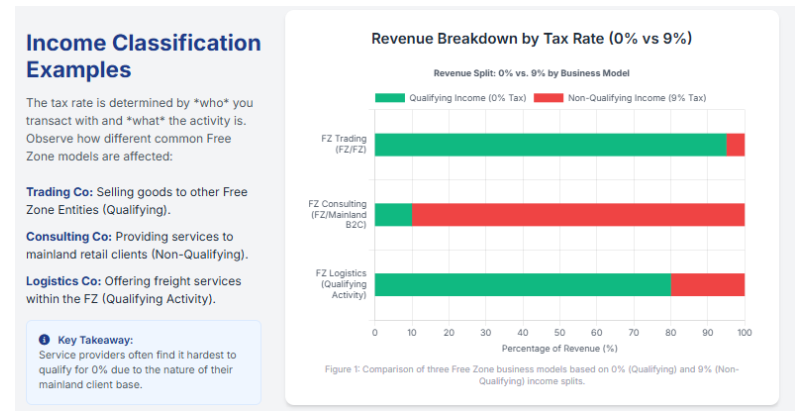
The 0% corporate tax rate in the UAE free zone applies exclusively to Qualifying Income (QI). The rules carefully delineate income streams eligible for the zero rate from those subject to the standard 9% rate.
If the FZP serves mainland clients with a Qualifying Activity (like logistics or specific manufacturing), the income is QI and taxed at 0%. If the income is from a non-Qualifying Activity (like standard consultancy or retail sales to individuals), it is NQR and taxed at 9% (and counts towards the De Minimis test).
Case Study: HarborGate Holdings FZ owned a residential villa rented to an individual tenant, unaware that this was an Excluded Activity generating Non-Qualifying Revenue. DBTA advised restructuring the asset. The villa was sold and replaced with a commercial warehouse leased to a Free Zone company, restoring Qualifying Income status.
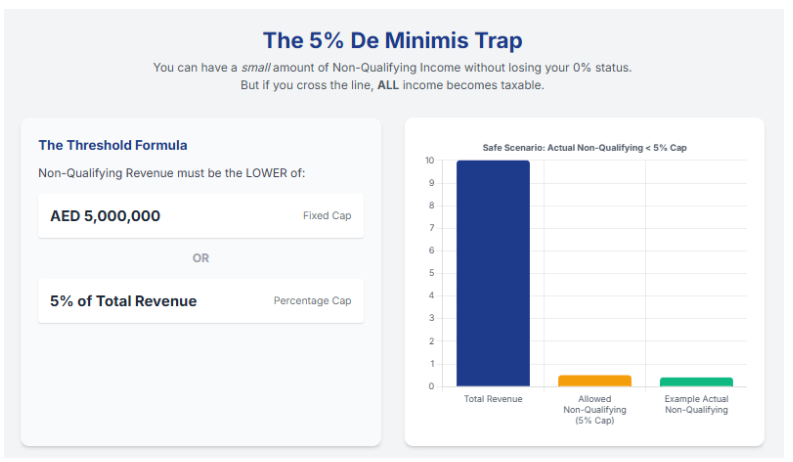
The De Minimis rule acts as the operational safeguard for the QFZP status. It acknowledges that incidental or minor amounts of non-qualifying income free zone corporate tax entities may arise but sets a strict ceiling on this exposure. Explanation in simple terms
The rule states that a QFZP must ensure that its Non-Qualifying Revenue (NQR) does not exceed the lower of the following two thresholds:
If the NQR surpasses the lower of these two values, the FZP instantly loses 0% free zone corporate tax status and is disqualified from QFZP status for five years. This is a severe compliance tripwire. For an entity with AED 100 million in total revenue, the limit is AED 5 million. For an entity with AED 60 million in total revenue, the limit drops to 5% (AED 3 million).
The strict nature of the De Minimis test means that a QFZP with very high revenue has a relatively tighter threshold (5% might be lower than AED 5 million), while an entity with low overall revenue faces a higher hurdle (if 5% is less than AED 5 million, the 5% applies).
| Metric | Value | Requirement |
|---|---|---|
| Threshold A (Percentage) | 5% of Total Annual Revenue | Non-Qualifying Revenue must be less than this amount. |
| Threshold B (Absolute Value) | AED 5,000,000 | Non-Qualifying Revenue must be less than this amount. |
| QFZP Criterion | Non-Qualifying Revenue (NQR) | NQR must be less than the lower of Threshold A or Threshold B. |
| Consequence of Failure | Loss of QFZP Status | Disqualification for the current year and the subsequent four tax years. |
The most common mistakes include:
During any inquiry or free zone corporate tax audit risk UAE assessment, the FTA requests documents that prove the flow of funds, the nature of transactions (FZ vs. Non-FZ, qualifying vs. Excluded), the geographical location of CIGAs, and the transfer pricing justification for related-party dealings.
Case Study: Zenith Digital FZ received an FTA request for documentation regarding transactions with a related party. Because they had engaged DBTA early, all contracts, financial records, and transfer-pricing support were already organized. With DBTA’s assistance, the company submitted the full documentation set within 48 hours, demonstrating full compliance with Free Zone corporate tax requirements.
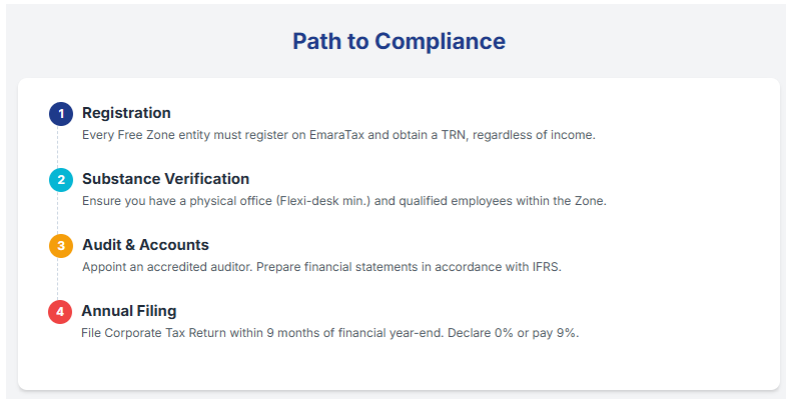
The mandatory nature of the annual tax return submission is a critical point that dispels a common misconception. The law makes it clear that the requirement to file applies to every taxable person, including Free Zone entities.
Registration with the FTA via the EmaraTax portal is mandatory for all Free Zone juridical persons, regardless of their expected tax liability. Failure to register before the end of the first tax period incurs penalties up to AED 10,000.
Every Free Zone Person, including those classified as QFZPs with full UAE 0% free zone corporate tax income, must file an annual Corporate Tax return.
Corporate tax returns and any associated tax payments are due within nine months after the end of the relevant financial year. For most businesses with a calendar year-end (December 31, 2024), the first free zone corporate tax filing deadline is September 30, 2025.
Failure to meet these free zone corporate tax filing deadlines results in late filing penalties, such as AED 500 per month for the first 12 months, and AED 1,000 per month thereafter.
The filing serves as the formal declaration to the FTA that the entity meets all necessary qualifying free zone person rules to maintain its preferential status. It is the annual affirmation that answers the question, can qualifying free zone avoid corporate tax return, the answer being no.
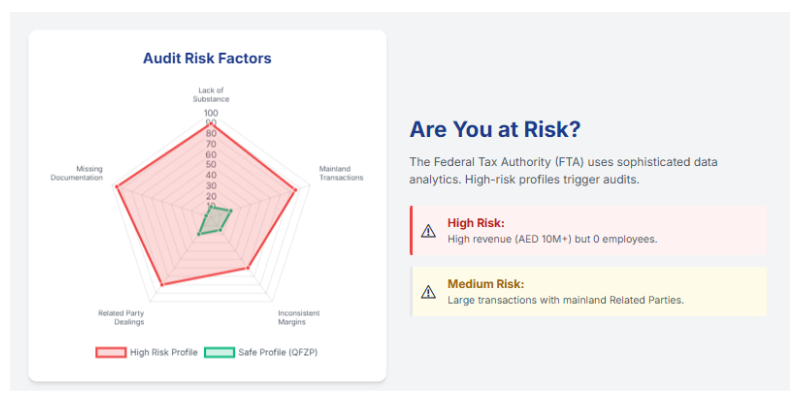
While the UAE 0% free zone corporate tax rate is attractive, QFZPs face a heightened free zone corporate tax audit risk UAE compared to standard mainland entities, primarily because the potential recovery for the FTA (a five-year back-tax at 9% on global income) is substantial.
The high potential tax recovery associated with a QFZP failure, coupled with the mandatory filing of a return that must prove substance and income segregation, makes these entities primary audit targets. Top audit triggers
The FTA’s auditing strategy is likely to prioritize:
The FTA requires comprehensive documentation for qualifying free zone corporate tax, including segregated accounting ledgers, detailed contracts, audit reports, payroll evidence, and transfer pricing support for related party dealings.
Mitigating corporate tax risks for qualifying free zone entities requires a proactive, audit-ready approach: continuous, real-time tracking of NQR against the total revenue base, rigorous maintenance of substance documentation, and ensuring that all related-party transactions are justified by transfer pricing principles.
Many Free Zone companies require interaction with the mainland UAE market. The CT Law provides a controlled mechanism for managing mixed free zone and mainland income tax through the concept of the Domestic Permanent Establishment (DPE).
A Free Zone Person that has a presence or conducts business activities in the mainland (e.g., through a specific branch license) is deemed to have a DPE. The income correctly attributed to this DPE is subject to the standard 9% corporate tax rate.
Invoicing non-qualifying services from the Free Zone to a mainland client will generate NQR, which counts toward the De Minimis test. However, strategically establishing a DPE to ring-fence mainland income offers a compliance advantage. Income correctly attributed to the DPE is taxed at 9% but is excluded from the NQR calculation used for the De Minimis test. This allows the QFZP to serve the mainland market without risking losing 0% free zone corporate tax status of its core international business.
For extensive mainland interaction involving non-Qualifying Activities, the recommended structure is establishing a DPE or a separate mainland subsidiary. For Qualifying Activities (like logistics, if meeting the definitions) to the mainland, the Free Zone entity can retain the 0% rate, provided the De Minimis rule is monitored.
A Free Zone holding company performing only qualifying holding activities (like ownership of shares and securities) can typically maintain its QFZP status easily, assuming substance is met. An operating company must rigorously segregate all income streams and monitor the NQR derived from mainland clients or Excluded Activities.
A compliant Free Zone entity must implement internal controls to track Non-Qualifying Revenue (NQR) monthly against the De Minimis threshold (lower of 5% of total revenue or AED 5 million). This proactive step prevents accidental breach and the resulting five-year status loss.
The mandatory audit must be planned early to ensure audited financials are finalized in time for the nine-month free zone corporate tax filing deadlines.
Ensure continued alignment with free zone corporate tax substance requirements (CIGA, assets, employees, expenditure).
Retain all CT-related records and documentation for qualifying free zone corporate tax for a minimum of seven years from the end of the relevant tax period.
Case Study: DBTA implemented a compliance program for Global Trading FZ, performing quarterly internal audits against this free zone corporate tax compliance checklist. During one review, a projected breach of the De Minimis rule was identified due to unexpected NQR. DBTA advised the client to delay the non-qualifying contract until the subsequent tax period, when total revenue was expected to increase, thus avoiding the threshold breach.
Client Testimonial: “DBTA’s quarterly checks are our primary safeguard. They ensure we adhere to every point on the free zone corporate tax compliance checklist and eliminate the high-stakes risk.” – Manager, Global Trading
Protecting your UAE 0% free zone corporate tax status requires building a defensive operational structure that meets every requirement of the qualifying free zone person rules simultaneously.
When dealing with the mainland, always assess if the activity qualifies. If it does not, consider using a separate mainland DPE or subsidiary to handle that revenue, thereby protecting the FZ entity’s De Minimis calculation. Contracts should clearly define the service, the location of delivery, and the counterparty status (FZ Person vs. Non-FZ Person, Juridical vs. Natural Person).
While separate financial statements are not strictly mandatory for each income stream, robust internal accounting must allow for easy and auditable segregation. This means tagging all invoices and revenue entries by counterparty and activity type, enabling the precise calculation of NQR for the De Minimis test monthly.
Ensure the number of qualified employees and the level of operational expenditure dedicated to Core Income-Generating Activities (CIGAs) are documented and commensurate with the scale of the income generated. Document management oversight of outsourced CIGAs.
Implement an accounting system that tracks the relevant data points (Revenue, NQR, QI, DPE income) for the CT return and audit, ensuring alignment with IFRS.
Perform internal quarterly reviews against the free zone corporate tax compliance checklist, prioritizing the continuous calculation of the De Minimis threshold to pre-emptively manage the high-stakes risk of losing 0% free zone corporate tax status.
Given the complexity, high stakes, and potential for a five-year penalty clawback, relying on expert advice is essential. DBTA helps businesses correctly interpret the qualifying free zone person rules for their specific commercial activities, structure mainland interactions compliantly, and maintain the precise documentation for qualifying free zone corporate tax status.
Don’t risk losing 0% free zone corporate tax status for five years due to a minor misstep. Contact Dubai Business & Tax Advisors today to schedule your comprehensive QFZP Compliance and Audit-Readiness Review. Let our senior tax consultants secure your Dubai free zone corporate tax advantage for the long term.
The era of presumed tax exemption for Free Zone entities in the UAE has ended. The Dubai free zone corporate tax landscape is now governed by precise and demanding qualifying free zone person rules. The UAE’s 0% free zone corporate tax rate is a powerful incentive, but it comes tethered to a substantial burden of proof: adequate substance, clear income segregation, rigorous compliance with the De Minimis test, and mandatory annual filing.
The most significant corporate tax risk for qualifying free zone entities stems from the failure of the De Minimis rule, which results in the retroactive application of the 9% tax rate to all income for 5 years. Continuous adherence to the free zone corporate tax substance requirements and strict compliance with free zone corporate tax filing deadlines are non-negotiable pillars of this regime.
Business owners must implement systems to monitor Non-Qualifying Revenue (NQR) and economic substance metrics in real-time, treating the De Minimis calculation as a crucial, ongoing operational metric, not a year-end accounting exercise.
Yes, annual filing is mandatory for all Free Zone entities, even those with 0% corporate tax in the UAE free zone. Filing is required to prove you meet the qualifying free zone person rules.
Your non-qualifying income free zone corporate tax (NQR) must not exceed the lower of 5% of your total revenue or AED 5 million. Exceeding this limit is the most significant risk.
You immediately risk losing 0% free zone corporate tax status. The standard 9% tax rate applies retroactively to all your company’s profits, and the disqualification lasts for five years.
You must prove real activity by maintaining adequate assets, qualified full-time employees, and operating expenditure for your Core Income-Generating Activities (CIGAs) physically inside the Free Zone.
Income from mainland clients is 9% if it stems from non-Qualifying Activities (e.g., general consulting or B2C sales). This revenue is NQR and severely risks breaching the De Minimis threshold.
The main disqualifying activities for the free zone 0% rate are transactions with natural persons (B2C sales) and income from non-commercial property ownership.
The free zone corporate tax filing deadlines are strictly within nine months after the end of your financial year (e.g., September 30, 2025, for a Dec 31, 2024, year-end).
Voluntarily electing the standard 9% rate is a strategic choice for high-NQR businesses. It ensures structural stability, avoids the complex rules and high corporate tax risks for qualifying for free zone status, and prevents the five-year status loss penalty.
As CEO of DBTA, Aurangzaib Chawla advises globally mobile businesses and individuals on cross-border tax planning and structuring. With expertise spanning the UK, UAE, and wider GCC, Zaib helps clients minimise double taxation, protect assets, and achieve long-term financial efficiency while staying fully compliant.
Let’s talk about how to structure your business for growth the smart, compliant, and tax-efficient way

As CEO of DBTA, Aurangzaib Chawla advises globally mobile businesses
and individuals on cross-border tax planning and structuring. With expertise spanning the UK, UAE, and wider GCC, Zaib helps clients minimise double taxation, protect assets, and achieve long-term financial efficiency while staying fully compliant.
Let’s talk about how to structure your business for growth the smart, compliant, and tax-efficient way.
Get in Touch