
UAE VAT Exemptions and Zero-Rated Supplies: A Strategic Guide for Businesses

Recent Insights
Table of Contents
Introduction: Making Sense of VAT in the UAE
VAT came to the UAE on 1 January 2018. On paper, it is a small 5% tax applied to most goods and services. It was part of a bigger plan to move the country away from depending too much on oil and to build a system that matches global standards. But the interesting part is, it is not the standard rate. It is how the rules treat different sectors. That is where two categories come in: zero-rated and exempt. Zero-rated supplies still count as taxable, just at a rate of 0%. This means businesses in areas like healthcare, exports, and education can claim back the VAT they spend on running costs. It gives them breathing room, keeps them competitive, and in many ways works like a government incentive. Exempt supplies do not fall under VAT at all. Think residential rents or local transport. These are kept simple so that people do not pay extra, and businesses do not have to handle the admin of VAT recovery. This design is not random. The government set it up this way to strike a balance: support key industries that fuel growth, while keeping basic services affordable for everyday life. In that sense, VAT in the UAE is not about collecting money, it is part of the country’s wider economic playbook.
The Defining Line: A Detailed Comparison of Zero-Rated vs. Exempt Supplies
Why the Difference Matters So Much
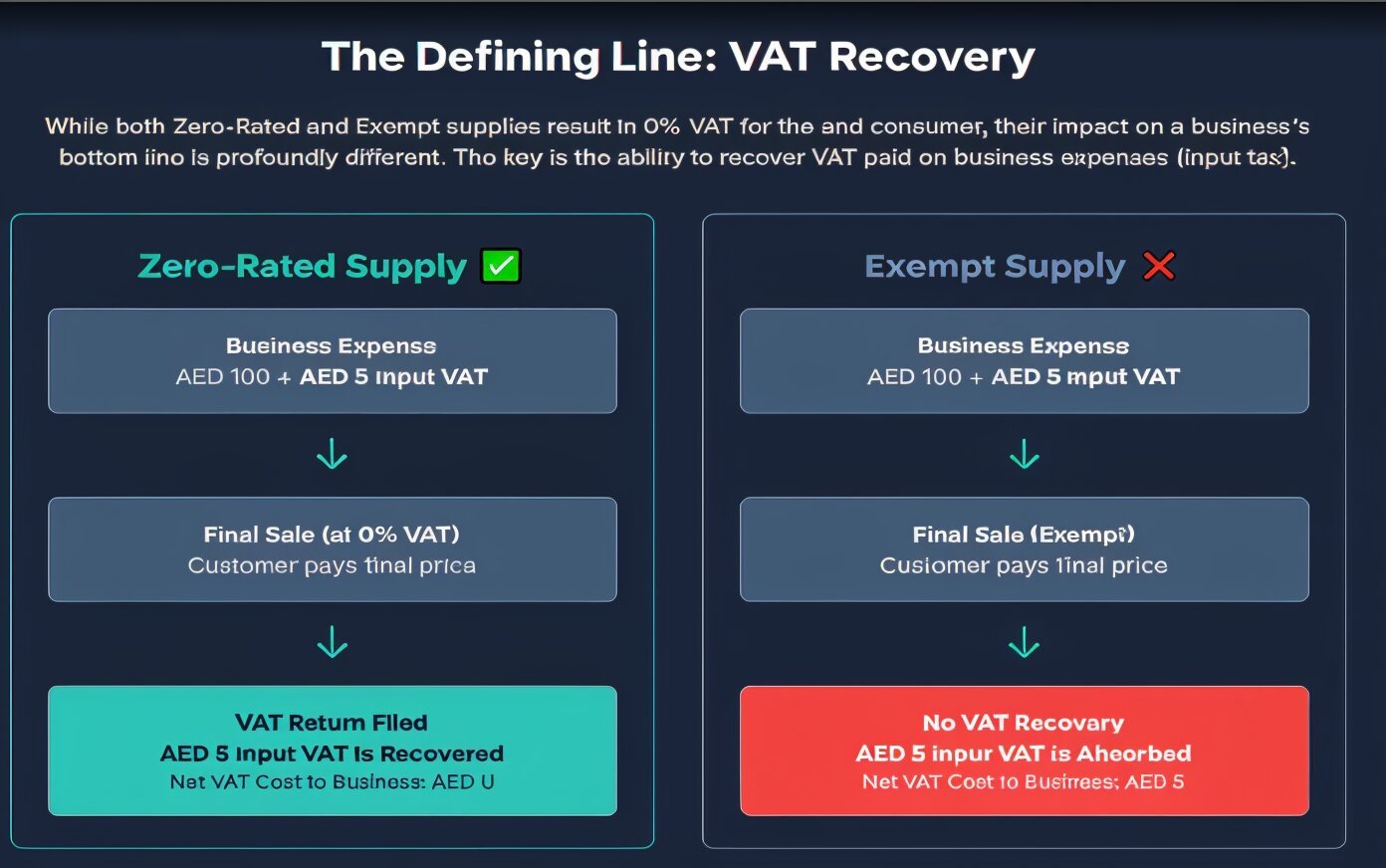
If you are running a business in the UAE, one of the trickiest but most important VAT rules is understanding the line between zero-rated and exempt supplies. From the customer’s point of view, they look the same because no VAT appears on the bill. But for you, the business owner, the impact is completely different. The real question is: can you claim back the VAT you have already paid on your costs? With zero-rated, the answer is yes. With exempt, it is no.
So, what is a Zero-Rated Supply?
In simple terms, it is still a taxable sale, just at 0%. That means the customer does not pay VAT, but you, as the supplier, are not left carrying the burden of VAT you have already paid. You get to reclaim it. Take a school, for example. It pays VAT on utilities, books, even rent. Because education services can be zero-rated, that school does not lose out on the VAT it’s been charged. It claims it back. The result? Lower running costs, more room to stay competitive, and less pressure on cash flow. Now, here is the catch: because zero-rated supplies still count as taxable, they add up when you are looking at the VAT registration threshold. If your total sales (zero-rated included) cross AED 375,000 in a year, you must register. And once you are registered, you must file returns and keep your paperwork clean to show which sales are truly zero-rated. Without that, the refund claim could get messy.
What Is an Exempt Supply?
Exempt supplies look like zero-rated at first, no VAT shows up on the customer’s bill. But under the surface, they are hugely different. The key difference? If you are supplying exempt goods or services, you do not get to reclaim any VAT you have already paid on your costs. That means every bit of VAT you pay on rent, office supplies, utilities, even professional services stick with you. It becomes a direct cost. And over time, those costs add up, slowly squeezing your margins. In practical terms, what you save on paperwork you lose in money. Now, the admin side seems easy. If a company deals only in exempt supplies, it does not need to register for VAT, file returns, or keep the same level of tax documentation. Simple, yes but the catch is you are paying more out of pocket. Most businesses eventually make up for it by nudging prices higher, which shifts the cost back onto the consumer anyway.
Zero-Rated Supplies | Exempt Supplies | |
VAT Rate | 0% | No VAT applied |
Input Tax Recovery | Permitted | Not permitted |
Taxable Status | Taxable supply | Non-taxable supply |
VAT Registration | Required if turnover exceeds AED 375,000 | Not required (if no other taxable supplies) |
VAT Return Filing | Mandatory | Not required (if no other taxable supplies) |
Impact on Costs | Favorable; input VAT is recovered, reducing operational costs | Unfavorable; input VAT becomes an unrecoverable expense |
Impact on Pricing | Allows for competitive pricing due to cost recovery | May lead to higher pricing to cover irrecoverable VAT costs |
Zero-Rated Supplies: Driving Economic Competitiveness
The whole point of zero-rating is not just tax relief. It is about keeping the UAE attractive to investors and traders by making sure VAT doesn’t become a cost that businesses must swallow. When companies can recover the VAT, they have already paid, it frees up capital that can be used for growth whether that is reinvesting in operations, developing new products, or simply keeping prices competitive.
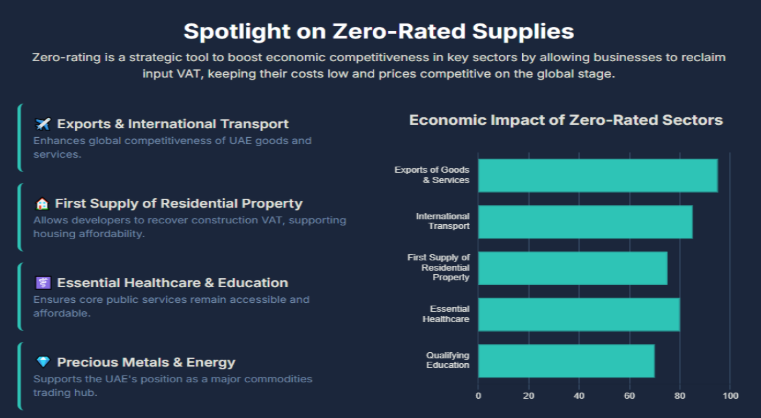
Exports of Goods and Services
One of the clearest examples is exports. Both goods and services sold outside the UAE are zero-rated, even when the buyer is in a country that has not implemented VAT yet. The idea is simple: UAE businesses should not be penalised with local VAT when competing on global markets. For goods, the rule is straightforward if you are shipping items abroad, you charge VAT at 0%. Services are a little trickier. They qualify as zero-rated when supplied to a customer “outside the state,” which can even cover someone who is in the UAE temporarily for less than a month. Of course, the catch is compliance. To apply for the 0% rate, you need to back it up with paperwork. Customs declarations, shipping records, proof that the buyer received the goods all of it matters. Without that evidence, the transaction cannot be treated as zero-rated, and the VAT benefit disappears.
International Transportation
International transport is treated generously under VAT. If the trip starts, ends, or even just passes through the UAE, it is zero-rated. Same goes for the extras tied to the journey port handling, customs, transshipment, that sort of thing. The logic is straightforward: the UAE thrives as a global hub. Slapping VAT on every shipment or ticket would only dull that edge. So, the tax stays out of the way for cross-border trade and travel. Local trips are different: passenger transport inside the country is exempt, while domestic couriers pay the standard 5%.
Real Estate: The First Supply of Residential Property
Property has its own wrinkles. The rule that matters most here is this: the first sale or lease of a brand-new residential building, within three years of its completion, is zero-rated. That is not just red tape. Developers pour money into construction and pay VAT on every part of it. Being able to claim that back means they do not have to pass it all on to first-time buyers. In practice, that keeps housing costs in check while still letting developers recover their spending.
Healthcare
Healthcare gets special treatment too. Preventive and essential services are zero-rated, and the same applies to approved medicines and equipment signed by the Ministry of Health. The aim is obvious: to cut the cost of basic care and make it widely accessible. Not everything qualifies though. Cosmetic surgery, elective treatments, and wellness extras sit at the standard 5%. Put simply, the system backs what people need, not what they want.
Education
Education gets mixed treatment under VAT. Core services from recognized nurseries, schools, and government-backed universities are zero-rated. Same with textbooks and digital materials that are part of the actual curriculum. But here is the thing, not every service a school provides falls under that rule. Uniforms, a new laptop, canteen food, even a fun field trip, those all carry the standard 5% VAT. So, inside the same school, you will see both treatments. That is just how the system’s set up.
Other Zero-Rated Categories
There are a few other categories worth noting. Investment-grade precious metals gold and silver that are 99% pure or more qualify. So do supplies of crude oil and natural gas. The reasoning is clear enough: these are big industries for the UAE, and the government does not want VAT to weigh them down in global trade.
VAT-Exempt Supplies: Focusing on Public Welfare
VAT exemptions mostly cover essentials the kind of goods and services people rely on day to day. The idea is simple: keep them affordable by making sure tax does not pile onto the closing price. For businesses, though, the other side is that input VAT on costs cannot be reclaimed, so expenses often sit heavier on the books.
Financial Services
Finance is a bit of a mixed bag. Not everything is exempt, but some common activities are. Interest on loans or deposits, life insurance policies, and profits from currency exchange spreads all fall under the exemption. The reason is straightforward: taxing them would risk distorting financial markets. But as soon as there is a clear fee or commission involved say, account opening charges, credit card fees, or advisory services the standard 5% VAT kicks in. This leaves banks and financial institutions juggling both exempt and taxable activities, which means they must run partial exemption calculations to figure out what input VAT they can reclaim. It adds complexity behind the scenes.
Residential Real Estate
Housing follows a split rule. The very first sale or lease of a new residential property is zero-rated. After that, any later sales or rental income are exempt. The same goes for bare, undeveloped land. The logic here is about balance. Developers get to recover their VAT on the first supply, but buyers and tenants in the secondary market benefit from affordability when VAT does not apply on resale or rental. It is one of the ways the system keeps the housing market stable.
Local Passenger Transport
Public transport is also carved out as exempt. That includes buses, metro rides, taxis, and even domestic flights. The point is to make commuting and travel inside the country affordable and accessible for everyone, residents, tourists alike. It is seen as a necessity rather than something to tax.
Charitable Organizations
Charities get special treatment too. If they are registered with the Federal Tax Authority, their core activities are VAT-exempt. On top of that, donations and grants given to them are not subject to VAT at all. This ensures funds go directly to humanitarian work instead of being eroded by tax.
The Broader Business Implications: Compliance, Strategy, and Free Zones
Why the Difference Matters?
Zero-rated vs exempt is not just a tax label. It changes how a business runs, how much money it keeps, and how much admin it must deal with.
Operational and Financial Impact
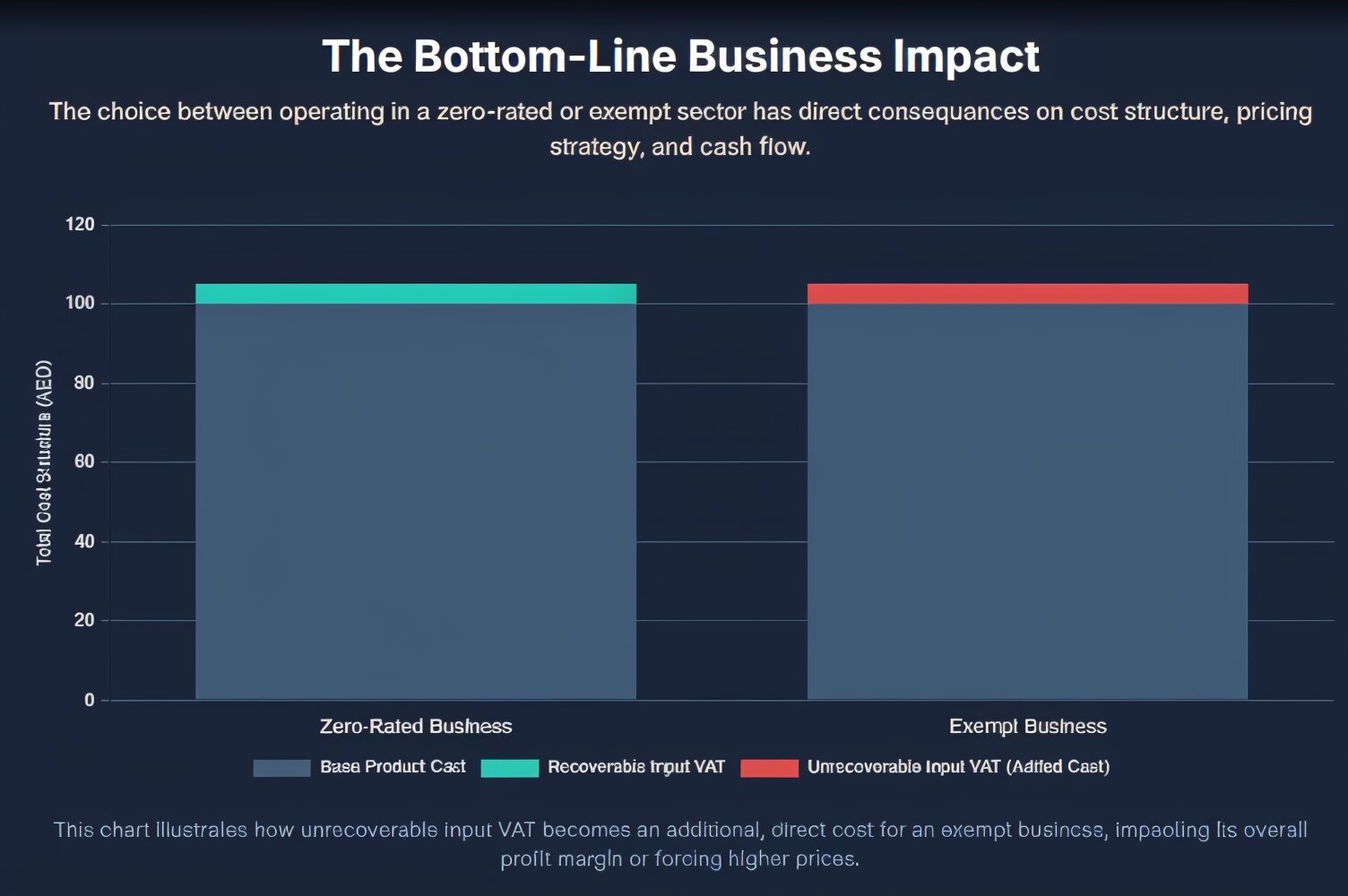
Zero-rated businesses get the upside. They can reclaim input VAT rent, utilities, supplies which lowers costs and sometimes even gives cash flow a lift. That recovery can be the difference between staying competitive and losing ground. Exempt businesses? They do not get that relief. Every bit of VAT paid on expenses becomes a cost that sticks. Margins shrink, or prices rise to make up for it. Either way, it is a squeeze.
Compliance and Risk Management
The system only works if you classify things correctly. Mix up exempt and zero-rated and the FTA can step in with penalties. And zero-rating is not a free pass you must prove it with paperwork: invoices, contracts, export docs. If you cannot back it up, you lose the 0% treatment. So, the trade-off is clear. Exempt businesses keep things simple on the admin side no registration, no returns but they carry higher costs forever. Zero-rated businesses deal with more compliance, but they get VAT back, which leaves them in a stronger position financially.
Free Zones: A Special Case
Free zones add another layer of complexity. Some are Designated Zones. For VAT purposes, they are treated as if they sit outside the UAE at least for certain transactions. Moving goods between designated zones does not attract VAT. But sell those goods to the mainland, or directly to consumers inside the zone, and the 5% rate applies. Other free zones do not get that treatment. They are classed as non-designated and follow the standard VAT rules. If they cross the threshold, they register just like a mainland business.
Partnering with DBTA for VAT and Tax Advice
VAT in the UAE looks simple. If you have a mix of standard, zero-rated, and exempt supplies, suddenly it is not so simple anymore. One mistake can eat into your margins or land you with penalties, and nobody wants that. That is why many businesses reach out to us. At Dubai Business and Tax Advisors (DBTA), we do not treat VAT as just paperwork. We look at it in the context of your business. How does it affect your pricing? Your cash flow? Your long-term plans? That is where the real value comes in. Sometimes our role is straightforward getting your registration sorted, filing returns on time, and keeping you compliant. Other times it is more strategic, like planning the right structure so you do not pay more than you need to or guiding you through an audit without the stress. And quite often, it is bigger than VAT alone. We help with budgets, forecasts, and financial strategy because all of it ties together. In the end, working with DBTA gives you more than compliance. It gives you peace of mind and the confidence that someone is watching your blind spots while you focus on running and growing the business.
FAQs on VAT Exemptions and Zero-Rated Supplies
Zero-rated supplies often throw people off. They look like there’s no tax at all, but technically they are still taxable just at 0%. The key difference is this: if your business makes these supplies, you can recover the VAT you already paid on costs like electricity, raw materials, or outside services. That recovery can be a lifesaver for cash flow. Exports, international travel, certain healthcare and education services, and the first supply of new housing usually qualify. And here’s the point many forget they still count toward the AED 375,000 registration threshold.
Exempt supplies don’t work the same way as zero-rated, and that’s deliberate. The government keeps some essentials out of VAT to stop everyday costs from spiraling. Think about transport taxis, buses, the metro, all exempts. The resale of homes and bare land also fall in, as do certain financial services, like interest on loans when no clear fee is involved. But the catch is this: businesses cannot reclaim VAT on the expenses tied to exempt supplies. So whatever VAT they pay just sticks, and over time, those costs squeeze profits and force price hikes.
Residential property is usually exempt, but not always. The first sale or lease of a new building, within three years of its completion, is treated as zero-rated. That little rule helps developers because they spend heavily on construction and VAT applies to almost everything; they buy materials, contractors, and services. By making the first supply zero-rated, they can reclaim it all. Later sales or rentals don’t get that treatment; they fall back into the exempt category. It’s basically a balancing act: protecting developers upfront, while keeping long-term housing costs affordable for residents.
To be fair, not every sector in the UAE gets the same treatment as VAT and that’s exactly how the system was built. Industries people rely on daily, like housing, schools, and healthcare, get the biggest break so services stay within reach. Export-heavy fields of aviation, shipping, cross-border trade also gains, since international sales are usually zero-rated. And then you’ve got the heavyweight players: oil, gas, even precious metals. They receive relief to stay competitive on a global scale. In the end, exemptions protect essentials, while zero-rating pushes trade and investment forward.
Look, VAT exemptions sound great at first. No VAT added to invoices, less paperwork, fewer returns, it feels like less of a headache. But the thing is, whatever VAT a company pays on rent, power bills, or outside services, they can’t claim it back. That money just sticks. Over time, those costs eat away at margins. Expenses keep piling up, recovery never comes, and you know how it goes sooner or later; businesses push prices higher just to cope. Customers enjoy the savings, but businesses end up carrying the weight quietly.
Honestly, no it doesn’t get any special break under VAT rules. Safety items such as helmets, protective clothing, or even firefighting gear are taxed at the normal 5% rate. That means businesses pay VAT upfront whenever they buy them. Now, here’s the thing: if the business is VAT-registered, most of that tax can usually be reclaimed, provided the equipment is clearly for work use. So, the cost isn’t entirely lost. Still, because this gear is mandatory in many industries, smart companies plan and put VAT into their budgets every year.
Conclusion: A Path to Informed Compliance and Strategic Advantage
Final Thoughts
VAT in the UAE does two jobs. It brings in revenue, but it also shapes how the economy works. The split between zero-rated and exempt is right at the center of that. Zero-rated supplies help businesses recover costs and keep their prices sharp. Exempt supplies, on the other hand, keep essentials affordable for people, but businesses in those sectors do not get the same breathing room. For businesses, the challenge is figuring out the truth. You cannot just assume. Some supplies will be standard rated, others zero-rated, others exempt. The point is you must classify them carefully. And here is the catch: zero-rating is not automatic. You need paperwork to back up contracts, invoices, and export documents. No evidence, no 0%. That is why a lot of companies lean on advisors. Free zones, partial exemptions, mixed activities, it all gets messy fast. Having someone who knows the system can save money and prevent headaches. In practice, VAT does not have to be just another compliance chore. Done right, it works in your favour lowering costs, shaping pricing, even giving you a competitive edge.
Latest news & articles
About the Author:
AURANGZAIB CHAWLA
As CEO of DBTA, Aurangzaib Chawla advises globally mobile businesses and individuals on cross-border tax planning and structuring. With expertise spanning the UK, UAE, and wider GCC, Zaib helps clients minimise double taxation, protect assets, and achieve long-term financial efficiency while staying fully compliant.
Planning to launch in Dubai or the UAE?
Let’s talk about how to structure your business for growth the smart, compliant, and tax-efficient way

About the Author:
AURANGZAIB CHAWLA
As CEO of DBTA, Aurangzaib Chawla advises globally mobile businesses and individuals on cross-border tax planning and structuring. With expertise spanning the UK, UAE, and wider GCC, Zaib helps clients minimise double taxation, protect assets, and achieve long-term financial efficiency while staying fully compliant.
Planning to launch in Dubai or the UAE?
Let’s talk about how to structure your business for growth the smart, compliant, and tax-efficient way
About the Author:
AURANGZAIB CHAWLA

As CEO of DBTA, Aurangzaib Chawla advises globally mobile businesses
and individuals on cross-border tax planning and structuring. With expertise spanning the UK, UAE, and wider GCC, Zaib helps clients minimise double taxation, protect assets, and achieve long-term financial efficiency while staying fully compliant.
Planning to launch in Dubai or the UAE?
Let’s talk about how to structure your business for growth the smart, compliant, and tax-efficient way.
Connect with Reliable Dubai Business Consultants
Get in Touch