
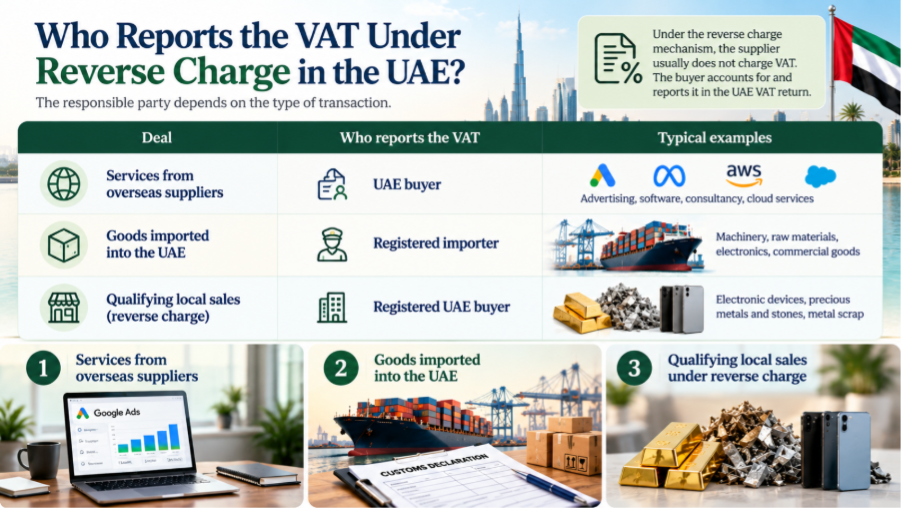
Under the UAE VAT reverse charge mechanism, you (the buyer) are responsible for reporting VAT instead of the supplier. This usually applies when you purchase services from an overseas supplier or import goods.
The supplier is not charging UAE VAT, but you are required to report the same. From 1 January 2026 you do not issue a self-invoice on these purchases. You still need to have evidence of each transaction. This guide explains when the rule applies, how to fill in your VAT201 and what to do if you missed something.
What Is the Reverse Charge Mechanism in UAE VAT?
Reverse charge is a VAT regulation where the buyer is responsible for reporting the tax instead of the seller. It is prescribed in Article 48 of Federal Decree Law No. 8 of 2017.
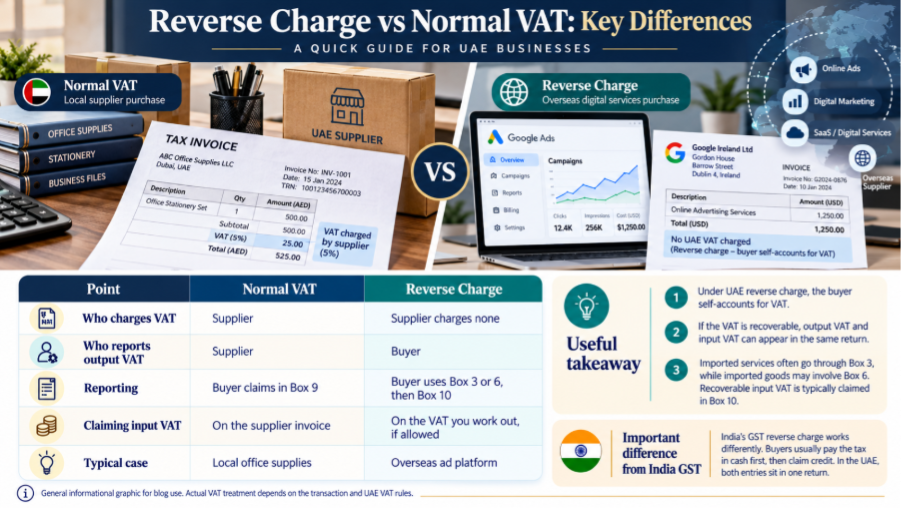
Your supplier sends you a VAT-free invoice. You calculate the 5% and declare it and reclaim it if you are eligible.
How the Reverse Charge Mechanism Works?
Normally, the seller collects VAT and sends it to the Federal Tax Authority (FTA). The reverse charge turns this on its head.
The buyer records the VAT as tax due and where permitted, as tax recoverable. Both entries appear on the same return.
Who is liable to pay VAT under Reverse Charge?
You are the purchaser. You must be VAT registered and buying for business use. Local deals require both sides to register. Each deal must also meet the conditions of the rule itself.
When Does the Reverse Charge Mechanism Apply in the UAE?
Reverse Charge on Imported Goods
Technically, import VAT is due as soon as goods cross the border. But if your business is registered for VAT you can often avoid paying at customs and declare it on your VAT return instead. The customs system extracts the import data into Box 6 for you using your Tax Registration Number (TRN). But do not take my word for it. Place the figure next to your clearance papers before filing, as mismatches do happen.
Reverse Charge on Services Bought from Overseas
Reverse charge VAT for imported services in United Arab Emirates applies to consultancy, advertisements, software services and charges. This applies if the supplier is outside the UAE, the service is taxable in the UAE, and the invoice does not include UAE VAT. But if the services are for real estate or an event outside of the UAE, the rules are different.
Reverse Charge for Certain Local UAE Supplies
Reverse charge is not only for cross border purchases. It also includes a few sales between two UAE registered businesses: electronic devices, precious metals and stones, metal scrap and some supplies of hydrocarbons. There are conditions to each category. Sometimes the buyer needs to give a written statement to the supplier before the mechanism can be used.
Reverse Charge for Free Zone and Designated Zone Businesses
Free zone status does not remove your VAT duties. A registered free zone company reports overseas services just like a mainland firm.
Designated zones work differently for goods. Goods there can count as outside the UAE until they move. That rule does not cover services.
Reverse charge VAT questions for free zone businesses in the UAE need a case-by-case check.
Which Purchases Do Not Fall Under Reverse Charge VAT?
Reverse charge is not automatic for every purchase. Here is where it usually does not apply.
Purchases From UAE VAT Registered Suppliers
If a UAE supplier charges 5% and shows its TRN, normal rules apply. You pay the VAT and claim it in Box 9 if you are allowed to. The local reverse charge groups above are the exception.
Input VAT recovery is not automatic. The FTA may restrict or deny recovery in defined circumstances, including where the recipient knew or should have known that the supply was connected with fraud or another specified irregularity. Check the specific legal conditions before assuming a claim is available.
Zero Rated, Exempt and Out of Scope Purchases
Zero rated supplies carry 0% VAT. Exempt supplies carry no VAT and limit what you can claim back. If your purchase falls in either group, you have no VAT to report yourself.
Does Reverse Charge Apply to Google Ads, Software and Foreign Freelancers?
Often yes but check each invoice first.
Google Ads and Meta Advertising Invoices
Check three things. Who bills you? Does a UAE TRN appear? Is UAE VAT charged? If an overseas company bills you with no UAE VAT, reverse charge on Google Ads in the UAE usually applies. If a UAE registered company charges VAT, it does not.
Foreign Software and Cloud Subscriptions
The same test covers SaaS, cloud hosting and app plans. Some global providers register for UAE VAT. Many do not.
List each provider and note whether it charges UAE VAT.
Overseas Consultants and Freelancers
Services from an overseas freelancer or firm usually follow the same rule. Keep your contracts as proof of where the supplier is and what they did for you.
How to Calculate Reverse Charge VAT in the UAE
Multiply the value in AED by 5%. If you were billed in another currency, convert it at the UAE Central Bank rate.
What you can claim back depends on UAE VAT law and how you use the purchase. There are three common outcomes.
When You Can Claim All of the VAT
If the purchase supports fully taxable business activity, the VAT you report equals the VAT you claim. The net amount you pay to the FTA is zero.
When You Can Claim Part of the VAT
If some of your activity is exempt, you can claim only a share. You pay the rest, and it becomes part of your real cost.
When You Cannot Claim Any of the VAT
If the purchase supports only exempt activity, you claim nothing. The full 5% is a cost to your business.
How to Report Reverse Charge VAT in a UAE VAT201 Return
The FTA’s VAT Returns User Guide explains each box. Follow the order below for reverse charge reporting on the VAT201.
Step 1: Find Purchases Subject to Reverse Charge
Review foreign invoices, card statements, customs papers and any special local purchases.
Step 2: Work Out Output VAT and Recoverable Input VAT
Convert the value to AED and apply 5%. Then work out how much you can claim.
Step 3: Report Imported Services and Local Reverse Charge Purchases in Box 3
In Box 3, enter the value and VAT of imported services and local reverse charge purchases. Goods cleared through customs go in Box 6 instead.
Step 4: Report Imported Goods in Boxes 6 and 7
Box 6 fills in by itself from customs data tied to your TRN. Use Box 7 only to fix missing or wrong import values.
Step 5: Claim Eligible Input VAT in Box 10
Box 10 is where you claim VAT from Boxes 3, 6, and 7. If you can claim in full, the same figures appear in Box 10.
Step 6: Reconcile Your Records Before Filing
Match your invoices, ledgers, customs records and return figures. A few minutes here can save you a correction later.
| Box | What it holds | Who fills it |
| 3 | Imported services and local reverse charge purchases | You |
| 6 | Goods imported through customs | Automatic |
| 7 | Fixes to Box 6 | You, if needed |
| 10 | VAT you claim from Boxes 3, 6 and 7 | You |
How to Record Reverse Charge VAT in Your Books
Record the purchase and the VAT separately. The supplier is owed the purchase value only. The FTA is owed the VAT you work out.
Journal Entries When All the VAT Is Claimable
| Account | Debit | Credit |
| Expense (for example, marketing) | Purchase value | |
| Supplier payable | Purchase value | |
| Input VAT (reverse charge) | 5% of purchase value | |
| Output VAT (reverse charge) | 5% of purchase value |
Journal Entries When the VAT Is Only Partly Claimable
Book only the part you can claim as input VAT. Add the rest to the expense. The supplier credit stays at the purchase value. The output VAT credit stays at the full 5%.
What Has Changed Under the UAE Reverse Charge Mechanism in 2026?
There was a couple of updates this year, and each one affects how you do reverse charge. This is what they mean in practice.
End of Self-Invoicing 1 January 2026
On 1 January 2026, the Federal Decree Law No. 16 of 2025 came into force. With reverse charge you don’t have to invoice yourself anymore.
That doesn’t mean the paperwork goes away. You still need evidence of the transaction, so hold on to your supplier invoices, contracts, payment records and customs documents.”
Metal Scrap Joined the Local List on 14 January 2026
The Cabinet Decision No. 153 of 2025 was effective from 14 January 2026. It applies to scrap metal sold between registered businesses for resale or processing.
The buyer makes a written statement. The seller checks the registration of the buyer and indicates on the invoice that reverse charge is applicable.
FTA Clarification on Metal Scrap in October 2026
The FTA issued Public Clarification VATP047 on metal scrap in October. The rule applies to both ferrous and non-ferrous metal waste that has commercial value and can be used after processing.
The rule does not apply to zero rated exports. If those conditions are not satisfied, normal VAT applies and the seller charges 5%.
Reverse Charge and UAE E-Invoicing
Ministerial Decision No. 244 of 2025 introduces electronic invoicing gradually. Businesses whose annual revenue is equal to or exceeds AED 50 million must appoint an Accredited Service Provider by 30 October 2026 and implement the e-invoicing system by 1 January 2027. The original appointment deadline of 31 July 2026 was extended to 30 October 2026 through an amendment to the decision.
The deadlines for other businesses and governments need to be cross-checked with those from the Ministry of Finance, because there might be changes made later via decisions made. After going live, reverse charge invoices for local transactions, including scrap sales, can be done through this system. Overseas vendors, who are not part of this system, need to keep their original invoices.
Common Reverse Charge VAT Mistakes and How to Avoid Them
| Mistake | How to avoid it |
| Missing imported services | Check foreign vendors and card statements each month |
| Wrong return box | Use Box 3 for services. Use Boxes 6 and 7 for customs goods |
| Claiming too much | Work out your allowed share before you claim |
| Wrong local treatment | Confirm declarations and registration before the sale date |
| Weak records | Keep invoices, contracts and proof of payment |
| Customs mismatch | Match Box 6 to clearance papers |
What Happens if You Do Not Report Reverse Charge VAT in the UAE?
Plenty of businesses miss reverse charge VAT at some point. It’s fixable, but only if you deal with it quickly once you spot it.
How to Correct Reverse Charge Reporting Errors
First, pull together a list of the purchases you missed. Next, go back through each affected period and redo the output and input VAT. Then look at where that leaves you overall.
Say you were entitled to claim every dirham back, so nothing extra is owed. The return is still wrong. Those boxes were filled in incorrectly, and they have to be fixed anyway.
When You Must File a Voluntary Disclosure
Underpaid by more than AED 10,000? Then you need to file a voluntary disclosure, and you get 20 business days from the day you find the error. Anything smaller can normally be sorted out on your next VAT return. If no return is coming up, a disclosure is the way to go.
Refunds work differently. Overclaim one and you need a disclosure, however small the amount. Check tax.gov.ae for the current rules before you file.
Potential Penalties for Incorrect VAT Reporting
The penalty depends on what went wrong and how long you waited. The UAE changed its VAT penalty rules in April 2026, so an older guide could steer you wrong. Waiting costs more, and in some situations the FTA may refuse your input VAT claim entirely. Read the FTA’s latest penalty schedule before you decide how to proceed.
Frequently Asked Questions
Usually, yes. If you’re a UAE VAT registered business and you buy taxable services from an overseas supplier, reverse charge generally applies.
Yes, as long as the purchase supports your taxable business activity. If part of it is used for exempt supplies, your claim is limited accordingly.
Yes, and that’s the usual situation. A foreign supplier leaving VAT off the invoice doesn’t remove your duty to account for it.
Yes. You report the output VAT in Box 3 or Box 6, and your claim goes in Box 10 of the same return.
Conclusion: How to Comply with UAE Reverse Charge VAT Rules
Don’t try to tackle everything at once. Begin with whichever part of the reverse charge mechanism actually touches your business.
Buying services from abroad? Go through each invoice and look for the supplier’s UAE TRN and a VAT line. Importing goods? Match your customs records against Box 6 before you file.
If your VAT recovery is restricted, work out how much you can actually claim before it goes on the return. And if you’ve already missed a transaction, list the returns it affects and decide how each one gets corrected.
Some situations are worth handing to a specialist: unusual local rules, or deals that involve several countries.
Not sure whether reverse charge is applicable to your transactions? Dubai Business and Tax Advisors (DBTA) will assist you in evaluating your VAT compliance, preparing your reports, and submitting UAE VAT returns in an accurate way. Feel free to contact our specialists.