
UAE Corporate Tax De Minimis Rule for Free Zone Companies

Recent Insights

Table of Contents
Introduction
The promise of a 0% Corporate Tax rate is the primary reason many founders and multinational groups establish a presence in the UAE Free Zones. However, maintaining this status is not automatic. It hinges entirely on meeting specific criteria, the most critical of which is the de minimis test.
For finance leads and entrepreneurs, the de minimis rule is the operational safety valve that allows a Qualifying Free Zone Person (QFZP) to earn a small amount of non-qualifying income without disqualifying their entire revenue stream from the 0% benefit. Not completely understanding this threshold is one of the quickest ways to lose your 0% position and end up paying 9% corporate tax on all taxable income, not just the non-qualifying slice.
This guide explains, in plain terms, how the de minimis test works, how to calculate it correctly, and what internal controls you need in place to protect your position. If you want a broader context on how the UAE moved from “tax-free” assumptions to enforceable compliance, start here: UAE company tax-free or not.
Key definitions
To navigate the de minimis rule in the UAE, we must first define the variables involved. The law uses specific terminology that differs from standard accounting language.
De minimis threshold (5% or AED 5,000,000)
The de minimis exemption applies if, during a tax period, a Free Zone Person’s non-qualifying revenue stays within the de minimis limit. The limit is the lower of:
- 5% of the Free Zone Person’s total revenue for that tax period, or AED 5,000,000.
If your total revenue is AED 200 million, 5% works out to AED 10 million. But you do not have AED 10 million “buffer.” The rule caps you at AED 5,000,000, so that is the maximum non-qualifying revenue you can have and still stay within the threshold. For practical applications tied to filing and eligibility, align this with DBTA Corporate Tax guidance.
Qualifying income vs non-qualifying revenue
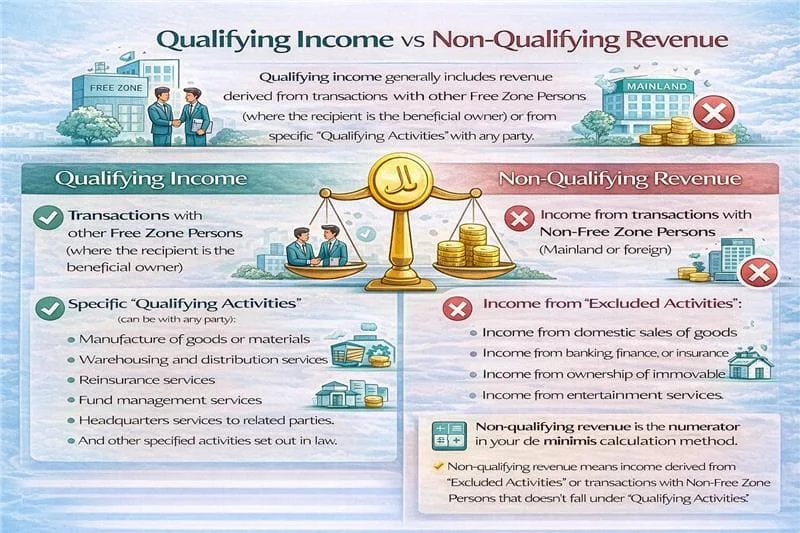
Qualifying income generally includes revenue derived from transactions with other Free Zone Persons (where the recipient is the beneficial owner) or from specific “Qualifying Activities” with any party.
Non-qualifying revenue means income derived from “Excluded Activities” or income from transactions with Non-Free Zone Persons that does not fall under specific “Qualifying Activities” (noting that transactions with foreign persons, Non-Resident Persons, for many services are generally classified as Qualifying Activities under the ‘Headquarter’ or ‘Distribution’ mandates). This is the numerator in your de minimis calculation method.
Excluded activities
These are specific activities listed in the relevant decisions (e.g., banking, insurance, ownership or exploitation of immovable property affecting the mainland) that generally generate non-qualifying revenue. If a Free Zone company engages in these, the revenue is non-qualifying and counts toward the de minimis cap.
Domestic PE and mainland branch
A Domestic Permanent Establishment (PE) typically arises when a Free Zone entity has a fixed place of business in the mainland or dependent agents habitually exercising authority there. Revenue attributable to a Domestic PE is taxed at 9%. Crucially, this revenue is often excluded from the de minimis calculation entirely to prevent double-counting, provided it is treated as taxable.
Beneficial recipient
To treat revenue from another Free Zone Person as Qualifying Income, the payer must be the “Beneficial Recipient” of the services or goods. They must use the goods/services for their own business, not strictly as a conduit for a third party.
Assumptions and items to confirm in official guidance
- Ministerial Decisions: As of late 2025, Ministerial Decision No. 229 of 2025 has officially replaced MD No. 265 of 2023. (e.g., Cabinet Decision No. 100 of 2023 and Ministerial Decision No. 265 of 2023).
- Immovable Property: Verify the latest treatment of commercial property income within a Free Zone versus mainland property.
- Intellectual Property: Confirm if your IP income meets the OECD nexus approach requirements adopted by the UAE.
- Domestic PE attribution: Validate the transfer pricing method used to attribute income to a mainland branch (see DBTA Transfer Pricing advisory and broader Tax Advisory support).
QFZP basics
What a Qualifying Free Zone Person is
A Qualifying Free Zone Person (QFZP) is a Free Zone entity that meets all substance requirements, derives Qualifying Income, complies with transfer pricing rules, and has not elected to be subject to standard Corporate Tax. Only a QFZP is eligible for the 0% rate.
Requirements linked to maintaining 0%
Maintaining the 0% rate requires a holistic approach. You must keep adequate substance (employees, assets, expenditure) in the Free Zone, ensure your non-qualifying revenue is within the de minimis value, and prepare audited financial statements.
What breaks QFZP status other than de minimis
While the de minimis breach is a common trap, you can also lose QFZP status by:
- Failing to maintain adequate substances in the Free Zone.
- Failing to comply with arm’s length transfer pricing standards.
- Voluntarily electing to be taxed at the standard rate.
- Failing to prepare audited financial statements (a mandatory requirement for all QFZPs).
Revenue classification map
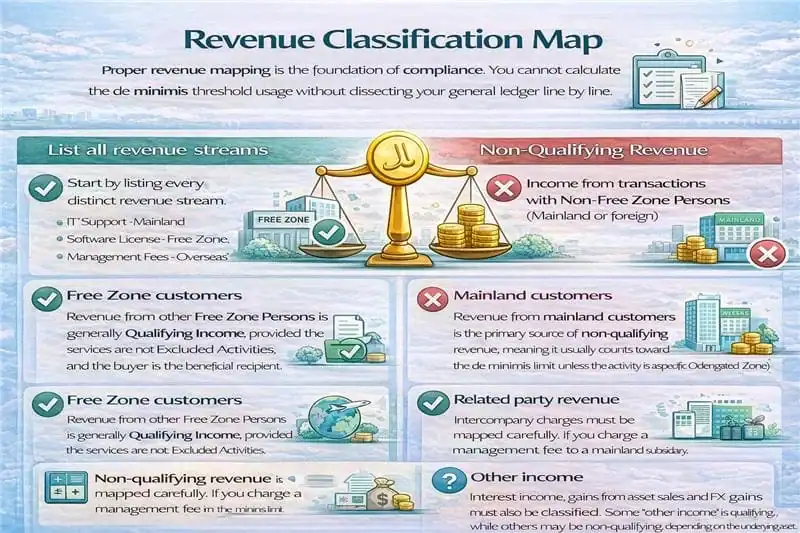
Proper revenue mapping is the foundation of compliance. You cannot calculate the de minimis threshold usage without dissecting your general ledger line by line.
List all revenue streams.
Start by listing every distinct revenue stream. Do not group them vaguely like “Consulting Services.” Be specific: “IT Support – Mainland,” “Software License – Free Zone,” “Management Fees – Overseas.”
Free Zone customers
Revenue from other Free Zone Persons is generally Qualifying Income, provided the services are not Excluded Activities, and the buyer is the beneficial recipient.
Mainland customers
Revenue from mainland customers is the primary source of non-qualifyingrevenue, meaning it usually counts toward the de minimis limit unless the activity is a specific Qualifying Activity (like the distribution of goods from a Designated Zone).
Overseas customers
Income from exports of services or goods to customers outside the UAE is typically Qualifying Income, provided the activity is not an Excluded Activity.
Related party revenue
Intercompany charges must be mapped carefully. If you charge a management fee to a mainland subsidiary, this is likely non-qualifying revenue counting toward the de minimis limit. This is also where documentation gaps trigger risk, so align intercompany policies to transfer pricing requirements and documentation.
Other income
Interest income gains from asset sales, and FX gains must also be classified. Some “other income” is qualifying, while others may be non-qualifying depending on the underlying asset.
Classify each stream
Qualifying revenue
This goes into the Denominator of your test but stays out of the numerator. It protects your 0% status.
Non-qualifying revenue
This is the danger zone. It goes into the numerator. This includes standard services provided to mainland clients or revenue from Excluded Activities.
Revenue excluded from the de minimis test
Revenue attributable to a Domestic PE (taxed at 9%) and revenue from immovable property located in a Free Zone (specifically transactions with non-Free Zone persons regarding non-commercial property, or any property transactions that are not “Qualifying”) are excluded from both the numerator and denominator of the de minimis calculation.
Case Study: The Intercompany Conflict
A Free Zone holding company charged AED 6,000,000 in “Management Fees” to its mainland subsidiary to cover global overheads. Because a mainland entity paid these fees for a non-qualifying activity, the holding company immediately breached the AED 5M cap.
Testimonial:
“We thought intercompany recharges were ‘neutral’ for tax, but the FTA viewed them as standard non-qualifying revenue that disqualified our entire 0% claim.” — Group Controller, Retail Global.
How to calculate de minimis
Accurately performing the de minimis calculation method is a monthly necessity for finance teams.
Calculation inputs
Non-qualifying revenue (numerator)
Identify every dirham of revenue derived from Excluded Activities or non-qualifying transactions with non-Free Zone Persons.
Total revenue for testing (Denominator)
This is your total turnover for the tax period, adjusted for specific exclusions.
Items excluded from the calculation
If you have a mainland branch treated as a Domestic PE, and you pay 9% tax on that branch’s income, that revenue is removed from this calculation. It does not help dilute your non-qualifying revenue, nor does it count against you. If you are unsure about the correct registration and filing timeline for this structure, cross-check against UAE corporate tax registration deadlines and align your approach with DBTA Corporate Tax compliance support.
Calculation method
5% test
Calculate: (Non-Qualifying Revenue / Total Revenue) x 100. Is it below 5%?
AED 5,000,000 test
Is the total Non-Qualifying Revenue below AED 5,000,000?
Apply the lower limit
You must pass the stricter of the two. If your 5% calculation results in AED 8M, your limit is AED 5M. If 5% results in AED 200k, your limit is AED 200k (if AED 200k is the lower of 5% of revenue or AED 5,000,000).
Gross or net
Gross revenue vs net profit treatment
The de minimis rule is strictly based on gross revenue (turnover), not net profit. A high-revenue, low-margin business burns through the AED 5M limit just as fast as a high-margin business.
Revenue recognition and credit notes
Ensure revenue is recognised according to IFRS/accounting standards. Credit notes issued in the period reduce the revenue figure.
Worked examples
Low-revenue company where 5% triggers breach
- Scenario: A boutique consultancy has AED 3,000,000 total revenue.
- Limit: 5% of AED 3M = AED 150,000. (This is lower than an AED 5M).
- Result: If they earn AED 200,000 from mainland clients, they breach the de minimis threshold and lose 0% status, even though AED 200k is far below AED 5M.
High revenue company where AED 5M triggers breach
- Scenario: A large logistics software firm has AED 200,000,000 in revenue.
- Limit: 5% is AED 10,000,000. However, the cap is fixed at AED 5,000,000.
- Result: They can only earn up to AED 5,000,000 in non-qualifying revenue.
Mixed revenue with one misclassified stream
- Scenario: A company assumes “Management Fees” are qualifying. Upon review, AED 6M of management fees charged to a mainland sister company are reclassified as non-qualifying.
- Result: They breach the AED 5M cap immediately.
Mainland revenue and 0%
The interaction between Free Zone entities and the mainland is the most common cause of a de minimis breach.
Mainland customers and non-qualifying revenue
Unless you are distributing goods from a Designated Zone or providing specific qualifying services, revenue from mainland customers is generally non-qualifying.
Mainland contracts invoiced from the Free Zone.
Simply invoicing from the Free Zone does not make income qualifying. If the customer is on the mainland and the activity doesn’t fit a specific exemption, it counts toward the de minimis limit.
Mainland distributor or agent sales
Selling through a mainland distributor can sometimes help if structured correctly (where the distributor is the customer), but if the distributor is merely an agent, the risk remains.
Related party mainland transactions
Many groups use a Free Zone entity as an HQ. Charging “Head Office Costs” to mainland subsidiaries creates non-qualifying revenue, meaning you are filling up your de minimis bucket with intercompany charges.
Common misclassification traps
- Assuming all “software services” are qualifying (they may not be for mainland clients).
- Treating a mainland company as a Free Zone person just because they have a branch in the Free Zone (you must contract with the Free Zone branch).
Excluded activities and edge cases
What is treated as excluded activities
Certain activities are “tainted” and include:
- Transactions with natural persons (with limited exceptions).
- Banking, insurance, finance, and leasing activities.
- Ownership or exploitation of immovable property, except for transactions with Free Zone Persons in respect of Commercial Property located in a Free Zone.
- Intellectual property assets not meeting specific qualifying criteria.
The difference between excluded and non-qualifying
“Excluded Activities” revenue is always non-qualifying. However, “Non-Qualifying Activities” (like general services) can be qualifying if done with a Free Zone Person but become non-qualifying if done with a mainland person.
Practical controls to prevent excluded activity revenue
Implement a “Gateway Check” in your CRM. Sales teams should not be able to generate contracts for Excluded Activities without Finance approval.
Domestic PE and branch impact
What creates a domestic PE in practice
A Domestic PE is created if you have a fixed place of business on the mainland or dependent agents who habitually conclude contracts there.
Revenue attribution to PE
Attributing revenue to a PE reduces the de minimis numerator. It isolates the taxable income, so it doesn’t affect the 0% pool.
Branch mainland tax impact
The mainland branch is a Domestic PE. Its income is taxable at 9%.
When a separate mainland entity is safer
If domestic permanent establishment (PE) free zone attribution is too complex or risky, establishing a separate mainland LLC (subsidiary) is often cleaner. The mainland LLC pays 9%, and the Free Zone entity remains free zone attribution is too complex or risky. Establishing a separate mainland LLC (subsidiary) is often cleaner. The mainland LLC pays 9%, and the Free Zone entity remains pure.
Case Study: The “PE Shield” – Saving a 0% Rate Through Strategic Attribution
A Free Zone IT services client, “TechServe FZ,” had sales staff working permanently at a client’s site in the Dubai Mainland. They generated AED 4M in revenue from this client. They initially treated this AED 4M as non-qualifying revenue, which pushed them perilously close to the AED 5M de minimis limit. If they took even one more small mainland contract, they risked losing the 0% rate on their entire global turnover.
We identified that the permanent presence of staff on the mainland created a Domestic Permanent Establishment (PE). We helped them attribute the AED 4M to the Domestic PE. While this revenue was taxed at 9%, it was legally removed from the de minimis calculation. This lowered their non-qualifying revenue in the Free Zone entity back to zero, preserving the 0% rate on their remaining AED 50M of international income.
What happens if you breach de minimis
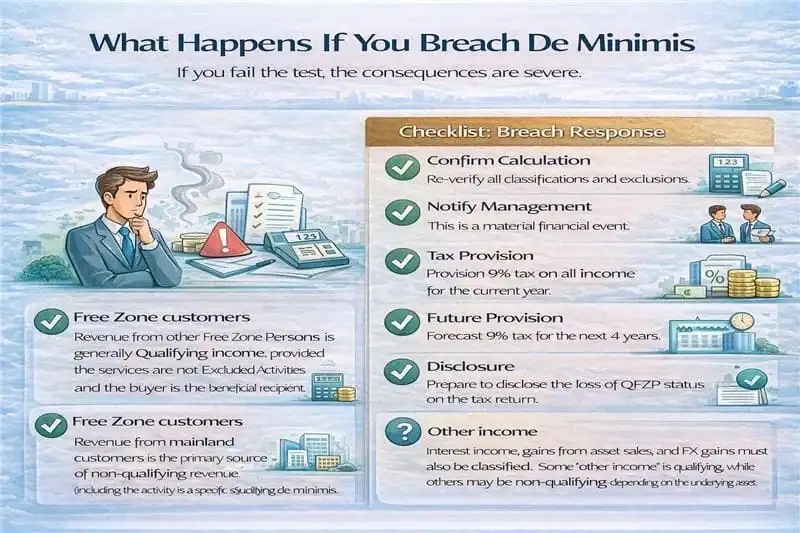
If you fail the test, the consequences are severe.
De minimis breach consequences
A de minimis breach of consequences includes the total loss of the QFZP tax benefit.
Loss of 0% for one year or multiple years
The lockout period is the tax period in which the conditions are not met, and the subsequent four tax periods. This is a mandatory five-year disqualification from the 0% regime. You may only re-test for QFZP status in the sixth year.
Taxed at 9% on all income or only part
You are taxed at 9% on all taxable income, not just the amount above the threshold. For how the 9% regime applies in practice (thresholds, compliance steps, and filing logic), reference the Understanding UAE’s 9% Corporate Tax compliance guide.
Compliance and audit exposure
A breach often triggers an FTA review. If you fail to self-declare the violation and the FTA discovers it, penalties for underpayment of tax and incorrect filing apply. If you want a practical breakdown of the penalty landscape (including the AED 10,000 registration fine), this is the reference point: UAE Corporate Tax Penalty Explained | AED 10,000 Fine.
What to do if you are close to the limit
Immediate steps
Stop invoicing non-qualifying revenue immediately if you are near the cap. Deferring revenue must strictly comply with IFRS 15 (Revenue from Contracts with Customers). Artificial deferral to avoid the de minimis cap can be flagged under the UAE’s General Anti-Abuse Rules (GAAR).
Reduce non-qualifying revenue
Review your pipeline. Can a partner service any mainland leads instead? Can the contract be structured differently?
Fix the de minimis breach.
You cannot “fix” a breach once the tax year is closed. Prevention is the only cure. However, if you are mid-year, you can aggressively manage the remaining months to stay under the cap.
Restructure mainland revenue
Separate mainland entity
Incorporate a mainland LLC to handle all mainland business. This entity pays tax, while the Free Zone entity handles international/Free Zone business at 0%.
Mainland branch
Register a branch and attribute income to it.
Distributor or agent model
Appoint a third-party distributor on the mainland to buy from you (export from the Free Zone) and sell to customers.
Contract and invoicing cleanup
Ensure your contracts explicitly state the scope and location of services to defend your classification.
Evidence and tracking
The FTA will not take your word for it. You need a defense file.
De minimis evidence checklist for FTA review
When the FTA reviews de minimis calculations, they ask for the transaction listing and proof of customer status (Mainland vs Free Zone). Missing trade licenses for customers is a common failure point.
De minimis tracking checklist
- Monthly reconciliation of GL to Tax Tracker.
- Quarterly review of “Excluded Activities.”
- Annual impact assessment before year-end.
Tracking frequency monthly vs quarterly
Monthly is mandatory for high-volume businesses. Quarterly is acceptable only for dormant or very low-activity entities.
Internal controls and threshold alerts
While a fixed AED 3.5M alert is helpful, the system must also track the 5% ratio simultaneously. For a company with AED 40M revenue, the 5% limit is only AED 2M, meaning an alert set at AED 3.5M would trigger far too late.
How DBTA can help
De minimis assessment and calculation model
We build custom models that integrate with your ERP to calculate your de minimis 5% aed 5m position in real-time.
Mainland expansion structure planning
We advise on whether to use a branch, a subsidiary, or a distributor to handle mainland expansion without contaminating your Free Zone tax status.
PE and branch risk review
We conduct deep-dive reviews to identify hidden Domestic PE risks that could serve as a tool to manage the de minimis threshold or a threat to your compliance.
Evidence pack and tracking setup
We help you compile the “audit-ready” defence file so you aren’t scrambling during an FTA audit.
Breach remediation plan
If a breach is inevitable, we help you manage the transition to the 9% regime, ensuring compliance and minimising penalties.
Case Study: The De Minimis Stress Test
Global Trade FZ was unsure if its brokerage revenue constituted an Excluded Activity. DBTA performed a “Stress Test” reviewing their top 50 contracts and found that 20% of their revenue was technically excluded. ‘
We advised them to restructure the brokerage arm into a separate mainland entity, which restructured mainland revenue to protect the 0% rate for the core AED 12M logistics business.
Client Testimonial:
“DBTA didn’t just file our taxes; they saved our business model. Their stress test caught a AED 1 million tax liability before it happened.” — Managing Director, Global Trade FZ.
Conclusion
The de minimis rule is a critical compliance threshold for all Free Zone businesses. By keeping non-qualifying revenue below 5% of turnover or AED 5,000,000, firms can protect their 0% rate. A single breach of the de minimis threshold results in a five-year lockout from the 0% regime. Other triggers include failing to maintain audited financials or inadequate economic substances.
Effective prevention relies on monthly tracking, robust CRM tagging of mainland vs. free zone customers, and proactive restructuring of mainland revenue streams before the limit is hit. Maintaining QFZP status requires constant vigilance.
Would you like us to review your current revenue mapping to see if you are approaching the de minimis limit? If yes, start with a focused Corporate Tax assessment with DBTA.
FAQ's:
It is a threshold that allows a QFZP to earn a small amount of non-qualifying revenue without losing the 0% tax benefit on their qualifying income.
Calculate the de minimis ratio by dividing non-qualifying revenue (arising from excluded activities or mainland services) by total revenue, excluding any income attributable to a Domestic Permanent Establishment. The resulting percentage must not exceed 5%, and the absolute amount of non-qualifying revenue must not exceed AED 5,000,000.
The calculation is strictly based on gross revenue (turnover). Expenses and net profit margins do not influence the 5% or AED 5M thresholds.
It is revenue from “Excluded Activities” or non-qualifying activities with Non-Free Zone Persons. Identification requires a line-by-line audit of your sales ledger against official definitions.
Yes, in most cases. Unless the activity is on the “Qualifying Activities” list and meets all conditions, sales to mainland entities are non-qualifying.
The location of the invoice doesn’t matter; the location of the activity and the customer do. If the revenue is non-qualifying and exceeds the limit, it breaks the 0% status.
If you sell goods to a mainland distributor (buy-sell), it might qualify as the distribution of goods. However, if the distributor acts as an agent, the sale counts toward your de minimis limit.
Yes. Charging management fees or intercompany costs to a mainland sister company counts as non-qualifying revenue and consumes your de minimis allowance.
These include banking, insurance, finance and leasing, and most transactions with natural persons (individuals) unless specific exceptions for ships/aircraft management apply.
You lose the 0% rate for the year of the breach plus the next four years. This is a five-year disqualification in total.
The company is taxed at 9% on its entire taxable income, including the income that would have otherwise been qualifying.
You must keep a detailed de minimis tracking checklist, copies of trade licenses for all customers, and clear contracts proving the nature of activities.
Monthly tracking is essential. It allows for mid-year course correction, such as pausing mainland sales or re-routing them, before a breach becomes permanent.
Assess if any revenue can be attributed to a Domestic PE or if you should stop taking mainland orders through the Free Zone entity until the next tax year.
The most effective options are incorporating a separate mainland subsidiary or registering a mainland branch that qualifies as a Domestic PE, effectively segregating the 9% revenue.
Latest news & articles


About the Author:
AURANGZAIB CHAWLA
As CEO of DBTA, Aurangzaib Chawla advises globally mobile businesses and individuals on cross-border tax planning and structuring. With expertise spanning the UK, UAE, and wider GCC, Zaib helps clients minimise double taxation, protect assets, and achieve long-term financial efficiency while staying fully compliant.
Planning to launch in Dubai or the UAE?
Let’s talk about how to structure your business for growth the smart, compliant, and tax-efficient way

About the Author:
AURANGZAIB CHAWLA
As CEO of DBTA, Aurangzaib Chawla advises globally mobile businesses and individuals on cross-border tax planning and structuring. With expertise spanning the UK, UAE, and wider GCC, Zaib helps clients minimise double taxation, protect assets, and achieve long-term financial efficiency while staying fully compliant.
Planning to launch in Dubai or the UAE?
Let’s talk about how to structure your business for growth the smart, compliant, and tax-efficient way
About the Author:
AURANGZAIB CHAWLA

As CEO of DBTA, Aurangzaib Chawla advises globally mobile businesses
and individuals on cross-border tax planning and structuring. With expertise spanning the UK, UAE, and wider GCC, Zaib helps clients minimise double taxation, protect assets, and achieve long-term financial efficiency while staying fully compliant.
Planning to launch in Dubai or the UAE?
Let’s talk about how to structure your business for growth the smart, compliant, and tax-efficient way.
Connect with Reliable Dubai Business Consultants
Get in Touch