
Corporate Tax Registration Deadlines UAE: 2025 Free Zone Guide

Recent Insights

Table of Contents
Introduction
The introduction of the UAE Corporate Tax (CT) regime, formalized by Federal Decree-Law No. 47 of 2022, represents the most significant change to the nation’s commercial landscape in decades. For years, Free Zones were synonymous with tax immunity, allowing businesses to operate with the comfortable assumption of minimal administrative oversight. That era has definitively ended. While many Free Zone entities, such as those registered in SHAMS, IFZA, RAKEZ, Meydan, or DMCC, will still benefit from the 0% rate on Qualifying Income, the obligation for compliance, specifically, registration, filing, and payment, is now non-negotiable.
The critical compliance pressure point for 2025 is not just about calculating tax, but about navigating a strict, administrative calendar. The overwhelming question we hear from Free Zone owners is: “When exactly do I need to register with the Federal Tax Authority (FTA)?” This article is dedicated to answering that question exhaustively. It is not enough to ask if you must register; you must understand the definitive and often overlooked dates that determine your liability for administrative penalties.
The year 2025 marks the point where CT enforcement moves from theory to reality. The first filing cycles for tax periods commencing in 2024 are starting, and the early grace or waiver windows provided by the FTA are now closing or requiring specific action to utilize them. This makes understanding the UAE corporate tax deadlines 2025 an urgent priority.
We identify three core issues causing critical compliance failures among Free Zone stakeholders:
- Communication Gaps: Many foreign founders, particularly those operating Free Zone entities remotely, often miss regulatory updates due to a lack of direct, personalized communication from their respective Free Zones.
- The Zero-Revenue Fallacy: There is a widespread and costly belief that if a company is dormant, non-trading, or has generated zero revenue, it has no compliance obligations. This is factually incorrect and dangerous.
- The Penalty Threat: The looming, fixed AED 10,000 penalty for late registration, a fine that the FTA began enforcing aggressively in 2024, causes significant, unnecessary financial strain.
This expert guide will break down the essential corporate tax registration deadline in the UAE and all other key dates that Free Zone businesses must monitor. We will demonstrate how your company’s trade license issue date sets your registration deadline, detail the compliance cadence for 2025, and show you exactly how to avoid substantial fines, supported by a clear corporate tax deadline checklist for the UAE.
The Three Clocks: Registration, Filing, Payment
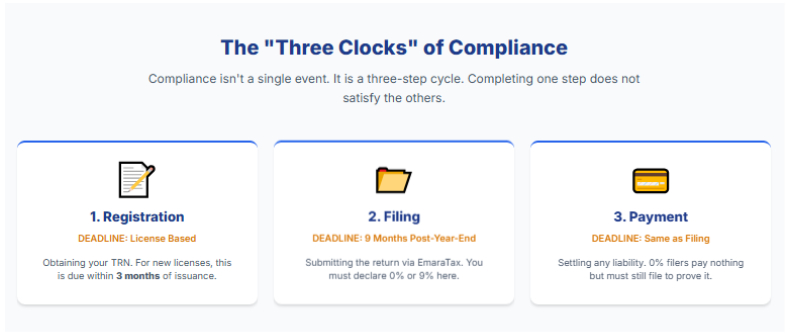
A common mistake is treating Corporate Tax compliance as a single event. Every Free Zone business must manage three distinct and critical compliance clocks: Registration, Filing, and Payment. Failure to meet the timeline for any one of these can trigger severe penalties.
Corporate Tax Registration Deadline UAE – Big Picture
Corporate Tax registration is the mandatory administrative step of informing the FTA that your entity exists and falls under the CT regime, resulting in the issuance of a Corporate Tax Registration Number (CT TRN) via the EmaraTax portal. This process is entirely separate from VAT registration, and the deadlines are set by specific FTA decisions.
The Crucial Link: License Issue Date
The timeline for registration is linked directly to your company’s license issue date, which is typically stated on your trade license or incorporation certificate. This rule applies uniformly to all juridical persons, Free Zone companies, holding entities, and SPVs. Crucially, the requirement to register is mandatory even for dormant, non-trading, or zero-revenue Free Zone companies. The FTA monitors the administrative fact of incorporation, not the commercial fact of trading.
FTA Decision No. 3 of 2024: Staggered Deadlines
To manage the volume of applications, the FTA established a staggered compliance calendar through Decision No. 3 of 2024. This decision provided the formal structure for the FTA corporate tax deadlines 2025 framework.
For older licenses issued in 2022 and 2023, fixed registration deadlines were set across 2024. If your Free Zone company was licensed before 2024, you must check the official schedule immediately, as you are likely already late and now face the AED 10,000 penalty, requiring immediate action to utilize the subsequent waiver mechanism.
For newer entities, the deadline rule is simpler but equally strict:
- The 3-Month Rule for New Free Zones: For any resident juridical person established (i.e., licensed) on or after 1 June 2024, the application for CT registration must be submitted within 3 months from the date of license issuance.
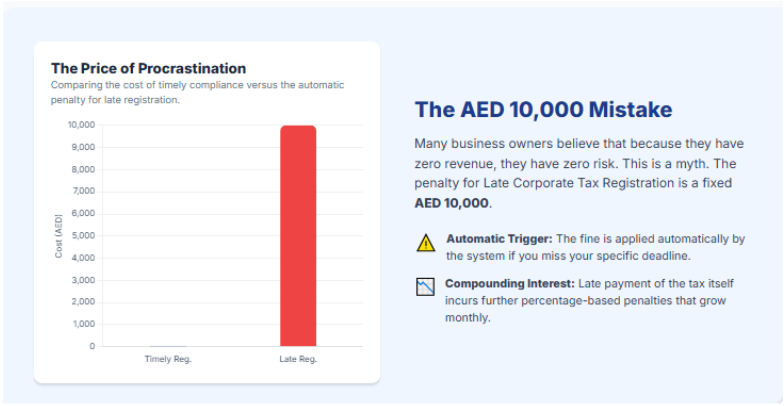
This immediate deadline is the single highest administrative risk for new Free Zone startups. Missing the corporate tax registration deadline UAE by a single day due to oversight, or the incorrect belief that zero-trading activity offers immunity, will result in the AED 10,000 fine. This system prioritizes administrative control (getting all entities registered) over immediate tax calculation (filing).
We summarize the current registration framework below, which helps define your corporate tax deadline by license date UAE:
| License Issue Date Range | Registration Due Date | Current Compliance Status |
|---|---|---|
| Before 1 Jan 2024 | Fixed dates across 2024 | Likely overdue; register immediately to utilize the penalty waiver. |
| 1 Jan 2024 – 31 May 2024 | Fixed dates (e.g., up to 31 August 2024) | Likely overdue; register immediately to utilize the penalty waiver. |
| On or after 1 June 2024 | Within 3 months from the date of license issuance | Immediate, crucial administrative deadline. |
What You’ll Need for Registration
To ensure you meet the corporate tax registration deadline in the UAE efficiently via the Emara Tax portal, Free Zone owners should prepare a dossier containing:
- A copy of the valid Trade License and Memorandum of Association (MOA).
- Passport, Emirates ID (if applicable), and residency documentation for major shareholders and authorized signatories.
- Proof of authorization for the signatory (if applicable).
- A confirmed UAE mobile number and dedicated email address for FTA correspondence.
Corporate Tax Filing Deadline UAE vs Payment Deadline
Once registered, the next clock starts ticking: the financial compliance period. The corporate tax filing deadline in the UAE and the corporate tax payment due date in the UAE are generally synchronized and fall exactly nine months after the end of your tax period.
For Qualifying Free Zone Persons (QFZPs) enjoying the 0% rate, the filing requirement remains mandatory even if the tax payment due is zero. For non-qualifying entities subject to the 9% rate, the synchronization of filing and payment means the tax liability becomes due simultaneously with the return submission. This necessitates rigorous cash flow planning; if your tax payment is delayed past the corporate tax payment due date, UAE, penalties are immediately applied. The free zone tax return deadline UAE cannot be treated as optional.
Key Concepts: First Corporate Tax Period & Year-End
To determine your deadlines, you must first identify your tax period. The CT regime applies to financial periods starting on or after 1 June 2023.
- Defining the First Tax Period: The first corporate tax period in the UAE for most existing established Free Zone companies, whose accounting year is the calendar financial year January to December 2024.
- The Impact of Your Financial Year-End (FYE): Your selected FYE will predetermine your ancillary compliance activities, in addition to the related specific UAE corporate tax year-end deadlines. A 31 December year-end company has less time to file than a 31 March year-end firm, even if they both have the same Free Zone base.
For a founder to quickly identify their first critical dates, they must know their FYE. This financial deadline serves as the basis for calculating the first corporate tax return deadline in the UAE and the payment deadlines that fall throughout 2025 and 2026.
Case Study: The Confused Filing Periods
An IFZA-registered e-commerce company was incorporated on 5 July 2023 with a financial year end of 30 June. The founder mistakenly thought that their first tax period would be the calendar year (ending 31 December 2024). We, during a routine check, discovered the compliance shortfall and reissued the client’s correct tax period to its adjustment tax period as 5 July 2023 – 30 June 2024 with a due date of lodgment falling on 31 March 2025. We promptly scheduled the necessary audit engagement and put into place a revised compliance calendar, which saved the client from incurring the filing penalty and established an organized timeline of deadlines for subsequent periods.
Client Testimonial:
“We found the breakdown of the three clocks, Registration, Filing, and Payment, hugely clarifying. It made us realize our administrative error was months older than we thought, but it gave us a clear path to correcting it.” – (IFZA E-commerce Client).
2025 Corporate Tax Deadlines for Free Zone Companies – Snapshot
The corporate tax filing timeline UAE free zone is currently one of the most dynamic areas of compliance, as the deadlines for the first tax periods are now arriving.
Standard Calendar-Year Free Zone Companies (31 Dec Year-End)
The majority of Free Zone SMEs and holding companies align their reporting with the calendar year.
- First Tax Period: 1 January 2024 – 31 December 2024.
- First CT Filing Deadline: 30 September 2025.
- Payment Deadline: 30 September 2025.
This September 2025 deadline is the primary target date for tens of thousands of UAE businesses and is non-negotiable, even if the eventual tax liability is zero.
Non-Calendar Year Examples (Mar/Jun/Sep Year-End)
If your company selected a non-calendar financial year, your free zone corporate tax deadlines are shifted, potentially easing the pressure of the September rush but requiring careful attention.The rule remains consistently nine months after the end date:
| Financial Year End (FYE) | First Tax Period End Date | Corporate Tax Filing Deadline UAE |
|---|---|---|
| 31 March | 31 March 2025 | 31 December 2025 |
| 30 June | 30 June 2025 | 31 March 2026 |
| 30 September | 30 September 2025 | 30 June 2026 |
Dubai Free Zone Examples (DMCC, IFZA, SHAMS, etc.)
The calculation logic applies consistently across all licensing authorities.
- DMCC Trading Company (31 March FYE): This entity’s 9-month deadline falls on 31 December 2025. This slightly later date compared to the calendar year entities allows more breathing room to finalize audits and secure advisory services outside the peak compliance season, affecting the strategic planning of the corporate tax deadline in Dubai Free Zone.
- SHAMS Free Zone Tax Deadline (New Incorporation): Consider a new e-commerce startup incorporated in SHAMS Free Zone on 15 June 2025, with its license date being the same day. Under the 3-month rule for new licenses established after 1 June 2024, the administrative corporate tax registration deadline UAE is 15 September 2025. This shows how quickly the compliance clock starts ticking. This company must file by 30 September 2026 (assuming a 31 Dec 2025 first financial year end). This timeline confirms the urgency embedded within the FTA registration calendar 2025.
Case Study: The Strategic Year-End Choice
A new European-owned consultancy setting up in DMCC was advised by DBTA to adopt a 31 March year-end instead of the standard 31 December. By doing so, they shifted their corporate tax filing deadline in the UAE from 30 September 2025 to 31 December 2025. This three-month buffer was strategically used to finalize their complex Transfer Pricing documentation without incurring the high, urgent fees associated with the Q3 rush.
Who Must Care About These Deadlines? Free Zone Personas

All juridical persons operating under corporate tax deadlines for free zone companies must adhere to the compliance framework. The obligations remain, regardless of size or activity level.
Active Free Zone Trading Company (SME)
An active SME, perhaps an IFZA digital marketing agency or a DMCC logistics firm, must manage the full complexity of CT. This involves meticulous record-keeping, audit coordination (mandatory for QFZP status), and potentially Transfer Pricing documentation. Their 2025–2026 path requires robust planning from registration through filing and payment.
Dormant or Zero-Revenue Free Zone Company
This category presents the highest risk of non-compliance. Owners of such entities often assume inactivity equals exemption. This is highly dangerous. They must still register by their license-based deadline. The FTA focuses solely on the license issue date, not whether the revenue is zero. Ignoring these free zone corporate tax deadlines means willingly accepting the AED 10,000 fine for late registration.
Holding / SPV in Free Zone
Holding companies or Special Purpose Vehicles (SPVs) are frequently established in Free Zones (like RAKEZ or DIFC) with minimal operational activity. Even with minimal transactions, these entities have mandatory registration and filing obligations. Maintaining a clean compliance record is vital, impacting corporate reputation and future due diligence processes during investment rounds or exits.
Freelancers & Side Businesses with Free Zone Licenses
Natural persons (freelancers, consultants, or sole proprietors) operating under a Free Zone license must consider the AED 1 million revenue threshold. Once this turnover is exceeded, the natural person is deemed a taxable person and must register for CT. They need immediate guidance on when corporate tax is corporate tax due UAE free zone, which will follow the standard 9-month rule for their business activities.
Small Business Using Relief
Businesses with revenues below AED 3 million for the current and previous tax periods may elect Small Business Relief (SBR). While this relief results in a 0% tax outcome on taxable income up to that threshold, it does not cancel the administrative requirements. Corporate tax deadlines for small business UAE still require timely registration and timely filing to successfully elect and utilize the SBR benefit.
Case Study: The Freelancer Who Crossed the Line
A Meydan-based freelance designer saw rapid revenue growth in Q4 2024, crossing the AED 1 million threshold. Although operating as a natural person under a freelance license, they became taxable the moment they crossed this limit and were required to register for Corporate Tax by March 2025. We identified the threshold trigger early, clarified their new compliance status, and executed the corporate tax registration process immediately, preventing the AED 10,000 late-registration penalty despite the freelancer having no previous Corporate Tax obligations.
Qualifying Free Zone Person (QFZP) vs Non-QFZP: Same Deadlines, Different Consequences
The primary distinction for Free Zone companies is whether they meet the criteria to be designated as a Qualifying Free Zone Person (QFZP), which grants the preferential 0% tax rate on Qualifying Income.
What is a Qualifying Free Zone Person?
To maintain QFZP status, an entity must satisfy four core conditions:
- Substance: Maintain adequate substances and perform core income-generating activities within the Free Zone.
- Accounting: Prepare and maintain audited financial statements.
- Qualifying Income: Derive income primarily from Qualifying Activities (e.g., transactions with other Free Zone Persons or income from outside the UAE).
- De Minimis Rule: Ensure that non-qualifying income (revenue from Excluded Activities or non-qualifying transactions with Non-Free Zone Persons) does not exceed the lower of 5% of total revenue or AED 5 million per financial year.
This status is a privilege, demanding continuous monitoring and meticulous record-keeping, rather than permanent entitlement.
Deadlines for QFZP vs Non-Qualifying Free Zone Companies
The UAE qualifying free zone tax deadlines for registration, filing, and payment are structurally the same for QFZPs and non-QFZPs. However, the consequences of non-compliance are dramatically different.
Missing a deadline is more than a simple administrative fine; it can be interpreted as a failure to maintain compliance conditions necessary for QFZP status. If a QFZP fails to meet any required condition in each tax period, the consequences are immediate and severe:
- Retroactive 9% Tax: The entity immediately loses QFZP status. The 0% tax rate is revoked, and the company’s entire taxable income for that period is subject to the standard 9% Corporate Tax rate (on income exceeding AED 375,000).
- Five-Year Disqualification: The failure triggers a statutory five-year lock-out. The entity is disqualified from being a QFZP for the tax period in which the failure occurred and the subsequent 4 tax periods.
This underscores the principle that timely compliance is the absolute foundation for preserving the 0% regime. An administrative error, such as missing the corporate tax filing deadline for the UAE, could result in five years of full tax exposure.
Case Study: The De Minimis Breach
A very successful JAFZA trading company, which was a QFZP, undertook a one-off mainland deal in Q4 2024, which has now caused its non-qualifying revenue to exceed the 5% De Minimis. DBTA considered the breach as part of its scrutiny, said that based on that one transaction, it would lose its QFZP status for the tax year 2024 and the subsequent four years, and redid sums following exposure to 9% Corporate Tax.
DBTA subsequently redefined its income categorization and adopted a proactive approach in order not to breach the requirements in the future.
Client Testimonial:
“Protecting our QFZP status was our top priority. DBTA’s team emphasized that timely compliance was a substantive requirement, not just a formality. That single piece of advice fundamentally changed how we manage our tax calendar.” – Client Testimonial (JAFZA Trading).
Penalties, Grace Periods & Waivers in 2025
The FTA has demonstrated its commitment to enforcing the deadlines through specific, high-value administrative penalties.
Penalty for Late Corporate Tax Registration & Filing
- Late Registration: The penalty for failing to submit the registration application within the timelines specified by the Authority is a fixed, non-discretionary fine of AED 10,000. This penalty applies even if the business is dormant or exempt from paying tax.
- Penalty for Late Corporate Tax Filing in the UAE: Missing the 9-month filing deadline incurs dual penalties: a fixed fine of AED 500 per month for the first 12 months, followed by AED 1,000 per month thereafter, compounded by additional penalties based on the under-declared tax amount. We cover this topic in depth in Blog 3: “AED 10,000 Mistake – What Happens If You Miss the UAE Corporate Tax Registration Deadline?”
Penalty for Late Corporate Tax Payment
For non-qualifying entities or QFZPs that generate non-qualifying income subject to the 9% rate, failure to pay the calculated tax liability by the UAE corporate tax payment due date results in severe financial consequences. The FTA charges a penalty equivalent to 14% annual interest on the unpaid tax, calculated and compounded monthly. This highly punitive rate highlights the necessity of accurate cash flow forecasting linked to the payment deadline. The penalty for late corporate tax payments in the UAE can quickly turn a manageable tax bill into a painful financial burden.
Compliance Calendar & Checklist for Free Zone Businesses
Proactive planning is the only way to meet the complex series of UAE corporate tax deadlines in 2025.
Corporate Tax Compliance Calendar UAE (2025–2026)
This corporate tax compliance calendar UAE focuses on QFZPs with a 31 December FYE, aiming to meet the accelerated penalty waiver deadline (31 July 2025).
| Timeline (2025) | Key Action Required | Compliance Goal |
|---|---|---|
| January – March | Year-end closing; confirm CT TRN; engage CT advisor and auditor. | Finalize accounts for first tax period (2024). |
| April – June | Prepare Transfer Pricing documents (if required); verify QFZP eligibility. | Ensure De Minimis threshold is not breached. |
| July | Accelerated Deadline: Submit CT Return and Annual Declaration. | Secure the UAE corporate tax grace period 2025 and waive the AED 10,000 penalty. |
| September | Final corporate tax filing deadline UAE (9-month rule); tax payment due. | Mandatory deadline for all entities; second chance for filing, but risk of penalty remains if registration was late. |
| October – December | Documentation review; prepare for Economic Substance Reporting (ESR) submission (if applicable). | Maintain readiness for the next tax cycle. |
Corporate Tax Deadline Checklist UAE (Free Zone Version)
Every Free Zone founder should maintain this ready-to-use corporate tax deadline checklist UAE to manage their obligations:
- Have we confirmed our license issue date and the corresponding corporate tax registration deadline UAE?
- Is FTA registration completed and a valid CT TRN issued via EmaraTax?
- Is our financial year-end confirmed and consistently applied across all financial and licensing documents?
- Are our books closed and audited (if necessary) in time to meet the July/September filing window?
- Have we engaged auditors and tax advisors early to avoid the peak season’s capacity crunch?
- Is the CT return prepared, reviewed, and filed before the mandatory corporate tax filing deadline UAE?
- Is the tax paid in full by the corporate tax payment due date UAE?
Real-World Scenarios: How Deadlines Play Out in Practice
Use concise, realistic examples to show how deadlines work in real life.
New Free Zone Startup in 2024 (Example Timeline)
- License date: 10 March 2024 (31 Dec FYE).
- Corporate Tax Registration Deadline UAE: 31 August 2024 (Fixed deadline for licenses issued in March 2024).
- First Tax Period: 1 January 2024 – 31 December 2024.
- First CT filing and payment dates: 30 September 2025. (Accelerated waiver deadline: 31 July 2025).
SHAMS Free Zone Company Example (2025)
- Company incorporated in SHAMS on 15 June 2025 (license date 15 June 2025).
- Registration deadline: 15 September 2025 (3 months from license date).
- Note: This SHAMS Free Zone tax deadline applies even if the company has not started trading.
- Penalty Risk: Failure to register by 15 September 2025 automatically incurs the AED 10,000 penalty.
Free Zone Holding Company / SPV with Minimal Transactions
A Dubai South holding entity licensed in 2023 must respect the same free zone corporate tax deadlines as an active business. Its registration deadline passed in 2024, and its first filing and payment deadline is 30 September 2025 (31 Dec FYE). Minimal activity does not grant any filing exemption.
Side-Hustle / Freelancer Crossing Threshold
A freelancer in Meydan earning AED 1.2 million in 2025 must register for Corporate Tax. Since they crossed the AED 1 million threshold, they must treat themselves as a business for CT purposes. They must register immediately upon crossing the threshold, and their first filing will follow the 9-month rule after their chosen FYE. This confirms when corporate tax is due to UAE free zone for natural persons.
How DBTA Helps Free Zone Businesses Stay Ahead of Deadlines
The intersection of Free Zone regulations, QFZP requirements, and administrative penalties has made UAE Corporate Tax compliance a high-stakes endeavor. For Free Zone owners, the administrative compliance deadline is often more critical than the tax calculation itself.
DBTA serves as your specialized, deadline- and penalty-proof partner, allowing you to focus on your core business while we manage the administrative and financial complexities.
Our expertise ensures practical outcomes that secure your Free Zone benefits:
- Deadline Management: We accurately pinpoint your specific corporate tax registration deadline UAE and implement a comprehensive corporate tax compliance calendar UAE tailored to your company’s financial year-end.
- Penalty Mitigation: We specialize in leveraging the 7-month waiver period to prevent or reverse the AED 10,000 late registration fine for companies that missed their 2024 deadlines.
- QFZP Assurance: We provide rigorous audit coordination and De Minimis verification, ensuring timely compliance to protect your Qualifying Free Zone status from five-year disqualification.
- End-to-End Filing: We handle the entire EmaraTax submission process, ensuring your corporate tax filing deadline UAE and corporate tax payment due date UAE are met accurately and on time.
Avoid the critical financial and regulatory risks associated with missed deadlines. We provide the experience and authority required to keep your compliance smooth, predictable, and fully protected against the UAE corporate tax deadlines 2025.
Case Study: Protecting the 0% Rate
A European founder who recently acquired a Free Zone business needed urgent confirmation of their tax exposure. DBTA performed a full compliance review and identified that the company was at high risk of losing QFZP status due to poor documentation and a looming filing deadline. By restructuring their accounting system and accelerating the audit, we protected their 0% rate and ensured the corporate tax return due date UAE was met with confidence.
Conclusion: Your 2025 Action Plan for Free Zone Compliance
The 2025 compliance cycle is not a drill; it is the definitive moment where the UAE Corporate Tax regime officially touches every Free Zone entity. The most immediate and critical takeaway is that administrative oversight, not financial burden, is the biggest threat to your business continuity.
You must treat the corporate tax registration deadline UAE, dictated by your trade license issue date, as the most immediate priority. Missing it incurs a fixed AED 10,000 penalty. Similarly, the corporate tax filing deadline UAE (30 September 2025 for most calendar-year businesses) is mandatory, even if your tax liability is 0%. For any entity that missed its initial registration deadline, the time to act is now: utilize the UAE corporate tax grace period 2025 by accelerating your first return filing to seven months from your year-end.
Ultimately, compliance is the key to protecting the privilege of the 0% regime. Late compliance can be fatal, risking the loss of QFZP status and triggering a five-year, retroactive 9% tax exposure. Stay proactive, consult experts early, and ensure every date on your corporate tax compliance calendar UAE is met.
Need Help? Book a consultation with our specialized Free Zone Tax Advisory team today. We can help you confirm your deadline, complete FTA registration, ensure ongoing compliance, and protect your QFZ status.
FAQs
Yes. All Free Zone juridical persons must adhere to the corporate tax registration deadline UAE, which is determined by the corporate tax deadline by license date UAE. Dormancy or lack of revenue does not negate this administrative requirement.
For most companies that follow a calendar financial year (31 December FYE), the filing and payment deadline for the first tax period (2024) is 30 September 2025.
To have the AED 10,000 late registration penalty waived, your company must submit its first Corporate Tax return within seven months of the end of its first tax period (e.g., by 31 July 2025 for a 31 December FYE).
Absolutely. QFZPs must register and adhere to the UAE corporate tax filing deadline to demonstrate continuous compliance and prevent the loss of QFZP status and the resulting 9% retroactive tax exposure.
Immediately confirm your license date, verify your FTA registration status, and set a target date to finalize your first audited accounts in time to meet the accelerated July 2025 deadline, if necessary for penalty mitigation.
The filing and payment deadline will be nine months later, on 31 December 2025.
Does renewing my license change my registration deadline?
No. The corporate tax registration deadline UAE is based on the initial license issuance date, not subsequent renewal dates.
The FTA imposes high, compounding penalties on late tax payments, calculated as 14% annual interest on the outstanding tax liability.
Latest news & articles



About the Author:
AURANGZAIB CHAWLA
As CEO of DBTA, Aurangzaib Chawla advises globally mobile businesses and individuals on cross-border tax planning and structuring. With expertise spanning the UK, UAE, and wider GCC, Zaib helps clients minimise double taxation, protect assets, and achieve long-term financial efficiency while staying fully compliant.
Planning to launch in Dubai or the UAE?
Let’s talk about how to structure your business for growth the smart, compliant, and tax-efficient way

About the Author:
AURANGZAIB CHAWLA
As CEO of DBTA, Aurangzaib Chawla advises globally mobile businesses and individuals on cross-border tax planning and structuring. With expertise spanning the UK, UAE, and wider GCC, Zaib helps clients minimise double taxation, protect assets, and achieve long-term financial efficiency while staying fully compliant.
Planning to launch in Dubai or the UAE?
Let’s talk about how to structure your business for growth the smart, compliant, and tax-efficient way
About the Author:
AURANGZAIB CHAWLA

As CEO of DBTA, Aurangzaib Chawla advises globally mobile businesses
and individuals on cross-border tax planning and structuring. With expertise spanning the UK, UAE, and wider GCC, Zaib helps clients minimise double taxation, protect assets, and achieve long-term financial efficiency while staying fully compliant.
Planning to launch in Dubai or the UAE?
Let’s talk about how to structure your business for growth the smart, compliant, and tax-efficient way.
Connect with Reliable Dubai Business Consultants
Get in Touch