
FZCO vs FZE: The Definitive Guide to Choosing the Right DUBAI Free Zone Structure

Recent Insights
Table of Contents
Introduction
Dubai is one of the top places in the world to start a business. But the range of company types can feel confusing at first. The biggest choice you will face is between an FZCO and an FZE.
On paper, they look the same. Both give you 100% ownership and zero tax on most profits. But one letter sets them apart. That difference shapes how easy it is to open a bank account, how much control you keep, and what you pay to get started.
Picking the wrong structure is a costly mistake. It can lead to bank rejections or a large bill to change your setup later. This guide gives you the clear facts you need to make the right call from day one. If you are still choosing between a Free Zone and Mainland setup, read our guide on Free Zone vs Mainland UAE business setup first.
What Are FZCO and FZE?
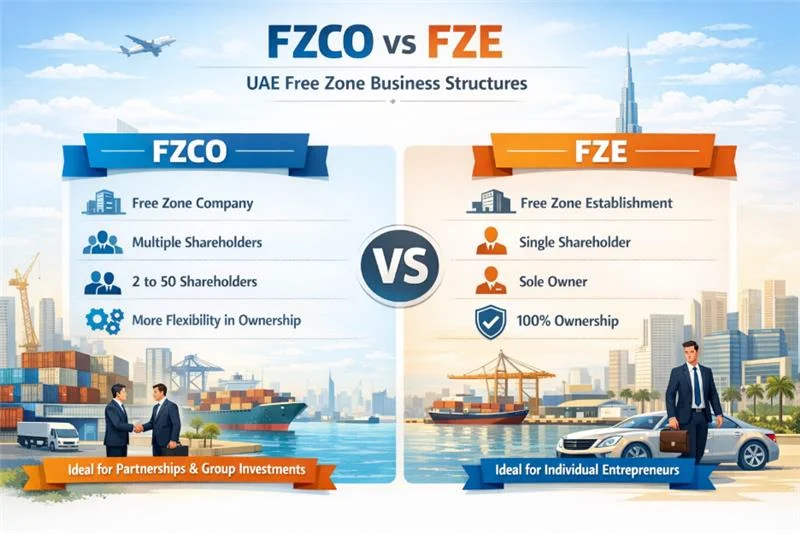
Before you compare FZE vs FZCO, you need to know what each one is.
FZE (Free Zone Establishment)
An FZE has one owner. That owner can be a person or a company. It is a legal entity set up in a Free Zone. It works like a sole trader setup, but with one key bonus: your personal assets are protected. Your liability is limited to what you put into the company.
FZCO (Free Zone Company)
An FZCO has two or more owners. Most Free Zones allow up to 50 shareholders. Some zones call it an FZC. Ownership is split by shares, just like a standard limited company (LLC). Each owner holds a set percentage of the business.
Do Both Protect You from Personal Liability?
Yes. Both the FZCO and the FZE are limited liability structures. This is a common point of confusion around FZCO vs FZE liability. In both cases, your personal assets are safe. You can only lose what you put into the company. But banks and investors see the two types very differently, and that gap matters more than most people expect.
How Does Shareholder Control Work in FZCO vs FZE?
The key difference between FZCO and FZE lies in who owns the company and how it is run.
FZE: Full Control for One Owner
With an FZE, the sole owner has total control. There are no partners to consult. No votes or board meetings are needed. You make every call yourself. FZE shareholder control is as simple as it gets.
This suits freelancers, solo founders, and holding companies where one parent entity wants to stay in full charge.
FZCO: Shared Control Between Partners
FZCO shareholder requirements set a minimum of two owners. These can be people, companies, or a mix of both. There are no rules about which country they come from, unlike some Mainland setups.
Decisions are made in accordance with the rules set out in the MOA (Memorandum of Association). This gives all partners a clear say. It also protects the business if one partner walks away. Banks see this as a sign of stability, and it matters a great deal when you apply for a business account.
What Are the Setup Costs for FZCO vs FZE in Dubai?
Cost is often the first thing founders look at. Here is how the FZCO setup cost in Dubai compares to the FZE setup cost.
In the past, Free Zones asked for large upfront capital, sometimes AED 1 million or more. Today, most major zones, such as IFZA, DMCC, and Meydan, have changed this. Many have either dropped the paid-up capital rule or sharply cut it.
The license fee is about the same for both structures. But the admin costs differ. An FZCO costs a bit more to register because the MOA is more complex to write and sign off on. For an FZE, the paperwork is much simpler, so the fees are lower.
On share capital, some zones still ask you to show funds in a bank account. For an FZCO, this can be AED 10,000 to AED 50,000. FZE rules are often lighter, and some zones waive this step. Annual renewal fees are broadly the same for both. But FZCO renewal fees in Dubai can increase if you change partners often, since each update incurs its own admin charge.
Cost Comparison Table
| Cost Item | FZE (One Owner) | FZCO (Two or More Owners) |
|---|---|---|
| Registration Fee | Lower (simple setup) | A bit higher (complex MOA) |
| License Fee | Same | Same |
| MOA Signing | Standard fee | Higher (often per owner) |
| Share Capital | Varies (often waived) | Varies (often waived) |
| Establishment Card | Same | Same |
Expert Note: The FZE setup cost in Dubai may look cheaper by AED 2,000 to 5,000 upfront. But if you need to add a partner later and convert to an FZCO, the cost is far higher. Plan.
How Do Setup Timelines and Documents Compare?
Speed matters too. When you compare the FZCO vs FZE setup timeline, the FZE is faster.
FZE: Fast and Simple
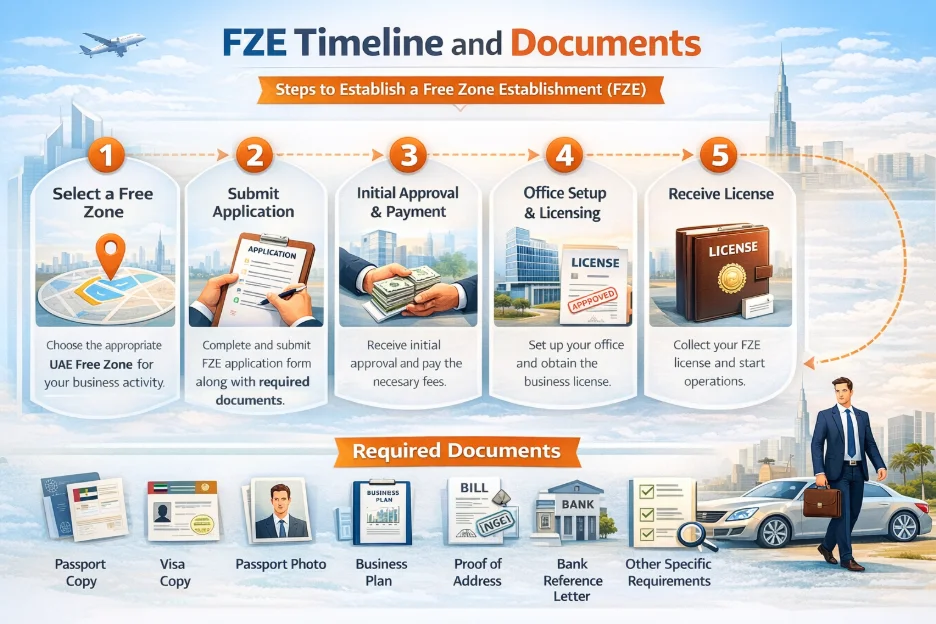
For a one-owner FZE company, the documents in Dubai are short. There is only one person to check. In zones like SHAMS or IFZA, you can often get your license in 3 to 5 working days.
You will need a passport copy, a visa copy if you have one, proof of address, and a Board Resolution if a company owns the FZE.
FZCO: Longer but Still Manageable
The FZCO company documents list in Dubai is longer. Every owner needs a background check. If one owner is a company based abroad, their papers must be signed off by the UAE Embassy in their home country. This can add weeks to the process.
You will need passports and visas for all owners, a signed MOA, and Board Resolutions from any corporate shareholders.
Setup Checklist:
Define your business activity clearly, as it affects the license cost
- Pick a trade name and have three options ready
- Get clean, high-quality scans of all owner passports
- Agree on the share split (for example, 51% / 49%) before the MOA is written
What Are the Compliance Rules and Risks for Each Structure?
Once your company is set up, the day-to-day rules come into play. FZCO compliance requirements and FZE compliance requirements are converging as the UAE pushes for greater transparency. But key gaps remain.
Governance and Reporting
An FZCO must hold annual meetings, even if they are informal. Any big decision, such as taking a loan or selling an asset, needs a written resolution. This creates a clear paper trail that protects all partners.
An FZE has lighter rules. But that is not always a good thing. Without structure, it is easy to mix personal and business money. Tax authorities flag this as a problem. Our guide on UAE corporate tax for Free Zone companies explains the full picture on why clean records matter.
What Happens if the Owner Leaves or Dies?
This is the biggest risk people miss when they compare FZCO vs FZE risks.
With an FZE, if the sole owner dies or becomes unable to work, the bank accounts are frozen immediately. The company is stuck in legal limbo. This can take months to sort out in the courts. With an FZCO, the other partners keep things running. The business does not stop. This is why FZCO ownership rules Dubai suits long-term businesses much better.
How Do Banks View FZCO vs FZE?
This section may be the most important in this guide. You can hold a valid license, but without a bank account, your business cannot function.
UAE banks are very careful about who they work with. When you compare FZCO vs FZE for banks, FZCO wins every time. Banks see a single-owner FZE as a high-risk structure. If that one person leaves the country or runs into legal trouble, any loan or line of credit is at risk.
An FZCO spreads that risk across multiple owners. This makes banks far more comfortable. FZCO bank account approval rates are higher across the board. FZE applications face more checks on the owner’s background and source of funds. Banks want proof that one person can run the whole operation alone.
If you must use an FZE, digital banks like Wio and Mashreq Neo are more open to single-owner setups than large legacy banks. Our team at DBTA supports you through the entire bank application process as part of our Dubai business setup service, including KYC pack preparation and direct bank liaison.
Which Structure Is Better for Getting Investment?

If you want to run a small personal business, an FZE works fine. But if you want to raise money, bring in partners, or plan an exit, an FZCO is the only real option.
Investors need equity. They cannot invest in an FZE without a full legal rebuild. To take on investment, an FZE must convert to an FZCO. This costs money in legal fees and government charges, and it takes time.
Starting as an FZCO, even if the second owner holds just 1%, sets the right base from day one. FZCO ownership rules in Dubai allow easy share transfers. This makes it a better vehicle for growth. You can also see how a holding structure fits into this in our guide on UAE holding company benefits for global business growth.
Case Study: How Switching to FZCO Saved TechNova Solutions
Background
Sarah, a software developer from the UK, set up TechNova Solutions in Dubai as an FZE. She wanted to save on costs and keep full control. She soon landed a big contract with a Saudi client. To take it on, she needed an AED 200,000 loan to hire staff.
The Problem
Sarah applied to three major banks in the UAE. All three said no. The reason was the same each time: a single-owner FZE with less than one year of trading was too risky. Then an angel investor offered AED 500,000. He walked away when he found out he could not take a share without a full legal overhaul.
How DBTA Fixed It
Sarah came to DBTA. We moved fast. We converted her FZE to an FZCO by bringing in a silent partner. This trusted advisor held 5% non-voting shares. That met the two-owner rule. We then revised her MOA to include a clear plan for what to do if one owner leaves. This tackled the bank’s biggest concern. We also built a comprehensive compliance file to demonstrate how the new FZCO was operated.
The Result
Within three weeks, TechNova had a business account with a top bank. The angel investor came back. The share transfer took 48 hours to complete.
“I thought I was smart by saving money on an FZE setup. In reality, I was locking myself out of the banking system and investment opportunities. DBTA did not just file paperwork. They showed me why the FZCO structure was key to my credibility. Making that switch was the turning point. The team handled the move without a hitch.” — Sarah J., Founder of TechNova Solutions
FZCO vs FZE: Key Advantages and Disadvantages
| Feature | FZE (One Owner) | FZCO (Two or More Owners) |
|---|---|---|
| Owner Count | One person or one company | Two to fifty owners |
| Main Benefit | Full control with no partner sign-off needed | Banks trust it more, and it is easy to bring in investors |
| Main Drawback | Banks see it as high risk | More paperwork and formal rules to follow |
| Bank Account | Harder to get. More checks, higher balance demands | Easier to get. Preferred by Tier-1 banks |
| Risk Level | High. Business can freeze if the owner steps away | Lower. Other owners keep things running |
| Raising Money | Hard. Must convert to FZCO to issue shares | Easy. Share transfers are built into the MOA |
| Setup Cost | Lower admin and signing fees | A bit more due to multi-owner paperwork |
| Best For | Freelancers, solo founders, and holding companies | Startups, small firms with partners, and those seeking bank loans |
On FZCO vs FZE tax benefits, both structures pay the same rate. Corporate tax is 9% on profits above AED 375,000, and 0% below that. There is no tax edge to one over the other, as long as you meet the Economic Substance rules. Read the full breakdown in our guide on the UAE Free Zone 0% corporate tax and QFZP status.
How DBTA Can Help
Choosing between FZE vs FZCO takes more than a quick web search. You need a team that knows the system.
At DBTA, we do not just sell licenses. We review your business plan and tell you which structure gives you the best shot at opening a bank account and raising money. We handle all the FZCO company documents Dubai needs, from writing the MOA to getting it signed and filed. We have strong ties with UAE banks and know how to build a profile that gets approved.
We also manage the long term. From FZCO renewal fees in Dubai to yearly audits and tax filings, we act as your outsourced company secretary. Find out more about our full range of services through our business tax advisory page.
Conclusion
The FZCO vs FZE decision is one of the most important calls you will make when setting up in Dubai. It is not just a form-filling exercise. It is the base your entire business sits on.
The FZE gives you full control and a lower setup cost. But it limits your access to bank accounts and makes it harder to attract investors. The FZCO costs a little more to set up, but it opens far more doors. Banks trust it. Investors can buy into it. And it keeps running even if one owner steps away.
If you want to build something that lasts in the UAE, think past the first-year setup fee. A business that cannot open a bank account or take on a partner cannot grow. See all your options in our guide to Dubai company formation and registration.
Ready to get started? Talk to the DBTA team today. We handle the setup, get your bank account approved, and keep your structure working for you as your business grows in Dubai.
FAQ's:
The core difference is the number of owners. An FZE has one owner, either a person or a company. An FZCO has two or more owners. This shapes how the company is run, how banks view it, and how easy it is to raise money.
An FZE needs exactly one owner. An FZCO needs at least two. Most Free Zones allow up to 50 owners in an FZCO.
In an FZE, the sole owner holds 100% control. In an FZCO, control is split according to the share percentages set out in the MOA. Day–to–day operations can be handed to a manager, but major ownership decisions require a formal vote.
Yes. Both protect your personal assets. In both FZCO vs FZE liability cases, you can only lose what you put into the company. Your private money and property are safe.
FZCO setup cost in Dubai ranges from AED 15,000 to AED 25,000 for the license and registration. Add visa costs of AED 4,000–6,000 per person, plus medical cover where required.
The FZE setup cost in Dubai is slightly lower than that for an FZCO. You typically save AED 1,000 to AED 3,000 on registration fees. There is no complex MOA to sign, so costs are lower.
Banks prefer the FZCO by a wide margin. Multi–owner companies look more stable to banks. Single–owner FZEs carry what banks call Key Man Risk, which leads to more rejections and stricter terms.
An FZE takes 3 to 5 working days. An FZCO takes 5 to 10 working days. The extra time comes from checking all owners and getting documents signed off, especially if any owner is a foreign company.
Most modern Free Zones, such as IFZA, SPC, and Meydan, have dropped this rule. For both FZCO minimum capital Dubai and FZE minimum capital Dubai, you can state the capital on paper without putting it in the bank right away.
No. Only one person can set up an FZE. To form an FZCO, you need a second owner. That person can hold as little as 1% of the company.
You need passport copies for all owners, visa copies, a No Objection Certificate (NOC) where needed, and a signed MOA. If any owner is a company, you also need corporate Board Resolutions
FZE company documents in Dubai are much simpler. You need a passport copy, a visa copy, and proof of address. Most zones do not ask for an MOA for a single–owner entity.
Both must renew their licenses each year and comply with the UAE Economic Substance Regulations (ESR). FZCOs must also hold annual owner meetings and keep formal records of big decisions. See how this links to your tax duties in our Free Zone QFZP compliance checklist.
No. Both pay the same corporate tax: 9% on profits above AED 375,000 and 0% on profits below that level. There is no tax edge to either. The FZCO wins on banking and growth, not on tax rates.
FZCO ownership rules in Dubai give banks more to work with. Multiple owners reduce risk. FZE ownership puts all the weight on one person. If that person has a thin profile or a tricky passport situation, the account gets rejected. An FZCO lets you back up a weaker profile with a stronger co–owner.
Latest news & articles

Visa-Free Countries for Emirates ID Holders (2026): Full List, Rules, and Travel Requirements
Read More »
About the Author:
AURANGZAIB CHAWLA
As CEO of DBTA, Aurangzaib Chawla advises globally mobile businesses and individuals on cross-border tax planning and structuring. With expertise spanning the UK, UAE, and wider GCC, Zaib helps clients minimise double taxation, protect assets, and achieve long-term financial efficiency while staying fully compliant.
Planning to launch in Dubai or the UAE?
Let’s talk about how to structure your business for growth the smart, compliant, and tax-efficient way
About the Author:
AURANGZAIB CHAWLA

As CEO of DBTA, Aurangzaib Chawla advises globally mobile businesses
and individuals on cross-border tax planning and structuring. With expertise spanning the UK, UAE, and wider GCC, Zaib helps clients minimise double taxation, protect assets, and achieve long-term financial efficiency while staying fully compliant.
Planning to launch in Dubai or the UAE?
Let’s talk about how to structure your business for growth the smart, compliant, and tax-efficient way.
