
Documents Required for Family Visa in UAE (2026): Complete Checklist & Requirements

Recent Insights
Table of Contents
Introduction
Taking your family to the UAE is a big step. It is about living together and building a stable future. But when you start checking the document requirement for family visa in the UAE, it can get confusing very quickly.
There are different rules for each case. Your job role, visa type, and emirate all affect the process. Even a small missing document can slow things down or stop approval.
This guide explains everything in a simple way. You will understand what is needed and what to do next. With support from Dubai Business and Tax Advisors, you can handle the process smoothly and bring your family without stress.
What Documents Do You Need to Sponsor Your Family in the UAE (2026)?
The exact documents depend on your visa status. You need to show who you are and prove income. Authorities also check if your residency is valid. If something is missing or unclear, delays can happen. That’s why it helps to prepare everything in advance.
Core Sponsor Documents (Employee, Investor, or Business Owner)
No matter your role, some documents are always required. These confirm your legal stay and personal identity.
In most cases, you will be asked for:
- A valid Emirates ID
- An active UAE residence visa
- A passport copy with enough remaining validity
- A recent photo with a plain white background
It’s better to keep soft copies ready as well. Clear, updated files usually make the process smoother.
Dependent Documents (Spouse, Children, Newborn)
Each family member must have their own documents. Requirements are checked separately for every applicant.
For a spouse or child, you will need:
- Passport copies for each person
- Recent photos that meet official guidelines
- An attested marriage certificate for your spouse
- Attested birth certificates for children
For newborn applications, the process is simpler. A birth certificate and passport are usually required. Make sure all documents are clear and valid. Even small issues can delay your application.
Mandatory Supporting Documents (Ejari, Salary Proof, Emirates ID)
You cannot apply for a family visa online in the United Arab Emirates without proof of accommodation. A registered tenancy contract or Ejari is mandatory for Dubai residents. Other emirates require a verified housing contract through the ICP portal. The Emirates ID requirement for a family visa applies to all dependents over 15. They must attend a biometrics center to complete this step.
Attestation and Legal Translation Requirements for Foreign Documents
Documents from outside the UAE must be verified. They are not accepted without proper attestation. First, get them attested in your home country. Then, complete verification within the UAE. If documents are not in Arabic, translation is required. Only by Professional translators certified by the Ministry of Justice.
Which Documents Change Based on Your Situation? (Employee vs Business Owner vs Investor)
The required documents for a family visa in the UAE vary by your employment type. The government checks different files to confirm your monthly earnings.
If You Are a Mainland Employee (MOHRE Contract + Salary Proof)
Mainland employees must show a MOHRE employment contract. This document lists your basic salary and total allowances. The minimum salary for a family visa in the UAE for employees is AED 4,000.
If You Are a Free Zone Employee (Salary Certificate + Company Letter)
A free zone sponsor’s family visa in the UAE requires a salary certificate. The Free Zone Authority (like DMCC or DIFC) issues this document. It must be addressed to the specific immigration department. It should be dated within the last 30 days.
If You Are a Business Owner / Partner (Trade License, MOA, Company Documents)
Business owners do not provide a MOHRE contract. Instead, they show the company Trade Licence and Memorandum of Association (MOA). You must also provide proof of a security deposit for each dependent. This deposit is usually AED 3,000 per person in some emirates. Remember that business profits are subject to a 9% Corporate Tax. This applies if your taxable income exceeds AED 375,000.
If You Are a Freelancer or Self-Employed (Permit + Income Proof)
Freelancers must show a valid freelance permit. You also need recent bank statements to prove your monthly income. The immigration office checks these to ensure financial stability.
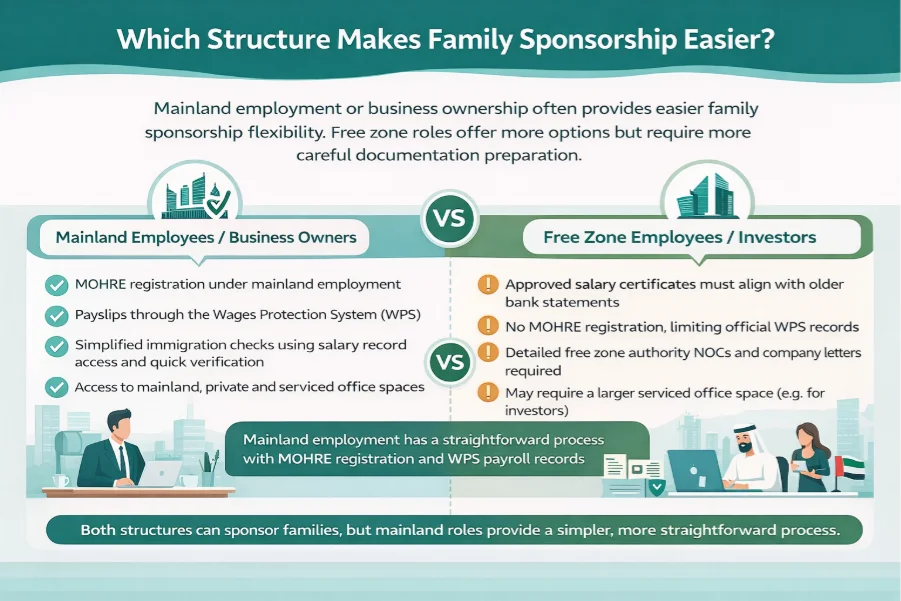
Free Zone vs Mainland Sponsorship – What Changes in Documents and Eligibility?
Both systems allow family sponsorship, but the proof differs. Mainland sponsors fall under MOHRE regulations and the Wage Protection System (WPS).
Document Differences Between Mainland and Free Zone Sponsors
| Document Type | Mainland Sponsor | Free Zone Sponsor |
|---|---|---|
| Employment Proof | MOHRE Labour Contract | Free Zone Salary Certificate |
| Salary Verification | WPS Records | Bank Statement / Letter |
| Portal Used | GDRFA or ICP | Specific Free Zone Portal |
Income Proof Differences (WPS vs Salary Certificate vs Business Income)
The UAE government tracks mainland salaries through the WPS. This system logs every payment to your bank account. Free zone employees rely on certificates issued by their authority. If you own a business, you must prove shareholding value. Your income must cover the family’s cost of living and healthcare.
When Free Zone Investors Face Restrictions
Some free zones have specific rules outlined in the family visa checklist for the United Arab Emirates in 2026. Investors might need to show a minimum investment amount. This is often AED 72,000 or a share in a company.
Step-by-Step Family Visa Process (Where Each Document Is Used)
The family visa processing time in the UAE usually takes 10–15 days.
Entry Permit Stage (Initial Document Submission)
You first apply for an entry permit for your dependents. This allows them to enter the country or change their status. You submit the birth certificates and marriage certificates at this stage. The entry permit is valid for 60 days.
Medical Fitness Test Requirements (Age-Based Rules)
Dependents over 18 must pass a medical fitness test. This test screens for HIV and Tuberculosis (TB). You need the original passport and entry permit for this. The test happens at DHA (Dubai) or SEHA (other emirates) centers.
Results are linked digitally to the visa application. If a dependent does not pass, the visa will not be issued.
Emirates ID Application and Biometrics
After the medical test, you apply for the Emirates ID. This is a critical part of the Emirates ID requirement for a family visa. Children under 15 usually do not need biometrics. Adults must visit a center to provide fingerprints.
Residence Visa Stamping Process
The family visa stamping process in the United Arab Emirates is now fully digital. Most visas are linked directly to your Emirates ID. You will receive a digital residency file via the ICP app. You no longer need a physical sticker in the passport.
Timeline and Processing Delays Explained
The family visa processing time in the UAE can increase during public holidays. Missing documents or incorrect translations cause most delays. Ensure all files are high-resolution scans.
What Is the Minimum Salary and Income Proof Required in 2026?
The UAE sets strict financial rules for sponsors. You must show you can afford the family’s expenses.
Current UAE Salary Thresholds (AED 4,000 / 3,000 + Accommodation)
The minimum salary for a family visa in the UAE remains AED 4,000 monthly. This is the gross salary including basic pay and allowances. If you have company housing, AED 3,000 is acceptable.
What Counts as Valid “Accommodation Proof”
You must provide a valid Ejari certificate in Dubai. In other emirates, use the Tawtheeq or ICP-linked contract. The property must have enough space for the family size. Sharing bachelor accommodation is not allowed for family visas.
Income Proof for Investors and Business Owners
Investors show company ownership rather than a monthly salary. Trade license copies and bank statements are the primary proofs. The business must be active and in good standing.
Common Issues with Salary Verification
Inconsistent bank statements can lead to visa rejection. The immigration officer checks if the salary matches the contract. Large cash deposits without supporting proof are often questioned.
Why Do Family Visa Applications Get Rejected? (Most Common Mistakes)
Understanding the family visa rejection reasons in the UAE helps you avoid errors. Most rejections happen due to simple administrative mistakes.
Unattested or Incorrectly Translated Documents
You cannot skip the MOFA attestation process. A marriage certificate from your home country is not valid on its own. It must carry the UAE Embassy stamp from your country. Then it must also have the MOFA stamp from the UAE.
Wrong Sponsor Category (Employee vs Investor Mismatch)
If you are a partner, do not apply as an employee. The document requirements for these two roles are different. Using the wrong application form leads to immediate rejection.
Incomplete Tenancy/Ejari Documentation
An expired Ejari is a common reason for failure. The contract must be in the name of the sponsor. If the contract is in the spouse’s name, extra steps apply.
Salary Threshold Misinterpretation
Do not include bonuses or commissions in your minimum salary. Immigration looks at the “Total Salary” on the MOHRE contract. If the base salary is too low, the visa will be denied.
Errors in Application Stages or Missing Steps
Forgetting to apply for a visa extension for a family visa in the United Arab Emirates can result in fines. Always follow the sequence: Entry Permit > Medical > ID > Visa.
Dubai vs Other Emirates: Does the Process or Documents Change?
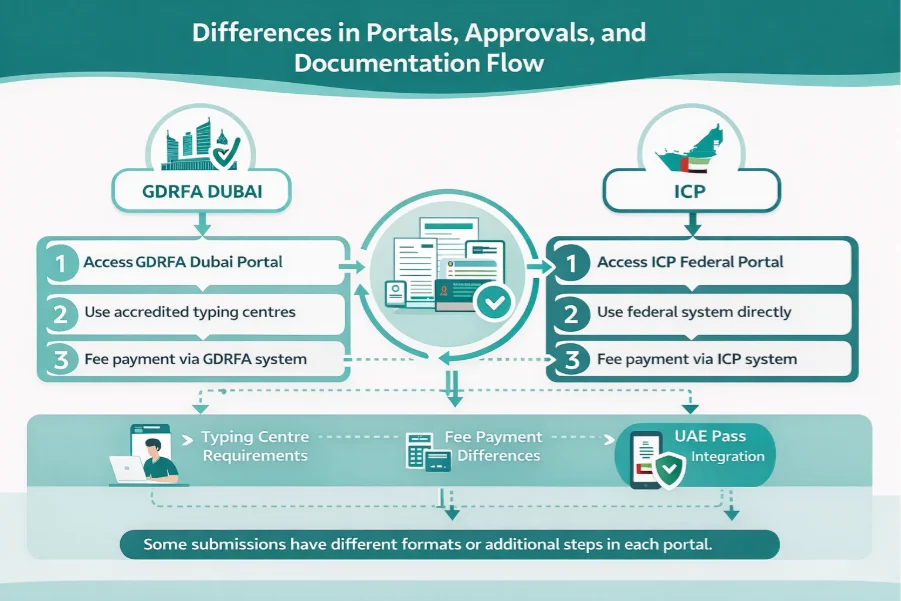
The UAE has two main immigration authorities. Dubai uses the GDRFA, while the rest of the country uses the ICP.
GDRFA (Dubai) vs ICP (Rest of UAE)
If your visa is issued from Dubai, you use the GDRFA portal. If your visa is from Abu Dhabi or Sharjah, use the ICP portal. The required documents for a family visa in the UAE are 95% identical across both systems.
Cost and Timeline Variations
The family visa cost in the United Arab Emirates varies slightly by emirate. Dubai fees include a knowledge and innovation fee. Total costs range from AED 2,500 to AED 5,000 per person. This excludes the security deposit and medical insurance.
Latest UAE Regulatory Updates Affecting Family Visas (2024–2026)
Family visa rules in the UAE don’t stay the same for long. Over the past few years, most changes focus on digital systems and stricter checks.
Overstay Fines and Compliance Rules
Overstaying a visa now leads to a fixed daily fine. At the moment, it is AED 50 for each extra day. This applies whether you are a visitor or a resident. Many people miss this and only realise it later. A simple way to stay safe is to check your visa dates often. Using official apps makes this much easier to track.
Age Limit Updates for Dependent Children
The dependent visa age limit in the United Arab Emirates has changed recently. You can sponsor sons until they are 25 years old. Daughters can be sponsored indefinitely if they are unmarried.
Changes in Visit Visa vs Residence Visa Conversion
You can convert a visit visa to a residence visa. This requires an “In-Country” status change fee. This fee is usually around AED 650 plus VAT.
Digital Application Channels (ICP, UAE Pass, Dubai Now)
The UAE Pass is now mandatory for all digital visa services. It allows you to sign documents electronically. The Dubai Now app is the fastest option for Dubai residents.
Special Cases:
Some family situations require extra documentation. These cases often take longer to approve.
Sponsoring Parents: Additional Document Requirements
Sponsoring parents requires a much higher salary. Usually, you must earn at least AED 20,000 monthly. You must also provide medical insurance for them. A dependency certificate from your consulate is also required.
Newborn Visa Requirements and Timelines
You have 120 days to complete the newborn visa requirements in the UAE. After 120 days, daily fines will apply. You need the birth certificate and the baby’s passport to proceed.
Sponsoring Adult Children (Students / Special Cases)
Students studying in the UAE can maintain their sponsorship. You must provide a continuation of study certificate. This must be from a UAE-registered university.
Switching from Visit Visa to Family Residence Visa
You do not have to leave the country to switch. The “Status Adjustment” document is issued after the entry permit. This allows the family to remain in the UAE while the medical test is being processed.
Renewal, Cancellation, and Overstay Compliance: What Documents Are Needed?
The family visa renewal documents required in the United Arab Emirates are straightforward. You must renew the visa before it expires.
Family Visa Renewal Documents Checklist
- Original Emirates ID of the dependents.
- Updated salary certificate or employment contract of the sponsor.
- New medical fitness test results for adults.
- Renewed medical insurance policy.
Visa Cancellation Process and Required Documents
The family visa cancellation process in the United Arab Emirates is fast. The sponsor must cancel the dependents’ visas first. Only then can the sponsor cancel their own visa. You can do this online or at a typing center.
Overstay Fines and Grace Periods Explained
There is usually a grace period after visa expiry. This period is often 30 to 60 days to either renew or leave. After this window, the family visa overstay fine in the UAE starts accumulating.
Extension Options and Penalties
If you need more time, apply for a visa extension for your family visa in the United Arab Emirates. This is possible in certain humanitarian or health-related cases. Penalties for illegal overstaying can lead to a travel ban.
How DBTA Advises Expats and Investors on Family Visa Structuring
We help clients manage the documents required for a family visa in the UAE efficiently. Our team ensures your corporate structure supports your family goals.
Choosing the Right Business Structure for Family Sponsorship
A mainland company often allows for easier visa processing. However, free zone companies offer 100% ownership benefits. We analyze which option fits your specific family size and needs.
Ensuring Income Proof Meets Immigration and Compliance Standards
We review your MOHRE contracts and salary certificates. This prevents rejections based on insufficient salary figures. We also assist with 9% Corporate Tax filings for business owners.
Handling Document Attestation and Legal Translation Correctly
Our partners manage the MOFA attestation process on your behalf. We ensure every document translation requirement for United Arab Emirates visas is met. This saves you weeks of back-and-forth with government offices.
Preventing Delays and Rejections Through Pre-Submission Audits
We audit your family visa checklist for the United Arab Emirates in 2026 before filing. This reduces the risk of rejection due to common family visa issues in the UAE. Our goal is a 100% approval rate for your loved ones.
Conclusion
A UAE family visa is not difficult when things are done properly. Clear documents and correct details make the process easier.
Most delays come from small mistakes. Missing papers, wrong formats, or weak income proof can slow approval. Checking everything early helps you avoid these issues.
With the right support and a clear plan, the whole process feels much easier to manage. At Dubai Business and Tax Advisors, we guide you at each step, help you avoid common mistakes, so you can move forward with confidence and bring your family to the UAE without unnecessary delays.
FAQs
You need your passport, residence visa, Emirates ID, salary proof, and tenancy contract. For family members, provide passports, photos, and attested marriage or birth certificates.
You must earn at least AED 4,000 per month, or AED 3,000 with accommodation.
You need your passport, visa, Emirates ID, salary proof, tenancy contract, and an attested marriage certificate.
Submit the child’s passport, photos, and attested birth certificate, along with your sponsor documents.
You must attest the certificate in your home country, then at UAE MOFA. It also needs Arabic translation.
Dependents above 18 must pass a medical test for HIV and tuberculosis.
It usually takes 10 to 15 days. Express services may take 3 to 5 days.
It ranges from AED 2,500 to AED 5,000 per person, depending on the emirate.
Yes, a valid tenancy contract like Ejari is required as proof of accommodation.
Yes, all dependents must apply for Emirates ID. Biometrics are needed for those above 15.
You need updated Emirates ID, medical test results, insurance, and salary proof.
Missing documents, wrong attestation, low salary, or incomplete applications can cause rejection.
Yes, free zone employees can sponsor family members with proper salary proof and documents.
Yes, health insurance is mandatory for dependents in most emirates.
Apply through ICP or GDRFA portals. Upload documents, complete medical tests, and follow the steps.
Latest news & articles

About the Author:
AURANGZAIB CHAWLA
As CEO of DBTA, Aurangzaib Chawla advises globally mobile businesses and individuals on cross-border tax planning and structuring. With expertise spanning the UK, UAE, and wider GCC, Zaib helps clients minimise double taxation, protect assets, and achieve long-term financial efficiency while staying fully compliant.
Planning to launch in Dubai or the UAE?
Let’s talk about how to structure your business for growth the smart, compliant, and tax-efficient way

About the Author:
AURANGZAIB CHAWLA
As CEO of DBTA, Aurangzaib Chawla advises globally mobile businesses and individuals on cross-border tax planning and structuring. With expertise spanning the UK, UAE, and wider GCC, Zaib helps clients minimise double taxation, protect assets, and achieve long-term financial efficiency while staying fully compliant.
Planning to launch in Dubai or the UAE?
Let’s talk about how to structure your business for growth the smart, compliant, and tax-efficient way
About the Author:
AURANGZAIB CHAWLA

As CEO of DBTA, Aurangzaib Chawla advises globally mobile businesses
and individuals on cross-border tax planning and structuring. With expertise spanning the UK, UAE, and wider GCC, Zaib helps clients minimise double taxation, protect assets, and achieve long-term financial efficiency while staying fully compliant.
Planning to launch in Dubai or the UAE?
Let’s talk about how to structure your business for growth the smart, compliant, and tax-efficient way.
Connect with Reliable Dubai Business Consultants
Get in Touch