
Best UAE Business Setup Consultants for Mainland & Free Zones

Recent Insights

Table of Contents
The UAE is no longer a regional trading market; it is now a global hub for business; however, the regulatory regime here is more convoluted than ever before. Given the current 9% Corporate Tax regime and increased KYC/AML policies from the Central Bank, building an entity correctly right from the start means everything.
Business setup consultants are no longer just filing agents; they’re strategic risk advisers. The license fee is not the main problem for new firms; it is being able to secure a corporate bank account and remain tax compliant. For all founders and especially for foreign investors whose deal is bent towards 100% ownership, the real question isn’t how quickly can I get a license, but how do I make sure my business is bankable, compliant, and set up on the right structure to avoid drag from lengthy restructurings, fines, or worse.
Best UAE Business Setup Consultants (Categorization, Credentials, and Comparison)
The landscape of professional service providers in the UAE is broad, but quality and specialization vary drastically. To find the Best UAE business setup consultants, founders must first identify the specific expertise required for their business model.
Categories of Expertise and Recommended Consultants
The Best UAE business setup consultants are not generalists but specialists, positioned to solve specific challenges, from regulatory approval to complex taxation.
- General & Free Zone Specialists: These firms excel in overall company incorporation and specific high-volume Free Zone setups. For instance, Businessetup.com offers comprehensive services, including Free Zone Company Setup and Dubai Company Incorporation, focusing on a hassle-free, complete entrepreneur support experience.
- Strategic & Mainland Specialists (e.g., Jesser Al Najah LLC): These consultants excel in Mainland operations, navigating the complex requirements of the Department of Economy and Tourism (DET) and securing physical office space (Ejari). Firms like Jesser Al Najah LLC are positioned to help founders evaluate their specific business model and recommend the optimal jurisdiction (Mainland vs. Free Zone) to ensure compliance and market access. They are essential for any business targeting direct access to the entire UAE market or bidding for government contracts.
- Regional Expansion Specialists (e.g., Nimbus Consultancy, Feamish): A unique and highly valuable category is firms that offer integrated regional expansion support. For clients planning to use the UAE as a hub for broader GCC operations, particularly expansion into Saudi Arabia (KSA), firms like Nimbus Consultancy and Feamish offer tailored consultancy and comprehensive services to navigate cross-border tax implications and multi-jurisdictional licensing procedures.
- Operational & Visa Support Specialists (e.g., Auxilium): Beyond the license, some firms specialize in managing labor constraints. For businesses that quickly hit a hard visa quota cap, a common issue for Free Zone startups, firms like Auxilium offer Employer of Record (EOR) services. This provides a legal bridge solution to manage visas, payroll, and insurance without delaying expansion.
- Compliance-First Advisory (DBTA -The High-Trust Benchmark): This is the category where Dubai Business & Tax Advisors (DBTA) is positioned. We prioritize structural integrity and regulatory preparedness over transactional speed or minimal Dubai business setup cost. Our focus is heavily on tax structuring (CT, VAT), ESR compliance, UBO registration, and, most crucially, bank readiness. This approach is vital for high-revenue entities and international SMEs where regulatory failure is an unacceptable risk.
| Consultant Type | Primary Focus | Example Firms | 2025 Risk Mitigation Focus |
|---|---|---|---|
| General & Free Zone | Standard licensing, Free Zone access | Businesssetup.com | Speed, accessibility, basic compliance |
| Mainland Specialists | DED licensing, Ejari management | Jesser Al Najah LLC | Operational access, legal structure, local market eligibility |
| KSA Expansion | Multi-jurisdictional setup | Nimbus Consultancy, Feamish | Cross-border tax exposure, regulatory friction |
| Operational/EOR | Visa quota management, payroll | Auxilium | Labor law compliance, scaling interruptions |
| Compliance-First (DBTA) | Tax, Banking, CT/TP, ESR readiness | Dubai Business & Tax Advisors (DBTA) | Regulatory penalties, AML fines, banking failure |
Founders should treat firms that compete purely on offering the low-cost business setup of UAE options with extreme caution. While a low initial price may be attractive, these firms often lack the necessary tax and banking expertise, which is the most valuable service in the contemporary regulatory environment.
DBTA Case Study: Structuring Regional Ambitions
A Kuwaiti logistics firm sought to establish a business setup consultant in Dubai to manage cross-border operations between the UAE and KSA. The firm initially looked at a simple Free Zone license. DBTA advised against a basic setup, ensuring the structure was aligned for future business setup consultants in Saudi Arabia expansion by incorporating compliant related-party transaction policies and securing a Mainland company setup UAE for broader regional market access, avoiding limitations inherent in certain free zones.
What Business Setup Consultants Actually Do
The primary distinction between a highly rated UAE business setup consultancy and a mere filing agent lies in their capacity for advisory service and risk mitigation. An expert consultant focuses on correcting foundational mistakes before they become expensive compliance issues.
Critical Advisory Functions
- Accurate Activity Classification: One of the most common pitfalls is misclassifying the business activity to fit a cheaper or simpler license. For instance, a software developer should obtain a Professional license, not a Commercial (Trading) one. Incorrect classification can lead to regulatory fines, immediate rejection by banks (which scrutinize the license against the business model), or denial of necessary permits. Business setup consultants ensure the legal license type (Commercial, Professional, or Industrial) precisely matches the company’s planned revenue streams.
- Visa Logistics and Quota Planning: Consultants help strategize long-term staffing needs. Mainland companies have scalable visa quotas based on office size, while Free Zone companies typically receive a limited quota (0–6 visas per license). Expert business setup consultants advise on managing growth projections against these quota constraints, often recommending necessary office upgrades or structuring solutions like Employer of Record services to legally navigate visa caps without delaying expansion.
- UBO and ESR Compliance: Modern compliance mandates the identification of the Ultimate Beneficial Owner (UBO) and ensuring adherence to Economic Substance Regulations (ESR) for certain activities, especially in Free Zones seeking 0% CT status. An expert new business setup consultant in Dubai ensures all UBO declarations are filed correctly and that the company can demonstrate actual economic substance (physical presence, decision-making, core income-generating activities) to satisfy auditors and the FTA.
- Vetting and Credibility (E.E.A.T): Founders must be wary of non-licensed agents. True business setup consultants operate under a valid commercial license which can and should be verified via relevant government portals. Working with a licensed UAE business setup consultancy ensures legal accountability and access to accurate, up-to-date regulatory interpretations, safeguarding the client from potentially fraudulent or misleading practices.
DBTA Case Study: Correcting Activity Misclassification
An expatriate financial coach sought a quick setup in a Free Zone, selecting a generic “Business Services” license activity to save time. DBTA reviewed the business plan and identified that the client’s actual activities constituted regulated financial advisory and required a specialized Professional license and potentially a specific financial Free Zone (e.g., DIFC or ADGM), or additional approvals, which the generic license would not cover. DBTA facilitated the correct, compliant registration.
Mainland vs Free Zone (Full Breakdown)
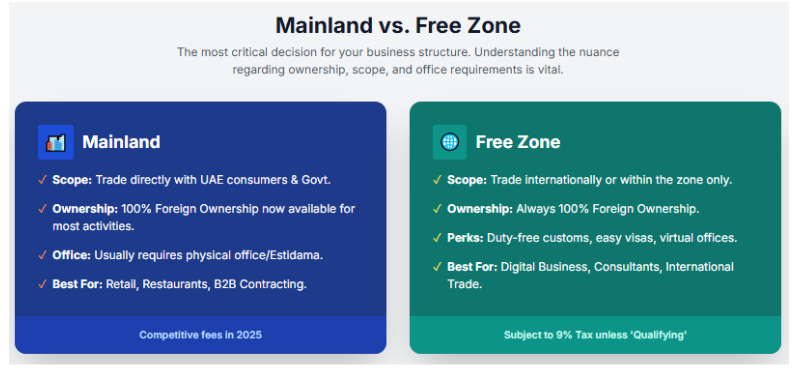
The fundamental decision, Mainland vs free zone UAE, must be assessed based on modern operational realities, cost components, and the new tax regime, not historical advantages.
Core Differences in 2025
| Factor | Mainland Company Setup UAE | Free Zone Business Setup Dubai |
|---|---|---|
| Market Access | Full UAE market, government contracts. | Restricted (international/zone-to-zone). |
| Office Requirement | Mandatory physical office (Ejari). | Flexible (virtual/flexi-desk) – often scrutinised by banks. |
| Corporate Tax Rate | 9% on profits > AED 375k. | Potential 0% (high ESR compliance required for qualifying income). |
| Visa Scalability | High (linked to office size). | Limited (0–6 initial quota, higher cost per visa). |
| Initial Cost (Est.) | AED 25,000 – AED 40,000+. | AED 5,500 – AED 15,000 (licence only). |
Market Access and Operations: A Mainland company set up in the UAE is the right choice if you need to sell directly in the local market, run a physical shop, or bid for government contracts. Foreign ownership is now allowed in most Mainland sectors, but you must still maintain a physical office (Ejari). Free zone business setup in Dubai, on the other hand, is mainly suited to international or zone-to-zone activities, and accessing the mainland usually requires a local distributor or an additional DET dual license, which adds extra steps and costs.
Tax Implications: The most complex modern factor is Corporate Tax. Mainland companies pay a standard 9% rate on taxable profits exceeding AED 375,000. Free Zone entities can potentially achieve a 0% CT rate, but only if they meet strict criteria regarding “Qualifying Income” and adhere rigorously to ESR. If a Free Zone company fails the substance test or derives non-qualifying income, the 0% benefit is voided, and the standard 9% rate applies. This complex regulatory hurdle negates the perceived advantage of a simple, low-cost Free Zone setup if compliance is ignored.
Initial Cost & Timeline: Free zone business setup Dubai is generally faster (7–14 days for the license) and cheaper initially due to flexible office solutions. However, the initial outlay for a Mainland company to set up UAE (estimated at AED 25,000 – AED 40,000+) is higher because it mandates a physical office lease and associated government fees.
DBTA Case Study: Choosing Compliance over Cost
A large UK-based trading company needed a hub. They favored a Free Zone for the perceived 0% tax benefit. DBTA analyzed their model and discovered they planned significant goods movement and required a large number of visas. The cost of upgrading a Free Zone to accommodate the required office size and visa quota became comparable to the initial cost of a Mainland setup, while still imposing operational restrictions. DBTA recommended the mainland for its superior visa scalability and market access, accepting the 9% CT rate as a trade-off for operational simplicity and maximum growth potential.
Free Zone Breakdown (DMCC, IFZA, RAKEZ, Meydan, SHAMS, Ajman, KEZAD)
Choosing the correct Free Zone requires careful consideration of three factors: cost, specialization, and, critically, banking credibility.
Profiles of Key UAE Free Zones
| Free Zone | Emirate | Best For | Banking Perception (Credibility) | Starting License Cost (Est.) |
|---|---|---|---|---|
| DMCC | Dubai | Global trade, high reputation | Strongest relationships, premier | Higher / premium |
| IFZA | Dubai/Fujairah | SMEs, digital startups | Good (flexibility and digital focus aid setup) | Medium (best value in Dubai) |
| RAKEZ | RAK | Logistics, manufacturing | Competitive, stable | Low (from AED 6,000 for Biz Starter) |
| SHAMS | Sharjah | Media, e-commerce, creative | Good (sector-specific) | Very low (from AED 5,750) |
| Ajman FZ | Ajman | Ultra low cost | High risk (commonly flagged for banking and KYC scrutiny) | Lowest (from AED 5,000) |
| Meydan FZ | Dubai | Consultancy, digital | Competitive pricing in Dubai | Medium |
| KEZAD | Abu Dhabi | Logistics, industry | High (strategically focused zone) | Varies by activity |
DMCC (Dubai Multi Commodities Centre): Located near the district often serviced by Business setup consultants at JLT, DMCC enjoys the strongest global reputation and maintains the premier banking relationships. It is ideal for large budgets and long-term global trade.
IFZA (International Free Zone Authority): Known for its flexibility, fast setup times, and support for SMEs and startups with lean budgets. While it offers cost-effective pathways, its reputation is aided by a strong digital approach that often expedites account opening.
RAKEZ (Ras Al Khaimah Economic Zone): This zone is highly competitive for logistics, manufacturing, and industrial setups, offering excellent warehouse facilities and affordability.
SHAMS (Sharjah Media City): Offers a very competitive entry point (starting from AED 5,750 for a basic license), focusing on the media and creative industries.
The Banking Credibility Risk: Ultra-cheap Free Zones, such as Ajman FZ can save money on the front-end but are regularly flagged by banks and payment providers for a lack of credibility.
The result is delayed, rejected, or in a lot of cases, very expensive re-structuring. In the UAE, Free zone selection is a significant factor in how convenient it is to get a corporate bank account.
DBTA Case Study: Prioritizing Credibility for an E-commerce Setup
One e-commerce founder in the US who was selling outside the States asked: “Do I go set up at DMCC or take a cheap AED 5,500 Ajman FZ package? As the business was using Stripe/PayPal and dealing with cross-border transfers, DBTA said it was all about banking credibility rather than headline price. We suggested IFZA as a mid-level cost, higher-trust solution and had both the corporate banking and payment gateways in place in weeks.
2025 Cost Breakdown, All Hidden Fees Exposed
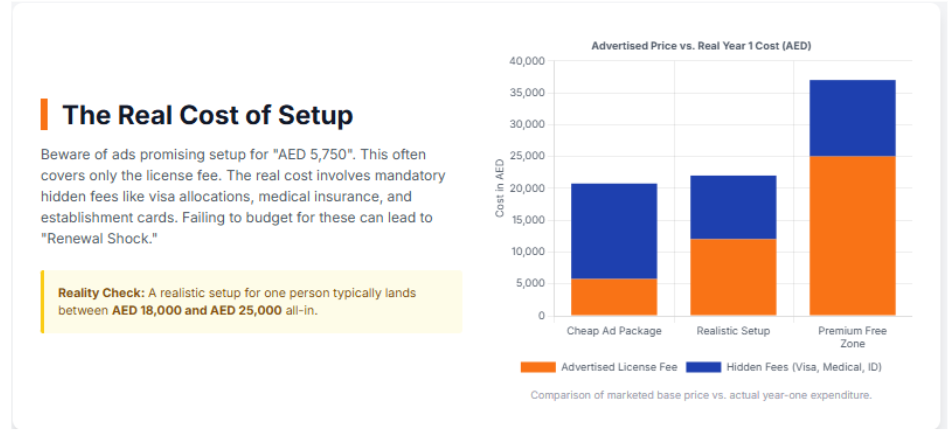
The single greatest source of misunderstanding and financial shock for new entrepreneurs is the misleading advertising surrounding the Dubai business setup cost.
Exposing the “AED 5,500” Myth
When firms advertise a low-cost business setup UAE package, such as “AED 5,500,” this price point only covers the base license fee for a zero-visa package in specific zones (e.g., UAQ or SHAMS). This price excludes every mandatory operational component required for a functional business and a UAE residency.
Mandatory Government Fees and Hidden Costs
The true total cost for an operational setup (e.g., a Free Zone company with one investor visa) typically falls in the range of AED 20,000 to AED 27,650 in the first year. The differences are accounted for by essential, often hidden, government deposits and fees:
- Immigration Setup: To initiate any visa process, the company must register for an Establishment Card/Immigration File (approx. AED 1,500) and register for the E-Channel system. The E-Channel setup often includes a large, refundable deposit (up to AED 7,150) that must be paid upfront. These deposits are essential but frequently omitted from advertised license-only prices.
- Visa Costs: Once immigration is processed, the actual cost of the visa (medical, Emirates ID, stamping) ranges between AED 3,000 and AED 5,000 per person.
- Office/Substance: Even a Free Zone requires a Flexi-desk or virtual office package (AED 5,000 – AED 7,500 annually) to satisfy the substance requirements and bank compliance checks.
- Compliance Costs: Mandatory annual audit fees (AED 5,000 – AED 10,000 annually) are required for Free Zones like DMCC and CT compliance. Additional costs include legal translation, MOA notarization, and liability insurance requirements, all of which are crucial for protecting the business.
Failing to budget for these initial fees leads to severe renewal shocks and unexpected operational delays. Expert business setup consultants provide a transparent, comprehensive cost breakdown to prevent these surprises.
Exposed: The True Cost of “Low-Cost Business Setup UAE” (Free Zone Example – 1 Visa)
| Cost Component | Type | Est. Cost (AED) | Notes |
|---|---|---|---|
| Basic License Fee (0 Visa) | Initial | 5,500 – 7,000 | The advertised “low cost” rate |
| Establishment Card/Immigration | Initial/Mandatory | 1,500 | Required for all visa processing |
| E-Channel Registration + Deposit | Initial/Refundable | 5,000 – 7,150 | Mandatory for visa processing, highest hidden fee |
| 1st Investor/Employee Visa | Initial | 3,000 – 5,000 | Medical, ID, stamping fees |
| Flexi-Desk/Virtual Office | Annual | 5,000 – 7,500 | Mandatory for substance/banking checks |
| Realistic Minimum Operational Cost | Total Est. | ~20,000 – 27,650 | Total cost for an operational setup with 1 visa |
DBTA Case Study: Full Cost Transparency
A client was quoted AED 7,000 by another provider for a Free Zone business setup Dubai package. DBTA provided a detailed quote that was higher, but included the mandatory E-Channel deposit, investor visa costs, and the required audit fee for the first year. The client initially hesitated but chose DBTA for its clarity. The client avoided the common scenario where, post-licensing, they are suddenly informed of an additional AED 12,000 required to begin visa processing.
Key Problems People Face
Mistakes made during the initial setup phase invariably lead to disproportionately high costs and operational stalls later. Most pain points revolve around non-compliance or lack of foresight regarding regulatory constraints.
The Consequences of Short-Term Thinking
- Activity Misclassification: As discussed, choosing the wrong license activity (e.g., using a trading license for IT consultancy) is a structural error that guarantees banking issues and potential penalties if auditors deem the company is operating outside its authorized scope.
- Visa Quota Constraints: Many firms choose a 1- or 2-visa Free Zone license to save on the initial Dubai business setup cost. When the business scales quickly and requires five more staff, it hits a hard limit imposed by the Free Zone Authority (FZA). Upgrading the office space and license mid-year is often time-consuming and far more expensive than planning for adequate capacity from the start.
- Dealing with Agents vs. Consultancy: Using unlicensed agents or brokers exposes the founder to unreliable advice and potential scams, as these parties may disappear, leaving the founder legally exposed or with an incorrectly structured entity. Licensed business setup consultants are legally accountable for their advice.
- The “Tax-Free Forever” Misconception: Many founders still believe that simply being in a Free Zone means they are exempt from all tax and filing obligations. Post-2023, the reality is that CT registration is mandatory for almost all entities, and compliance with ESR must be maintained annually to secure the 0% rate on Qualifying Income. Ignoring these obligations leads directly to severe penalties and regulatory scrutiny.
The core problem is structural weakness: any initial savings made by cutting corners (low-cost license, misclassified activity, low visa quota) is exponentially multiplied when the business must restructure to satisfy a bank, a client audit, or a government authority.
DBTA Case Study: Resolving Visa Bottleneck
A Canadian marketing firm utilized a low-cost RAKEZ license with a single visa. Six months later, they secured a large contract requiring three more employees, but they had hit their visa quota limit tied to their shared desk space. DBTA intervened, negotiating an accelerated upgrade of the RAKEZ package to include dedicated office space and the requisite visa quotas. While the upgrade cost was substantial, the intervention prevented the firm from breaching its client contract due to staffing limits.
Client Quote: “When our growth stalled due to the visa cap, DBTA provided the fastest, most reliable pathway to scaling our workforce. Their solution prevented a major contractual issue.” — Marie Dubois, Operations Manager.
Region-Specific Guidance
The choice of Emirate or micro-location significantly impacts licensing, compliance, and operational costs. The Best UAE business setup consultants provide nuanced advice that considers the strategic location of the company.
Choosing Your Operational Center
- Business setup consultants in Dubai: Dubai offers the highest global visibility and a dynamic market, making it the default choice for highly competitive service sectors, trade (DMCC), and financial services (DIFC). While operational and living costs are higher, the infrastructure and market density justify the premium. Specific hubs, like finding Business setup consultants JLT (near DMCC) or Business setup consultants in Business Bay (near downtown and Mainland DED), cater to specific business clusters.
- Business setup consultants in Abu Dhabi: Abu Dhabi generally offers lower operational costs, particularly office rental, compared to Dubai. The regulatory environment, while historically more stringent, is supported by government initiatives like Ghadan 21, providing financial incentives for innovation. Abu Dhabi is strategically ideal for businesses aligning with government-driven sectors (energy, defense, heavy industry) and regulated finance (ADGM).
- Business setup consultants in Sharjah: Sharjah, through zones like SHAMS, provides highly cost-effective entry points. These zones are attractive for startups and e-commerce focusing on regional rather than global prestige. Business setup consultants in Sharjah often emphasize media or creative activity licensing due to the zone’s specialization.
- Business setup consultants in Ras Al Khaimah: RAKEZ is highly regarded for logistics, industrial activities, and its stable, competitive environment. Business setup consultants in Ras Al Khaimah often recommend RAKEZ for manufacturing or trade businesses requiring physical facilities and lower operational overheads compared to Dubai.
- Business setup consultants in Ajman: Ajman is strictly recommended only for the most cost-sensitive operations that may not require immediate banking facilities, given the noted banking risk profile of Ajman Free Zone (AFZ).
Banking Support — What Consultants Don’t Tell You
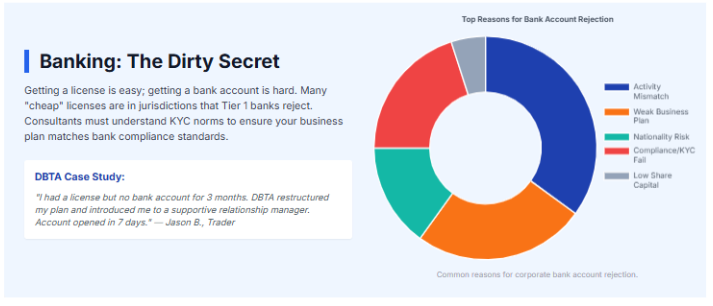
The corporate bank account remains the single most difficult operational bottleneck for new UAE companies in 2025. This difficulty is a direct result of increased regulatory pressure on banks.
The Compliance Wall
Since the CBUAE began issuing significant fines for breaches of AML and KYC governance, local banks have dramatically tightened their internal scoring and application processes. Banks prioritize risk mitigation, meaning any perceived inconsistency or regulatory gap in the company’s profile will trigger a rejection or lengthy delay.
Top Bank Account Rejection Triggers:
| Rejection Reason | Consultant Mitigation Strategy | Underlying Compliance Issue |
|---|---|---|
| High-Risk Free Zone Choice | Direct alignment with high-credibility zones (DMCC, IFZA, Meydan). | AML/KYC scrutiny. |
| Foreign UBO / No Residency | Advising UBOs to obtain residency or providing notarised legal proof. | UBO clarity and fund source verification. |
| Vague Business Activity | Creation of detailed business plan and ensuring activity matches bank risk profile. | Mismatch between licence and operation. |
| Incomplete Compliance | Ensuring UBO declaration, Ejari/Flexi-desk contract, and audit readiness. | Regulatory failure. |
The Role of Residency: Foreign shareholders or directors without a UAE residence visa face significantly higher scrutiny, and the lack of a local Emirates ID often results in the application being halted, even if documents are technically complete.
Jurisdiction Impact: The Free Zone choice directly impacts banking options. Reputable zones like DMCC have strong relationships, while others, like IFZA, leverage digital infrastructure to expedite KYC. However, a low-credibility zone, such as Ajman FZ, can trigger an automatic flag and rejection by several local banks.
A consultant’s true value in 2025 is measured by their ability to prepare a “bank-ready blueprint”, aligning the company’s activity, structure, UBO clarity, and residency status before the bank application, thereby significantly improving approval chances and preventing months of operational delay.
DBTA Case Study: Securing the Corporate Account
An Italian consulting company in a Dubai Silicon Oasis Free Zone could not open its bank account for 4 months because of the intricate offshore UBO structure and just a Flexi-desk they had. DBTA rectified the UBO reporting, submitted notarized evidence, and recommended an exchange to a small, dedicated desk. The addendum was acceptable to the bank, and the account was instated two weeks after re-submission.
How to Choose the Right Consultant
Selecting the right partner among the plethora of business setup consultants in UAE requires rigorous due diligence that focuses on compliance expertise rather than speed or price.
Due Diligence Checklist
- Verify Licensing and Credentials: Insist on viewing the consultant’s official trade license and verifying its validity via the relevant DED or Free Zone authority portal. Avoid “agents” who operate without proper licensing or provide services outside their authorized scope.
- Mandatory Tax and Audit Expertise: The consultant must demonstrate specific, up-to-date knowledge of the Corporate Tax regime, particularly the Transfer Pricing rules (Articles 35–36). Ask for proof of experience assisting clients with audit readiness and TP documentation, which must be completed by September 30, 2025, filing deadline for FY 2024. A firm cannot claim to be one of the best business setup consultants in Dubai if they lack this critical tax expertise.
- Proven Banking Track Record: Ask for verifiable case studies related to bank account approvals for similar high-compliance entities (e.g., those with foreign shareholders or complex activities). The ability to navigate the CBUAE-driven scrutiny is non-negotiable.
- Fee Transparency: Reject any proposal for Dubai business setup cost that obscures mandatory initial fees. A comprehensive quote must expose immigration deposits (E-Channel), visa costs, and mandatory annual renewal fees, including the necessary audit fee.
The optimal choice is a partner that approaches the setup as a structural, tax, and legal problem, ensuring the entity is built to be compliant and sustainable.
DBTA Case Study: Vetting for Tax Expertise
A high-revenue trading company was interviewing business setup consultants. DBTA was the only firm that proactively discussed the AED 40 million aggregate related-party transaction threshold for Transfer Pricing disclosure, explaining the need for contemporaneous TP documentation and its integration into the audited financials. This immediate focus on complex tax structures differentiated DBTA from firms focused solely on license issuance.
Dubai Business & Tax Advisors Advantage (DBTA)
Dubai Business & Tax Advisors (DBTA) differentiates itself by adopting a risk-centric, compliance-first methodology, essential for the modern UAE market. Our service is built on mitigating the primary operational bottleneck, banking, and taxation.
Our Commitment to Compliance and Structural Integrity
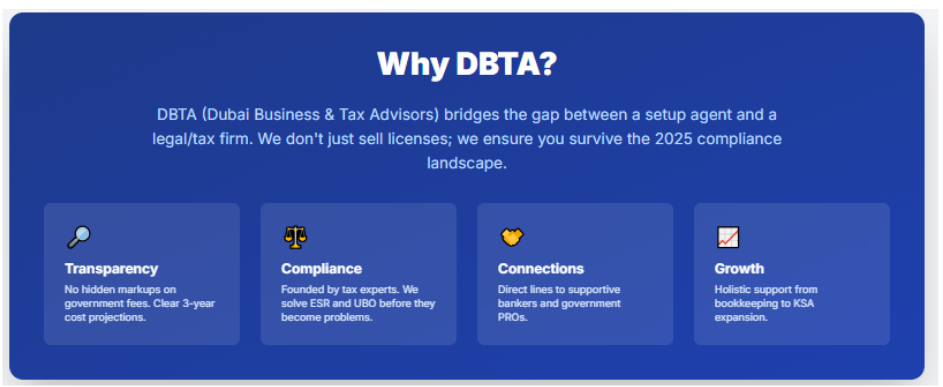
- Compliance Certainty: DBTA structures every entity, whether Mainland company setup UAE or Free zone business setup Dubai, with tax and regulatory compliance baked in. We ensure the UBO structure, activity classification, and residency status are robust enough to withstand the most stringent CBUAE-driven KYC checks and FTA audits.
- Bank-Ready Blueprint: We possess a proprietary understanding of the internal scoring mechanisms of major UAE banks. DBTA guides clients through essential profile preparation, minimizing the painful corporate account rejection bottleneck that stalls most foreign-owned startups.
- Multi-Disciplinary Expertise: Our team includes seasoned corporate structuring advisors, tax specialists, and registered accountants. This synergy allows us to offer true end-to-end support, from the initial Dubai trade license process to complex Transfer Pricing documentation and ongoing ESR requirements, positioning us as one of the best business setup consultants in Dubai.
- Transparent Costing: We eliminate the risk of hidden business setup fees in Dubai. DBTA provides a single, realistic, all-inclusive quote covering all government deposits, immigration fees, and mandatory annual audit costs, ensuring financial stability and preventing costly renewal shocks.
DBTA Case Study: From Inception to Full Functionality
A high-net-worth individual sought to establish a family office. The complexity of the UBO structure and the regulatory sensitivity of the financial activities demanded unparalleled expertise. DBTA successfully structured the entity in a high-credibility Free Zone, secured multiple executive visas, ensured complete CT and UBO registration, and secured the necessary premium corporate banking facility on the first attempt by providing extensive, verified source-of-wealth documentation.
Client Quote: “The setup of our complex family office was executed flawlessly. DBTA ensured not only legal compliance but secured the specific banking relationships our activities required.” — Sheikh Mohammed Al Suwaidi, Family Office Principal.
Final Summary
The evolution of the UAE’s corporate environment dictates that success no longer hinges on acquiring the fastest or cheapest license, but on establishing structural integrity from day one. The Best UAE business setup consultants are strategic partners who provide expert guidance through the new regulatory landscape dominated by Corporate Tax, rigorous Transfer Pricing rules, and highly scrutinized banking compliance.
For any founder seeking long-term operational viability in Dubai, Abu Dhabi, or any other Emirate, the choice of a business setup consultant in UAE must be driven by expertise in risk mitigation and compliance certainty. Do not allow a minor saving in initial Dubai business setup cost to compromise your entire operational future through preventable banking failure or severe regulatory penalties. Secure your compliant, sustainable path to growth.
DBTA provides the expertise necessary to build a bank-ready, tax-compliant foundation.
FAQs
It’s realistic only for the license. Once you add visa costs, deposits, and mandatory setup fees, a proper operational structure usually lands around AED 20,000–27,650.
The effective date is the start of your first financial year, which begins on the date of incorporation. You must determine this date immediately to track your deadlines.
Mainland companies must have an Ejari. Free Zones allow Flexi-desks, but banks may ask for a dedicated desk if the business profile is more complex.
Mainland gives full UAE market access and government contract eligibility, while Free Zones focus on international/zone-to-zone activity with easier, wholly foreign-owned setups.
Mainland companies pay 9% above AED 375,000 profits. Free Zones may achieve 0%, but only if they meet strict substance and qualifying-income rules.
Yes, most activities now allow full foreign ownership, with only a few strategic sectors still requiring Emirati participation.
Mainland visa capacity grows with office size. Free Zone visa quotas depend on your package; basic Flexi-desk options allow very few visas.
Yes, but it requires setting up a new Mainland entity or branch and shifting contracts and employees. It is easier and cheaper when planned from the beginning.
Free Zones allow remote incorporation. Most banks still require in-person or video-KYC verification, so the process must be coordinated carefully.
Latest news & articles
About the Author:
AURANGZAIB CHAWLA
As CEO of DBTA, Aurangzaib Chawla advises globally mobile businesses and individuals on cross-border tax planning and structuring. With expertise spanning the UK, UAE, and wider GCC, Zaib helps clients minimise double taxation, protect assets, and achieve long-term financial efficiency while staying fully compliant.
Planning to launch in Dubai or the UAE?
Let’s talk about how to structure your business for growth the smart, compliant, and tax-efficient way
About the Author:
AURANGZAIB CHAWLA

As CEO of DBTA, Aurangzaib Chawla advises globally mobile businesses
and individuals on cross-border tax planning and structuring. With expertise spanning the UK, UAE, and wider GCC, Zaib helps clients minimise double taxation, protect assets, and achieve long-term financial efficiency while staying fully compliant.
Planning to launch in Dubai or the UAE?
Let’s talk about how to structure your business for growth the smart, compliant, and tax-efficient way.
