
Why Audit, Attestation, and Assurance Services Are Crucial for UAE Businesses

Recent Insights
Table of Contents
Introduction: Navigating a Hub of Opportunity with Sound Financial Governance
The United Arab Emirates’ reputation as a business hub did not happen by chance. Over the last two decades, Dubai, Abu Dhabi, and other Emirates have positioned themselves as gateways between East and West, drawing in global corporations and ambitious start-ups alike. For many founders, the initial excitement lies in launching fast and tapping into this energy. But sooner rather than later, they discover that sustainable growth in the region depends on something less glamorous but vital for financial transparency. This is where audit attestation and assurance services prove their value. They are not simply about producing reports for regulators. At their core, they ensure that the numbers guiding decisions are solid and independently verified. Investors tend to ask for this proof before they commit funds. Banks want it before extending credit. Even business partners often prefer to work with companies that can show clear records. By turning to audit services UAE, using attestation services UAE, or opting for wider assurance services for businesses, firms demonstrate accountability well beyond basic compliance. It often surprises companies that these checks do more than satisfy laws or meet international standards like IFRS. They build confidence. They reduce uncertainty. And they send a powerful signal to stakeholders that the business is run with integrity. In a market as fast-moving as the UAE, that signal can make the difference between being seen as a short-term player or a trusted long-term partner.
Differentiating the Pillars: A Nuanced Guide to Audit, Attestation, and Assurance
The terms audit services, attestation services, and assurance services are used for businesses. They sound similar, but each one carries a distinct role in protecting your company and shaping investor confidence.
Assurance Services: Creating a Foundation of Confidence
Business assurance services in the UAE are the broadest of the three. The idea is straightforward: stakeholders want confidence that the information they are relying on is accurate. Independent professionals step in, review that information, and provide an opinion that adds credibility. It doesn’t always have to be financial statements; assurance can apply to systems, risk controls, or even sustainability reporting. In a market that values transparency as highly as the UAE, these services create the baseline of trust every serious company needs.
Attestation Services: Verifying Management’s Word
Inside that wider category sit attestation services UAE. These engagements are more specific. Here, a professional looks at a claim made by a company and says that the financial reports give a true picture of performance and issues a written conclusion on whether that claim is fair. It’s an extra layer of accountability, especially valuable when approaching banks for financing or updating shareholders. A simple rule of thumb: all attestation is assurance, but not all assurance qualifies as attestation.
Audit Services: Delivering the Highest Level of Assurance
At the most detailed level are audit services UAE, particularly a financial statement audit UAE. An audit is far more than just checking numbers. Auditors dig into records, processes, and systems to see if everything aligns with international standards like IFRS. The result of an audit and attestation report carries the strongest possible weight of assurance. This is why audit services for companies in the UAE are so widely sought after. Whether you engage in an external audit and assurance service for regulatory purposes or maintain internal audit and assurance services for ongoing oversight, the benefit is clear: you’re building credibility, not just complying with rules.
| Service | Primary Objective | Scope of Work | Level of Assurance | Common Examples |
|---|---|---|---|---|
| Assurance | To improve the quality or context of information for decision-makers. | Broad, covering financial and non-financial data, processes, and systems. | Can be high, limited, or none, depending on the service. | Risk assessment, business performance measurement, IT system reliability reviews. |
| Attestation | To provide an opinion on a specific assertion made by a third party. | Narrower than assurance, focusing on a specific subject matter. | High (audit), Limited (review), or None (agreed-upon procedures). | Financial statement audit, review of financial information, a report on internal controls. |
| Audit | To provide an opinion on the fairness and accuracy of financial statements. | Specific to financial statements and internal controls over financial reporting. | High (reasonable assurance). | External financial audit, internal audit. |
The Indispensable Value of Auditing for UAE Businesses
Building Investor Confidence and Attracting Capital
In the UAE, reputation and financial transparency often speak louder than marketing claims. For banks, investors, and partners, numbers only mean something if they can be trusted. That’s why a financial audit attestation is so important. An audited report is more than paperwork. It shows outsiders that a company is willing to open its books and be held accountable. That assurance removes much of the doubt, no hidden liabilities, no blurred lines in reporting. Investors get a clearer view of liquidity, leverage, and cash flow. For many firms, this credibility translates directly into growth. Companies with audited financials usually find it easier to secure capital, negotiate better loan terms, and attract serious partners. Whether preparing for a merger, raising equity, or entering a joint venture, having independent verification gives a business an edge. In a crowded UAE market, that kind of trust can tip the scales.
Navigating the Evolving UAE Regulatory Landscape
The rules have tightened in recent years. The truth is, keeping up with audit regulatory compliance in the UAE is now a legal requirement, not just a best practice. Federal Decree-Law No. 32 of 2021 requires all mainland companies to conduct external audits. Ministerial Decision No. 82 of 2023 widened that net, making audits mandatory for firms with annual revenue above AED 50 million and for all Qualifying Free Zone Persons. Free zones like DIFC and ADGM also apply their own, often stricter, rules. Then there’s tax. The Federal Tax Authority conducts VAT and Corporate Tax audits, and penalties for errors or late filings can be steep. Companies are required to keep records for at least five years, up to ten if fraud is suspected. Reliable audit services for companies in the UAE have therefore become essential for staying compliant and avoiding unnecessary risks.
Strengthening Internal Controls and Mitigating Risk
External audits are crucial for regulators and investors, but companies also need to look inward. This is where internal audit and assurance services make a difference.
An internal audit can reveal inefficiencies, weak controls, or even fraud risks that management may not see. Basic steps like splitting financial duties across staff or carrying out regular reconciliations can make systems far stronger. These checks are part of broader business assurance services UAE. Internal audits do not replace external ones; they prepare the ground. By fixing gaps early, businesses make the external review smoother and more reliable. Together, they build resilience, ensure compliance, and give stakeholders confidence that the company is being run responsibly.
A Deeper Look: The Spectrum of Audit and Assurance Services
Internal Audit vs. External Audit: A Strategic Partnership When people hear the word “audit,” they often think of one thing: someone checking the books. But the truth is, there are two very different sides to auditing internal and external. Each has its own purpose, and together they form a safety net that keeps a company accountable.
Internal audits happen inside the business. They might be done by an internal team or by outside professionals reporting directly to management. The focus here is on the daily: Are internal controls working? Are policies being followed? Is money being managed efficiently? The results do not go to the public; they go to leadership. And those insights usually turn into action points that help management tighten processes, reduce risks, and improve performance.
External audits, by contrast, are carried out by independent, licensed audit and assurance firms UAE. These firms don’t have ties to the company, which is why their opinion carries weight. Their role is to review financial statements and issue a verdict on whether they give a fair and accurate picture. That verdict matters. Investors, regulators, and banks often will not move forward without it, and in many cases, the law makes it mandatory for financing or compliance purposes.
Put the two together, and you get balance. Internal audits keep management alert and help prevent issues before they snowball. External audits provide outsiders with the trust they need. For UAE companies, using both is no longer just good practice; it is becoming the standard for building long-term credibility.
| Feature | Internal Audit | External Audit |
|---|---|---|
| Independence | Conducted by employees or outsourced professionals who report to management. | Conducted by an independent, third-party audit firm with no ties to the organization. |
| Objective | To evaluate and improve internal controls, governance, and operational efficiency. | To provide an independent opinion on the fairness of financial statements. |
| Scope | Broad, focusing on processes, controls, compliance, and risk management. | Primarily focused on the financial statements and internal controls related to financial reporting. |
| Frequency | Conducted periodically, often continuously as needed by the organization. | Typically conducted annually, as a statutory requirement. |
| Beneficiary | Management, the Board of Directors, and other internal stakeholders. | External stakeholders, including investors, creditors, and regulatory authorities. |
Specialized Audits for Specific Business Needs
Beyond the standard external and internal audits, businesses can also benefit from a range of specialized audit services tailored to specific needs.
- Tax Audits: The FTA may conduct a tax audit to ensure that a business’s VAT and Corporate Tax filings are accurate and compliant with the latest tax laws.
- Forensic Audits: This is a specialized form of investigation conducted to uncover and analyze financial fraud, misconduct, or irregularities. Forensic audits can lead to legal proceedings and are essential for resolving financial disputes.
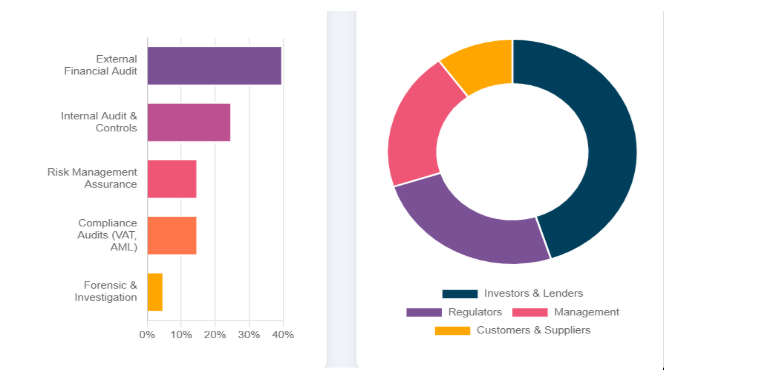
- Risk Management and Assurance: These services provide a proactive assessment of an organization’s potential vulnerabilities. They help businesses identify and mitigate risks related to market fluctuations, operational inefficiencies, and regulatory changes, strengthening a company’s overall financial resilience and stability.
The Role of Audit Firms in the UAE Business Ecosystem
From Compliance Checkers to Strategic Partners
Let’s be clear: in today’s UAE market, audit firms are not just compliance officers. The reality is that external audit and assurance services have become part of a company’s strategy. A skilled auditor won’t stop checking boxes; they’ll highlight risks, spot inefficiencies, and give management insights that drive growth. Why does this matter? Because the UAE’s regulatory landscape isn’t simple. Between the Commercial Companies Law, shifting tax rules, and IFRS reporting, there’s a lot that can go wrong. One mistake can mean financial penalties, licensing delays, or reputational damage that takes years to repair. Having an experienced firm on your side helps businesses avoid those traps. Audits also tend to shine a light on internal weaknesses. Cash flow is being managed poorly. Maybe controls aren’t as strong as management thinks. Or maybe resources are being wasted in ways nobody noticed. A good firm points these things out. Senior leaders can then use that information to refine budgets, improve forecasting, or plan a more confident entry into new markets. And there’s another angle of credibility. Investors and lenders in the UAE want reassurance before committing funds. By promoting accountability and corporate governance, audit firms give companies that credibility. In a market where trust opens doors, this can be the deciding factor in securing capital.
The Credentials and Value of an Approved Auditor
Choosing an auditor is not paperwork. It’s a decision that influences how a company is viewed by regulators, by investors, and by potential partners. That is why it is essential to work with licensed, experienced firms that know both local laws and international reporting standards. Free zones such as DIFC and ADGM have their own registers of approved auditors. These registers exist to protect businesses. They make sure that firms meet strict professional requirements, experience, qualifications, and even indemnity coverage before being allowed to operate. For companies chasing global investors, the decision carries even more weight. Partnering with firms that provide international audit attestation services under IFRS signals a commitment to transparency. And if that partner happens to be one of the Big Four PwC, Deloitte, KPMG, or EY, the message is even stronger: this company takes accountability seriously and aligns with global best practices. That kind of partnership does not just keep the business compliant; it boosts credibility in boardrooms around the world.
Navigating Common Challenges and Adopting Best Practices
Common Audit Challenges in the UAE
- Regulations keep changing. Corporate Tax, VAT, and reporting standards are updated often. Many firms struggle to keep pace, and missing one update can mean non-compliance.
- Records are messy. It’s not unusual to see missing invoices, unreconciled transactions, or incomplete filings. Auditors then face delays, and companies risk penalties.
- For SMEs, the cost feels heavy. Smaller businesses sometimes view audits as an unnecessary burden. The reality is, postponing them usually leads to bigger risks and higher costs later.
- Audit firm rotation. Rules requiring companies to switch auditors every few years protect independence, but they also create a knowledge gap. New auditors take time to understand the business.
Best Practices for Audit Readiness
- Strengthen compliance internally. Clear roles, documented policies, and proper segregation of duties reduce errors and build a solid base for a smoother audit.
- Use technology wisely. Cloud accounting systems automate record-keeping and make retrieving information easy. This directly fixes the “scattered records” problem.
- Check regularly, not just annually. Quarterly reviews or self-audits let businesses catch issues early. It’s far cheaper to correct them internally than during an external audit.
- Train the team. Finance staff should stay up to date on UAE tax laws and reporting rules. Pairing training with external experts ensures the business is always prepared for audit and regulatory compliance UAE.
FAQs
In the UAE, competition is tough, and regulations change quickly. The point is that companies need audit and assurance services to keep their finances transparent and compliant. These reviews reassure regulators, banks, and investors that the numbers can be trusted. At the same time, they help management by exposing weak controls, catching risks early, and improving decision-making. For example, an audit may highlight cash flow issues that were overlooked. In practice, these services build credibility and create a foundation for sustainable growth.
The truth is that these three services overlap but are not identical. Assurance is the widest term; it means an independent review that gives confidence in information. Attestation sits within that it’s when a professional reviews a claim, like management’s financial results, and issues an opinion. An audit is the most detailed form of attestation, offering the highest level of checking and reliability. Put, every audit is an attestation, and every attestation is part of assurance.
In the UAE, credibility can make or break a business. That is where audit and assurance services step in. They verify that financial reports are accurate and compliant, giving regulators, banks, and investors the confidence they need. But the benefits do not stop at compliance. These reviews highlight risks, reveal gaps in internal controls, and point out inefficiencies draining resources. For management, that means clearer decisions. In practice, audits strengthen trust, reduce penalties, and create a stronger base for long-term growth.
The truth is, businesses in the UAE have plenty of options. Large international networks like PwC, Deloitte, EY, and KPMG provide attestation and assurance services with global standards. But they are not the only choice. Many well-regarded local firms focus on UAE laws, tax rules, and free zone requirements. For example, DIFC and ADGM publish approved auditor lists to guide companies. The best partner depends on what a business values most: global recognition, sector expertise, or strong local regulatory knowledge.
The reality is that not all audit firms deliver the same value. Many stops at compliance. DBTA goes further. Our role is not only to provide audit, attestation, and assurance services but to ensure they support your growth. What this means for you is simple: confidence. Our team understands the UAE’s regulatory landscape inside out, from VAT and Corporate Tax rules to IFRS standards. That mix of local and international expertise helps businesses avoid penalties while staying credible with global investors. But the real difference is how we work. We don’t just review the books; we point out risks, tighten processes, and highlight areas where efficiency and cost savings are possible. Whether it’s audit regulatory compliance UAE, preparing for investment, or running a specialised review, we focus on solutions that make sense for your business. In practice, partnering with DBTA means more than hiring auditors. It means gaining advisors who care about long-term credibility and resilience. And in a competitive market like the UAE, that edge can make all the difference.
Conclusion: A Strategic Investment for Long-Term Success
Business in the UAE moves fast. Competition is tough, and the rules shift often. In this kind of landscape, audit, attestation, and assurance services are more than paperwork; they’re a way to stay credible and ahead of the curve. A company that invests in these services is telling investors and lenders one thing: our numbers can be trusted. And that trust quickly turns into real advantages, access to capital, smoother partnerships, and stronger negotiating power. The benefits don’t stop there. Audits also uncover risks early, flag weak processes, and give leaders the data they need to make sharper decisions. In practice, financial reports stop being static files and start acting as working tools for growth and protection. For any business that wants lasting success in the UAE, the takeaway is clear. Professional audit, attestation, and assurance are not costs to cut their investments in resilience and long-term credibility.
Latest news & articles

About the Author:
AURANGZAIB CHAWLA
As CEO of DBTA, Aurangzaib Chawla advises globally mobile businesses and individuals on cross-border tax planning and structuring. With expertise spanning the UK, UAE, and wider GCC, Zaib helps clients minimise double taxation, protect assets, and achieve long-term financial efficiency while staying fully compliant.
Planning to launch in Dubai or the UAE?
Let’s talk about how to structure your business for growth the smart, compliant, and tax-efficient way
About the Author:
AURANGZAIB CHAWLA

As CEO of DBTA, Aurangzaib Chawla advises globally mobile businesses
and individuals on cross-border tax planning and structuring. With expertise spanning the UK, UAE, and wider GCC, Zaib helps clients minimise double taxation, protect assets, and achieve long-term financial efficiency while staying fully compliant.
Planning to launch in Dubai or the UAE?
Let’s talk about how to structure your business for growth the smart, compliant, and tax-efficient way.
