
Dubai generated more than $8.8 billion in online sales in 2024, and the market is expected to reach $13.8 billion by 2029. With growth moving this quickly, businesses that are properly set up will be in the strongest position to benefit.
To sell online in the UAE, you must have a valid ecommerce license. Without a license, you won’t be able to open a business bank account, sell your products on Amazon UAE or Noon, process card payments, or even sponsor employees.
This guide reveals the actual expenses of purchasing an ecommerce license in Dubai, requirements, and the right setup. It is intended for business owners, foreign investors, and online sellers who want straightforward answers.
What Is an Ecommerce Business License in Dubai?
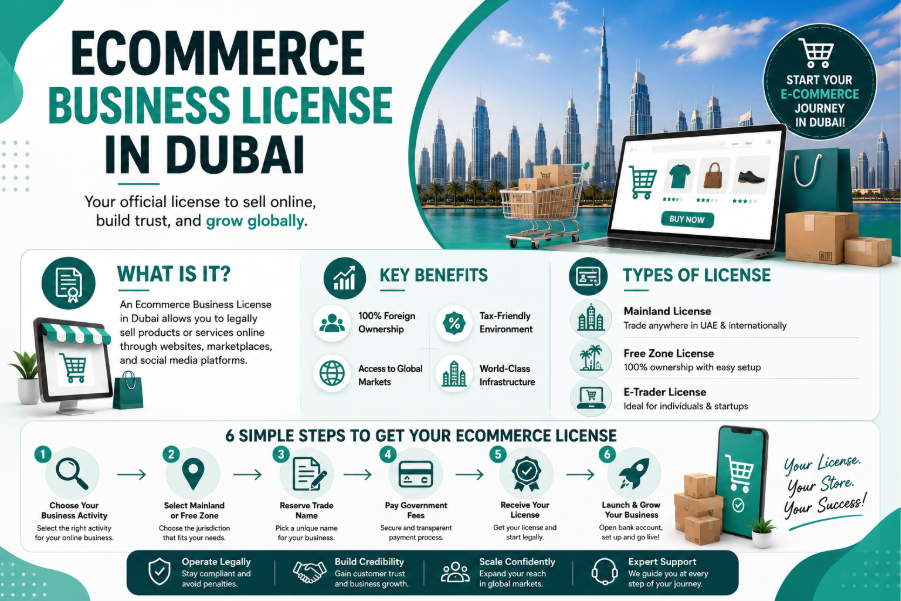
It is basically a legal permit that authorizes you to offer goods or services for sale through online channels. This could be your own website, a mobile app, social media platforms, or even well-known shopping sites like Amazon UAE and Noon.
The law behind it is Federal Decree-Law No. 14 of 2023. This replaced the old 2006 rules on online trade.
The Department of Economy and Tourism (DET) is the authority that grants these licenses to mainland companies. Free zones, on the other hand, come up with their own licensing systems. Your decision between the two will determine your expenses, the customers you are allowed to sell to, and whether you require a local partner.
What Does the License Cover?
A standard ecommerce trade license in UAE allows you to operate the following:
- Selling of physical products such as clothing, electronics, and home goods
- Offering digital products like e-books, software, and online courses
- Engaging dropshipping with the help of third-party suppliers and couriers
- Conducting B2B and B2C sales through your own store or a marketplace
- Selling via social media such as Instagram, TikTok, etc.
Who Needs One?
Anyone who takes payment online for goods or services needs a license. It does not matter if you live in the UAE or run the business from abroad.
Can You Sell Online Without a License?
No. It’s against the law. Fines run from AED 5,000 to AED 50,000. Your business can be shut down. If you’re an expat, you risk being deported.
Amazon UAE and Noon both check for a valid trade license. They won’t let you list without one.
Why Start an Ecommerce Business in Dubai in 2026?
The UAE has one of the highest internet use rates in the world. It’s above 99%. The government pushes digital trade hard. Logistics is fast and well-run. You can reach buyers across the Gulf region with ease.
The tax setup is one of the best you’ll find anywhere. Corporate tax is 9% on profits above AED 375,000 per year. Below that level, the rate is 0%. Most countries in Europe and North America charge between 19% and 30%.
Foreign founders can own 100% of their company. This is true in free zones and, since 2021, in most mainland sectors too. You can set up from abroad. You can get a UAE visa and run the whole business remotely.
Types of Ecommerce Licenses in Dubai
Mainland Ecommerce License Dubai
The DET issues this license. It lets you sell directly to UAE buyers, and no local partner is required. You can also bid on government contracts. The main drawback is the need for a physical office, which increases your setup costs. Learn more about Dubai Mainland Company formation.
Free Zone Ecommerce License UAE
Free zones like Dubai Commerce, IFZA, DMCC, SHAMS, and RAKEZ are popular options. Setup is faster. Costs are lower. You keep full ownership.
You can sell on Amazon UAE and Noon as a marketplace seller. To sell directly to UAE consumers, you’ll likely need a local distributor or a dual license.
E-Trader License
This is for UAE and GCC nationals only. It works for small social media sellers and personal websites. It’s cheap, but it doesn’t cover all types of online sales.
Mainland vs Free Zone: Side by Side
| Factor | Mainland (DET) | Free Zone |
|---|---|---|
| Foreign Ownership | 100% in most sectors since 2021 | 100% |
| License Cost 2026 | AED 10,000 to AED 15,000 | AED 5,770 to AED 12,900 |
| Office Needed | Physical office required | Flexi-desk or virtual allowed |
| Sell Direct to UAE Buyers | Yes, no limits | Via distributor or dual license |
| Amazon and Noon Listing | Yes | Yes |
| VAT Needed | Above AED 375,000 per year | Above AED 375,000 per year |
| Setup Time | 7 to 14 working days | 3 to 7 working days |
| Visa Slots | Based on office size | Based on chosen package |
Ecommerce License Cost in Dubai (2026 Breakdown)
The ecommerce license cost in Dubai isn’t one number. It depends on where you set up, how many visas you need, and what kind of office you take.
Here’s what you can expect to pay:
| Cost Item | Mainland (DET) | Free Zone |
|---|---|---|
| Trade License Fee | AED 10,000 to AED 15,000 | AED 5,770 to AED 12,900 |
| Name Reservation and Approval | AED 600 to AED 1,000 | Included in most packages |
| Office or Flexi-Desk | AED 8,000 to AED 20,000 per year | AED 1,500 to AED 5,000 per year |
| Company Card | AED 1,200 | AED 1,200 |
| Investor or Staff Visa | AED 3,500 to AED 5,000 per visa | AED 3,000 to AED 5,000 per visa |
| Emirates ID | AED 370 per person | AED 370 per person |
| Medical Test | AED 320 to AED 500 | AED 320 to AED 500 |
| Year One Renewal | Close to original license cost | Close to original license cost |
| First Year Total | AED 20,000 to AED 40,000+ | AED 10,000 to AED 20,000 |
Hidden Costs Most Founders Miss
The license fee is just the entry point. These extra costs are what catch most new founders off guard when planning their ecommerce startup budget in Dubai.
| Extra Cost | Typical Range (AED) |
|---|---|
| Payment Gateway Setup | 2,000 to 8,000 one-time |
| Business Bank Account Fees | 500 to 3,000 per year |
| Website Build | 5,000 to 30,000+ |
| VAT and Accounting Fees | 5,000 to 12,000 per year |
| Customs Duty on Imports | 5% of shipment value |
| Shipping and Delivery | Varies by order volume |
| Ads and Marketing | 5,000 to 20,000+ per month |
| Corporate Tax Filing | 2,000 to 8,000 per year |
Ecommerce License Requirements in UAE
Who Can Apply?
Anyone aged 18 or over can apply for an ecommerce license in Dubai. You don’t need to live in the UAE. You can start the whole process from your home country.
You’ll need to visit the UAE for biometric checks if you want a residency visa. The license itself can be sorted remotely.
Documents You’ll Need
Here’s the full list:
- Passport copy for all owners and directors, valid for at least 6 months
- Passport photo with a white background
- UAE residency visa if you have one or are applying for one
- Emirates ID for anyone already living in the UAE
- Trade name approval letter from DET or your free zone
- Initial approval certificate from the licensing authority
- Memorandum of Association notarized for mainland setups
- Lease or desk contract as proof of your business address
- Business plan sometimes asked for by banks and payment providers
If you’re applying from outside the UAE, you may also need a notarized and certified copy of your passport.
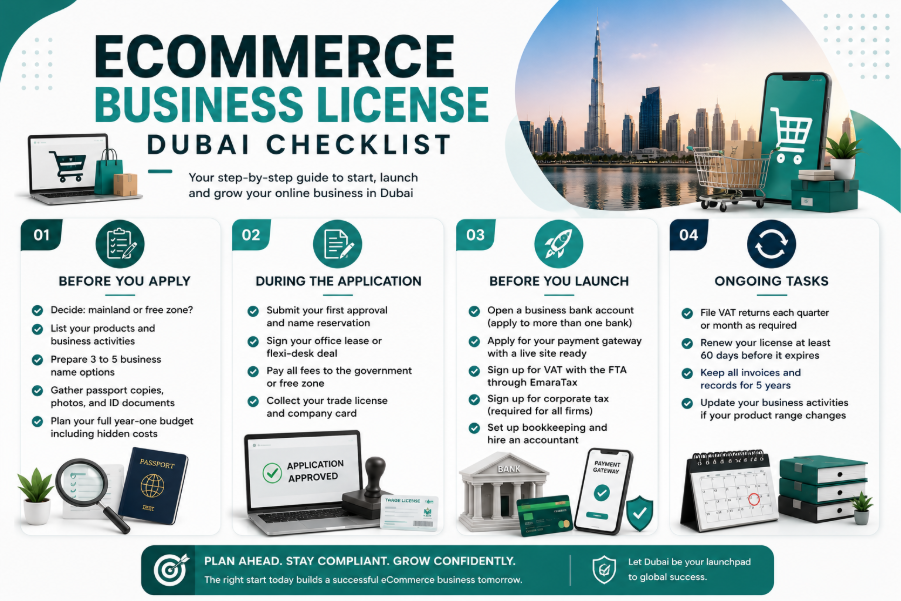
How to Apply for an Ecommerce Business License in Dubai
- Pick your setup type. Choose between mainland DET or a free zone. Base this on where your customers are, your budget, and whether you need a visa. Read our full guide on how to start a business in Dubai to understand each path.
- Reserve your business name. Submit 3 to 5 name options. Avoid names tied to religion, governments, or brands that already exist.
- Get your first approval. Submit your business type and owner details. This usually takes 1 to 3 working days.
- Lock in an address. Sign a lease or flexi-desk deal. Mainland firms need a physical lease registered with Ejari.
- Send your final papers and pay. Upload all documents to the DET or free zone portal. Pay the license fee and any government charges.
- Get your license. It’s sent to you digitally. You can now open a bank account, apply for visas, and sign up for VAT.
How Long Does It Take to Get an Ecommerce License in Dubai?
| Step | Free Zone | Mainland (DET) |
|---|---|---|
| Name Reservation | 1 to 2 days | 1 to 3 days |
| First Approval | 1 to 2 days | 2 to 5 days |
| Document Check | 1 to 2 days | 3 to 7 days |
| License Issued | 3 to 7 days total | 7 to 14 days total |
| Bank Account Open | 4 to 12 weeks | 4 to 12 weeks |
| Residency Visa | 2 to 4 weeks | 2 to 4 weeks |
| Payment Gateways Live | 2 to 6 weeks | 2 to 4 weeks |
Most delays come from missing papers or vague business type descriptions. A good business advisor will help you avoid both.
Can Foreigners Start an Ecommerce Business in Dubai?
Yes. Foreign investors can own 100% of a UAE ecommerce firm. In free zones, this has always been the case. On the mainland, the 2021 law changes opened most sectors to full foreign ownership too.
You can start everything remotely. Just send your scanned documents to your advisor. You only need to visit the UAE if you want a residency visa stamped in your passport.
Once your license is active, you can apply for a UAE investor or partner visa. It lasts 2 to 3 years and can be renewed. It lets you live, work, and bring family members to the UAE. Our visa processing service handles the full application.hat is broken inside your setup. A quick fix for one team is cheap. A total rewrite of an old firm takes more work.
Selling on Amazon UAE, Noon and Other Platforms
Amazon Seller License Requirements
To sell on Amazon UAE, you need a valid UAE trade license. The ecommerce or trading activity must be listed on it. Amazon checks your license number, your business bank account, and your Tax Number (TRN).
If you don’t have a TRN, Amazon may limit your account once your sales grow past the VAT threshold.
Noon Seller Requirements
Noon needs a UAE trade license and a business bank account. A Tax Number is also needed if you’re above the VAT limit. Both mainland and free zone licenses are fine, but your listed activity must match what you sell.
Staying Compliant on Marketplaces
Selling without a license, or with one that has expired, leads to account bans and frozen funds. Keep your license current. File your VAT on time.
Business Banking for Ecommerce Companies in Dubai
Why Do Ecommerce Bank Accounts Get Rejected?
This is one of the biggest pain points in the ecommerce setup Dubai process. Banks say no for several reasons:
- High-risk products: supplements, electronics, dropshipping, and digital goods
- No business plan or unclear revenue model
- No sales history or proof of active sales channels
- Free zone license with no UAE-based buyers or suppliers
- Incomplete ID checks or unclear source of funds
How to Get Approved
The best banks for ecommerce firms in the UAE include Emirates NBD, Mashreq Neo, Wio Bank, and Liv. Business. Fintech banks like Wio and RAKBANK Digital tend to move faster and are more open to new ecommerce firms.
To boost your chances, prepare a clear business plan, a live website or seller profile, supplier proof, and a sample invoice. Apply to 2 or 3 banks at the same time to cut down waiting time.
Payment Gateway Setup for Ecommerce Businesses
You must have a trade license, a business bank account in a UAE bank, and a website that is live to get your payment gateway approved in Dubai.
The top providers in the space are Telr, PayTabs, Stripe (for cross-border sales), and Network International. Each one has its own sign-up rules.
Rejections happen when your website is not live, the type of license you have does not match the products you are selling, or the product itself is classified as high-risk. You should set aside a time frame of 2 to 6 weeks for the approval and have a test site ready when you do the application.
VAT and Corporate Tax for Ecommerce Businesses in UAE
VAT Rules
VAT is 5% on most goods and services. You must sign up for VAT once your sales pass AED 375,000 per year. You can sign up early from AED 187,500.
Most sales to UAE buyers carry 5% VAT. This applies even if your firm is based in a free zone.
Both Amazon UAE and Noon ask for a Tax Number (TRN) for verified seller accounts. You sign up with the Federal Tax Authority (FTA) through the EmaraTax portal.
Corporate Tax Rules
The UAE started a 9% corporate tax in 2023. It applies from June 2023 onwards. Profits under AED 375,000 are taxed at 0%.
Every business must now sign up for corporate tax. This includes online sellers at any profit level. Skip this and you’ll face a fine.
Tax Mistakes to Avoid
- Not signing up for corporate tax even when profits are below the limit
- Charging VAT without holding a valid Tax Number
- Missing the 28-day VAT filing window after each tax period
- Not keeping digital invoices and records for 5 years
Ecommerce License Renewal in Dubai
Your ecommerce license renewal in Dubai is due every 12 months. Renewal fees are close to what you paid at the start.
Pay before the expiry date. A short grace period may apply. But trading on an expired license still carries risk.
Late renewal means fines of AED 250 per month. Your bank may freeze your account. Marketplace platforms may pull your listings. Set a reminder 60 days before expiry and budget for renewal each year.
Penalties for Trading Without a License
The UAE does not go easy on unlicensed trade. Here’s what you risk:
- Fine of AED 5,000 to AED 50,000 for trading without a license
- Business closure and goods seized
- FTA fine of AED 10,000 for not signing up for VAT when required
- AED 15,000 to AED 50,000 for VAT fraud or false returns
- Deportation risk for expat owners running without a license
Common Setup Mistakes and How to Avoid Them
- Wrong setup type: A free zone license costs less but may block direct sales to local buyers. Map your revenue plan before you choose. Our guide on free zone vs mainland business setup covers this in full.
- Wrong business type listed: Banks and payment firms check your activity codes. If they don’t match what you sell, expect rejections.
- Budget too low for year one: The license is just the start. Add banking, VAT, accounting, marketing, and renewal to your plan from day one.
- Only applying to one bank: Apply to 2 or 3 banks at once to cut waiting time if the first one turns you down.
- Skipping corporate tax sign-up: You must sign up even if you make no profit. Do it within 9 months of your financial year start.
- Missing VAT filing dates: The FTA won’t remind you. Set up a tax calendar or hire an accountant from the start.
How Dubai Business and Tax Advisors Can Help
Getting your ecommerce license in Dubai right the first time saves you weeks of back and forth. It also saves money you’d otherwise spend fixing avoidable errors.
Dubai Business and Tax Advisors (DBTA) helps ecommerce founders at every step. We help you pick the right setup, prepare your documents, and get your bank account and payment gateway approved. We deal with the paperwork and government filings so you can focus on the business itself.
Frequently Asked Questions
Free zone licenses start from around AED 5,770 with no visa included. Mainland licenses through DET cost AED 10,000 to AED 15,000 before office and visa fees. A full first-year budget, including banking, VAT, and other running costs, typically falls between AED 35,000 and AED 60,000.
Yes. Foreigners can own 100% of a UAE ecommerce firm. This applies in free zones and on the mainland since the 2021 law changes. You can start remotely. You only need to visit the UAE when applying for a residency visa.
Free zone setups take 3 to 7 working days once all papers are in order. Mainland DET setups take 7 to 14 working days. Opening a bank account takes 4 to 12 weeks depending on the bank and your business type.
Yes. Amazon UAE and Noon both accept mainland and free zone licenses. You need an active trade license with an ecommerce or trading activity listed, a UAE business bank account, and a Tax Number once your sales pass AED 375,000.
Yes. Corporate tax is 9% on profits over AED 375,000 per year. Profits under that are taxed at 0%. All firms must still sign up for corporate tax, even with zero profit. Free zone firms may qualify for a 0% rate on certain income if they meet the set conditions.
Fines range from AED 5,000 to AED 50,000. Your business can be shut down. Banks may freeze your account. Amazon and Noon will ban your seller profile. Expat owners also risk being deported.
Conclusion
The first thing to decide is simple: mainland or free zone.
If you want to sell directly to UAE buyers, win local contracts, or build a physical presence, go mainland. If you’re starting small, selling through marketplaces, or running a fully remote business, a free zone setup is faster and cheaper.
If you’re not sure where to start, or you’ve already hit a wall with banking or payment gateway issues, contact Dubai Business and Tax Advisors (DBTA) today. We’ll look at your business model and point you to the right ecommerce license in Dubai without wasting your time or money.
Speak to a DBTA advisor now and get your UAE ecommerce setup done the right way.