
Introduction
What Every UAE Business Owner Needs to Know About ESR
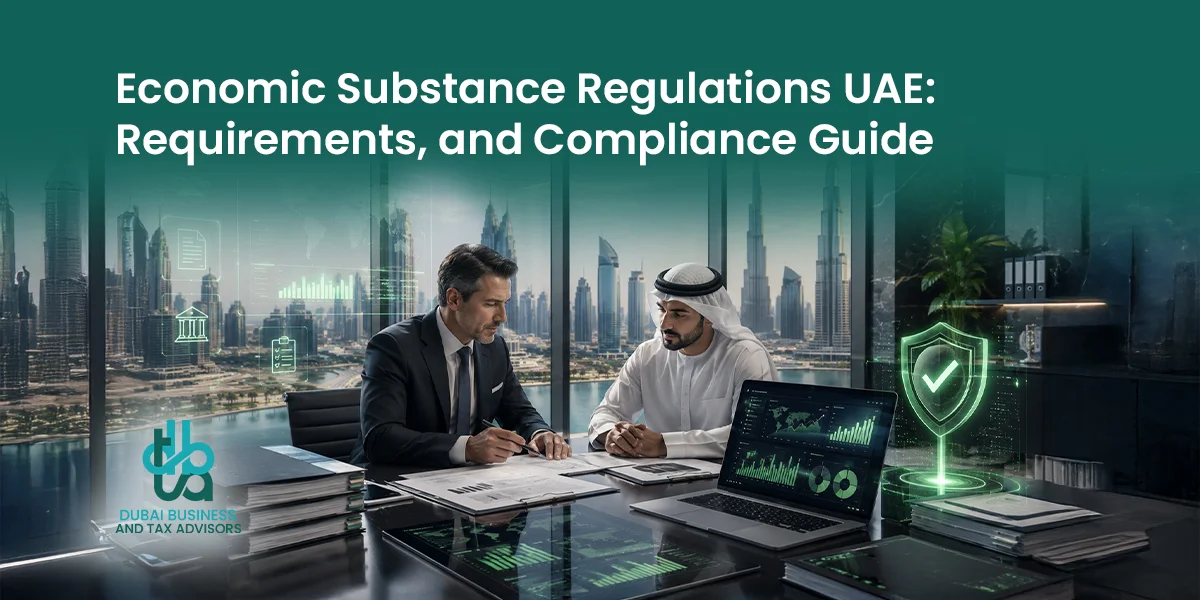
In fact, if you own a business in the UAE, you must have heard the word ESR. It is known as the Economic Substance Regulations. These rules are based on Cabinet Resolution No. 57 of 2020 and Ministerial Decision No. 100 of 2020.
All Licensees in the UAE are subject to ESR. That would include juridical persons, natural persons and unincorporated partnerships. In simple terms, it encompasses virtually all kinds of business.
Owners, many find these rules difficult to adhere to. Here is a guide that will simplify them step by step. It’s not only about avoiding fines when following ESR. Additionally, it demonstrates your business is a living part of the UAE economy.
What Has Changed in 2026
Standalone ESR filing ended on 1 January 2023. From that date, most businesses no longer file annual ESR notifications or reports for new financial years.
But ESR has not gone away. It still applies to the years 2019 to 2022. If regulators ask you to review old filings, you need to be ready.
The UAE has also moved much of the substance focus into the Corporate Tax system. This matters most to Free Zone companies seeking the 0% tax rate on qualifying income. If that is you, substance rules still apply.
Why the UAE Introduced These Rules
The UAE joined the OECD’s global push to stop firms from shifting profits to low-tax jurisdictions without doing real work there. The ESR rules were built to prove that UAE businesses are not just paper shells.
When you follow these rules, you help the UAE stay on the global list of trusted places to do business. The government wants to see that if you earn money in Dubai or Abu Dhabi, the real work is done here.
Think of it as fair play on the world stage. It also keeps your trade licence and your company name safe.
Does Your Business Need to Comply
The first step is working out whether ESR applies to you. Many small business owners think they are too small to matter. That is a common mistake, and it can be costly.
ESR applies to almost every licensed company in the UAE. This includes firms in the DIFC, ADGM, and all free zones. Size does not matter.
The full substance rules only apply if your business carries out a “Relevant Activity.” There are nine of these. If your trade licence or daily work falls into any one of them, you are in the system. Check this every year, because a new income stream can change your category.
Who Is Still at Risk in 2026
New ESR filings are no longer needed from 2023 onwards. But old exposure from 2019 to 2022 does not just go away.
Regulators can still ask you to review or defend past ESR submissions. So before you assume it is all over, ask yourself a few honest questions.
Were your old notifications and reports filed on time and in full? Did you keep your evidence, such as board minutes and financial records? Are there any unpaid fines or open notices with an authority? This is most urgent for firms that did Relevant Activities in the DIFC, ADGM, or UAE free zones.
The Nine Relevant Activities Explained
These nine groups were chosen because they are often used to shift profits across borders. The government wants the real work and key decisions behind these businesses to stay inside the UAE.
Banking Business: This applies to licensed banks that take deposits and make loans. Most regular businesses do not fall here. It is specific to regulated banks in the financial sector.
Insurance Business: This applies if your company sells insurance policies. That includes life, motor, or reinsurance cover. It covers firms that take on risk, not brokers who sell policies for a larger provider.
Investment Fund Management. This is common in the DIFC. It applies if you make key investment decisions for a fund. That means deciding which assets to buy or sell. The government wants those choices made by real people in a UAE office, not from abroad.
Lease-Finance Business: This one surprises many business owners. You do not need to be a bank to fall into it. If your company lends money to another entity and charges interest, you are likely in this category. This includes loans to related or sister companies in other countries.
Headquarters Business: If your UAE office acts as the hub for a wider group of companies, you fall under this category. This includes planning risks or giving central services to branches in other countries. The government treats your UAE office as the group head office.
Shipping Business: This covers firms that run ships in international waters. It applies to carrying cargo or passengers between countries, and to chartering vessels. It does not usually apply to small local boats or coastal tour operators.
Holding Company Business: A holding company owns shares in other firms. It earns income through dividends, not trading. These companies face simpler substance rules. But they still need a real place of business and at least some staff to manage their holdings.
Intellectual Property Business: This is the most closely watched group. If you earn money from patents, trademarks, or copyrights, you are in it. Regulators around the world watch where IP is held. You must prove that the IP is genuinely created or managed from within the UAE.
Distribution and Service Centre Business: This is the most common business type among UAE firms. It has two parts. First, if you buy goods from a connected company outside the UAE and resell them, you are a Distribution business. Second, if you provide services to a connected company outside the UAE, you are a Service Centre.
A connected company usually refers to a parent, subsidiary, or related branch. These setups also link to transfer pricing rules. Those rules control how transactions between related parties must be priced and recorded.
How the Economic Substance Test Works
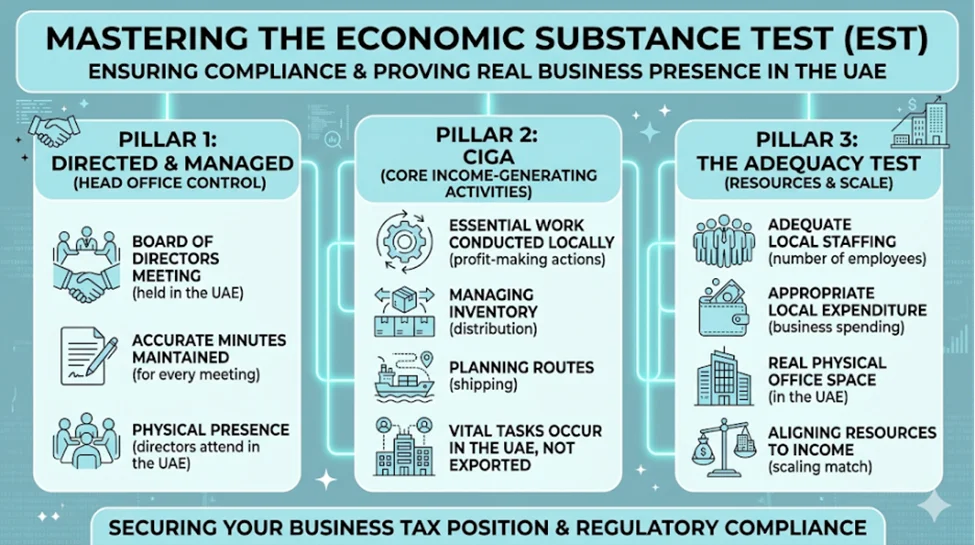
If your business does one of the nine activities, you must pass a substance test. This test proves your business has real roots in the UAE, not just a paper address. There are three parts.
The Directed and Managed Test. This checks who is actually running the business. Your board of directors must meet in the UAE. You need written minutes from those meetings. At least some directors must be in the room in person, not joining by video from another country.
The Core Income-Generating Activities Test. The government wants to see the most important work done on UAE soil. These are the tasks that directly create your profit. A distribution company might need to manage stock locally. A shipping company might need to plan routes from a UAE office. You cannot run a Dubai headquarters while the real work is done somewhere else.
The Adequacy Test: This checks whether your staff, spending, and office space align with your business’s size. What is enough for a small firm is not the same as what a large group needs. The government looks at your income and checks whether your local setup is a fair match.
Historical ESR Filings from 2019 to 2022
Between 2019 and 2022, businesses had to complete two filing steps every year. These are no longer needed for periods after 2022. But they still matter if regulators ask you to defend against an old submission.
Step One: The Notification. All companies doing a Relevant Activity had to file an ESR notification. For historical periods, this was usually due within six months of the financial year end.
Step Two: The Report Businesses earning money through a Relevant Activity also had to submit a full ESR report. This had to include supporting evidence and was usually due within 12 months of the financial year-end.
Who Was Exempt from ESR
Not every company had to meet the full substance rules. Some were exempt. These included companies that were tax-resident outside the UAE; overseas branches already taxed in another country, businesses with only local operations, and UAE-owned firms that operated entirely within the country.
But being exempt did not mean you could ignore the rules. Exempt businesses still had to file a notification and show proof of their status. The exemption removed the substance burden, not the duty to engage with the system.
What Replaces ESR in 2026
The standalone ESR filing requirement is gone. But economic substances are still very alive. It has simply moved into a different part of the tax framework.
Under the UAE Corporate Tax regime, Free Zone companies seeking the 0% tax rate on qualifying income must demonstrate genuine business activity in the UAE. That means real staff, true operational control, and a physical presence that matches the work being done.
Many of the old ESR ideas, such as local management, staff, and office space, are now part of the Corporate Tax and Free Zone substance rules. If your business is in a free zone and relies on the 0% rate, substance still applies to you. The rules have not changed. They have just moved closer to your tax return.
The Real Cost of Non-Compliance
The majority of ESR fines for 2026 relate to outstanding fines from 2019 to 2022. The penalties for non-compliance for financial years from 1 January 2023 have not been increased. But for historical periods, the government imposes severe punishment. Fines of up to AED 20,000 may apply for late notification. If someone failed the substance test, failed to submit a complete report or provided false ones, they were fined AED 50,000 or more. They will be running the total up to AED 400,000 if they make repeated failures.
Penalty Waivers and Refunds The UAE Ministry of Finance has confirmed that ESR penalties for financial years after 2022 may be waived or refunded in certain cases. If your business received notice during that later period, check whether you qualify for relief.
Beyond fines, serious non-compliance can also result in overseas tax authorities being notified. In the worst cases, it can result in a trade licence being blocked.
Common Mistakes That Get Businesses into Trouble
Most ESR problems do not come from breaking the rules on purpose. They come from simple mix-ups and poor records. Here are the mistakes that show up most often.
Miscounting Connected Persons. Many businesses do not spot who counts as a “Connected Person.” If you have a branch in Oman and your UAE company serves it, you are already in the Service Centre category. Parent companies, subsidiaries, and overseas branches all count as connected. Many owners only find this out when it is too late.
Relying on a Virtual or Flexi-Desk Office. A virtual office or flexi-desk may be fine for your trade licence. But it may not hold up for ESR if your income is high, or your team is large. The government expects your office to match the scale of your work. Ten staff sharing one hot desk will not pass inspection.
Missing or Weak Board Minutes. If you say a board meeting took place in Dubai, you need to prove it. That means written minutes, signatures, and travel records for directors who flew in. Without this proof, the government has no reason to believe that the meeting took place in the UAE.
Practical Steps You Can Take Right Now
You do not need to wait for a deadline or notice to act. A few simple steps can put you on much stronger ground.
Review Your Income Sources Each Year. Go through your income and ask where it came from. If any of them link to the nine Relevant Activities, start your records now. Pay close attention to money from related companies outside the UAE.
Check Your Office Setup: Make sure your office lease is in your company’s name and covers the actual physical space. If you use a virtual address and your income is growing, consider moving to a small, dedicated office. The cost is small compared to the risk of a fine.
Match Your Local Team to Your Activity. Look honestly at your UAE-based staff. Do they have the skills your business needs? A fund management firm with no finance staff in the UAE will struggle to pass the substance test. Your local team must reflect on the work you say is being done here.
Set Filing Reminders Well in Advance. Most fines occur not because someone broke the rules but because they missed a deadline. Set reminders in your calendar for six and twelve months after your financial year-end. That one habit can save you a lot of money.
A Note for DIFC and ADGM Businesses
If your company is in the DIFC or ADGM, the bar is higher than elsewhere in the UAE. These zones have their own teams that closely review filings. They know funds, holding structures, and intercompany deals very well.
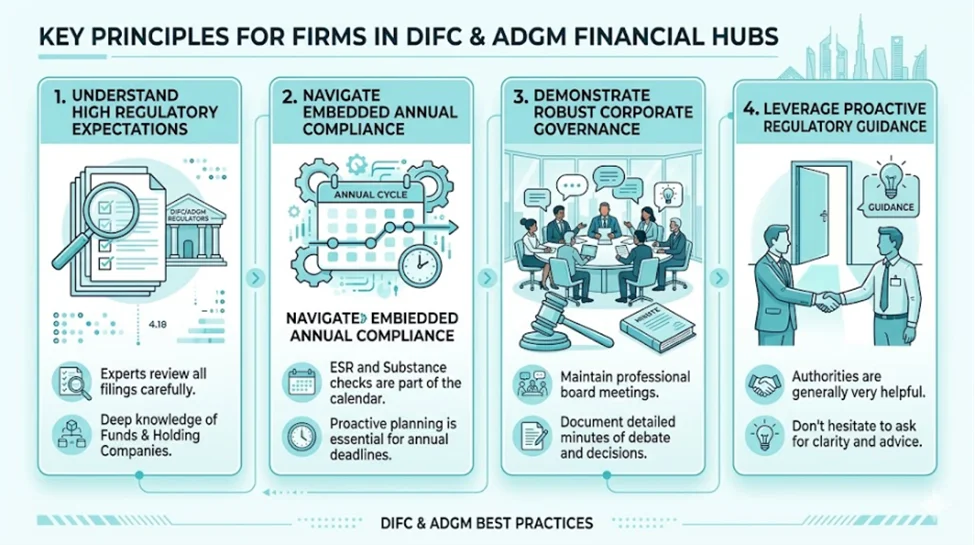
Treat your board meetings as proper formal events, not quick chats. The minutes must show real debate and real decisions. The regulators in these zones are usually helpful, so if you are unsure about anything, ask them directly. It is better than guessing.
Why Getting Expert Advice Makes Sense
The overlap between old ESR rules and the current Corporate Tax substance requirements is complex. Getting your activity classification wrong or setting up your business in a way that does not match current rules can expose you on both fronts.
A good tax advisory team can review your historical exposure, check your documents, and confirm that your current setup meets both frameworks. This is not an area where guessing serves you well.
Final Thoughts for 2026
Most businesses that truly operated in the UAE passed the ESR test without big problems. Those that did not manage well generally had poor records; directors located overseas, offices that did not match the income received, or a combination of these.
New periods may not be subject to the annual filing requirement. Economic substance is alive and well within the Corporate Tax system, however. Whether you realise it or not, you are currently in a substance framework: if you’re in the Free Zone or have the 0% qualifying income rate.
Simple is the most crucial. Go over the previous exposure to ESR. Maintain a well-organised bookkeeping system. Keep abreast of UAE Corporate Tax changes. In doing so, these steps will safeguard your licence, your reputation, and the future of your business in the Emirates.
Don’t know what your business is doing regarding ESR or the new Corporate Tax substance rules? Dubai Business & Tax Advisors (DBTA) can review your past exposure, assess your current configuration, and ensure you are adequately covered. Talk with us about your compliance position today.