

Introduction
The days of easy box-ticking are over for UAE finance firms. If you run a fund or a wealth office, you know the score. The Ministry of Finance is no longer just sending polite reminders. They are now checking XML files for errors. They are also reviewing books on-site. To keep your license in Dubai or Abu Dhabi, you must comply with the requirements of your license.
This guide gives you the straight talk on FATCA and CRS. We cover the steps you need to take this year. Follow them and stay off the radar. Ignore them, and you face heavy fines.
What Are FATCA and CRS?
At their core, these are systems built to stop people from hiding money in offshore accounts. If you manage money in the UAE, you ar
e now a data collector for the global tax world.
FATCA: The US Tax Reporting Law
FATCA is a US law. The UAE agreed to follow it back in 2015. It targets “US Persons” only. This includes anyone with a US passport, a green card, or a US birthplace.
The goal is simple. Americans must pay their taxes no matter where they live. For a UAE firm, the risk is real. If you don’t comply, you could face a 30 percent tax held back on payments from US sources.
The UAE-US Intergovernmental Agreement (IGA): Reporting Flow, how it works.
The UAE signed a Model 1 IGA with the United States. This implies that UAE financial institutions will not report directly to the IRS. Rather, they provide information to the UAE Ministry of Finance, which in turn reports this information to the US authorities. Knowing this flow is important since it will influence the type of portal that you use, who will see your data first, and what legal restrictions may apply to you as a reporting entity. The IGA also offers some exemptions and simplified rules, in addition to the standard FATCA rules. Companies that don’t know what they have in place could be on the wrong IGA model.
CRS: The OECD Global Reporting Standard
FATCA only covers the US. CRS covers almost everyone else. The OECD built it, and over 100 countries use it. People call it the “Global FATCA.”
If you have a client from the UK, India, or France, the story is the same. The UAE Ministry of Finance sends its bank data to its home country. In 2026, CRS makes up most of your reporting work. It covers so many countries.
FATCA vs CRS: Key Differences Explained
The main difference is what the report starts with. FATCA is triggered by citizenship. Being American is enough. CRS is triggered by where you live and pay taxes.
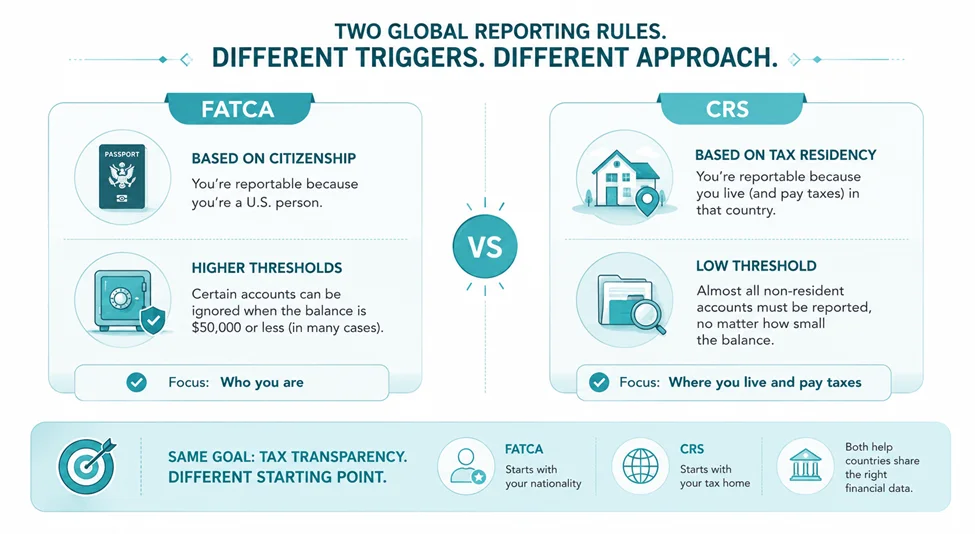
There is also a gap in thresholds. FATCA lets you skip accounts below 50,000 dollars in some cases. CRS often requires you to report every non-resident account. This applies even to low-balance ones.
Who Needs to Comply in the UAE?
You do not need to be a major bank to be caught in this net. The UAE’s view of a “Financial Institution” is broad on purpose.
Reporting Financial Institutions (RFIs): Definition and Scope
An RFI is any firm that holds, manages, or invests money for others. Banks are also covered, as well as brokers, wealth managers, and some insurance firms. If your firm earns most of its income from managing client assets, you are likely an RFI. You must register with the state.
Investment Entities: A Common Classification Mistake
This is where many smaller firms get into trouble. You might think you are just a “consultancy.” But if you manage portfolios or act as a fund manager, the law sees you as an Investment Entity. Even some family offices fall here.
If another financial body manages you and you trade financial assets, you have reporting duties. Ignoring this is the easiest way to trigger a surprise audit.
Firms unsure about their status should seek proper tax advisory guidance on UAE financial institution classification and reporting duties before making any assumptions. Getting it wrong early creates problems all the way to the filing date.
Use the Entity Classification Decision Tree to decide on your classification
Misclassification is one of the most prevalent misclassifications that the MoF identifies during audits. A simple Decision Tree can help. First, ask, does your firm have, manage, or invest in the financial assets of your clients? If so, you may be an RFI. If not, then ask: Does over half of your gross income come from passive sources (interest, dividends or rental income)? Yes, you are a Passive NFE, and the bank must “peer underneath” the controlling persons. If not, you are an Active NFE that has a low reporting burden. If the entity is managed by another financial institution and trades in financial assets, the classification is “Investment Entity”, irrespective of the name that the firm gives itself. Firms should record this classification exercise formally and retain it on the firm’s files for audit purposes.
Active vs Passive Non-Financial Entities (NFEs)
If you are not a financial body, you are an NFE.
Active NFEs are standard firms. Think of a builder or coffee shop. They only need to fill out a form for their bank.
Passive NFEs earn more than 50 percent of their income from passive sources. This includes interest or dividends. For these, the bank will look through the company to find the actual human owners.
Exempt Entities: Who Qualifies as a Non-Reporting FI
Very few groups qualify for an exemption. Usually, only state bodies, global groups, and certain pension funds are exempt.
Even if you think you qualify, you often still need to register on the portal to claim that status. Never assume you are exempt without a formal legal opinion on file.
How to Register: GIIN and UAE MoF Portal
Registration is your first formal contact with the regulators. Do not wait until the reporting due date starts.
Applying for a GIIN from the IRS
If you are an RFI, you must first register with the US IRS to get a Global Intermediary Identification Number, or GIIN. This number is your international ID.
Without it, the UAE portal will not let you finish your sign-up. It also signals to other banks that you take FATCA seriously.
Registering on the UAE Ministry of Finance AEOI Portal
Once you have your GIIN, you go to the UAE Ministry of Finance portal, also known as the MoF portal. This is the only place to file your reports. You will need your trade license and your company’s legal details.
The portal is where you get all formal notices. Keep the login details current, most of all when staff changes. Firms that are also handling UAE corporate tax sign-up at the same time should work with advisors who understand how UAE corporate tax registration and broader tax compliance duties interact with each other. This way, nothing gets missed between the two.
Appointing a Responsible Officer (RO)
Every firm must name a Responsible Officer. This person is legally liable for the accuracy of your data. It should be a senior person who knows the legal risks. If reports are often wrong, the RO will be called in for a formal review.
Client Due Diligence Requirements
Due diligence is daily work. It means checking your clients’ details well. It is much more than collecting a passport copy.
Self-Certification Forms: What to Collect and Why
You cannot open a new account in the UAE without a signed Self-Certification Form. The client uses this to tell you where they pay taxes. They also give you their Tax ID Number, or TIN. If these forms are missing, you are already in breach of the law.
Identifying and Acting on Tax Indicia
You have a duty to review client details carefully. If a client says they live in Dubai but holds a US passport, that is a red flag. A UK phone number is also a warning sign. These clues are called “indicia.”
You must ask the client for a clear reason or proof of their address. If they cannot show they are only a UAE resident, you must report the account to the other countries involved.
Pre-Existing Account Reviews
If your firm has been running for a long time, you likely have old accounts. These were opened before the rules were strict. You are required to go back through these files. Look for any signs of foreign residency in your old KYC records. The MoF expects all high-value older accounts to be fully reviewed by now.
Controlling Persons: Look-Through Rules for Funds and Trusts
For corporate clients or trusts, the state wants to know who truly controls the money. You must find any “Controlling Person” who owns more than 25 percent of the entity. This means collecting tax data and passports for the actual human owners. Company directors alone are not enough.
This kind of structured client review is at the core of what professional due diligence services for financial and corporate entities in the UAE are built to handle. Firms that use expert support here tend to have far fewer problems during reviews.
Annual Reporting: Deadlines, XML Filing, and Nil Returns
The reporting phase is the hard part of the job. It causes the most stress for most firms.
FATCA and CRS Filing Deadlines in the UAE
The filing due date is June 30th each year. This covers data from the year before. But be careful. Some free zones, like DIFC or ADGM, may ask for your data earlier. They want to check it first. Missing the due date by even one day brings an automatic fine.
If your firm is set up through a Dubai free zone company, your free zone body may have its own internal cut-off that falls several weeks before the national June 30th date.
Firms Operating Across UAE Free Zones are required to do Multi-Jurisdictional Reporting
There may be overlapping reporting requirements if your company has several free zones or branches in several emirates. For instance, if a firm is licensed in both the DIFC and ADGM, it has to deal with two different regulators, each with its own review period. A third channel is for the Mainland companies subject to the Central Bank’s regulation. If these parallel duties are not taken into account, it can lead to a filing compliant in one jurisdiction and a filing due in another. Identify all the regulatory points of contact your firm has and verify the regulatory reporting requirements with each authority individually.
XML Schema Requirements and Common Errors
You cannot upload an Excel sheet or a PDF. The MoF requires an XML file. Their systems read this format on their own. Common errors include a missing TIN or a wrong date format. Either one can cause the whole file to be rejected. Most firms use expert software to build these files. Doing it by hand is nearly impossible without errors.
How to File a Nil Return (And Why It Is Mandatory)
If you have no clients to report, you still must file. This is called a “Nil Return.” It is a formal statement that you checked your records and found nothing to report. If you skip it, the state assumes you forgot. They will fine you just as if you had missed the due date.
Remediation/Correction Procedures:
A TIN can be misregistered, or the tax residency of a client can change after the report is submitted. The MoF portal is used for submission of corrected or amended XML files after the deadline. The secret is speedy action. Errors which are self-discovered and quickly fixed are not treated as severely as errors found in an audit. Your correction file has to reference the original report, and it is important that you clearly mark which records have been changed. Firms should have an internal review process in place that is established as quickly as possible (preferably within the 30-day grace period from the June 30th filing) to detect and correct any problems before the Ministry identifies them.
Reporting on Closed and Dormant Accounts
One frequently asked question is whether or not the accounts of a closed reporting year are still to be included. The answer is yes. If you had an account in existence at any time in the calendar year, it should be reported on your annual filing. Reported balance should be the balance at the closing date. This does not also exempt dormant accounts if there has been no activity. If the reportable person is the account holder, then the account is included regardless of the activity level. Closed accounts or dormant accounts are common audit issues.
Penalties for Non-Compliance: Cabinet Decision 129
The UAE has raised its fines sharply. It wants to show the world that it is serious about openness. Cabinet Decision 129 sets out the full list of fines.
Failure to Register
If you are an RFI and have never registered on the MoF portal, you face an instant fine. This sits between 10,000 and 20,000 AED.
Late or Missing Filings
Missing the June 30th due date brings an automatic 10,000 AED fine. If the delay continues.
Nil Return Violations
Skipping a Nil Return is a common and costly mistake. It can cost you 10,000 AED for FATCA. For CRS, a long delay can cost up to 50,000 AED.
Data Errors and Inaccurate Reports
Submitting a file with wrong addresses or missing TINs can cost you 10,000 AED per material error. Ten clients with wrong data equal 100,000 AED in fines. That adds up fast.
Due Diligence Failures
If a reviewer finds you did not collect self-certification forms, you face a 20,000 AED fine. This applies to each account found in breach.
Willful Non-Compliance
This is the most serious level. If the state believes you are helping people hide money on purpose, the fine can reach 100,000 AED. They may also move to revoke your business license.
Audit Readiness and Record-Keeping
An audit should be expected, not feared. The key is keeping your paper trail ready at all times.
Building a FATCA and CRS Compliance Manual
You should have a written manual that describes your process. If a reviewer arrives, they will ask how you are onboarding clients. They will also ask how you handle red flags. A manual shows that your process is consistent. It proves you are not just scrambling in June each year. Firms that go through a proper compliance audit to check gaps in their legal processes and internal controls before the Ministry of Finance arrives tend to come out of reviews with minor fixes. Those without one often face six-figure penalty notices.
Arabic Record-Keeping and Translation Requirements
In the UAE, Arabic is the main language of law. Your daily work may be in English. But the MoF can demand Arabic versions of your compliance manual and client files during an audit. You often have only a few days to hand these over. A pre-translated summary of your policies is a smart and low-cost way to avoid a 5,000 AED fine for language violations.
What to Expect During a Ministry of Finance Compliance Review
An auditor will often ask for a random sample of client files. They will check if the TIN is correct. They will also look for ignored foreign phone numbers. They are not looking for perfect records. They want to see a “culture of compliance.” Finding your own errors and fixing them before an audit always looks better than a reviewer finding them for you.
Co-ordination with UAE Economic Substance Regulations (ESR)
The UAE’s Economic Substance Regulations also apply to many that are required to comply with FATCA and CRS. For some licensees, ESR will mandate a minimum substance in the UAE, such as local decision-making, qualified employees, and operating expenditure. The calendar of compliance for ESR and AEOI is very similar, and both must be completed each year with the Ministry of Finance. It is suggested that firms integrate their ESR and FATCA/CRS compliance processes to prevent efforts from being duplicated and to ensure that the entity classification and reporting positions are aligned between the two. If you’re not consistent in your classification, it’s a red flag that an auditor will see.
How to Reduce Your Compliance Costs
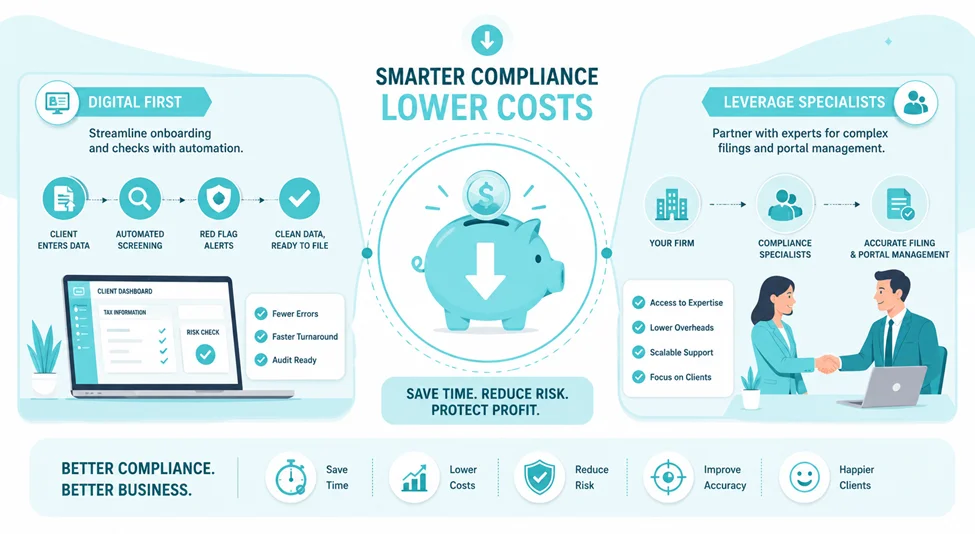
Compliance costs money. But it does not have to drain your budget if you use the right approach.
Digital Onboarding and Automated Due Diligence Systems
If you are still using paper forms and Excel, you will make mistakes. Most successful firms in 2026 use digital onboarding. The client enters their tax data directly into a system. The system then checks for red flags on its own. This turns the June reporting period into a quick task. It is no longer a month of manual data entry.
When to Outsource to a Specialist Advisor
Hiring a full-time compliance expert is too costly for many firms. Outsourcing to an expert is often a better option. They handle XML filing and portal management. You stay focused on your clients.
A large, fixed cost becomes a manageable service fee. This is exactly the kind of senior-level financial oversight that outsourced CFO and financial advisory services for UAE businesses are designed to provide. It gives growing firms access to experienced compliance leadership without the cost of a full-time hire.
What Is Coming Next: CARF and Digital Asset Reporting
The rules are already expanding to include the crypto world.
The Crypto-Asset Reporting Framework (CARF) Explained
CARF is essentially “CRS for Crypto.” It will require crypto exchanges and wallet providers to report on the tax residency of their users. The UAE is a major hub for digital assets. These rules will likely be built into the local portal by the end of 2026.
How UAE Firms Should Prepare for CARF Now
If you deal with digital assets, start collecting tax residency data from your users today. Do not wait for the law to become official. The data you collect now is what you will have to report later.
Starting early saves you from a large compliance headache down the line. Firms that work across borders should also think about how transfer pricing documents and cross-border tax structures will connect with CARF as regulators start to link data across reporting frameworks.
How DBTA Helps UAE Businesses Stay Compliant
At DBTA, we take the technical weight off your shoulders. We help firms confirm their status, set up their portal accounts, and produce the mandatory XML files for reporting. Our goal is to keep you compliant without making you become a tax expert.
We provide the senior oversight you need to ensure you never receive a penalty notice from the Ministry of Finance.
Conclusion
Compliance with FATCA and CRS in 2026 is a test of how well your firm is organised. It is a technical and often frustrating task. But it is the cost of running a business in a global financial centre like the UAE. Get your systems right, and it becomes a quiet routine. Ignore it and it becomes an expensive disaster.
You should have reviewed your client files from day one. But if you have not, now is the time. June due dates are getting close. Make sure your XML files are clean, up to date, and easy to find. Your Responsible Officer should know exactly where everything is stored.
A single missing file or small error can lead to serious fines. Keeping your records in order protects your firm just as much as winning new clients does.