


Introduction
I have been advising businesses in the UAE on tax registration since before corporate tax existed here. Back then, VAT was the only thing businesses needed to register for, and even that caused confusion.
Now there are two separate registration requirements, two different numbers, two sets of deadlines, and a lot of businesses sitting past their deadline without knowing it.
This article covers the whole picture simply. What is the TIN number? Who needs one? What happens if you miss the deadline? And how to get through the EmaraTax process without your application bouncing back three times.
TIN and TRN: They Mean the Same Thing
The UAE does not call it a TIN. The Federal Tax Authority uses the term TRN, which stands for Tax Registration Number.
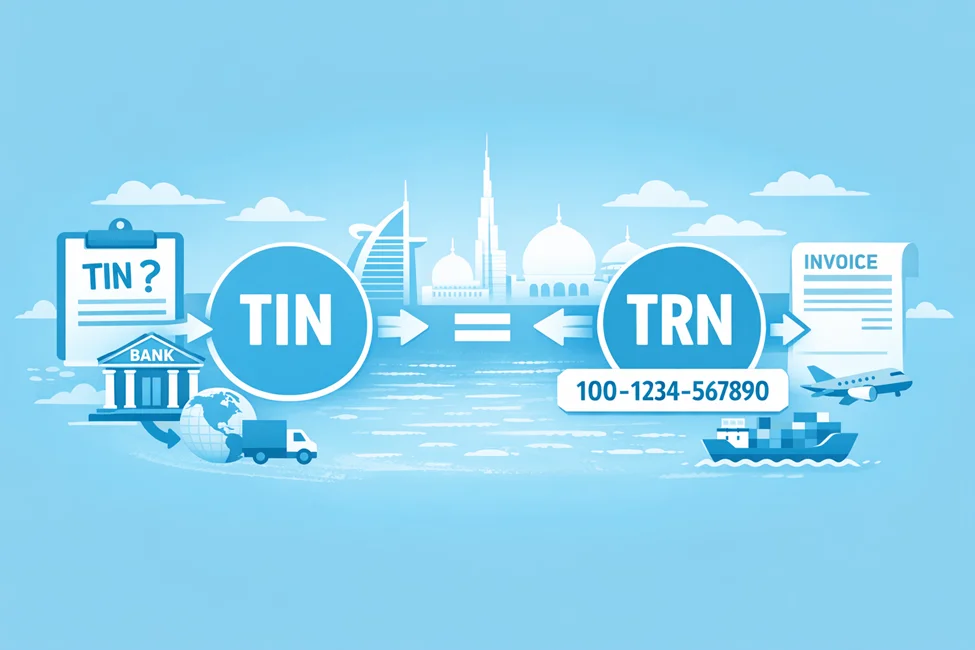
When your bank asks for your TIN, they want your TRN. When an international supplier asks for your tax ID, they want your TRN. It is the same 15-digit number, format 100-xxxx-xxxxxxx, issued by the FTA when you register.
Why the Confusion Exists
TIN is the international standard term. Most countries use it. The UAE chose TRN for its own system. So when foreign banks and global compliance forms ask for a TIN, UAE businesses sometimes think they are being asked for something they do not have.
They do have it. It is their TRN.
What About Personal TINs?
There is no personal income tax in the UAE, so there is no personal TIN for individuals who are just employees or private investors. If someone is asking you as an individual for a TIN, it is almost certainly because you run a business. And if your business turnover hits AED 1 million, you will need to register.
VAT Number, Corporate Tax Number, TRN: What Is Actually Different?
When VAT launched in January 2018, registered businesses got a TRN. That number became their VAT identity.
When corporate tax came in during June 2023, the FTA started issuing a separate Corporate Tax TRN through the corporate tax registration process. This can be a different number from the VAT TRN.
Which Number Does What
Your VAT TRN goes on your tax invoices, your VAT returns, and your customs documents.
Your Corporate Tax TRN goes on your corporate tax returns and any FTA correspondence about corporate tax.
If you are registered for both, you hold two separate TRNs. If you are only required to do corporate tax registration and fall below the VAT threshold, you hold one.
Who Needs to Register
Most UAE businesses need to register. The question is usually which registrations apply and when.
VAT Registration
Mandatory for any business with a taxable turnover above AED 375,000 in any 12-month period. Applies to both mainland and free zone companies. (Source: tax.gov.ae)
Voluntary registration is available from AED 187,500. This is worth considering if you are spending heavily on startup costs and want to reclaim input VAT before you hit the mandatory threshold.
Corporate Tax Registration
This is where people get surprised. Every company in the UAE must register for corporate tax. Mainland LLCs, free zone entities, and branches of foreign companies. All of them. It does not matter whether you made a profit. It does not matter whether your income is below the taxable threshold.
Registration is mandatory. Tax liability is a separate question.
Free Zone Companies Specifically
A lot of free zone owners assume the 0% corporate tax rate means they do not need to register. That is wrong. The 0% rate, if you qualify for it as a Qualifying Free Zone Person (QFZP), applies to your tax liability. Registration requirements exist regardless.
And qualifying as a QFZP is not automatic. It depends on substance requirements, the nature of your income, and whether your activities meet the specific criteria in the corporate tax law. Do not assume eligibility without checking.
Natural Persons and Sole Traders
If your business turnover from UAE activities exceeds AED 1 million in a calendar year, you must register for corporate tax. Salary, personal investment income, and rental income from property you own personally are excluded from that calculation. Only business activity revenue counts. (Source: tax.gov.ae)
What are the Deadlines
Missing your corporate tax registration deadline costs AED 10,000. That is a fixed administrative penalty from the FTA. Registration is free. The penalty is completely avoidable. (Source: FTA Decision No. 3 of 2024)
If Your Business Was Set Up Before March 2024
Your deadline was assigned based on the month your trade licence was issued. All these deadlines fell between May and December 2024. If you have not registered yet, you are past your deadline. Register now and expect the penalty to be assessed when you do. Waiting longer makes it worse.
If Your Business Was Set Up on or After 1 March 2024
You have three months from your date of incorporation to register. Both mainland and free zone entities follow this rule.
For Foreign Companies
If you have a permanent establishment in the UAE, you have six months from when that establishment was created. If you have a UAE nexus but not a full permanent establishment, you have three months.
For Sole Traders and Freelancers
If your business turnover exceeded AED 1 million in 2024, your registration deadline was 31 March 2025. For each year going forward, the deadline is 31 March of the following year.
If you are unsure which deadline applies to your situation, our tax advisory team can tell you in a single conversation.
Documents to Prepare Before Opening Emara Tax
Do not open Emara Tax and then start looking for documents. Get everything ready first. Applications that bounce back almost always do so because of missing or expired paperwork.
The Core Documents
- Valid UAE trade license. If it is expired, the application will not go through. Renew it first.
- Memorandum or Articles of Association
- Passport copies of all shareholders and the authorized signatory
- Emirates ID of the authorized signatory if they are a UAE resident
- Proof of business address, either a tenancy contract or a utility bill
- Your IBAN and bank account details
For Foreign Companies
You will also need documentation confirming your permanent establishment or UAE nexus. This varies depending on your structure, so get advice before you start if you are unsure what counts.
For VAT Registration
Add recent financial statements or evidence of expected turnover, plus customs registration details if your business imports or exports.
Translation Note
If any of your documents are not in English or Arabic, you will need certified translations before you begin. This is the most common reason applications get stuck halfway through. Sort it before you log in.
Getting your business licence confirmed and current before you start saves a lot of back-and-forth.
Registering on EmaraTax, Step by Step
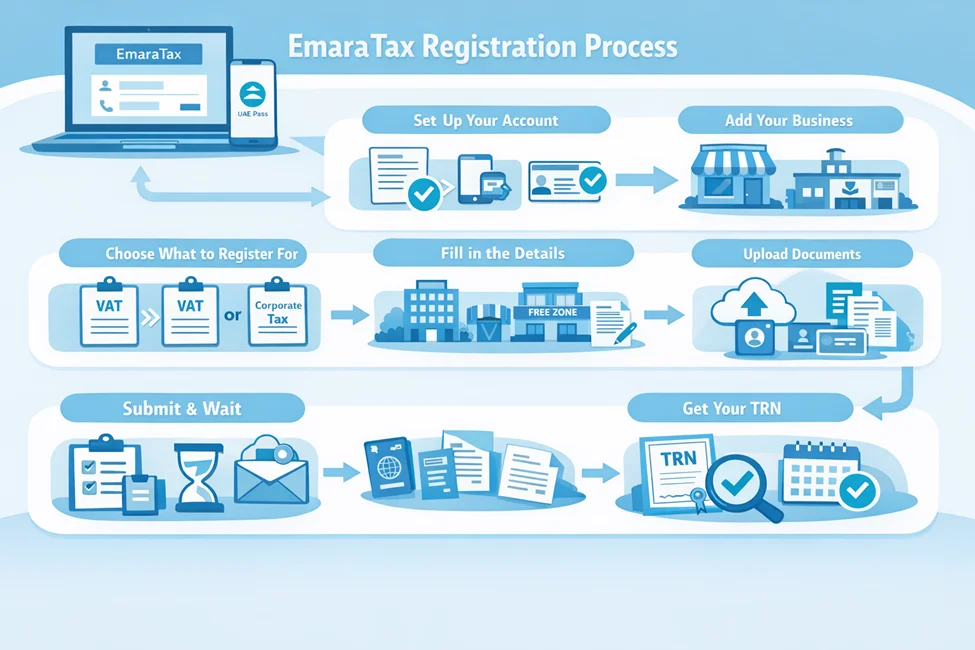
The whole process runs through the FTA’s Emara Tax portal. Here is how it goes.
Setting Up Your Account
Go to the EmaraTax portal. Register with your email and mobile number. If you have UAE Pass, use it because it speeds up verification. Confirm via the link sent to your email before doing anything else.
Adding Your Business
Once you are in, add your taxable person profile. Enter your trade licence number, legal business name, and the Emirates ID of the authorised signatory.
Choosing What to Register For
Select VAT, corporate tax, or both. If both apply, you can run them as separate applications or, depending on your situation, simultaneously.
Filling In the Form
Enter your legal structure, business activities, physical address, contact details, and ownership information. For corporate tax, you also need to confirm your financial year-end. Be specific about whether your entity is mainland or free zone because some fields depend on this.
Uploading Documents
Attach everything from the list above. Clear scans. Current documents. This step is where most delays happen.
After You Submit
You get a reference number. Keep it. The FTA will contact you at the email on your account if they need more information. Not responding in time can get your application rejected, and you would need to start again.
Getting Your TRN
The FTA usually processes applications within 5 to 20 business days. (Source: tax.gov.ae) When approved, your TRN appears in your Emara Tax dashboard. Download your Tax Registration Certificate. Put the TRN on every tax invoice and filing from that point on.
One important note: if your registration deadline is close, submit before the deadline even if approval has not come through yet. The FTA looks at the submission date, not the approval date, when assessing whether you were on time.
Does the 9% Rate Actually Apply to You?
Probably not, if you are a small business. But you still need to register.
The Rate Structure
Corporate tax is 0% on taxable income up to AED 375,000. It is 9% above that. (Source: Federal Decree-Law No. 47 of 2022)
Small Business Relief
If your annual revenue is AED 3 million or less, you can elect for Small Business Relief. This treats your taxable income as nil for the relevant tax period. It is available for periods ending on or before 31 December 2026.
What This Means in Practice
Most small businesses, freelancers, and early-stage startups in the UAE will either sit in the 0% band or qualify for Small Business Relief. Their effective tax bill is zero. But they must still register. The relief does not replace the registration requirement.
For anything involving QFZP eligibility or more complex structures, get a proper assessment from our tax advisory team before you assume you qualify.
Fixing Errors, Deregistering, and Handling an FTA Audit
Errors in Your Registration
Most mistakes, such as a wrong financial year-end or an incorrect address, can be fixed through an amendment application on Emara Tax. Some changes need supporting documents. Changing your legal entity type goes through FTA review.
If You Need to Cancel
If your business closes or falls below the VAT threshold, deregistration is possible. For VAT, you file a final return and clear any outstanding liability first. Corporate tax deregistration follows the same logic. You must have filed all returns and have no pending liabilities before the FTA processes it.
FTA Audits
The FTA can audit any registered business within five years. Good records, filed returns, and clean FTA correspondence are what protect you. Our accounting team helps businesses keep their records in the kind of shape that makes an audit something you can handle calmly, not something you panic about.
How We Handle This for Clients at DBTA
We see two types of clients come to us on this. The first type comes before they have done anything and wants to get it right from day one. The second type has already missed a deadline and wants to know how bad it is.
For the first group, we go through their structure, confirm which registrations apply, and handle the Emara Tax application end to end. We have done this for newly incorporated startups, established mainland LLCs, free zone companies checking QFZP eligibility, and foreign businesses setting up UAE operations.
The process is straightforward when the documents are in order and someone who knows the portal is doing the submission.
For the second group, we assess the penalty position, get the registration done, and advise on what else may need to be filed. The AED 10,000 penalty is fixed. There is no negotiating it down. But further exposure from additional missed filings is avoidable, and that is where the advice matters.
Beyond registration, we support VAT return filing, corporate tax return preparation, and FTA audit support. See how we approach business licensing and tax compliance for businesses setting up from scratch.
Conclusion
The UAE tax system is simpler than people expect. Two registrations, clear thresholds, one portal. What catches businesses out is not the complexity. It is your fake thought that registration can wait, or that a zero tax bill means zero obligation.
It does not work that way. The registration requirement exists separately from the tax liability. And the penalty for missing it is the same whether your turnover is AED 100,000 or AED 10 million.
If your business is set up in the UAE and you are not sure whether you are registered correctly, or whether you have missed a deadline, get it checked now.
Frequently Asked Questions
Yes. TIN is just the global term for it. In the UAE it is called a TRN. Give your bank the 15-digit number from your FTA certificate and you are done.
Yes. Everyone registers. The 0% rate is about what you owe, not whether you register. Skipping registration is a AED 10,000 fine regardless of your tax bill.
Probably yes, but register anyway. The fine is fixed at AED 10,000 whether you are one month late or one year late. The longer you wait, the more risk you add on top of that.
For VAT, no. For corporate tax, it depends. If you are a limited company, you still have to register no matter what your sales are. If you are a sole trader, the trigger is AED 1 million in business income per year.
Go to tax.gov.ae and use the TRN verification tool. Enter the 15 digits and it shows whether it is valid and which business it belongs to. You need the TRN number itself to search. You cannot look up by company name.