
Incorporation Certificate in the UAE: How to Obtain, Verify & Use (2026 Guide)

Recent Insights

Table of Contents
Introduction:
The UAE is one of the best places in the world to start a business. In 2026, it keeps attracting record levels of foreign investment. If you want to set up a company here, one document matters more than any other: the Certificate of Incorporation. Banks need it. Immigration needs it. Government contracts require it. Without it, your business does not legally exist.
This guide explains the UAE incorporation certificate clearly. It covers what it is, who issues it, what it costs, how long it takes, and how to spot a fake one. Whether you are going Mainland or Free Zone, this is your full 2026 reference.
What Is a Certificate of Incorporation in the UAE?
A Certificate of Incorporation is the legal proof that your company exists. It confirms your business is registered under UAE law. Think of it as your company’s birth certificate. Under the UAE Commercial Companies Law No. 32 of 2021, a company only becomes real once it appears in the Commercial Register. The COI proves that it happened.
Many people mix up the COI and the Trade License. They are not the same thing. The COI creates your company as a legal entity. It means your business can own assets, sign contracts, and carry debt in its own name. The Trade License is just a permit. It lists what your company can do commercially. You need both. Banks will ask for both. If you only bring one, your account opening will stop.
What appears on the certificate depends on where you register. Mainland certificates show the company name in Arabic and English, the registration number, the start date, and the emirate. Free Zone certificates from DIFC or ADGM often include more detail, such as the legal structure and the governing law.
Who Issues the Certificate of Incorporation in the UAE?
Where you register decides who issues your COI. That choice also shapes your whole business structure.
Mainland companies register through the Department of Economy and Tourism (DET) in Dubai. Other emirates use their own DED office. Abu Dhabi, Sharjah, and Ras Al Khaimah each have one. These work under the UAE federal law. A Mainland COI lets your company trade anywhere in the country. It also lets you bid for government contracts without a local agent. If you are considering this route, see how DBTA handles Dubai Mainland company formation from start to finish.
Free Zone companies register with their own Free Zone Authority. The UAE has over 40 Free Zones. Each one focuses on a specific sector. DMCC handles commodities. IFZA serves general business. DAFZ focuses on aviation. ADGM and DIFC serve finance. Each authority issues its own COI. DIFC and ADGM certificates carry extra weight with global investors. Both zones use common law, which Western banks and partners know well. For a detailed look at your options, explore DBTA’s Dubai Free Zone company formation service.
This choice affects more than paperwork. It affects who can own your company, what you can trade, your tax position, and how banks view your certificate.

What Are the Certificate of Incorporation Requirements in the UAE?
The UAE checks are strict, and they match global standards. Every document you submit answers one of three questions: who owns this company, who runs it, and what it will do.
For individuals, you need clear passport copies for all owners and directors. You also need proof of home address. A recent utility bill works. Passport photos are required, too.
For corporate owners, more is needed. You must provide the parent company’s own COI and its founding documents. A board decision letter approving the UAE investment is also required.
The MOA and AOA form the core of your application. These set out the internal rules of the company, the share structure, and what directors can do. Most UAE authorities now require digital signatures through UAE PASS. A physical office address is also needed. Mainland firms need an Ejari, which is a registered rental contract. Free Zones need a signed lease for their own office or desk space.
One thing many people miss is the UBO declaration. Every company must name the real human beings who own or control it. Getting this wrong is not a small error. It can mean rejection, heavy fines, and personal liability for directors.
How Do You Get a Certificate of Incorporation in the UAE?
The process runs in a set order. Skipping steps or sending incomplete papers is the main reason applications slow down. Working with a professional company formation and trade license management service from the start removes that risk entirely.
Step 1: Pick your structure and zone. Decide if an LLC, branch, or another form suits your needs. Then choose between Mainland and Free Zone.
Step 2: Reserve your trade name. Your name must be unique and free from existing brands. Name approval must come before anything else.
Step 3: Get initial approval. This is the authority’s green light that your business activities are allowed in that zone. You cannot move forward without it.
Step 4: Draft and sign the MOA and AOA. Mainland firms often need a notary. Free Zones usually give you a template you can adjust. This makes the step faster.
Step 5: Secure your office address. Complete the Ejari for Mainland or sign your Free Zone lease before you send the final application.
Step 6: Submit and pay. Once all papers are checked and fees are paid, the authority reviews your file and issues your COI.
Working with a business setup expert at this stage saves real time. This is especially true if your activity needs sign-off from more than one government body.
How Long Does It Take?
The UAE is one of the fastest places in the world to get a COI. But the time varies a lot depending on where you register and what your company does.
| Jurisdiction | Typical Time | Key Factor |
|---|---|---|
| Free Zone (IFZA, Meydan) | 1 to 5 business days | Document quality, KYC check |
| Free Zone (DMCC, ADGM) | 3 to 7 business days | Activity type, due diligence |
| Mainland (simple activity) | 5 to 10 business days | DED review, federal checks |
| Mainland (regulated activity) | 10 to 14 business days | Extra ministry approvals |
Free Zones move fast. If your papers are clean, some issues will be addressed by the COI in 24 to 48 hours. Mainland setups go through more steps, especially if your activity needs health, transport, or food safety approval. For complex Mainland setups, give yourself two full weeks.
What Does It Cost?
The cost is not one flat fee. It is a mix of charges that vary by zone and company type.
| Fee Type | Typical Cost |
|---|---|
| Free Zone registration (small zone) | From AED 3,500 |
| Free Zone registration (ADGM, DIFC) | AED 15,000 to 20,000+ |
| Trade name approval | AED 600 to 1,000 |
| Initial approval | AED 100 to 500 |
| MOA notarisation (Mainland LLC) | AED 1,000 to 2,500 |
The base fee covers the review and the register entry. Beyond that, name approval, initial approval, notarisation, and office space all add to your total. Map out every charge before you start so nothing surprises you. DBTA’s company formation and trade license management team provides a clear cost breakdown before you commit to anything.
How Do You Verify a Certificate of Incorporation in the UAE?
Knowing how to verify a COI is a core business skill. It protects you before you sign deals, approve credit, or enter a joint venture. If you need help with formal checks before acquiring a business or entering a partnership, DBTA’s due diligence services cover this in full.
For Mainland companies, use the National Economic Register (NER) run by the Ministry of Economy. Search by company name or license number. It shows live status, expiry date, and approved activities. It is free to use and open to anyone.
For Free Zone companies, each authority has its own public register. DMCC, RAKEZ, ADGM, and IFZA all have search tools online. The key is using the right register. If you search for a RAKEZ company on the DED site, you will get no results. That does not mean the company is fake. It just means you looked in the wrong place.
QR codes are now standard on all UAE certificates. Every COI issued in 2026 carries a unique code. Scan it with your phone, and it links to live government data. This is far more reliable than trusting a printed copy that could be months or years old.
Four mistakes to avoid:
- Trusting an old physical copy without running your own search
- Looking in the wrong register for the company’s zone
- Only checking the COI without also checking if the trade license is still active
- Missing status flags like “Suspended” or “Cancelled”
What Is Certificate of Incorporation Attestation?
If you want to use your UAE company documents in another country, you need to go through attestation and legalisation first. This applies when opening a foreign bank account, setting up a branch abroad, or buying property overseas.
The process works in stages. First, the issuing authority checks its own document. Then it moves to the UAE Ministry of Foreign Affairs (MOFA). MOFA puts an official stamp on it. This confirms the document was issued by a real UAE government body. That stamp is the key step in the attestation process because it carries the federal government’s seal.
After MOFA, the document usually goes to the target country’s embassy in the UAE. A certified translation may also be needed. Each stage adds time, so start early if you have plans to expand globally. DBTA’s licensing and PRO services team manages the full attestation process, from local stamps to embassy legalisation.

How Do You Use the Incorporation Certificate?
Once you hold your COI, it becomes one of the most used documents in your business life. Here is where it comes up most often.
Corporate bank account. Banks in the UAE follow strict Central Bank rules. When you apply for a business account, the bank checks your COI details against its AML lists. Any mismatch will delay or end the application. The COI is the base document on which the whole review is built.
Visa sponsorship. To sponsor visas for yourself, your family, or your staff, your company needs an Establishment Card from the ICP or GDRFA. That card needs a valid COI. Without it, immigration cannot see your company as a legal employer. The visa process stops before it starts. DBTA’s visa processing service handles everything from the Establishment Card to Emirates ID, so your team is legally ready to work without delays.
Tax registration. To register with the Federal Tax Authority and get a Tax Registration Number for VAT or Corporate Tax, you submit the COI as part of the application.
Customs and trade. Companies that import or export goods through UAE ports need the COI to register with customs and get the right trade codes.
Government tenders. The COI is the first document asked for when you register as a vendor with a government body or a large firm. It shows your company is legal, active, and real.
What Are the Key Differences Between Free Zone and Mainland Certificates?
The differences go well beyond the logo at the top of the page.
A Mainland certificate is issued under UAE federal civil law. It is written in both Arabic and English. It gives your company the right to trade directly with the local market and with government bodies. Mainland firms sit under Ministry oversight, which adds credibility with local government departments.
A Free Zone certificate is issued under that zone’s own rules. For DIFC and ADGM, this means common law with independent courts. These certificates are in English only. They work well for holding structures, global contracts, and services aimed at international clients. The trade-off is that Free Zone firms face limits on direct Mainland trading. They often need a local agent or a separate branch to sell onshore.
Neither option is better across the board. The right choice depends on where your customers are, whether you need government contracts, and what legal framework your global partners prefer. If you are still deciding, DBTA’s company formation and trade license management team can walk you through both options and help you pick the right fit.
How Do You Replace a Lost Certificate of Incorporation?
Losing a COI during an office move is more common than most businesses admit. Replacing it has become simple under the UAE’s digital government model.
Log in to the online portal of the authority that issued your original. Look for a service called “Request for Duplicate” or “True Copy.” You need your license number and a copy of the manager’s or owner’s passport. The fee is usually between AED 200 and AED 500. The whole thing is done online for most companies.
Older Mainland companies may occasionally need a Lost Document report from the local police. This is rare now because UAE records are almost fully digital. But if your company is more than ten years old, it is worth checking with the authority directly.
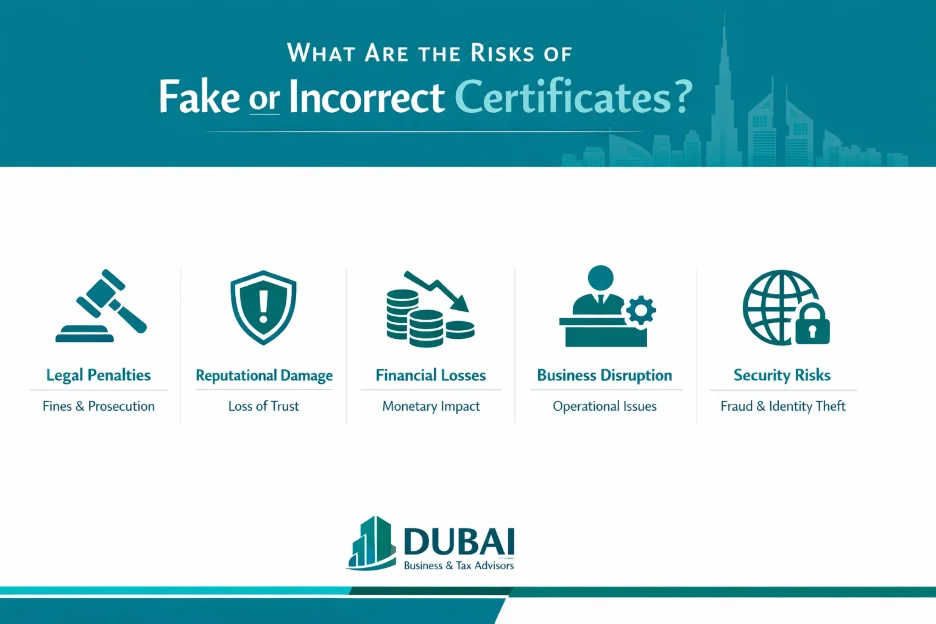
What Are the Risks of Fake Certificates?
Fake COIs are a real and growing problem as the UAE becomes a bigger global financial hub. The risks are serious for anyone who accepts one without checking.
If you rely on a forged COI, you could face criminal fraud charges. You may be held personally liable for debts run up by a company that does not legally exist. Banks may blacklist you. Any contracts signed using a fake COI are not enforceable in court.
Common warning signs include blurry logos, formats that don’t match the current style of the issuing authority, and missing QR codes. A QR code that links to anything other than an official government site is a major red flag. Fraudsters often take the registration number of a real but closed company and change the name to make the document look valid at first glance. Always verify before you trust.
Common Misconceptions
“Mainland companies only get a Trade License, not a COI.” This is wrong. Every Mainland entity registered in the Commercial Register is entitled to a formal COI. Some confusion comes from the fact that the DED historically put more focus on the Trade License during the setup process. But the COI is there, and you can request it.
“The Trade License and the COI are the same document.” They are not. If a bank asks for company incorporation documents and you only provide the Trade License, your The application will stall. The COI proves your company exists. The license proves what it can do. You need both, and both must be current.
“Only Free Zone companies need a COI for banking.” Banks require a COI from every company, whether Mainland or Free Zone. The KYC review works the same way in both cases.
How Can DBTA Help?
The UAE company registration process has many steps, strict compliance rules, and real variations between zones. Small mistakes can be costly and slow to fix.
At Dubai Business and Tax Advisors (DBTA), we manage the full process from start to finish. We help you pick the right zone for your business model, prepare all founding documents, handle notarisation, and file with the right authority. Our company formation and trade license management service means you get your certificate of incorporation in the UAE without having to deal with government portals yourself.
We also support clients after setup. We manage UBO registers, handle COI attestation for global use, verify certificates before you enter partnerships, help open corporate bank accounts, and keep your company compliant through renewals and rule changes. If you need your documents legalised for use abroad, we handle that too.
Frequently Asked Questions (FAQs)
It is the official legal document that confirms your company is registered and exists under UAE law. It is different from a Trade License. The COI proves your company exists as a legal entity. The Trade License lists what your company can do commercially. You need both.
Choose your zone, reserve a trade name, get initial approval, sign your MOA and AOA, secure an office address, then submit your full application with all required documents and fees. The authority then reviews and issues the COI.
You need a trade name certificate, initial approval, passport copies for all owners and directors, proof of address, and a signed MOA and AOA. Corporate owners must also provide their own COI, founding documents, and a board resolution.
Free Zones like IFZA and Meydan typically take 2 to 5 business days. Mainland setups take 5 to 14 business days, depending on the activity and how many government bodies need to sign off.
Base fees range from AED 3,500 in smaller Free Zones to AED 20,000 or more in premium hubs like ADGM. Add trade name approval at AED 600 to 1,000, initial approval at AED 100 to 500, and MOA notarisation at AED 1,000 to 2,500 for Mainland LLCs.
Yes. Use the Ministry of Economy’s National Economic Register for Mainland companies. Use the relevant Free Zone’s public register for Free Zone companies. Every certificate also has a QR code that links to live government data.
Yes. Log in to the portal of the authority that issued it, select the duplicate or true copy service, upload your license number and a passport copy, and pay the fee. It usually costs between AED 200 and AED 500 and is fully online.
Conclusion
The certificate of incorporation in the UAE is not a document you file and forget. It is the legal base your business stands on. It comes up at every major stage: banking, visa sponsorship, tax registration, global expansion, and government contracts. Getting it right from the start matters. Knowing how to use, verify, and maintain it matters just as much.
Whether you go to Free Zone for speed and full foreign ownership, or Mainland for direct market access and government contract rights, the core process is the same. Prove who you are. Show what you plan to do. Meet the compliance rules for your zone.
The UAE’s systems for issuing and checking these certificates are among the best in the world in 2026. Real-time QR verification and digital-first processing mean the tools are there. Use them, keep your documents current, and treat your COI as the active business tool it is.
Ready to set up your company in the UAE? Contact DBTA today for a personal consultation. Our team handles the hard parts so you can focus on building your business.
Latest news & articles


About the Author:
AURANGZAIB CHAWLA
As CEO of DBTA, Aurangzaib Chawla advises globally mobile businesses and individuals on cross-border tax planning and structuring. With expertise spanning the UK, UAE, and wider GCC, Zaib helps clients minimise double taxation, protect assets, and achieve long-term financial efficiency while staying fully compliant.
Planning to launch in Dubai or the UAE?
Let’s talk about how to structure your business for growth the smart, compliant, and tax-efficient way

About the Author:
AURANGZAIB CHAWLA
As CEO of DBTA, Aurangzaib Chawla advises globally mobile businesses and individuals on cross-border tax planning and structuring. With expertise spanning the UK, UAE, and wider GCC, Zaib helps clients minimise double taxation, protect assets, and achieve long-term financial efficiency while staying fully compliant.
Planning to launch in Dubai or the UAE?
Let’s talk about how to structure your business for growth the smart, compliant, and tax-efficient way
About the Author:
AURANGZAIB CHAWLA

As CEO of DBTA, Aurangzaib Chawla advises globally mobile businesses
and individuals on cross-border tax planning and structuring. With expertise spanning the UK, UAE, and wider GCC, Zaib helps clients minimise double taxation, protect assets, and achieve long-term financial efficiency while staying fully compliant.
Planning to launch in Dubai or the UAE?
Let’s talk about how to structure your business for growth the smart, compliant, and tax-efficient way.
Connect with Reliable Dubai Business Consultants
Get in Touch