
UDI vs Emirates ID vs Visa File Number What’s the Difference (and Which One Banks Ask For)

Recent Insights
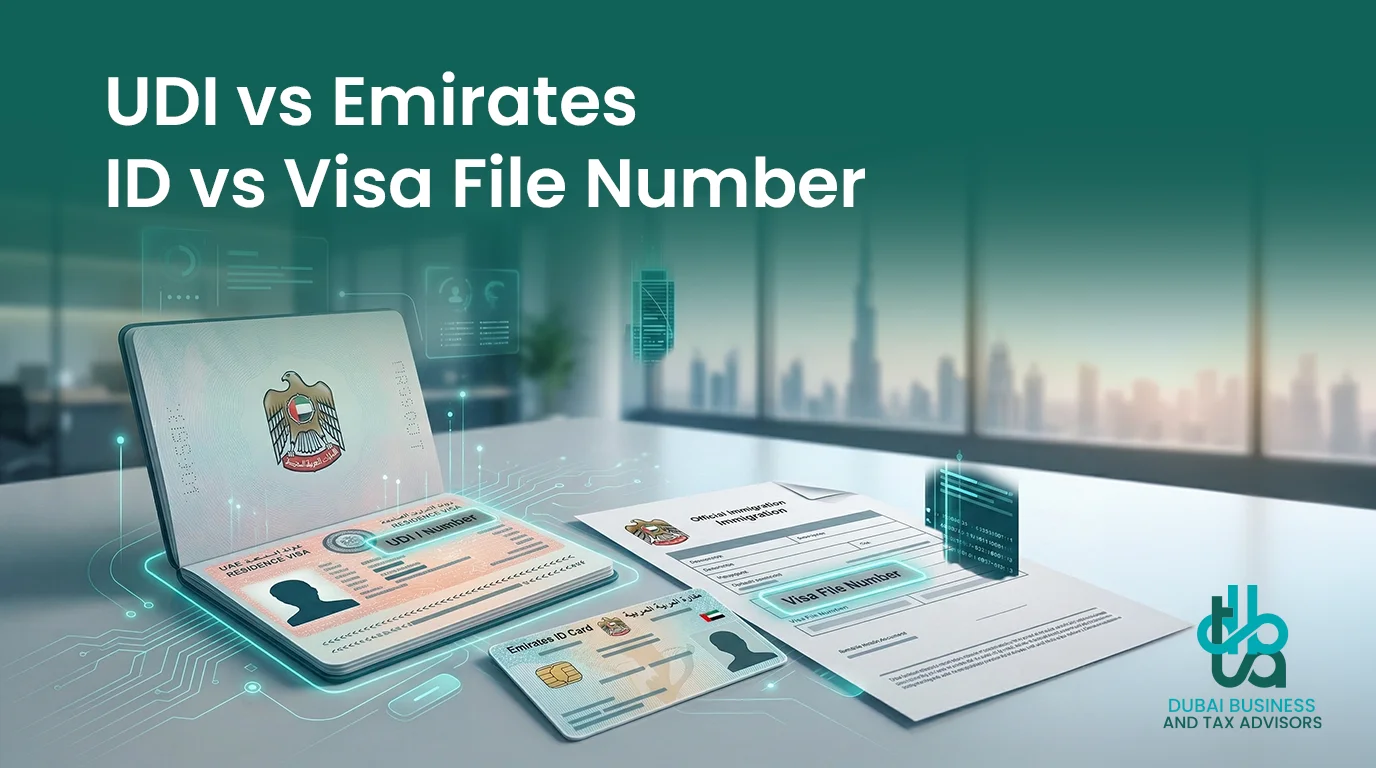
Table of Contents
Introduction
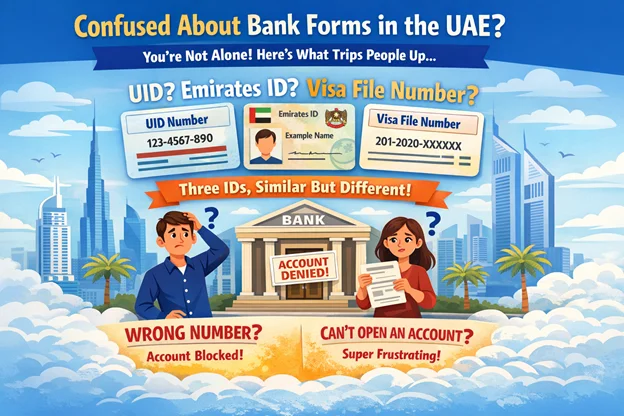
Have you ever filled out a bank form in the UAE and felt completely lost? You’re not alone. Many people who have lived here for years still get confused about the difference between the UDI number UAE, the Emirates ID, and the Visa File Number. Think of it like having three different ID cards that look similar but serve completely different purposes.
Banks ask for these specific numbers to confirm that you’re allowed to live and work here. Getting the wrong number can stop you from opening an account, which is frustrating.
This guide will make everything clear. We’ll explain what a UDI number UAE is, where to find it on your passport, and why the bank needs to see your Emirates ID vs UID. We’ll also give you a simple checklist of documents banks ask for in the UAE, so you know exactly what to bring. By the end, you’ll handle your visa file number UAE and other important documents like a pro.
What Is a UDI Number in the UAE?
What Does UDI Mean?
Think of the UDI number UAE as your “forever number.” UDI stands for “Unified Identification.” The UAE government gives this special number to every person who enters the country. Whether you’re here for a short holiday or you moved here to work, the government’s computer system assigns this number to you.
The immigration office uses it to track who you are. This office checks your passport at the airport. Even if you change your job or move to a different city in the UAE, this number stays the same. In banking, this is your primary identity link in the government’s database.
How Is the UDI Number Formatted?
The UDI number format is usually 9 digits. Unlike other numbers that might change when you get a new passport, your UDI stays with you for life. It works like your “username” in the UAE government’s computer system.
You might see it printed on your visa or written by hand in your passport by an officer. Even after an Emirates ID renewal in the UAE, your UDI remains the foundation of your digital file. It’s the first thing a bank checks to see your history in the country.
Who Needs a UDI Number?
The UDI eligibility UAE rules include almost everyone who interacts with the country:
Residents: Everyone living and working here has one.
Visitors: If you have a tourist visa, you have a UDI assigned to you.
Dependents: Children and spouses have their own unique UIDs.
Non-residents: Even people who don’t live here but own property in the UAE will have one. This is why a UDI for non-residents matters when opening savings accounts.
How Do You Find Your UDI Number?
If you’re wondering how to find UDI UAE, don’t worry. It’s actually quite easy. You don’t need to be a computer expert.
On your Visa: Look for the “Unified No.” section on your residency visa or eVisa. It’s usually near the top.
Online: You can check the UDI number UAE by visiting the official ICP website. You just need to enter your passport details and your nationality.
Entry Stamp: Sometimes, the immigration officer writes it by hand near your entry stamp in your passport when you first land.
For a complete guide on finding and checking your UID number, including troubleshooting duplicate UID issues, see our detailed article on UID Number in the UAE.
Common UDI Problems
Sometimes a person might get two different numbers by accident. This is called a “Duplicate UID.” This happens if the system thinks you are two different people. Maybe your name was spelled differently on an old visit visa.
If this happens, your UDI for bank account setup might fail because the bank’s computer gets confused. To fix this, you need to visit an immigration center to merge them into one. It’s a common mistake that’s easy to fix once you know what to look for.
What Is an Emirates ID?
What Does the Emirates ID Represent?
The Emirates ID is a physical plastic card you can hold in your hand. It looks a bit like a driver’s license. While the UDI is just a number in a computer, the Emirates ID is the actual identity card you carry in your wallet every day. It shows your photo, your name, and your nationality. In the UAE, you need this card for almost everything. You use it to get a phone plan or see a doctor at a hospital.
How Does Emirates ID Compare to UID?
When comparing Emirates ID vs UID, remember that they’re connected but different. The 15-digit number on the front of your card is your ID number. It starts with “784,” which is the country code for the UAE.
However, your UDI is stored inside the card’s electronic chip. It’s often printed on the back of the card or on your residency visa. You need both to satisfy the UDI vs Emirates ID requirement at most government offices and banks. Think of the UDI as your “account number” and the Emirates ID as your “access card.”
Why Do Banks Need Emirates ID?
Banks in the UAE must follow very strict rules to keep money safe. An Emirates ID required banks policy exists to make sure the bank knows exactly who is putting money into an account.
Daily Use: You need your Emirates ID for transactions like withdrawing a lot of money from a teller or updating your phone number in the bank’s system.
Security: The card has a gold chip that the bank “reads” with a special machine. This confirms the card is real.
Renewal: If your card expires, you must do an Emirates ID renewal in the UAE quickly. If you don’t, the bank might freeze your account. This means you won’t be able to use your debit card at the grocery store.
What Is a Visa File Number in the UAE?
Visa Number vs Visa File Number
This is a big point of confusion for many newcomers. Many people ask about the difference between a visa number and a file number.
The Visa Number is a shorter number that refers to that specific piece of paper.
The visa file number UAE is a longer code that looks like a math problem (for example: 201-2024-1234567). It acts like a folder name for your current permission to stay in the UAE. It tells the government who is sponsoring you and how long you’re allowed to stay.
Where Do You Find the Visa File Number?
You can find the visa file number UAE on your residency visa page in your passport or on your digital visa. Banks often ask for the visa file number to prove that your company is sponsoring you correctly and that you’re allowed to work in the country. If you’re a student, your file number will be linked to your school.
Understanding your visa status and documentation is crucial when setting up your business in the UAE. Learn more about visa processing services that can help streamline your immigration requirements.
Does the Visa File Number Replace the UDI?
The answer is no. This is a mistake many people make. Your UDI stays the same forever, no matter what happens. Your Visa File Number changes every time you get a new job, move to a new company, or change your type of visa. For example, you might move from a student visa to a work visa. The bank needs to see both to make sure your “forever file” (UID) is linked to your “current stay” (Visa File).
UDI vs Emirates ID vs Visa File Number Comparison Table
This table shows the UDI vs Emirates ID vs visa differences clearly, so you can see them all at once.
| Feature | UDI (Unified Number) | Emirates ID | Visa File Number |
|---|---|---|---|
| What is it? | A 9-digit computer ID | A physical plastic card | A record of your current visa |
| Does it change? | No, it stays forever | The card expires, but the number stays | Yes, it changes with new visas |
| Who needs it? | Everyone (Visitors & Residents) | Only Residents | Only Residents |
| Where is it? | On your visa or online | On the front/back of the card | On your residency visa sticker |
| Bank Purpose? | To identify your history | Primary proof of identity | Proof of legal residency |
Which One Do Banks Ask For in the UAE?
What Do You Need for Resident Personal Bank Accounts?
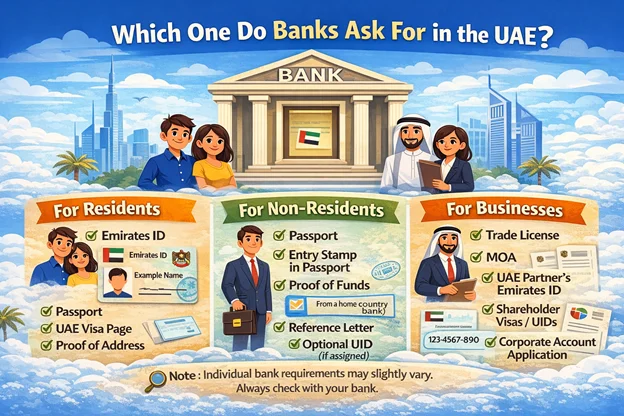
If you live in the UAE, the bank’s main rule is that UAE banks accept Emirates ID as the best way to prove who you are. However, when you first fill out the long forms to open an account, you’ll need to provide your UDI for the bank account and your visa details. This fulfills the bank’s UDI requirement. The bank uses these numbers to run a background check and make sure you have a clean record.
What Do Non-Residents Need?
If you don’t live here and are just visiting to invest or save money, you won’t have an Emirates ID. In this case, the bank will focus heavily on the UDI for non-residents. They will look at your passport and the UDI vs visa for banking details from your entry stamp. Because you don’t have a plastic card, the UDI is the only way the bank can track your identity in the UAE system.
What Do Business Bank Accounts Need?
For people starting a company, the bank needs even more information. They will ask for the UDI number of every person who owns a piece of the company. Even if one of the owners lives in another country and only visits once a year, the bank still needs their UID. They also need the visa file number for banks for the person who oversees the company’s daily work.
If you’re setting up a new business, understanding the full scope of company formation and trade license management can help you prepare all necessary documentation from the start.
Complete Documents Banks Ask in the UAE Checklist
To make sure you’re ready, here’s a list of things you should put in your folder before you go to the bank.
Personal Account Resident Checklist
Original Passport: The bank needs to see the real book, not a photo of it.
Valid Residency Visa: This shows your visa file number in the UAE.
Emirates ID: You must bring the physical card.
Salary Letter: A letter from your boss saying how much money you make.
Proof of Home: A paper like a water bill or a rental contract.
UDI Number: Make sure you have this written down from your visa.
Personal Account Non-Resident Checklist
Original Passport
Entry Stamp: This is where they find your UDI eligibility in the UAE.
Home Bank Statements: Papers from your home country bank.
Reference Letter: A letter from your home bank saying you are a good customer.
Business Account Checklist
Trade License: The “permission slip” that lets your business operate.
Company Rules (MOA): The document that explains how the business is run.
Owner Documents: Passports, Emirates IDs, or UIDs for every owner.
Office Contract: Proof that your business has a real office or desk.
When preparing your business documents, consider exploring whether a Dubai Mainland company or Dubai Free Zone company structure better suits your banking and operational needs.
How DBTA Can Help
Walking through the maze of UAE documentation can feel like walking through a desert without a map. That’s where Dubai Business & Tax Advisors (DBTA) comes in. We act as your expert guides. We make sure every UDI number UAE and visa file number UAE is perfectly in place before you even set foot in a bank.
We solve the “Duplicate UID” problem. We help residents manage their Emirates ID renewal in the UAE without losing access to their bank accounts. Whether you’re a business owner needing to organize banks documents checklist in the UAE or a new expat trying to understand Emirates ID vs UID, our team handles the heavy lifting.
We talk to the banks and the immigration offices so you don’t have to. This makes sure your UDI for bank account application is approved on the very first try. Our comprehensive licensing and PRO services cover everything from visa processing to Emirates ID applications, ensuring smooth compliance every step of the way.
Conclusion
Understanding the UDI number UAE, the Emirates ID, and your visa file number UAE is the secret to a smooth life in the Emirates. These numbers might look like a lot of boring math, but they’re just the government’s way of making sure everyone is safe and correctly identified.
When you’re ready to open a bank account, remember that the bank is your partner. They aren’t trying to be difficult. They’re just following the laws of the country. The most important thing to keep in mind is that your UDI is your permanent “name” in the government’s computer, your Emirates ID is your daily identity card, and your Visa File Number is the proof of your current job or stay.
If you keep your Emirates ID renewal up to date and have your bank documents checklist ready in a folder, you’ll be able to open an account and start enjoying your life in this beautiful country. Most people get confused because they try to rush. If you take it one step at a time, you’ll be an expert in no time.
For personalized guidance on managing your UAE documentation and banking requirements, contact DBTA for expert support tailored to your specific situation.
Frequently Asked Questions (FAQs)
The UDI (Unified Identity Number) is a 9-15 digit number given to each resident when they enter the UAE on a visit or residency visa. It’s a unique number that tracks your travel history and residency status throughout your life in the country.
The UDI is a digital number that tracks your immigration file. It’s not the same as the Emirates ID, which is a physical card you’ll use every day to prove who you are. The UDI stays constant for life. The Emirates ID number changes with every card renewal.
The Visa File Number is a unique code linked to a specific visa issuance. It connects to a sponsor (employer or family). It’s a fresh number each time you renew, cancel, or modify your visa. It exists to check the legality of your current stay.
Banks need to see the Emirates ID card of all residents. They use it to verify your identity on a daily basis. But the UDI is also necessary when you first apply. They use it to verify your immigration record.
Yes. Non-residents like tourists or investors are automatically given a UDI number when they enter the country with a valid visa. It’s not something you apply for separately. It’s triggered by your first interaction with immigration.
You can find your UDI number on the official ICP (Federal Authority for Identity, Citizenship, Customs & Port Security) website in Abu Dhabi. You can also use the GDRFA Dubai (General Directorate of Residency and Foreigners Affairs) website. You’ll need to input your passport number, nationality, and date of birth to get it.
No, it does not replace them. It’s additional proof of your continued relationship with a sponsor. Banks need the UDI to conduct background checks and Emirates ID for identity verification. The Visa File Number confirms visa authenticity.
The UDI is automatically generated. You’ll receive it instantly when your visa is issued or when you come through immigration when you arrive. You don’t have to wait for an additional approval process to receive it.
To link your UDI with your Emirates ID, you’ll need a valid passport, a copy of your entry permit or residency visa, and an application form for the Emirates ID. Your visa sponsor (employer or typing center) usually handles this.
Emirates ID is used for most daily transactions, including banking and renting. The Visa File Number is mainly used by immigration authorities or for the initial document checking process to prove you’re staying legally.
No. Most banks ask for the complete set of documents. This includes Trade License, MOA, and each shareholder’s physical Emirates ID. The UDI information is just one piece of the mandatory compliance documentation.
A mistake in the number leads to a long account opening process or even denial of your application. The background check fails. It could also mean you temporarily lose access to your money if the bank can’t access and confirm your identity.
You can update these details by going to a bank branch with the original copy of your Emirates ID and the new visa page. You can also use the bank’s online platform. Keep your records current to avoid account freezing or business interruptions.
The list includes a valid passport and residency visa, a physical Emirates ID card, a salary transfer letter or most recent salary certificate, and address proof (for example, utility bill or tenancy contract). Non-residents might need bank statements from their home country.
Latest news & articles



About the Author:
AURANGZAIB CHAWLA
As CEO of DBTA, Aurangzaib Chawla advises globally mobile businesses and individuals on cross-border tax planning and structuring. With expertise spanning the UK, UAE, and wider GCC, Zaib helps clients minimise double taxation, protect assets, and achieve long-term financial efficiency while staying fully compliant.
Planning to launch in Dubai or the UAE?
Let’s talk about how to structure your business for growth the smart, compliant, and tax-efficient way

About the Author:
AURANGZAIB CHAWLA
As CEO of DBTA, Aurangzaib Chawla advises globally mobile businesses and individuals on cross-border tax planning and structuring. With expertise spanning the UK, UAE, and wider GCC, Zaib helps clients minimise double taxation, protect assets, and achieve long-term financial efficiency while staying fully compliant.
Planning to launch in Dubai or the UAE?
Let’s talk about how to structure your business for growth the smart, compliant, and tax-efficient way
About the Author:
AURANGZAIB CHAWLA

As CEO of DBTA, Aurangzaib Chawla advises globally mobile businesses
and individuals on cross-border tax planning and structuring. With expertise spanning the UK, UAE, and wider GCC, Zaib helps clients minimise double taxation, protect assets, and achieve long-term financial efficiency while staying fully compliant.
Planning to launch in Dubai or the UAE?
Let’s talk about how to structure your business for growth the smart, compliant, and tax-efficient way.
Connect with Reliable Dubai Business Consultants
Get in Touch