
How to Keep UAE Free Zone 0% Corporate Tax | QFZP Compliance Checklist 2026

Recent Insights

Table of Contents
The QFZP Compliance Checklist for Audit, Substance, and Defensible Records
The introduction of Federal Decree-Law No. 47 of 2022 on the Taxation of Corporations and Businesses marks the most significant fiscal transformation in the history of the United Arab Emirates. For decades, the UAE was perceived globally as a “tax-free” haven, a reputation built primarily on the success of its diverse and numerous free zones. However, the landscape has fundamentally shifted from a policy of total exemption to one of conditional compliance. For a boutique corporate tax consultancy advising international investors, the primary challenge is no longer just setting up a business; it is ensuring that a QFZP compliance checklist is meticulously followed to keep 0% corporate tax in the UAE in a landscape that is increasingly governed by international standards and strict local enforcement.
Investors and finance leaders are no longer trying to solve “if” they are taxable, but rather “how” they can maintain their eligibility for the 0% preferential rate under the Qualifying Free Zone Person (QFZP) regime. The transition from the legacy “letterbox” company model to one of genuine economic substance is not merely a suggestion; it is a legal mandate. This report provides an exhaustive, expert-level analysis of the requirements needed to satisfy the Federal Tax Authority (FTA) during an audit, detailing the operational rhythms and defensible records QFZPthat must be maintained to safeguard a firm’s financial position.
What does “staying at 0%” actually mean in the UAE corporate tax regime?
In the context of the current UAE corporate tax framework, the phrase “staying at 0%” is often a shorthand for maintaining the status of a Qualifying Free Zone Person. It is imperative to understand that under the Decree-Law, every free zone company is considered a “Taxable Person.” This means that the law applies to everyone; the distinction lies in the rate of tax applied to specific income streams. A QFZP benefits from a 0% rate on its “Qualifying Income,” while “Non-Qualifying Income” is taxed at the headline rate of 9%.
Staying at 0% means the business has successfully navigated a complex set of cumulative conditions that must be met in every single tax period. If any condition is breached, the 0% benefit is not just lost for that transaction; the entire entity may lose its QFZP status for five years. This “all-or-nothing” nature of the regime creates a high-stakes environment where corporate tax audit risk uae must be managed with extreme precision.
Case Study: Retaining QFZP Status During Audit (Design Services FZ-LLC)
Background: A design studio in Dubai Media City held the belief that a Free Zone license alone ensured a 0% tax position.
Problem: The firm was flagged during an FTA enquiry for not maintaining revenue segregation and lacking qualifying income documentation.
DBTA Intervention:
- Introduced IFRS-based accounting classifications
- Implemented a de minimis tracking model and revenue tagging
- Built a board governance record and meeting calendar
• Result: The entity passed its audit and retained 0% status, avoiding a five-year disqualification risk. Their audit pack is now used internally as a standard.
QFZP Status ≠ Automatic 0% (Myth vs Rules)
The most common misconception among entrepreneurs is that simply holding a free zone license guarantees a tax-free existence. In reality, the 0% rate is a privilege, not a right. The law distinguishes between a “Free Zone Person” and a “Qualifying Free Zone Person”. A standard Free Zone Person is subject to the 9% tax on any income exceeding the AED 375,000 threshold, just like a mainland company. To transition to the QFZP category, the entity must actively satisfy the criteria outlined in Article 18 of the Corporate Tax Law and subsequent Ministerial Decisions.
The myth of “automatic” status is further debunked by the fact that specific legal structures are ineligible for the QFZP regime. For example, natural persons (individuals) conducting business in a free zone or unincorporated partnerships cannot be QFZPs. Only “juridical persons”, legal entities with a separate personality, can qualify. Furthermore, the QFZP status requires the maintenance of audited financial statements of QFZP, a requirement that applies regardless of whether the company is currently generating profit or even revenue.
Economic Substance vs QFZP (distinctions and overlap)
The relationship between economic substance vsQFZP requirements is a source of confusion for many. Historically, the UAE implemented Economic Substance Regulations (ESR) to comply with OECD standards. While the separate ESR filing system was largely phased out after the 2022 financial year, the core principles were integrated directly into the Corporate Tax Law. Today, “adequate substance” is no longer just a regulatory filing; it is a fundamental condition of the QFZP compliance checklist.
The substance requirements of the UAE for a QFZP are more geographically restrictive than the old ESR rules.Under ESR, substances could often be demonstrated anywhere in the UAE. For a QFZP, the “Core Income-Generating Activities” (CIGAs) must specifically be performed within a Free Zone or a Designated Zone. The overlap exists in the type of proof required for employees, assets, and expenditure, but the standard is now higher because failing the test leads to immediate disqualification from the 0% tax regime for five years.
| Feature | Economic Substance Regulations (ESR) | QFZP Substance Requirements |
|---|---|---|
| Legal Basis | Cabinet Resolution No. 57 of 2020 | Decree-Law No. 47 of 2022 (Article 18) |
| Location of CIGA | Anywhere in the UAE | Specifically in a Free Zone or Designated Zone |
| Reporting | Separate ESR Portal (abolished for 2023 onwards) | Integrated into Corporate Tax Return and Audit. (The “26” appears to be a stray page number or typo). |
| Penalty for Failure | Financial fines (AED 50k – 400k) | Loss of 0% tax rate for 5 consecutive years |
| Main Target | 9 specific “Relevant Activities” | Any activity seeking 0% Qualifying Income status |
The QFZP conditions you must meet consistently
To keep 0% corporate tax in the UAE, a business must demonstrate compliance with a set of “Primary Conditions” during every tax period. These are not “set and forget” rules; they require ongoing management, particularly as the business model evolves or expands.
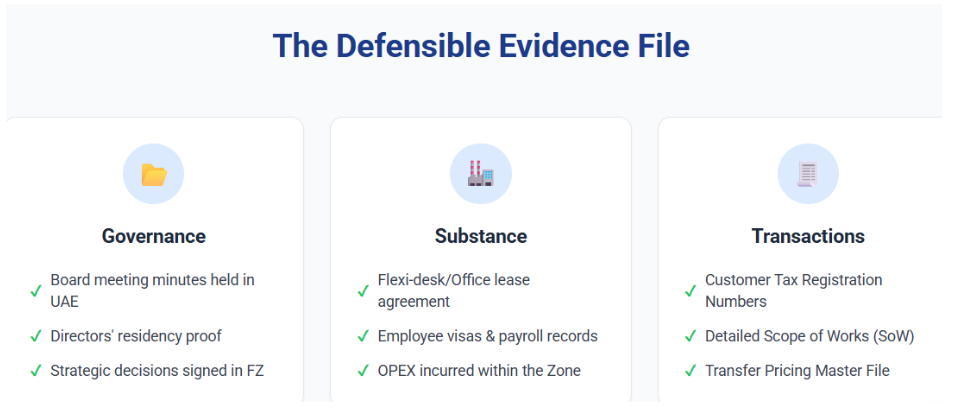
Condition 1: Corporate tax registration and filing
The first pillar of the QFZP compliance checklist is mandatory registration with the FTA. Every free zone entity, even those expecting to be fully exempt, must obtain a Tax Registration Number (TRN). Under FTA Decision No. 3 of 2024, strict timelines were established for registration based on the month the trade license was issued. Missing these deadlines triggers an immediate penalty of AED 10,000.
Once registered, the entity must adhere to the corporate tax filing deadline in the UAE, which is nine months after the end of the financial year. The filing must be accurate and reconciled; the FTA has enhanced its data integration with free zone authorities, allowing them to detect discrepancies between trade license activities and declared tax income. A “nil” return must be filed even if no tax is payable.
Condition 2: Proper accounting records and financial systems
A robust free zone accounting records checklist is the foundation of any defence during an audit. The law requires businesses to maintain all records and documents that support their tax position for at least seven years. For a QFZP, this goes beyond simple bookkeeping; it requires a sophisticated chart of accounts that can segregate income into three distinct buckets:
- Qualifying Income: Taxable at 0%.
- Non-Qualifying Income: Taxable at 9% (subject to the de minimis rule).
- Income specifically taxed at 9%: Such as income from immovable property located in a Free Zone that is not a Qualifying Activity or a mainland branch (Domestic Permanent Establishment). (Income from mainland immovable property is always taxed at 9% and does not count toward the de minimis threshold for QFZP status).
Accounting systems must be based on the International Financial Reporting Standards (IFRS), as traditional local shortcuts are no longer sufficient to satisfy the QFZ Paudit requirements.
Condition 3: Audited financial statements (when required)
One of the most significant compliance burdens for free zone entities is the mandate for audited financial statements of QFZP. While mainland SMEs can often avoid audits if their revenue is below AED 50 million, the QFZP regime requires all qualifying entities to be audited, regardless of revenue size. The audit provides the FTA with third-party verification that the entity has correctly applied the de minimis threshold and verified its substance requirements uae.
The free zone audit firm cost has thus become a mandatory operational expense. Auditors are now focusing on the “Nexus” for intellectual property and the “Beneficial Recipient” status of customers to ensure the 0% rate is not being applied to excluded activities of compliance.
Condition 4: Real Substance You Can Defend in the UAE
Proving “adequate substance” is the most qualitative and therefore most scrutinised part of an FTA corporate tax audit checklist. The FTA expects the entity to demonstrate it is a genuine operation, not a “shell”. This is measured through four sub-criteria:
- CIGA Performance: The most critical revenue-driving activities must be performed in the free zone.
- Qualified Employees: The company must have an adequate number of full-time staff with relevant expertise physically present in the UAE.
- Physical Assets: There must be an office or warehouse appropriate to the scale of the business.
- Operating Expenditure: The firm must spend an adequate amount locally on rent, utilities, and salaries.
Importantly, “adequacy” is proportional. A boutique advisory firm might only need two senior consultants and a small office to show substance, whereas a logistics hub would require a large warehouse and dozens of staff.
The Defensible Evidence File
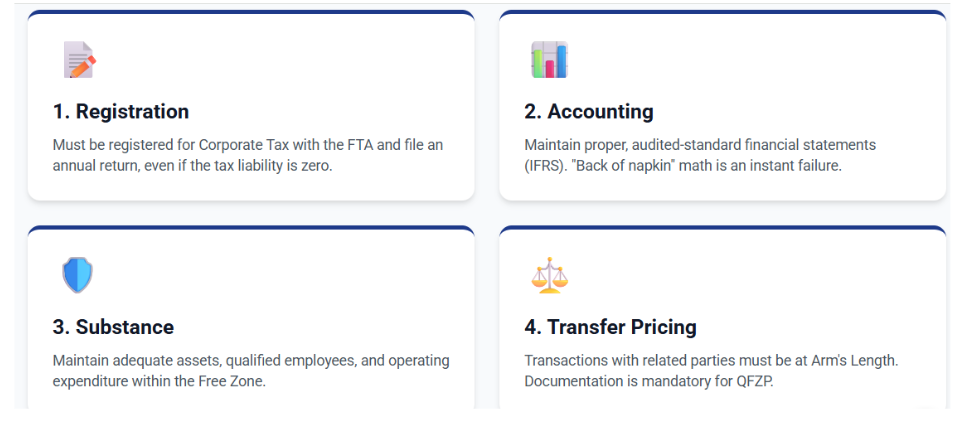
When an auditor requests proof of status, having a trade license is merely the beginning. A firm must present a comprehensive file of defensible records QFZP that provides an audit trail for every dirham of revenue.
Revenue classification evidence
The classification of income is the primary focus of any free zone 0% audit checklist. Businesses must produce QFZP qualifying income evidence for every transaction. This includes:
- KYC on Customers: Evidence that the customer is a “Free Zone Person” (e.g., their TRN and license).
- Beneficial Recipient Confirmation: Records proving the customer has the right to use and enjoy the service and is not just an agent for a mainland party.
- Activity Mapping: A document that explicitly maps each contract to the list of “Qualifying Activities” in Ministerial Decision No. 265 of 2023 (This is the decision that defines Qualifying Activities and Excluded Activities).
Activity alignment evidence
For specific sectors, the evidence requirements are highly technical. For example, the activity of “Distribution of goods or materials in or from a Designated Zone” requires customs documentation showing the goods physically entered in the designated zone. The QFZP compliance checklist for distributors must also show that they only sell to resellers or processors, as sales to end-consumers (retail) are generally excluded.
In the realm of “Trading of Qualifying Commodities,” the 2023 updates (specifically Cabinet Decision No. 100 of 2023) require evidence that the commodities are traded at a “Quoted Price” on a recognised exchange. The removal of the “raw form” requirement for these commodities has broadened the scope. However, firms must still prove that distribution-related revenue must be derived from a Designated Zone and meet the “Qualifying Activity” criteria. (There is no “51% total income” rule for commodity trading; the 51% rule generally pertains to ownership/control in other contexts, and the de minimis rule for non-qualifying income is 5% or AED 5 million).
Governance and UAE decision-making evidence
“Management and Control” in the UAE is a critical substantive pillar. The FTA expects to see that the real “mind and management” of the company is in the UAE. This is documented using a QFZP board minutes template that records:
- Board meetings are held physically in the free zone.
- A quorum of directors is present in the UAE.
- Detailed minutes and resolutions signed in the UAE.
- Attendance logs and travel records for non-resident directors.
Transfer Pricing, related-party transactions and the hidden risk to 0%
Transfer pricing (TP) is the “silent killer” of the 0% rate. The Law requires all related party transactions in the UAEto be at arm’s length. If a free zone company charges an artificially low price to a mainland sister company, the FTA can adjust that income, potentially causing the free zone entity to breach the de minimis threshold and lose its 0% status entirely.
When Transfer Pricing applies to Free Zone companies
TP rules apply to any transaction between “Related Parties” (based on ownership or control) and “Connected Persons” (such as owners, directors, or their relatives). This includes intercompany loans, management fees, and shared service costs.
A specific risk exists for connected persons’ expenses in the UAE, such as salaries paid to directors. If these salaries are deemed “excessive” (i.e., not at market rates), the portion deemed excessive is not deductible and could lead to tax adjustments that threaten the QFZP status.
Documentation required
All companies must follow the Arm’s Length Principle, but specific qfzp record keeping for TP becomes mandatory at certain thresholds:
- Master File and Local File: Required if annual revenue exceeds AED 200 million or if the entity is part of a multinational group with consolidated revenue over €750 million.
- TP Disclosure Form: Must be submitted with the tax return if the aggregate value of related-party transactions exceeds AED 40 million.
- Intercompany Agreements: Written contracts for every intercompany deal, detailing the pricing rationale.
Case Study: Intercompany Transactions and Transfer Pricing Rescue
Scenario: A UK parent company invoiced R&D costs to its UAE Free Zone subsidiary to shift profit.
Issue: No intercompany agreements and no arm’s-length justification, creating exposure under TP rules.
What DBTA Did:
- Drafted compliant intercompany agreements
- Benchmarked mark-ups against OECD comparables.
- Prepared TP disclosure filings and documentation
Outcome: The FTA accepted the pricing rationale with no adjustments. The Free Zone entity preserved QFZP status and avoided the 5-year disqualification trap.
Operating model to keep 0% status month after month
Maintaining a 0% rate is an operational commitment, not just an accounting one. It requires a “compliance by design” approach.
Monthly compliance rhythm (operational SOP)
Firms should implement a monthly qfzp compliance checklist review process:
- De Minimis Tracking: Calculate current “Non-Qualifying Revenue” as a percentage of “Total Revenue” to ensure it remains below 5%.
- Substance Spend Audit: Verify that office rent and UAE-based salaries are being paid and recorded in the correct ledger.
- WPS Verification: Ensure all employees are paid through the Wages Protection System (WPS) to provide government-verifiable proof of local staffing.
- IP Nexus Monitoring: If claiming 0% on “Qualifying Intellectual Property,” track research and development (R&D) expenditures month-by-month to maintain the “nexus” ratio.
Pre-contract review process (before signing deals)
Before any significant new contract is signed, a pre-contract compliance check is essential. This helps identify “Excluded Activities” or “Non-Qualifying” customers before they enter the books.
- Jurisdiction Check: Is the customer in the mainland or the free zone?
- Activity Verification: Does the contract scope align with the “Qualifying Activity” list?
- Reseller Status: For distribution, is the customer a reseller or an end-user?
The Free Zone 0% Audit Checklist
An expert-led free zone 0% audit checklist should be used for quarterly internal health checks to minimise corporate tax audit risk in the UAE.
| Compliance Area | Verification Step | Required Documentation |
|---|---|---|
| Entity Eligibility | Confirm juridical person status in an eligible free zone. | MOA, Trade License. |
| Tax Registration | Ensure that TRN is active and linked to the correct financial year. | EmaraTax Registration Certificate. |
| Audit Status | Confirm the engagement of a licensed auditor for the current year. | Auditor Engagement Letter. |
| Income Segregation | Verify that the GL has separate tags for Qualifying and Non-Qualifying revenue. | Trial Balance with Activity Tags. |
| De Minimis Limit | Confirm non-qualifying revenue is < 5% of total revenue or AED 5M. | Monthly De Minimis Spreadsheet. |
| Substance (Staff) | Confirm the number of adequate qualified staff physically in the free zone. (The law emphasizes “adequate,” as “qualified” refers to their competence, but “adequate” is the specific legal threshold for substance). | Visas, Organization Chart, WPS. |
| Substance (Office) | Confirm physical lease/ownership of office in the free zone. | Ejari / Lease Agreement. |
| Governance | Ensure at least two board meetings were held in the free zone this year. | Signed Board Minutes. |
| Transfer Pricing | Review all sister-company transactions. | Intercompany Agreements, Benchmarking Study. |
Common failures that lead to loss of QFZP status
Understanding why companies fail is the best way to prevent your own failure. The consequences of these mistakes are severe: a five-year lockout from the 0% regime.
Misclassifying customers and jurisdictions
The most frequent error is assuming that any company with a UAE trade license is a “Free Zone Person”. Many companies operate from mainland Dubai but have “Free Zone” in their name or historical roots. Selling to these entities without verifying their current license status results in “Non-Qualifying Revenue” that often pushes a firm over the de minimis threshold.
Infrequent mainland work that breaches de minimis
A typical scenario involves a free zone IT consultancy that primarily services international clients but accepts one large “implementation” project for a mainland government entity. If that single project generates AED 5,000,001 in revenue, the entire company loses its 0% status for five years. In this regime, even a one-dirham breach is fatal to the QFZP status.
Weak accounting and an undocumented scope of services
During a corporate tax audit risk in the UAE, the FTA will look past the “invoice” to the actual “work performed”. If a firm’s records are disorganised, or if the contract’s scope is vague, the auditor may reclassify “Qualifying” service income as “Excluded” income. For example, “Distribution” (qualifying) can easily be misconstrued as “Retail Sales” (excluded) if delivery notes and customer reseller certificates are missing.
Artificial or inconsistent substance
“Letterbox” companies that claim high profits but only have a “flexi-desk” and no resident staff are the primary target of the FTA corporate tax audit checklist. Inconsistency in substances, such as having five employees on paper, but no payroll records (WPS) or local expenses, is viewed as a red flag for artificial profit shifting.
Related-party charges without support or pricing rationale
Many groups charge “Management Fees” from the free zone to the mainland to reduce the mainland’s 9% tax bill. If the free zone company cannot provide a functional analysis showing what work was done,
When to consider a mainland entity or electing out of 0%
The corporate tax compliance cost in the UAE for a QFZP is significantly higher than for a standard mainland SME. Sometimes, the most professional advice is to walk away from the 0% regime.
Signals you may need a mainland entity
- Mainland Market Growth: If more than 5% of your revenue is coming from the UAE mainland, a separate mainland branch or subsidiary is necessary to protect the free zone entity’s 0% status.
- B2C Expansion: If you intend to sell directly to individuals (natural persons), this is an excluded activity for most free zone firms. A mainland entity is the appropriate vehicle for retail and direct consumer services.
Signals you may elect out of 0%
A company can voluntarily “elect” to be subject to the standard 9% regime. This may be beneficial if:
- Revenue ≤ AED 3 million: Small Business Relief applies where “Revenue” in the relevant and previous tax periods does not exceed AED 3 million. Note that for 2026, you should verify if any sunset clauses for SBR have been extended, as it was originally slated to end for tax periods starting on or after 1 January 2027. on all income with almost no compliance burden. QFZPs are barred from claiming SBR.
- Tax Grouping Benefits: A QFZP cannot be a member of a Tax Group if it seeks to benefit from the 0% rate. (Under Article 40, a QFZP is technically excluded from forming a Tax Group with non-QFZPs if they want to maintain their 0% status). Against profitable sister companies. If your group needs to consolidate tax purposes, electing 9% may be the only option.
- Cost vs Benefit: If the free zone audit firm costs and the expense of maintaining TP documentation and high substance exceed the actual tax savings, paying 9% may be more efficient.
Case Study: Electing Out of 0% for Strategic Advantage
Profile: Health services consultancy expanding into mainland hospitals.
DBTA Assessment: The compliance cost of maintaining QFZP outweighed the benefit due to consistent mainland revenue.
Advised Strategy:
- Elect out of 0% (enter 9% regime)
- Restructure as two entities (Free Zone for advisory, Mainland for implementation)
- Implement cross-billing with TP support.
Outcome: Lower administrative burden, unified tax reporting, and faster contract approvals from hospitals due to mainland presence. Profitability improved despite paying taxes.
How DBTA Maintains 0% Free Zone Status for Clients
For companies operating in UAE Free Zones, retaining the 0% corporate tax rate is no longer a function of location alone; it depends on demonstrable compliance. Dubai Business and Tax Advisors supports clients by building the internal systems, documentation standards, and governance controls required to meet the Federal Tax Authority’s expectations for a Qualifying Free Zone Person (QFZP).
Our role typically includes:
- Establishing eligibility and registering the entity correctly for corporate tax
• Aligning the accounting framework with IFRS to separate qualifying and non-qualifying income
• Preparing the evidence base that auditors and regulators expect (substance, decision-making, and activity alignment)
• Coordinating the statutory audit and ensuring year-end records withstand external review
• Structuring related-party and cross-border transactions to meet arm’s-length standards
• Creating compliant pathways for growth when mainland revenue or new business lines are introduced
This support is particularly effective for organisations that are scaling, entering new markets, adjusting their operating model, or preparing a first audit or FTA enquiry. The outcome is a compliance environment that is structured, traceable, and defendable, reducing the risk of disqualification and enabling the business to operate with certainty.
When integrated early, DBTA’s work allows clients to make commercial decisions, such as onboarding mainland customers or expanding services, without jeopardising the 0% rate.
Client Testimonial:
“As a tech consultancy entering Dubai’s Free Zone system for the first time, we underestimated how complex it would be to maintain 0%. DBTA built our entire QFZP compliance structure, audited our previous filings, and established a defensible evidence file. We maintained our 0% status with no FTA queries. The level of clarity we gained is immeasurable.”
— Founder, SaaS Engineering FZCO
FAQ's:
To maintain QFZP status at 0%, a company must: register for Corporate Tax; file annual returns; maintain audited financial statements; use IFRS accounting with revenue segregation; conduct core income-generating activities within the Free Zone; maintain substance through staffing, premises, and expenditure; monitor the de minimis threshold; avoid excluded activities; and maintain fully traceable documentation to evidence compliance throughout the tax period.
FTA auditors expect to see a full trail proving eligibility, including audited financial statements, Free Zone license and juridical status, customer KYC and classification, contracts aligned to licensed activities, revenue mapping to qualifying income, Free Zone substance records, monthly de minimis tracking, board minutes indicating UAE-based decision-making, and accounting files structured to separate 0% and 9% income. Each element proves operational and documentary compliance.
Yes. Audited financial statements are mandatory for all QFZPs, regardless of turnover or business size. They serve as the primary verification tool for the Federal Tax Authority, confirming revenue classification accuracy, accounting integrity, income segregation, and the application of the de minimis rule. Without audited statements, an entity cannot demonstrate defensibility and risks losing its 0% status and entering the five-year disqualification period.
FTA substance reviews typically request documents proving commercial presence: an active Free Zone lease contract, evidence of staff physically operating in the UAE (visas, payroll/WPS records), organisational charts, expenditure in the UAE linked to operations, governance records, board minutes with UAE attendance, and activity files showing that core income-generating functions were performed in the Free Zone. Collectively, these confirm that the operation is not an artificial or letterbox structure.
Segregation requires an IFRS-compliant chart of accounts with dedicated ledger codes for qualifying income taxed at 0%, non-qualifying income monitored under the de minimis threshold, and income automatically taxed at 9%, such as mainland PE revenue or immovable property income. Each revenue line must link to documentation supporting its classification, ensuring auditors can trace transactions from invoice to ledger entries without ambiguity.
The de minimis rule applies when non-qualifying income does not exceed the lower of AED 5 million or 5% of total revenue (The law specifies “Total Revenue” derived by the QFZP in that tax period. It is important to note that revenue from a Domestic or Foreign Permanent Establishment is excluded from both the numerator and denominator of this calculation.
To evidence compliance, companies should maintain monthly calculations, ledger extracts showing revenue mapping, contracts supporting classification, and reconciliations tied to audited financials. Breaching the threshold disqualifies QFZP status for five years, so monitoring and documentation must be continuous, not year-end only.
Confirming qualifying income requires verifying that the activity appears on the qualifying list, core functions are carried out within a Free Zone or Designated Zone, customer jurisdiction aligns with rules, contracts reflect licensed activity, and beneficial ownership of services is outside mainland UAE where required. Supporting documents include KYC, activity mapping to ministerial decisions, and operational evidence. If any condition fails, the income may be taxable at 9%.
If mainland sales occur, records must prove why the income is not treated as qualifying or how it fits within the rules without disqualification. This includes contract scope showing non-mainland delivery or benefit location, separate invoicing, commercial justification for revenue classification, de minimis calculations, and evidence that CIGAs occurred within the Free Zone. Documentation prevents misclassification that could void QFZP status during an audit.
Transfer Pricing compliance depends on thresholds, but generally requires an arm’s-length pricing justification, related party disclosure, and evidence of services performed. If thresholds apply, a Local File and Master File must be prepared with benchmarking comparables. Work papers, agreements, and internal approvals strengthen defensibility. Unsupported pricing may trigger revenue reclassification, de minimis breach, and loss of 0% status during review.
Intercompany service arrangements must include a written agreement detailing scope, deliverables, pricing basis, term, and payment mechanism. Supporting documents include work logs, deliverables, benchmarking justification, commercial rationale, invoices, and bank transfer proof. These collectively demonstrate arm’s length pricing. Without them, the Federal Tax Authority may adjust revenue, classifying it as non-qualifying and jeopardising QFZP eligibility for the current and subsequent tax periods.
Management fees require timesheets or activity logs proving service delivery, benchmarking studies for pricing, invoices and payment records, and board approval or documented authorisation. Cost allocations should follow a consistent methodology with supporting memos. These records demonstrate commercial purpose and arm’s-length terms; absent justification, fees may be disallowed or treated as non-qualifying income, increasing the risk of disqualification.
Connected Persons include owners, directors, and related individuals. Payments to them must reflect market value and commercial necessity. Required records include employment or consultancy agreements, market rate comparisons, work evidence, payment proof, and board authorisation. These prevent re-characterisation of expenses such as distributions or excessive payments, which could affect taxable income, related party classification, or QFZP status.
Frequent audit failures include misclassified customers, capacity mismatch in substance, undocumented related party pricing, lack of audited financials, improper ledger segregation, and unmonitored de minimis exposure. These errors suggest artificial structuring and typically lead to loss of QFZP status for five years. Most failures are preventable through structured monthly tracking and governance documentation rather than reactive, year-end correction.
Yes. It is common for Free Zone companies to have a mix of qualifying (0%) and non-qualifying (9%) income, provided revenue is correctly categorised and reported.
The loss of QFZP status applies from the beginning of the tax period in which the breach occurs. Once triggered, the entity becomes subject to 9% for that period and is locked out of the 0% regime for five consecutive tax periods. Reinstatement requires structural correction, compliance restoration, and potentially operational changes, as retroactive reversal is not permitted under current regulations.
A defensible audit file should include audited financial statements, revenue segregation schedules, de minimis records, customer and activity classification, substance evidence (staff, premises, expenditure), governance documents, and transfer pricing support if related parties are involved. The file should follow the transaction trail from commercial activity to accounting outcome, enabling clear validation of QFZP eligibility and tax treatment.
Conclusion:
Maintaining a 0% tax rate in the UAE is no longer a passive state; it is an active operational discipline. To keep 0% corporate tax in the UAE, firms must move beyond the trade license and build a “fortress of compliance”. This begins with a mandatory TRN registration and the implementation of IFRS-compliant accounting that can segment revenue with high precision. The universal requirement for audited financial statements of QFZP means that every claim of “Qualifying Income” will be scrutinised by an independent third party before it ever reaches the FTA.
The ultimate defence against a corporate tax audit risk in the UAE is a robust file of defensible records ofQFZP, proving not just that the money was earned, but that the substance was real, and the pricing was fair. By strictly adhering to the QFZP compliance checklist and monitoring the de minimis threshold every month, businesses can safely enjoy the UAE’s generous tax incentives while contributing to a transparent and world-class financial ecosystem.
Latest news & articles


About the Author:
AURANGZAIB CHAWLA
As CEO of DBTA, Aurangzaib Chawla advises globally mobile businesses and individuals on cross-border tax planning and structuring. With expertise spanning the UK, UAE, and wider GCC, Zaib helps clients minimise double taxation, protect assets, and achieve long-term financial efficiency while staying fully compliant.
Planning to launch in Dubai or the UAE?
Let’s talk about how to structure your business for growth the smart, compliant, and tax-efficient way

About the Author:
AURANGZAIB CHAWLA
As CEO of DBTA, Aurangzaib Chawla advises globally mobile businesses and individuals on cross-border tax planning and structuring. With expertise spanning the UK, UAE, and wider GCC, Zaib helps clients minimise double taxation, protect assets, and achieve long-term financial efficiency while staying fully compliant.
Planning to launch in Dubai or the UAE?
Let’s talk about how to structure your business for growth the smart, compliant, and tax-efficient way
About the Author:
AURANGZAIB CHAWLA

As CEO of DBTA, Aurangzaib Chawla advises globally mobile businesses
and individuals on cross-border tax planning and structuring. With expertise spanning the UK, UAE, and wider GCC, Zaib helps clients minimise double taxation, protect assets, and achieve long-term financial efficiency while staying fully compliant.
Planning to launch in Dubai or the UAE?
Let’s talk about how to structure your business for growth the smart, compliant, and tax-efficient way.
Connect with Reliable Dubai Business Consultants
Get in Touch