

The introduction of the UAE corporate tax regime marked a pivotal moment for the nation’s business landscape. While the 9% tax rate above a specific threshold is clear, a tidal wave of confusion has swept through the startup and small-to-medium enterprise (SME) community, particularly among those who are pre-revenue or simply taking their time to launch.
The core question we hear every day from smart, ambitious founders is this: “I’ve just incorporated. I have a license, an office, and money, but no income yet. Am I still required to register for UAE corporate tax?”
It is a logical question. Most tax systems link compliance directly to economic activity. However, the UAE’s approach is designed to establish comprehensive regulatory oversight for every legal entity operating here, right from day one. This means your compliance obligations are triggered by your legal status, not your financial performance.
The Immediate Verdict: Registration is Mandatory!
For nearly every company (Juridical Person) in the UAE, Mainland, Free Zone, or Holding Company, the answer to Do I need UAE corporate tax registration is a resounding YES.
While you might assume a corporate tax in the UAE with zero income for the year means zero urgency, the reality is different and potentially costly. The Federal Tax Authority (FTA) has established clear penalties for non-compliance.
The risk you run by adopting a “wait and see” approach is the potential AED 10,000 penalty for late registration. This non-negotiable fine is levied per incident of non-compliance and can be wholly avoided through proactive engagement with the system. No activity means no responsibility.
This guide will eliminate fear and confusion. We will walk you through every scenario, from the new Free Zone entity to the passive holding company and the side-business freelancer, to clarify exactly when and why you must comply.
Before diving into the legal definitions, use this checklist to immediately determine if you likely have a mandatory UAE corporate tax registration obligation:

| Scenario | Legal Status & Outcome |
|---|---|
| Are you a Juridical Person? (LLC, FZE, FZCO, PJSC, even an SPV) | MANDATORY REGISTRATION. The moment your license is issued, the clock starts. |
| Is your corporate license currently active? | MANDATORY REGISTRATION. If the license is active, your entity exists in the eyes of the law, regardless of trading status. |
| Are you a new Free Zone company (e.g., IFZA, DMCC, RAKEZ)? | MANDATORY REGISTRATION. Yes, even to secure your 0% rate later. Do Free Zone companies need corporate tax registration? Absolutely. |
| Is your company dormant, but the license is still renewed annually? | MANDATORY REGISTRATION. Corporate tax for dormant companies in the UAE is still a legal requirement. You are still considered a Taxable Person. |
| Are you an individual freelancer / sole proprietor? | CONDITIONAL. You only need to register if your total annual business income exceeds AED 1 million. |
| Are you a holding company with only passive income (dividends, gains)? | MANDATORY REGISTRATION. A UAE corporate tax holding company is a juridical person and must register to claim any future UAE corporate tax exemption criteria. |
| Are you a non-resident entity with a UAE-based Permanent Establishment (PE)? | MANDATORY REGISTRATION. Yes, the presence of a PE in the UAE triggers registration for a corporate tax UAE non-resident company. |
The registration process for UAE corporate tax is completed through the EmaraTax portal. You must be prepared with the following documents and information, regardless of whether you have started trading:
The quick verdict is emphatic: for almost all companies (Juridical Persons), you must register, even if you are entirely pre-revenue.
A significant source of confusion stems from blending the act of compliance (registration and filing) with the act of taxation (the 9% payment).
The law identifies nearly all Juridical Persons incorporated or established in the UAE, including those in Free Zones, as “Taxable Persons”. This status legally compels you to:
This means the corporate tax obligation for UAE startups begins not when you get your first client, but when you receive your trade license.
| Threshold Type | Value | Significance |
|---|---|---|
| UAE Corporate Tax Registration Threshold | None (for companies) | All juridical persons must register from inception. |
| Taxable Income Threshold | AED 375,000 | Profit above this amount is taxed at 9%. |
| Small Business Relief (SBR) Revenue Threshold | AED 3,000,000 | Total annual revenue must be below this to elect SBR. |
| Natural Person Registration Threshold | AED 1,000,000 | Annual business income above this amount requires individual registration. |

The takeaway is critical: AED 375,000 is NOT a registration threshold; it is the 9% taxable income threshold. If you are a company, you must register regardless of whether your revenue is zero or AED 300 million. Delaying registration because you are a UAE corporate tax pre-revenue is a serious compliance mistake.
The CT regime became effective for financial years starting on or after June 1, 2023.
For a newly incorporated company, the start date of your first Tax Period is generally the date your trade license was issued. Your first financial year can range from six to 18 months, as per the Companies Law.
This first Tax Period defines the precise date you must file for your first return (nine months after the end of that period). Consulting with us upon incorporation ensures this date is tracked accurately from the start.
Different business structures face unique compliance nuances. Here we address the most common scenarios for non-trading entities.
Imagine a new tech startup registered in Mainland Dubai. They have spent six months on development, legal fees, rent, and salaries, but have not yet launched or earned any revenue. They are currently showing a net loss.
The biggest risk here for the corporate tax UAE not trading entity is failing to register and file because they mistakenly believe there is no income, no tax, no problem.
DBTA Case Study: A new Mainland trading entity, a UAE corporate tax pre-revenue, incurred AED 500,000 in operational losses from fit-out costs. By registering and filing a loss return, DBTA advised the client against electing the UAE corporate tax small business relief, allowing them to carry forward the full loss amount. This preserved a future deduction of AED 500,000 against profits that will eventually be taxed at 9%.
A founder registers a technology consultancy in a Free Zone like DMCC or RAKEZ. They have an office and staff but are still in the process of onboarding their first international client.
A company was set up years ago for a potential venture, but the project stalled. The license has been renewed annually, but the bank account is inactive, and there have been no transactions for three years.
DBTA Case Study: An owner of a three-year-old active, but non-trading, Mainland entity (a corporate tax for a dormant company in the UAE) sought to liquidate. They were initially unaware they had incurred over AED 30,000 in cumulative penalties for late registration and three years of non-filing. DBTA managed the reconciliation of all historical tax periods, filed the outstanding zero returns, and secured compliance before initiating the liquidation process
“I thought my dormant company was safe, but DBTA showed me the cumulative fines. Their intervention was critical in clearing the penalties and managing the high UAE corporate tax risk of not registering before we closed the business.” — Khalid S., Former Director, Trading Establishment.
An investment group establishes an SPV or a holding company in a Free Zone to hold shares in international subsidiaries or local real estate assets. They have no employees and no active trading.
An individual operates a part-time side business (e.g., freelance design, social media influencing, or e-commerce) under a personal trade license.
A foreign company establishes a project office in the UAE or frequently sends staff here to sign contracts, potentially creating a Permanent Establishment (PE).
For all Juridical Persons, the compliance philosophy must be clear: registration is the cost of corporate existence, not the cost of making a profit. Proactive engagement with the CT regime is essential to safeguard the business license and financial future.

Removing Confusion: Key Corporate Tax Comparisons
To highlight common misunderstandings, here are essential comparisons between the different thresholds and entity types.
A common mistake is applying the VAT threshold logic to the CT regime.
| Aspect | VAT System (Value Added Tax) | Corporate Tax (CT) System |
|---|---|---|
| Registration Trigger | Revenue-based (mandatory at AED 375,000 revenue). | Legal status (mandatory for juridical persons). |
| Registration Threshold | AED 375,000 in revenue. | No revenue-based threshold for companies. |
| Tax Rate Trigger | All taxable supplies are subject to 5% VAT once registered. | Only taxable profit above AED 375,000 is taxed at 9%. |
| Key Compliance Point | You must register only when the VAT revenue threshold is hit. | You must register for UAE corporate tax even with no revenue. |
The legal classification of your business fundamentally dictates your registration requirements.
| Aspect | Mainland Company (LLC) | Free Zone Company (FZE/FZCO) | Holding / SPV |
|---|---|---|---|
| Registration | Mandatory | Mandatory | Mandatory |
| Tax Rate | 0% on taxable profit up to AED 375k; 9% above that threshold. | 0% (if QFZP on qualifying income) or 9% on non-qualifying income. | Often 0% if assets and income streams qualify under UAE corporate tax exemption criteria. |
| Filing | Annual CT return (even if UAE corporate tax is zero due to no income). | Annual CT return (required regardless of 0% status). | Annual CT return (to maintain status and claim exemptions). |
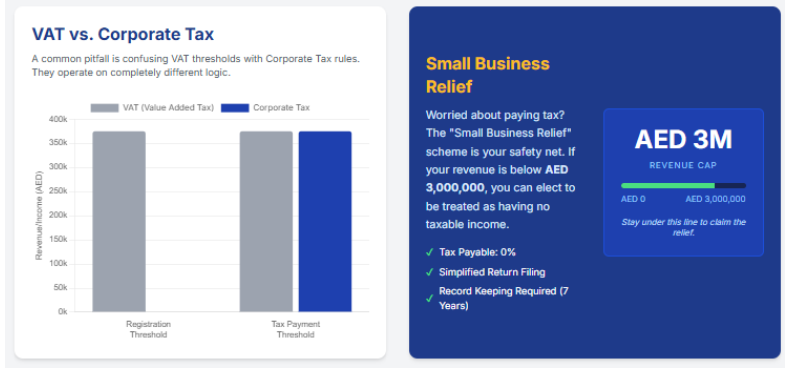
UAE corporate tax small business relief is a powerful tool for small businesses and startups, but it is not a reason to delay registration.
| Feature | Below AED 375k Profit (Standard Rate) | Small Business Relief (SBR) Election |
|---|---|---|
| Revenue Threshold | No revenue limit (relief applies to profit level). | Annual revenue must be ≤ AED 3 million. |
| CT Rate | 0% on taxable profit up to AED 375,000. | 0% on all Taxable Income while SBR is valid. |
| Losses Carried Forward | YES – losses can be carried forward to offset future 9% taxable profit. | NO – generally restricts loss carry-forward and other reliefs. |
| Purpose for Pre-Revenue | Ideal if you anticipate significant growth and future high profits. | Ideal if you want administrative ease and expect stable, lower revenue. |
For a UAE corporate tax pre revenue company, the decision to elect SBR is complex. You may benefit more by forgoing SBR to preserve your initial operating losses for when you start generating profit taxed at 9% after the SBR sunset date (2026).
The core obligation of a UAE corporate tax zero income entity is the annual return and the evidence to support it.
A zero-return filing is simply your annual Corporate Tax return where the calculation results in 0 AED of Taxable Income (often because of zero revenue and a resulting net loss).
This return must still be prepared based on your financial statements, demonstrating how the zero income was calculated. The deadline for this submission is strictly nine months after the end of your financial year. Missing this deadline, even with zero income, carries penalties.
All businesses, even pre-revenue entities, must maintain accurate and complete records for a minimum of seven years from the end of the relevant Tax Period.
For a non-trading company, this means retaining:
While the federal law mandates a statutory audit only for entities with revenue exceeding AED 50 million, the requirement often applies to smaller, pre-revenue entities due to local regulations.
Many Free Zones mandate an annual audit as a condition of license renewal, regardless of the federal revenue threshold. Additionally, Ministerial Decision No. 84 of 2025 states that all Qualifying Free Zone Persons (QFZPs) must maintain audited financial statements, a requirement that applies to Tax Periods commencing on or after 1 January 2025.
If you are a Free Zone company, you must budget for and complete an audit, even if you are entirely UAE corporate tax pre revenue.
The most important takeaway for a founder still asking, do i need UAE corporate tax registration, is the immediate risk of financial penalty.
As stated, failure to register for CT within the stipulated timeframe attracts a non-negotiable corporate tax UAE penalty for late registration of AED 10,000. Subsequent failures, such as non-filing of the annual return, attract cumulative, recurring penalties. This is the UAE corporate tax risk of not registering that far outweighs the minimal cost and time of registering correctly from the outset.
While newly incorporated companies must register immediately, the FTA set specific deadlines for companies established before the CT regime began (i.e., before June 2023). These deadlines are tied to the license issuance month, ensuring visibility on corporate tax UAE when registering.
| Date of License Issuance (Any Earliest Issued) | Deadline for Submitting CT Registration Application |
|---|---|
| 1–31 January and 1–28/29 February | 31 May 2024 |
| 1–31 March and 1–30 April | 30 June 2024 |
| 1–31 May | 31 July 2024 |
| 1–30 June | 31 August 2024 |
| 1–31 July | 30 September 2024 |
| 1–31 August and 1–30 September | 31 October 2024 |
| 1–31 October and 1–30 November | 30 November 2024 |
| 1–31 December | 31 December 2024 |
Example: A company licensed in the Free Zone in March 2019 had a registration deadline of June 30, 2024, regardless of whether it had started trading. Missing this deadline incurred the AED 10,000 fine.

The FTA has introduced a temporary, crucial measure: the AED 10,000 penalty may be waived if the business registers late but proactively file its first Corporate Tax return or annual report within seven months after the end of its first Tax Period.
This temporary relief is a clear signal that the FTA prioritizes compliant data submission. If you are already late, your immediate focus must be preparing and filing your first return on time to utilize this waiver opportunity.
If you’ve missed your initial corporate tax UAE when registering deadline, don’t panic. Take these steps immediately:
DBTA Case Study: A new trading LLC missed the initial CT registration deadline and immediately received the AED 10,000 penalty. DBTA swiftly processed their registration and prepared their first (zero income) return, ensuring it was filed within the seven-month deadline required by the FTA’s waiver mechanism.
Compliance extends far beyond mere registration. Use this checklist to ensure all mandatory corporate obligations are met, even when corporate tax UAE is not trading.
| Requirement | Non-Trading Entity Action | Legal Status Check |
|---|---|---|
| CT Registration | Mandatory immediately upon incorporation. | Confirm TRN issued on EmaraTax. |
| Annual CT Return | File mandatory annual zero-return filing within 9 months of FY end. | Maintain evidence to justify UAE corporate tax zero income status. |
| Record Keeping | Retain all financial records (statements, receipts, invoices) for 7 years. | Ensure that all records are digital and accessible. |
| Audited Statements | Required if you are a QFZP or if your licensing authority mandates it, regardless of revenue. | Engage an auditor before the financial year-end. |
| UBO Filings | Maintain up-to-date Ultimate Beneficial Owner (UBO) register with your licensing authority. | Keep local license compliance current. |
| Economic Substance (ESR) | While often related to income, track assets, employees, and operations if you are a Free Zone entity. | Ensure you are prepared to meet substance tests if required. |
| Deregistration | If closing, apply for CT deregistration within three months of cessation of business activity. | File a final CT return and obtain all necessary clearance letters. |
Compliance often fails on the small details that feel counter-intuitive to pre-revenue businesses:
At DBTA, we specialize in helping startups and established businesses navigate the intricacies of UAE corporate tax compliance, ensuring you avoid unnecessary financial penalties and structure your business optimally from day one.
Our services for non-trading, pre-revenue, and small businesses include:
The decision to register for UAE corporate tax is not optional for companies, regardless of revenue. A UAE corporate tax pre revenue entity is not exempt from the law; it is simply in the 0% tax bracket.
Early registration and meticulous record-keeping are significantly cheaper and safer than trying to correct a situation after the FTA has issued a penalty. Do not let the complexity of corporate tax UAE not trading paralyze your compliance efforts.
The moment your license is active, your UAE corporate tax registration threshold is zero, and your obligation to comply with it is 100%.
Book a free 15-minute Corporate Tax Compliance Review with a senior DBTA advisor today. We will assess your precise registration status, define your filing deadlines, and provide expert guidance tailored to your business structure.
Yes. If you are a company (Juridical Person), registration is mandatory regardless of your revenue or profit level. This is a legal requirement for corporate existence.
The effective date is the start of your first financial year, which begins on the date of incorporation. You must determine this date immediately to track your deadlines.
Yes. Corporate tax for dormant companies in UAE is still required. If your licence is active, the entity is a Taxable Person and must comply with registration and annual filing obligations.
Yes. Do free zone companies need corporate tax registration? absolutely. Registration is essential for obtaining a TRN and securing eligibility for the 0% Qualifying Free Zone Person (QFZP) status in the future.
The threshold for individuals is AED 1 million of business revenue per year, not AED 375k. If you are a freelancer below AED 1 million, you do not need to register for UAE corporate tax.
You face a penalty of AED 10,000 for late registration and risk accruing further penalties for non-filing annual returns. This is the chief UAE corporate tax risk of not registering.
Yes. A corporate tax UAE holding company is a juridical person and must register to formally claim the UAE corporate tax exemption criteria for passive income dividends.
It depends on your licensing authority. All QFZPs are required to maintain audited accounts, and many Free Zones mandate an annual audit, regardless of your UAE corporate tax zero income status.



As CEO of DBTA, Aurangzaib Chawla advises globally mobile businesses and individuals on cross-border tax planning and structuring. With expertise spanning the UK, UAE, and wider GCC, Zaib helps clients minimise double taxation, protect assets, and achieve long-term financial efficiency while staying fully compliant.
Let’s talk about how to structure your business for growth the smart, compliant, and tax-efficient way
As CEO of DBTA, Aurangzaib Chawla advises globally mobile businesses and individuals on cross-border tax planning and structuring. With expertise spanning the UK, UAE, and wider GCC, Zaib helps clients minimise double taxation, protect assets, and achieve long-term financial efficiency while staying fully compliant.
Let’s talk about how to structure your business for growth the smart, compliant, and tax-efficient way

As CEO of DBTA, Aurangzaib Chawla advises globally mobile businesses
and individuals on cross-border tax planning and structuring. With expertise spanning the UK, UAE, and wider GCC, Zaib helps clients minimise double taxation, protect assets, and achieve long-term financial efficiency while staying fully compliant.
Let’s talk about how to structure your business for growth the smart, compliant, and tax-efficient way.
Get in Touch