
RAK ICC Company Setup from India: Remote Process, Costs and Banking (2026 Guide)

Recent Insights
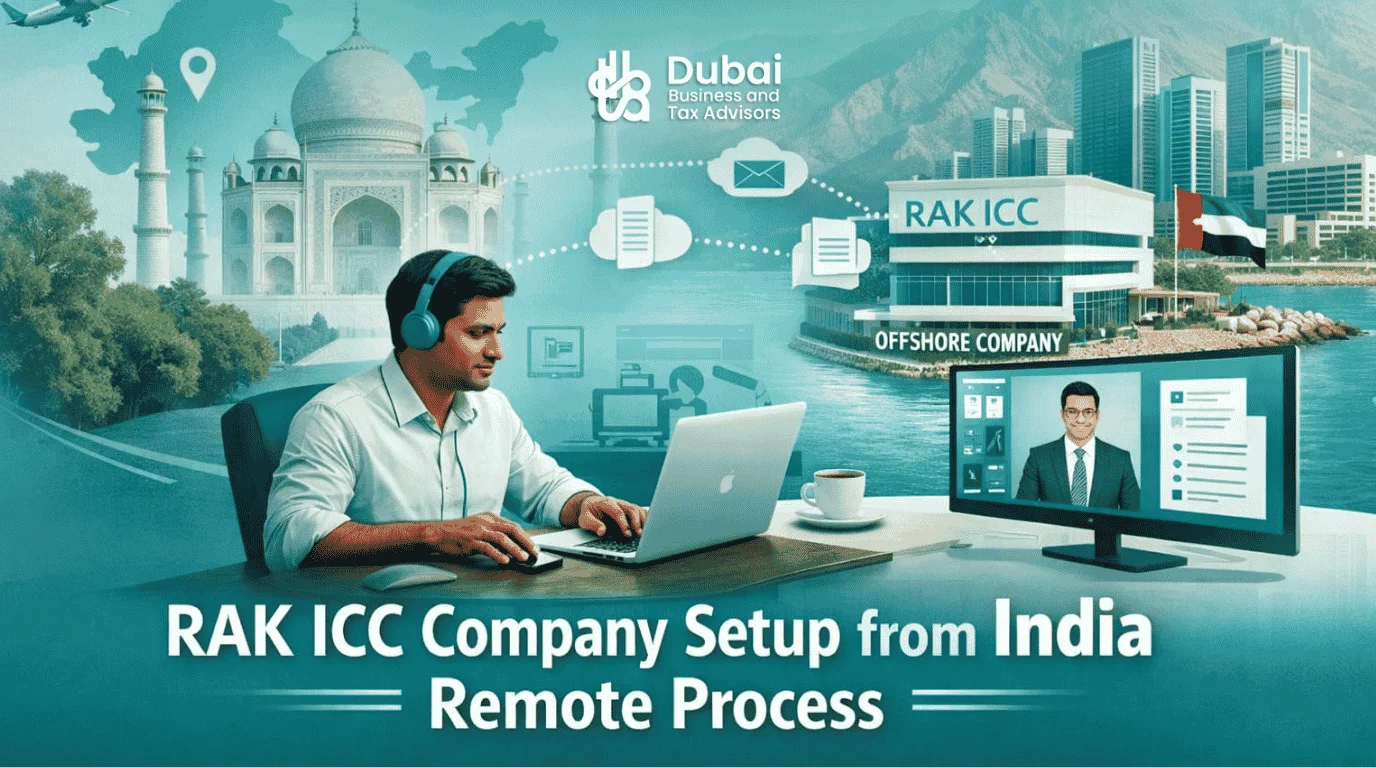
Table of Contents
Introduction:
The landscape for Indian entrepreneurs seeking a global footprint has shifted. In 2026, the demand for an RAK ICC company setup in UAE reached new heights due to its efficiency as a holding vehicle and its robust common-law framework. However, most information online stops at “remote are possible” This guide moves deeper into the actual mechanics of the process, specifically tailored for Indian KYC standards and the rigorous Source of Wealth requirements of UAE banks.
Navigating the UAE’s corporate environment requires a move away from generic “offshore” labels toward institutional-grade structuring. While the process is streamlined, success is not guaranteed. Approvals remain discretionary, and banking outcomes are entirely dependent on the quality of your file and the commercial rationale of your business. This guide provides the blueprint for a bank-ready application.
Quick answer for Indian founders and investors
For those looking for a rapid assessment, a RAK ICC company setup is primarily a strategic tool for asset protection and international holding. It is not an “all-purpose” license.
When RAK ICC is usually a fit
- Holding for shares/investments/IP: Ideal for Indians holding global equities or technology patents.
- Asset ring-fencing: Separating high-value assets from operational liabilities.
- Parent above an operating UAE company: Using the RAK ICC as the top-tier entity in a group structure to facilitate easier exit or succession.
When RAK ICC is usually NOT a fit
- UAE trading: You cannot physically trade or invoice local UAE customers.
- Hiring + visas: There is no provision for UAE residency visas or local staff.
- “Only for tax”: If the entity lacks a commercial narrative, it will likely face a corporate bank account rejection (as RAK ICC is a corporate registry, not a bank).
Most common setup for Indians (practical default)
The “Hybrid Model” is the dominant choice in 2026. This involves a RAK ICC holding company owning a UAE Free Zone operating subsidiary. This allows the founder to secure a residency visa and an operational bank account while keeping the ultimate ownership in a protected holding structure.
Can you set up RAK ICC remotely from India?
Yes, but define what “remote” really means.
Yes, RAK ICC remote company setup is standard. The registry accepts digital signatures and scanned copies for the initial incorporation phase. You do not need to fly to the UAE to receive your Certificate of Incorporation.
However, “remote” implies that your KYC, due diligence, and resolutions are processed digitally. Crucially, your banking readiness work begins on day one; you must prepare Source of Funds (SOF) and Source of Wealth (SOW) documents locally in India before a single form is filed.
What may still require in-person involvement?
While incorporation is fully remote, banking often is not. In 2026, many top-tier UAE banks still prefer or mandate a physical verification meeting. or a “wet-ink” signature on bank forms. While some digital banks allow remote onboarding, traditional commercial banks may trigger enhanced due diligence that requires a visit or a verified video call with specific location protocols.
Remote ≠ bank account guaranteed (set expectations cleanly)
Successfully registering the company remotely does not guarantee a corporate bank account. The registry (RAK ICC) and the banks are separate bodies with distinct risk appetites. A registered company with no bank account is legally valid but operationally paralysed. Indian applicants often face stricter scrutiny regarding capital controls (FEMA) and the source of funds.
Step-by-step remote setup process (India → UAE)

Step 1: Choose the correct structure (what to pick and why)
You must decide between an International Business Company (IBC) or a Foundation. For 90% of Indian entrepreneurs, the IBC is the correct choice for holding shares or trade. A Foundation is reserved for complex family wealth structuring, succession planning, or governance needs.
Step 2: Compliance pre-check (saves weeks)
Before spending money, we evaluate your intended use and transaction model. Banks will ask: Who are your counterparties? What is the frequency of transactions? We assess your UAE nexus. Why do you need a UAE account if you have no operations there?
Step 3: India-specific KYC pack preparation (preview)
This is where delays happen. We prepare the India-specific KYC pack. Indian documents like Aadhaar or generic utility bills often fail UAE banking standards if not formatted correctly.
Step 4: Incorporation + corporate document pack
Once the pack is ready, we submit for name approval and file the charter, registers, and resolutions. For Indian shareholders, we ensure the ownership chart and UBO declarations are precise.
Step 5: Banking strategy before submitting any application
We select the banking route based on your profile. We draft a “Narrative Memo,” a cover letter for the bank explaining the business logic, and compile the SOF/SOW pack.
Step 6: Ongoing compliance + annual maintenance (where many fail)
Post-setup; you must maintain record-keeping discipline. RAK ICC requires yearly renewal and economic substance filings (if relevant).
Case Study: Structuring the Remote Path
A Mumbai-based tech entrepreneur attempted to handle his own RAK ICC company setup but was stalled by a lack of India-specific document Apostille (the streamlined process used in 2026 following the UAE’s accession to the Hague Convention). Dubai Business and Tax Advisors (DBTA) intervened, restructured the KYC pack to meet 2026 UAE standards, and facilitated the remote signing via an approved digital platform. This proactive approach moved the file from “pending” to “incorporated” in 8 days.
India-specific KYC + Source of Funds / Source of Wealth
Personal KYC documents
- Passport: Clear colour scan, valid for at least 6 months.
- Proof of address: Recent utility bill or bank statement (not older than 3 months).
- PAN: Commonly requested for Indian tax identification.
- Aadhaar: Optional; used primarily for secondary identity verification.
- CV / Business Profile: Highlighting professional history and expertise.
Entity/ownership documents (if shareholder is a company/structure)
Corporate registry docs (India or other jurisdiction), shareholding proof, and board resolutions authorising ownership are required if a company is the shareholder.
Source of Funds (SOF): categories with examples
- Salary: Form 16, payslips, bank credits.
- Business income: ITR, financials, GST, CA summary letter.
- Investments: Demat/MF statements, broker reports.
- Sale of asset: Sale deed, contract note, capital gains computation.
Source of Wealth (SOW): clarify the confusion
SOF is the immediate money; SOW is the long-term narrative of wealth creation (3–5 years).
One-page “Bank Narrative Memo” (high-conversion, high-utility)
We create a document detailing the purpose of the entity, UAE nexus, transaction forecasts, and counterparty lists to give bankers immediate comfort.
Case Study: Proving the Paper Trail
An Indian investor had significant wealth from a property sale in Bangalore but lacked a cohesive “Source of Wealth” narrative for UAE banks. Dubai Business and Tax Advisors compiled a multi-year financial history, including tax returns and sale deeds, into a single, bank-compliant memo. This transparency led to an account approval where previous attempts had failed.
RAK ICC requirements for Indian applicants

Eligibility and due diligence standards
We explain who can apply and what triggers enhanced due diligence (EDD), such as being a Politically Exposed Person (PEP) or operating in high-risk industries.
UBO requirements (make it explicit)
RAK ICC UBO requirements demand total clarity on ownership. We assist in creating ownership charts that meet 2026 transparency standards.
Registered agent + office address requirement
You must have a registered agent. The office address is for legal domicile, not for physical operations or company visas.
Case Study: Navigating UBO Transparency
A group of Indian investors with a complex trust structure struggled to meet the RAK ICC requirements in India. DBTA simplified the UBO mapping, ensuring the registry received a clean, transparent chart that avoided the usual 4-week delay associated with multi-layered ownership.
Timelines
Set up timeline (incorporation)
Typically, 5–10 working days once the RAK ICC KYC documents India pack is finalised.
Banking timeline (approval is separate)
Banking takes 8–12 weeks. Approvals depend on the bank’s risk appetite and the clarity of your SOF/SOW.
Renewal timeline (annual planning)
Renewals happen annually. We recommend starting the process 30 days before the RAK ICC company renewal timeline expires to maintain bank account activity.
Costs for Indians (budgeting model)
Set up cost buckets
Includes registry fees, registered agent fees, and India-side Apostille
Banking cost buckets
Includes the bank-ready pack, compliance support, and any additional due diligence fees triggered by the profile.
Annual renewal cost buckets
Covers the RAK ICC annual renewal cost, accounting maintenance, and corporate tax compliance.
Cost driver’s checklist (simple scoring)
Factors include shareholder count, ownership complexity, and whether a hybrid model is required.
Case Study: Budgeting for the Long Term
An Indian startup initially looked for the cheapest RAK ICC company setup cost online. After consulting with DBTA, they realised that a “cheap” setup often leads to “expensive” bank rejections. We provided a transparent budgeting model that included necessary Apostille and compliance filings (reflecting the 2026 streamlined document verification process), ensuring they didn’t face hidden fees later.
Testimonial:
Business activity selection
Business activity list – how to select safely
The RAK ICC business activity list must match your commercial reality. Selecting “General Trading” without a trade history is a common path to rejection.
Activity vs transaction mismatch (top rejection cause)
If your license says “Consultancy” but your bank flows show “Wholesale of Electronics,” the account will be flagged. We ensure total alignment.
India–UAE tax treaty + Indian tax reality (trust-builder, compliant)
What the Treaty Is and Is Not
It is a mechanism for double taxation relief, not a “get out of tax free” card. Relief generally requires tax residency certificates, which can be difficult for offshore entities.
Five concepts’ founders should understand
- Tax Residency: How days in India vs. the UAE are counted.
- Permanent Establishment (PE): Avoiding the risk of being taxed in India despite a UAE license.
- Dividends/Interest: High-level treaty rates.
- Capital Gains: Rules regarding the sale of shares.
- Relief Mechanisms: How to claim credit for taxes paid.
Common India-side misunderstandings
The biggest myth is that “UAE income is invisible.” In 2026, global reporting standards make transparency the only viable strategy.
Banking for Indians: what affects outcomes
What drives approvals
Clean SOF/SOW, clear purpose, UAE nexus, and transparent UBO.
Top rejection reasons + exact fixes
| Rejection Reason | What It Really Means | Exact Fix | Evidence to Add |
|---|---|---|---|
| Weak SOF pack | Can’t trace the money | Rebuild 6-month trail | Pay slips, ITRs, bank credits |
| Generic activity | Risk is too high / vague | Narrow the activity list | Detailed narrative memo |
| No nexus story | “Why UAE?” unanswered | Show UAE connection | Local vendor / client LOIs |
| Entity type mismatch | Wrong tool for the job | Move to the Hybrid model | Operations / visa plan |
Banking options (bank-neutral, practical)
Traditional banks offer higher limits but stricter DD; digital banks offer faster onboarding but may have lower transaction thresholds.
If rejected – what to do next
Analyse the rejection, upgrade your evidence, and change the narrative. Do not just resubmit the same file.
Get a bank-ready pack for Indian applicants
Hybrid strategy (RAK ICC holding + UAE Free Zone operating)
When is a hybrid the smartest route
When you need visas, an office, and a stronger UAE offshore company India presence.
How it works (simple diagram text)
Indian Owner → RAK ICC Holding → Free Zone Operating → Clients/Suppliers
Real examples (India-real scenarios)
Scenario 1: Indian investor holding overseas investments
An investor consolidated global stocks under an RAK ICC. By providing a clear CA-certified net worth statement from India, we secured a private bank account.
Scenario 2: Indian services business expanding to the UAE
A software firm used an RAK ICC to hold IP and a Free Zone for 5 UAE-based employees. This “Hybrid” model provided the substance banks require.
Scenario 3: Family wealth + succession planning
A family business transitioned to the RAK ICC Foundation to ensure a smooth transition of UAE property assets.
Setup checklists
Incorporation checklist
- Valid Passport and PAN.
- Utility bill (Address Proof).
- Ownership Chart.
- Board Resolution.
Banking checklist
- Source of Wealth Pack.
- Business Plan / Narrative Memo.
- 3-Year Revenue Forecast.
- Counterparty List (Clients/Suppliers).
India tax + compliance checklist
- Residency Status Certificate.
- Foreign Asset Disclosure Review.
- FEMA Compliance Check.
How DBTA can help
At Dubai Business & Tax Advisors, we specialise in the “India-UAE Corridor.” We understand the friction points of Indian documentation and UAE banking.
- Structure Recommendation: We help you decide between RAK ICC vs Free Zone.
- Incorporation Execution: Professional handling of your RAK ICC company setup in Dubai.
- Bank-Ready Pack: We build your source of wealth documents into a professional dossier.
- Banking Strategy: We guide you toward the banks most likely to approve your specific profile.
Conclusion
A RAK ICC company setup remains one of the most effective tools for Indian investors in 2026, but only when executed with a “banking-first” strategy. The primary hurdle is no longer the incorporation, which is seamless and remote, but the demonstration of financial substance to the UAE’s compliance-heavy banking sector.
Whether you are using this structure for global asset protection or as a parent for a UAE operational hub, your success depends on two factors: the clarity of your commercial rationale and the precision of your documentation. By aligning your Indian tax history with UAE banking expectations from day one, you transform a simple offshore company into a robust global asset.
FAQ's:
Yes, the RAK ICC remote company setup is fully digital for incorporation. You only need to travel if the specific bank you choose requires a physical meeting for the account opening.
While we don’t publish flat rates, your budget should include registry fees, agent fees, and compliance support. Generally, it is the most cost-effective UAE offshore company option for Indian entrepreneurs.
The RAK ICC company setup timeline is usually 5 working days for the license. Banking takes an additional 2 to 3 months.
Standard RAK ICC KYC documents for India include your passport, a 3-month-old utility bill, and your Indian PAN card for tax identification and reporting.
You must disclose any individual with 25% or more ownership. RAK ICC UBO requirements are strictly enforced to align with global AML standards.
No, you use the RAK ICC office address requirement of your registered agent. You do not need a physical office lease.
Most non-regulated activities, such as holding, IP ownership, and international consulting, are accepted. Always check the RAK ICC business activity list before applying.
It is possible, but very difficult. Most entrepreneurs find that a UAE bank account without a visa leads to high minimum balance requirements (e.g., AED 500k+).
You need RAK ICC banking documents, such as a Narrative Memo, Source of Wealth proofs, and sample contracts with future clients.
The top reason for RAK ICC bank account rejection is a weak “Source of Wealth” narrative or a lack of a clear business purpose in the UAE.
In 2026, expect a 60-to-90-day window for full approval and IBAN activation.
For offshore entities, banks often ask for a minimum balance ranging from AED 200,000 to AED 500,000.
Yes, but you must consult your tax advisor regarding Indian GST and withholding tax (TDS) implications.
The RAK ICC annual renewal cost includes the registry fee and the registered agent fee, due every 12 months.
orgetting to renew the license or failing to update the registry when you change your Indian home address is a common RAK ICC compliance checklist failure.
Latest news & articles
About the Author:
AURANGZAIB CHAWLA
As CEO of DBTA, Aurangzaib Chawla advises globally mobile businesses and individuals on cross-border tax planning and structuring. With expertise spanning the UK, UAE, and wider GCC, Zaib helps clients minimise double taxation, protect assets, and achieve long-term financial efficiency while staying fully compliant.
Planning to launch in Dubai or the UAE?
Let’s talk about how to structure your business for growth the smart, compliant, and tax-efficient way
About the Author:
AURANGZAIB CHAWLA

As CEO of DBTA, Aurangzaib Chawla advises globally mobile businesses
and individuals on cross-border tax planning and structuring. With expertise spanning the UK, UAE, and wider GCC, Zaib helps clients minimise double taxation, protect assets, and achieve long-term financial efficiency while staying fully compliant.
Planning to launch in Dubai or the UAE?
Let’s talk about how to structure your business for growth the smart, compliant, and tax-efficient way.
