
Dubai Free zone Company Setup Expert Report: How to Comply with the Strategy and the New Corporate Tax Rules

Recent Insights
Table of Contents
Why Is “Dubai Free Zone Company Setup” So Liked – And Where Confusion Starts
The foreign investment environment in the United Arab Emirates (UAE) has changed drastically, providing brilliant business prospects for international investors. The first draw of UAE company formation in a free zone is based on strong economic drivers: 100% foreign ownership with no previous requirement for a local partner, ability to remit capital and profits without restrictions, and the benefit of the UAE’s position as a major logistics center of East and West. The importation and exportation of Goods in Free Zones are likewise generally free from customs duties. But, the narrative of a “tax-free” regime became misleading since the announcement of the 2023-2025 corporate tax (CT) changes. Although the preferential regimen allows for a 0% rate, it is subject to some very strict requirements. All Free Zone Persons must register for UAE CT, and 0% applies only to those who meet the narrowly defined criteria of a Qualifying Free Zone Person (QFZP) in respect of its QI. Otherwise, Companies pay tax at the normal UAE corporate rate of 9% on profits in excess of AED 375,000.
Who this guide is for: Entrepreneurs, investors, and business owners setting up
This is a guide for an international mix of readers comprising individual consultants working alone to e-commerce entrepreneurs and remote startup co-founders with Small and Medium-Sized Enterprises (SME) looking to expand in the GCC. It is tailor-made for readers who are analyzing the economic sense of choosing a UAE free zone vs a mainland setup, or who have already embarked on finding out the best cheap free zone in the UAE and are familiar with repercussions due to non-compliance.
What you will get
It is a comprehensive guide that explains the steps, the cost of setting up a business in the Dubai Free Zone, and when it falls from/to, tax law on businesses; you also have types available for companies in Dubai, their choice of the visa, recommendations regarding opening bank accounts, or having to renew sales. Success in today’s world depends on securing and retaining QFZP credit. A detailed FAQ section, at the end, answers questions asked by people struggling with the free zone of company registration in the UAE, Process, cost, and advantages.
At-a-Glance: Timeframes, Fees & Tax Quick Look at a Brief Overview of Purchasing Property
Required to be an Accredited Investor Process takes 2-3 weeks Definition of “Accredited investor” Excluding management company investment property ownership Document Signing Document signing within IBK Bank, lawyer’s office or branch location Agency Fees Parsing Out the Numbers Costs Calculate (assuming a 1loan from IBK or KEB) Assumes the middle six engineering firm BOQ amount Rate may vary depending on circumstances Insurance.
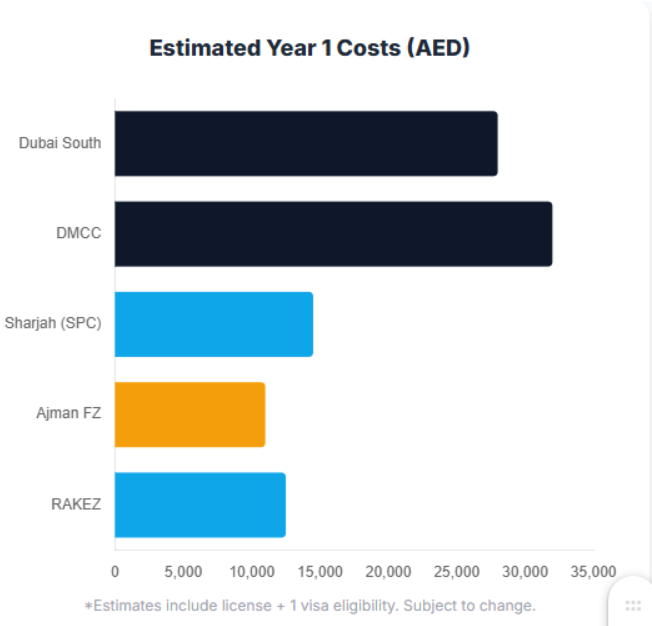
Set up the cost range in 2025
The average Dubai free zone company setup cost is around AED 8,000–50,000, which includes the cost of the specific zone (license type), the number of visas, and office space. You CAN obtain relatively affordable licenses, starting at AED 8,000-15,000. This is a far cry from the Northern Emirate zones, where Ajman free zone company setup costs or Sharjah free zone company setup costs (e.g., in SHAMS) can provide packages as low as AED 5,500–6,500. However, options priced lower would be perceived differently in corporate banking circles and might come with visa restrictions, such as limitations on visas or the level of operations. The RAK free zone company setup (RAKEZ) provides SME with an inclusive package at about AED 14000 with one visa and guaranteed renewal.
Timeline snapshot
It is the fastest track, 1–2 days for instant licenses. The Dubai freezone normal timeline is once a week, but it will be shortly. The time required from application to complete setup (bank account) for a free zone company varies, but typically takes 30–45 days. Visa and Emirates ID issuance will require extra days after the entry/medical examination date.
Corporate tax snapshot
The FTA requires all Free Zone Persons to register for the UAE CT with them.
A Qualifying Free Zone Person (QFZP) may apply the 0% CT rate for Qualifying Income. Otherwise, non-QFZP income is taxed at the standard tax rate of 9% (or all income if QFZP status is forfeited, or an alternative designation to be taxed at this rate is elected). This lower rate and preference rate depends on continued substance and compliance with the CT law.
What is the Dubai / UAE Free Zone Company? (Foundations & Benefits)
Free zone vs mainland and offshore
What is a free zone company setup in the UAE? A free zone company in the UAE is an entity created in a designated economic region. It is particularly concerned with the import or export of goods.
Onshore companies: shore (also referred to as Mainland) companies are those that fall under the regulation of DED. It grants unrestricted access to trade on the entire domestic market of the UAE. Previously, Mainland establishments had to rely on a local sponsor; however, 2021 amendments to the Commercial Companies Law allow expats to have 100% company ownership for most licensed activities, bringing it on par with a free zone model of ownership structure.
Offshore company: These are usually non-resident holding companies or wealth protection vehicles and are typically not allowed to carry out any business trade in the UAE, only doing so as a “by-pass” with no physical presence or visa eligibility, for example, due to the director’s residence.
Main advantages of a Dubai free zone company benefits
The following are the main Elmaging Dubai Free Zone Benefits. These benefits help set up a business in the UAE, especially in a free zone structured environment. You own everything. There may be exceptions to that general statement, but usually if your business is set up within a designated free trade zone, then trade policies are based on you actually retaining 100% ownership.
The main company advantages of a Dubai free zone company are:
- 100% expat ownership and 100% repatriation of capital and profits.
- Facilitated customs regulations and import-export duty exclusions for imports into and exports from the FZ. Access to sectoral ecosystems (clustering by industry). Areas such as Dubai Media City (DMC) are designed for media, while the Dubai South free zone company setup is predominantly geared towards logistics, aviation, and e-commerce. DMCC free zone company setup is famous for its commodities & solid infrastructure.
Typical use cases
Free zone structures are very useful for:
Advisory and consultancy services are provided through international engagement. E-commerce and web-based businesses (i.e., Amazon FBA, drop shipping, SaaS) that are international in marketing to businesses as opposed to individual consumers (B2B). Import/export, logistics, and re-export for customs advantage. Holding, IP, and investment vehicles in the sphere of international asset management.
Tax & Compliance Framework for Freezone companies (Post – Corporate Tax Topics)
Corporate Tax fundamentals for free zone company registration in the UAE
The default UAE CT regime applies a 9% tax rate to Earned Profits above AED 375,000. The focus for free zone entities is on achieving and then preserving Qualifying Free Zone Person (QFZP) status to fall within the 0% CT rate on Qualifying Income (QI). Simply put, you will need to keep a certain amount of substance in the license (have some buildings and staff), make Qualifying Income (as defined) from a ‘permissible activity’, followed by ensuring that Transfer Pricing rules are adhered to for revenue arising as well as submitting audited annual financial statements that do not contain too much Non-Qualifying Income which should be less than / equal to De Minimis limits whichever is lower: AED 5 Million or 5% of Total Revenue. EAs earn income that is not eligible for the 0% rate and is immediately taxed at 9%.
Registration & filing obligations
All Free Zone Persons are required to register for CT through the EmaraTax portal in order to receive a TRN, even if they expect to incur 0% or 9% CT. New entities (whose license is issued in 2024 and later) are generally required to register within three months from the issue date of their license to avoid penalties. All Free Zone Persons are required to keep accounts and file an annual CT return within nine months of the end of their financial year, even if they are filing a “nil return”.
Other mandatory regimes
VAT registration thresholds. A Free zone entity should register for VAT if the value of its taxable supplies and imports exceeds, or is expected to exceed, AED 375,000 per annum in the previous 12 months.
ESR (Economic Substance Regulations): Any Entity engaging in one or more Relevant activities is required to file an annual notification and, where it earns income in a financial year, an Economic Substance Report.
UBO reporting. As per international AML standards, all FZ entities are required to identify and maintain the registers of their UBOs and submit details to the relevant licensing authority.
“Tax-free” myths to address
“It is a misnomer that ‘free zone = no tax, no filings’. The 0% rate is not automatic but conditional. The fact of the matter is that the stringent compliance obligations under the new regime, viz. compulsory CT registration and filing (CT return), audited financial statements, and Transfer Pricing compliance, have to be met even by entities that end up with 0% tax liability on their Qualifying Income.
Selecting the Appropriate Structure: UAE Free Zone vs Mainland vs Offshore
Decision framework (high-level comparison)
The choice is based on market access, tax efficiency, and substance.
Table 1: Comparison Matrix: UAE Free Zone vs. Mainland
| Feature | Free Zone Company (FZ) | Mainland Company (LLC/Civil) |
|---|---|---|
| Ownership Rules | 100% (Standard) | 100% (for most activities) |
| Client Base | International, B2B, FZ-to-FZ | Unrestricted access across UAE |
| Substance | Mandatory FZ presence for QFZP status | Determined by DED and local tenancy |
| Dubai business setup cost | Generally lower for zero/one-visa packages | Generally higher for full compliance/office |
| Tax Treatment | 0% (if QFZP) or 9% | 9% (above AED 375k) |
| Regulatory Burden | FZ Authority + FTA (CT/VAT) + Central Bank (AML) | DED + FTA (CT/VAT) + MOHRE |
Instances when a free zone company is the best choice
The free zone structure is perfect for:
- Export services, online services or B2B with exclusively international customers.
- Holding or IP or investment structures that need a strategically focused and stable tax jurisdiction.
- Companies in need of easy customs procedures (re-export, logistics).
When the mainland may be better
All of mainland integration is a better option for:
- B2C brick and mortars (retail, F&B, clinics).
- Organizations that wish to have access to government or local private sector tenders.
- Businesses where physical delivery in all seven emirates is required.
Free zone vs offshore
Offshore structures are purely for asset protection or holding, with strict restrictions: onshore trading is not permitted, and they cannot be used to obtain resident visas. FZ businesses, on the other hand, are functional business operations that can hire people, obtain visa quotas, and do business internationally.
Outline of the Major Free Zones (Dubai, Sharjah, Ajman, RAK & “Cheapest Free Zone UAE”)
Key freezones to focus on in Dubai
- DMCC free zone company setup: The choice of any consultancy, commodities, and trading companies due to a high concentration of MNCs.
- Dubai South free zone company formation: Location (near Al Maktoum International Airport and Jebel Ali Port) – logistics, aviation, e-commerce.
- Dubai Airport Free Zone (DAFZA): Best for high-value, aviation, and luxury products, as it is directly connected to Dubai International Airport.
- IFZA, DSO, Meydan, DMC: Typically mentioned as cheap Dubai options. You can register at Meydan Free Zone at AED 12,500 onwards and have to deposit the paid-up share capital to the company.
You can find the most affordable free zone company set up in the Northern Emirates of the UAE.
Company formation cost in Sharjah free zone: Some of the lowest entry costs (licenses from about AED 5,750) are available at SHAMS and SPCFZ (Sharjah Media city and Sharjah Publishing city Free Zone), a favorite for media/tech/freelancers.
Ajman free zone company setup & fees calculator: Ajman Free Zone (AFZ) has the cheapest license costs from AED 5,500 and is distinctive as the only authority that allows payment in instalments.
Company formation in RAK free zone: RAKEZ (Ras Al Khaimah Economic Zone) is quite competitive, starting from about AED 14,000 all-inclusive SME package with flexible multi-activity licenses and fixed cost of renewal.
Sector-specific recommendations
- Tech & SaaS: Free zones such as SHAMS, IFZA, and Dubai Commerce provide specific e-commerce licenses and digital services.
- Logistics/Import-Export: Logistics is strong with Dubai South and RAKEZ, located near ports and airports.
- Freelancers: SHAMS and Meydan have customized, low-cost packages for solo founders and consultants.
Types of Licenses & Activities: Free Zone Trade License Dubai Explained
License categories
Free Zone Trade License Dubai ‐ Overview. Generally, a free zone trade license in Dubai can be one of the following types:
- Service/Consultancy: For professional service businesses, consulting companies, and agencies.
- Commercial/Trading: For trade data (import, export, distribution, e-commerce).
- Manufacturing/ Industrial: Appropriate for light and heavy manufacturing or processing.
- Retain / Investment: Use it for passive investment and asset management.
Alignment of business model and license
The heart of the matter is a proper matching of business model and licensed functions. A Commercial/e-commerce license is required for e-commerce. For an agency or consultant, the license is for Consultancy/Service. This is an important step as misclassification could result in a denial or worse, put the QFZP status at risk for future activity should it be determined to be an Excluded Activity.
Restricted / sensitive activities
Some occupations, such as finance or healthcare, or education, are extremely regulated. In many cases, they need specific external governmental sanctions or Mainland representation to do business legally. Invest in Dubai adds that some regulated professions could require a certain regulator or presence in the mainland.
End-to-End Process of Free Zone Company Setup Step by Step
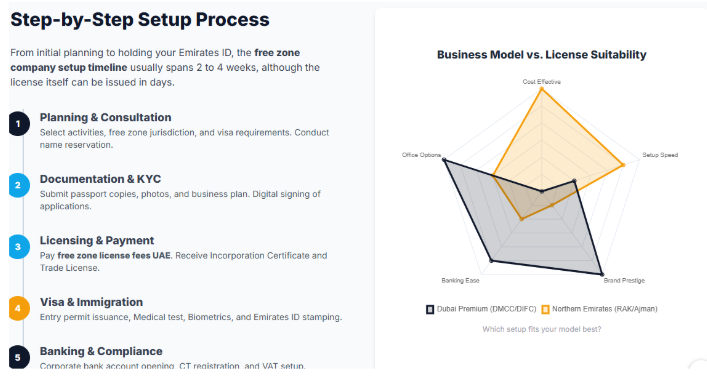
The process of setting up a business in a free zone follows a familiar pattern in most jurisdictions.
Pre-setup planning
The founder needs to select the right emirate (Dubai free zone company setup vs. other emirates), choose the shareholding structure (FZE or FZC), pick the right license type (e.g., trading, consultancy), and forecast which visa count is needed, which also outlines in this case the minimum office facility.
Documentation & approvals
The first step is to seek acceptance from the FZ authority through:
- A formal application form.
- A comprehensive business plan.
- Colour passport copies for all Shareholders and the nominated Director.
- Manager Registry Identification Code form.
- A notarized Copy of the Commercial License or Certificate of Incorporation for Corporate Shareholders.
Incorporation & licensing
After receiving initial approval and completing the legal documentation (MoA/AoA), payment of the free zone license fees in the UAE is required. Consequently, the Trade License and Certificate of Incorporation are issued.
Immigration & visas
The very next important step would be to get an Establishment Card (or Immigration Card as it is called) issued by either the General Directorate of Residency and Foreigners Affairs (GDRFA) or MOHRE. This card allows the FZ entity to be a sponsor for individuals. The next step involves application for the e-visa, entry, medical check-up, and issuance of the Emirates ID. While the free zone visa price UAE (including application, medical and ID) on average normally amounts to AED 4,670 per person.
Bank account opening
Having a corporate bank account is obligatory, but also the most challenging part operationally; this can take up to 3 months. Due to strict AML/KYC requirements, banks require a lot of documents, including detailed UBO [Ultimate Beneficial Owner) data and “proof of “SOI issues. Institutions lacking significant physical presence and a UAE-resident signatory will be subject to higher scrutiny and may find it difficult to open an account.
post-licensing registrations
MANDATORY POST-LICENCING REGISTRATIONS: Corporate Tax Registration (TRN), VAT registration (if applicable), UBO registration, establishing annual accounting systems to support compliance with QFZP rules, ESR, and TP requirements.
Cost Analysis: From ‘Cheapest Free Zone’ Ads to Actual Cash Spending
Core cost components
The overall Dubai free zone company formation cost comes to four figures:
- Registration & incorporation fees.
- Annually, a License fee (renewable).
- Office/flexi-desk/warehouse costs that influence the company’s visa quota and the substance capability.
- Visa fees in the UAE free zones (application, medical, and Emirates ID).
- Service fees for government transactions with (Establishment card, immigration file).
Dubai vs Sharjah vs Ajman vs RAK price banding
The total cost is highly variable, but the pricing tiers remain distinct:
| Package Type | Dubai (Meydan, IFZA, DMCC) | Sharjah (SHAMS, SPCFZ) | Ajman (AFZ) | RAK (RAKEZ) |
|---|---|---|---|---|
| Zero-visa package | AED 11,500 – 15,000 | AED 5,750 – 8,000 | AED 5,500 – 9,000 | AED 11,000 – 14,000 |
| One-visa entrepreneur package | AED 14,350 – 23,150 | N/A (often licence + separate visa cost) | AED 9,100 – 12,000 (licence + visa est.) | AED 14,000 (all-inclusive pkg) |
| Multi-visa SME package | AED 23,600+ (6 visas) | Higher cost, usually via office upgrade | Office upgrade required | Add’l visas AED 4,000 each |
Cost breakdown and typical traps
Cost breakdown and typical traps
Visa application fee/office flexi-desk lease is excluded from the prices, and entrepreneurs must remember that. In addition to upfront costs, the real and hidden costs are compliance obligations, including an annual audit (mandatory for QFZP status), which may range from AED 4000-10000, and regular CT/VAT filings.
Dubai free zone annual renewal cost
How much does it cost to renew a company in the Dubai free zone?
The cost of Dubai free zone renewal will be included in the annual renewal, and it is likely to reflect a renewal issue fee in the first year and an estimate of license expense (Between AED 10,000 and AED 25,000). In typical simple packages, the overall annual fee (license, admin desk, establishment card) would be around AED 21,500.
Material, Office Needs and Banking Reality
Flexi-desk versus physical office versus warehouse.
Facility determines scale and ability to comply:
- Flexi-Desk/Virtual Office: visas are usually required. As cheap as it is, using this facility only must be approached with caution and can hamper Corporate Tax substance tests and delay bank account success.
- Office: a physical space that grants higher visa quotas (visa per 9m² in DMCC). This is needed to prove the adequacy of the scaling companies.
- Warehouse: The physical operations must be connected directly with the licensed activities, and a warehouse is necessary for industrial or bulk trading/distribution activities.
Substance for QFZP status
A QSFP company is required to have “Adequate Substance” (enough trade being conducted in the business, sufficient employees in the UAE, and sufficient physical assets, premises, and IT costs). Circumstances tests for addressing the meaning of satisfactory substance, it must employ enough people physically situated at its place of operation in the United Arab Emirates. Decisions must be taken within the UAE.
Banking & payment gateways
Free zones and ‘risky’ activities from banks’ perspectives (such as owning through complex multi-jurisdictional structures or trading a lot of cryptocurrencies) are hotspots. Cheapest free zone UAE options- especially with the lower due diligence reputation, can also impact how successful you are in banking, as banks will typically require more substantial KYC/UBO validation. How to open a bank account? Account Opening Currency Control. There is no currency control present, but the physical resident director/authorized signatory significantly improves your chances of opening and speeds up the process.
Body Weight Management. Additional information: Register clients, generate repeat business relationships with Health Professionals. Industry Registration Details: Registered RMT in good standing for mainland Canada. Relevant work experience (required): Experience working with clients in mainland China. Body weight management: years. Please note that applicants must be able to work legally.
Can a free zone to the mainland be sold (11.1)?
A company in the free zone is not able to sell or trade directly within the UAE Mainland unless it complies with one of the approved three options:
- Local Distributor/Agency: Appoint a Mainland licensed agent.
- Mainland Branch: Setting up an FZ company entirely in the mainland.
- Free Zone Mainland Operating Permit (FZMOP): Launched in 2025, the permit makes it possible for Dubai-licensed FZ companies to sell and deliver services onshore to non-regulated sectors such as consulting and technology, legally up to six months (renewable).
Import/export & customs
The Free Zone is considered outside the customs territory. Customs duties (%) are levied only when moving the goods from the FZ to the mainland for consumption within. Commodities are re-exportable globally from the Free Zone free of duty.
Cross-border tax considerations
Shareholders remain subject to local tax, meaning that some may continue to pay tax on dividends or company profits in their home country under Controlled Foreign Corporation (CFC) rules. International tax compliance is important to address with bilateral tax advice.
Visas, Sponsorship & Family: Living (or Not) in the UAE
Investor & employment visas
A company’s maximum visa quota is dictated by the number of desks/offices it has on a lease. A flexi-desk will usually yield visas; a physical office grants an increased quota according to the square meters. In order to improve the visa quota, the company needs to upgrade its office.
Residence obligations
The UAE resident visa is usually valid for three years. Although the UAE has relaxed many of its regulations, visitors are not entirely free: they must adhere to visa requirements (including the entry/exit requirement that typically does not allow more than six months outside the country).
Family sponsorship
An expat employer or business owner can sponsor their family if they have a valid UAE residence visa. The minimum salary cap to qualify is AED 4000 per month or AED 3,000 per month plus employer accommodation. Attention: All sponsors need a valid Ejari/Tawtheeq and a salary certificate. Sponsoring parents is more limited and requires a higher salary (e.g., AED 10,000–15,000 vary by emirate).
Decision Tools & Checklists
60-second decision checklist
| Goal | Recommendation | Why? |
|---|---|---|
| Maximize tax efficiency (0%) | Free Zone (QFZP status) | 0% CT on Qualifying Income |
| Sell across all UAE Mainland | Mainland Company | Unrestricted access |
| Lowest start-up cost | Sharjah/Ajman FZ | Licence packages starting from AED 5,500 |
| Test Mainland Market (short-term) | FZMOP (in Dubai) | Fastest, low-commitment entry |
Zone selection matrix
| Business Model | DMCC | IFZA | Meydan | Dubai South | SHAMS | Ajman | RAKEZ |
|---|---|---|---|---|---|---|---|
| Tech/SaaS (Int’l) | Good | Best Fit | Good | Possible | Good | Possible | Good |
| Logistics/Import-Export | Good | Possible | Possible | Best Fit | Possible | Possible | Good |
| Media/Creatives/Freelance | Possible | Good | Best Fit | Possible | Best Fit | Good | Possible |
| Commodity/Trading | Best Fit | Good | Possible | Good | Possible | Possible | Good |
How DBTA Helps You Maintain Free Zone Tax Benefits Legally
For foreign investors running the maze of Dubai free zone company setup, knowledge in compliance, tax jurisdiction and local governance is not a nice-to-have layer (along with tape or any other barrier) between you and 0% tax benefit for your operations at company setup or long-term while operating. At DBTA, our offering takes the pain out of this regulatory fatigue and makes sure your setup is strategically correct and compliance-ready on day one. PROBLEMS WE SOLVE Regulatory Burdens. It is a constant battle to keep track of DIFC regulations to ensure you are working in full compliance with local rules.
Case 1: Preserving the 0% Tax Status of a Trading Group
The Client: Nexus Global Trading is a group of companies which is offering B2B sales services, with the company at hand operating on an international level and proposing itself as setting up in the Dubai Designated Free Zone (here referred to simply as DFZ).
The Challenge: Customer needed certainty on their 0.0% Corporate Tax rate and was subject to complex new Transfer Pricing Rules for transactions with Related Parties.
DBTA Solution: As part of the project, we painstakingly crafted their QFZP compliance package, including full TP Master File and Local File, showing all CIGA were performed by appropriate people on the ground in their FZ facility. We had internal controls to safeguard that all non-qualifying income did not exceed the level of De Minimis.
Client Quote: “The TP documentation prepared by DBTA was watertight. It gave us confidence that our 0% status is safe and put the focus back on growing our business instead of fearing a surprise tax bill.”
Case Study 2: Banking on the Fast Track for a One-Man Band Consultant
This was the case of Sarah J., a UK-based single consultant. She was based in a low-cost free zone with a virtual office (flexi-desk) and faced a challenge to get a corporate bank account for four months, jeopardizing her contracts.
The Challenge: Banks considered her lack of substance (virtual office) and being non-resident as very risky, resulting in rejection based on very strict AML/KYC policies.
DBTA Solution: We recommend that Sarah immediately upgrade to a physical, dedicated office space, appoint a co-resident director with a UAE visa and overhaul her business plan from scratch, including copious sources of funds. We then managed to arrange a pre-approval meeting through our bank liaison service.
CLIENT QUOTE:
“DBTA finally got our bank account open within three weeks from its facility upgrade after months of frustration. They taught me that substance is not a choice, it is the prerequisite to running a real business and making money in banking in the UAE.”
Case study 3: FZMOP and Strategic Mainland Expansion
The Client: Tech Nova FZ, a software development company based in Dubai South, focused on international B2B contracts. The Challenge: Secure a substantial, six-month contract with one of the major corporations on the Mainland without needing to set up a full LLC on the Mainland.
The Challenge: MB’s Mainland contract income would be exposed to the 9% CT rate, and they had to prevent this from “infecting” their core 0% Qualifying Income stream, potentially causing a five-year loss of QFZP status.
DBTA Solution: We advised Tech Nova on applying for and using the newly-launched Free Zone Mainland Operating Permit (FZMOP). Remember to segregate You retested our tax accounting systems and internal time-recording solutions, including setting up clear segregated channels for the booking and tracking of all FZMOP-related revenue and costs across the firm so we could assure you that Our team assisted you to ring-fence all income/expenses related to [FZMOP] Critically short, we spoke with your group finance director gtd(only) who thanked his core tax partner (me), Millar & co, for work at Between us we devised a way of ensuring an appropriate segregation/set-up hence, as retain a 0% ratable status on their core international business whilst receiving income taxed at 9% from trading within the QFZP.
Client Quote: “The FZMOP enabled us to do the mainland deal, but DBTA’s accounting segregation saved our 0% tax rate.” Their compliance guidance turned a tactical opening into a durable strategic edge.”
Conclusion and Expert Recommendations
The Dubai Free Zone platform continues to be second-to-none in terms of infrastructure for the international entrepreneur, with unbeatable benefits in terms of ownership and capital freedom and strategic tax-efficiency. But the regulatory environment calls instead for a sophisticated and proactive strategy to compliance, rather than relying on a previously assumed automatic exemption. For any Free Zone entity, the single most important strategic ingredient is that of demonstrating Adequate Substance. The cheap, competitive licenses, in particular, that are run on virtual or flexi-desk premises, are a ticking financial time bomb. With a business that ramps and substantially earns Qualifying Income, the minimum level of substance you will have with a base package would be below the FTA’s threshold. We will lose the 0% CT rate if we fail the substance test and will be exposed to a harsh five-year period of standard tax liabilities. Investors will need to allocate resources to upgrade the physical office and put in place qualified staff according to business activity size and volume.
FAQ's:
The steps include finding the appropriate free zone and business activity, selecting a legal structure, reserving a company name, applying for a license, renting facilities (flexi-desk or office), paying related fees, acquiring an establishment card and visa’s as well as opening a corporate bank account.
The cost to set up a company in a Dubai free zone varies significantly from AED 8,000 to over AED 50,000, depending on the selected free zone, type of license (trading, consultancy), number of visas, etc. The most affordable options to rent are located in the Northern Emirates, where one can start from about AED 5,500 (1 BHK), while zones within Dubai generally start at AED 12,500.
Typical documents needed are colored passport copies of all shareholders and managers, proof of address, a formal application form, a comprehensive business plan (usually a must), and a notarized commercial license/certificate for corporate shareholders.
Although most Dubai free zone areas are competitive (e.g., Meydan and IFZA), you will find that the lowest-cost free zone in the UAE tends to fall within the Northern Emirates, in areas such as SHAMS or Ajman Free Zone, where license-only packages can start from around AED 5,500-6,500.
Key Dubai free zone company advantages include 100% foreign ownership, full repatriation of capital and profits, no customs duties for goods imported into free zones if re-exported, easy access to an international customer base, and the possibility of obtaining a tax rate on QI as low as 0% (if granted QFZP status).
The License issuance is fast (1-2 working days), but the time-consuming business license filing will take, on average, 30–45 days for a free zone company setup to go from fully operational, including visa processing and, most importantly, corporate bank account opening.
Free zones allow a variety of activities; typically, these include: Service/Consultancy, Commercial/Trading, Industrial/Manufacturing, E-commerce, and Holding/Investment. Activities are subject to the zone’s approved activities list and regulatory permissions.
Latest news & articles
About the Author:
AURANGZAIB CHAWLA
As CEO of DBTA, Aurangzaib Chawla advises globally mobile businesses and individuals on cross-border tax planning and structuring. With expertise spanning the UK, UAE, and wider GCC, Zaib helps clients minimise double taxation, protect assets, and achieve long-term financial efficiency while staying fully compliant.
Planning to launch in Dubai or the UAE?
Let’s talk about how to structure your business for growth the smart, compliant, and tax-efficient way
About the Author:
AURANGZAIB CHAWLA

As CEO of DBTA, Aurangzaib Chawla advises globally mobile businesses
and individuals on cross-border tax planning and structuring. With expertise spanning the UK, UAE, and wider GCC, Zaib helps clients minimise double taxation, protect assets, and achieve long-term financial efficiency while staying fully compliant.
Planning to launch in Dubai or the UAE?
Let’s talk about how to structure your business for growth the smart, compliant, and tax-efficient way.
