

Who Needs It and How to File in 2026
You run a UAE company. You heard about UBO filing. But you are not sure it applies to you. This guide covers UBO declaration rules in the UAE for 2026. It shows you how to find your ultimate beneficial owner. It also covers documents, deadlines, and what to do if a filing is wrong.
Core rules stay the same across the UAE. Filing steps do not. Your registrar sets the exact process.
What Is an Ultimate Beneficial Owner in the UAE?
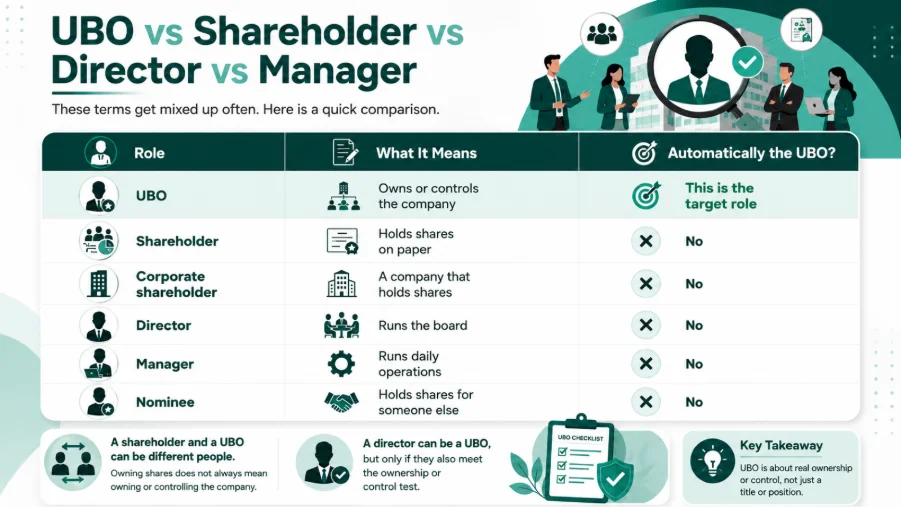
An ultimate beneficial owner is the real person who owns or controls a company. A UBO is always a human being. It is never a company or a trust.
What Does Ultimate Beneficial Owner Mean?
A person is your UBO if they meet any one of these tests.
- They own 25 percent or more of the shares, directly or through another company.
- They hold 25 percent or more of the voting rights.
- They can appoint or remove most of the directors.
Indirect ownership counts too. If someone owns a holding company and that company owns your UAE firm, they can still be your UBO.
Who Can Be the Ultimate Beneficial Owner?
A shareholder is not always the UBO. A director is not always the UBO. These are job titles. A UBO comes from real ownership or control. A company cannot be the final UBO either. You trace ownership up until you reach a real person.
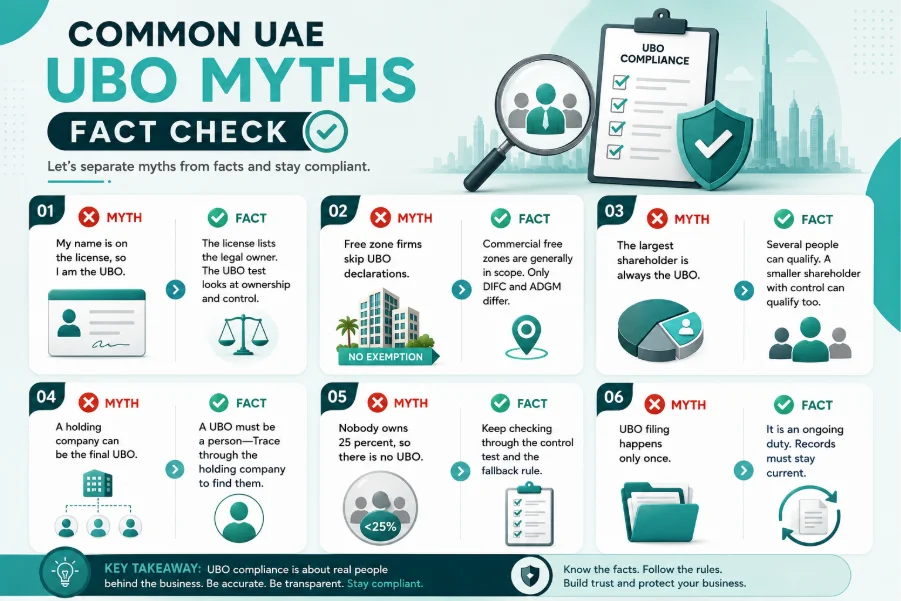
More than one person can be the ultimate beneficial owner in your firm. If several people pass the 25 percent test, you declare all of them.
UAE UBO Rules in 2026: What Businesses Need to Know
The latest regulation is the Cabinet Decision No. 109 of 2023, which came into effect in November 2023. It was an update to the previous Cabinet Decision No. 58 of 2020.
Many blog articles mention the outdated rules from 2020. There were amendments to the way ownership chains were handled under the new regulation.
Penalties fall under a different regulation, which is Cabinet Decision No. 132 of 2023. This will be discussed below.
Federal Rules vs Registrar Procedures
Cabinet Decision No. 109 of 2023 sets the federal principles. It defines a UBO. Your registrar sets the paperwork. Forms and portals differ by authority. Two free zones can give different instructions.
If your firm holds more than one license, treat each one separately. Filing with one authority does not cover the other, which is why keeping your trade license and company formation records aligned across each entity matters.
Who Needs a UBO Declaration in the UAE?
Most mainland companies and companies in commercial free zones need a UBO declaration. This covers single-owner LLCs and firms owned by other companies.
Government-owned entities are usually treated differently. DIFC and ADGM run their own separate rules. Confirm your exact status with your own authority.
UBO Declaration for Mainland Companies
Mainland firms file through their Department of Economic Development or the equivalent body, the same authority that oversees your mainland company formation in the first place.
UBO Declaration for UAE LLCs
Your UBO declaration for a company in the UAE depends on your structure.
- One owner with 100 percent: usually the simplest case.
- Multiple shareholders: anyone at 25 percent or above must be named.
- Corporate shareholders: trace to the real people behind them.
- Owner and manager as one person: the test still looks at ownership and control.
UBO Declaration for Free Zone Companies
A UBO declaration for a free zone firm follows the same core rules as those for mainland firms, whether you registered through DMCC, IFZA, or another free zone company formation route. But each free zone runs its own portal.
Being in a free zone does not exempt you. Only DIFC and ADGM run separate rules, and it is worth noting this obligation sits apart from your free zone corporate tax qualifying status, since the two are assessed independently.
Branches, Offshore, and Dormant Companies
A company that never traded may still need a UBO filing. Licensing status triggers the rule, not trading activity. Offshore firms are usually in scope too, including those set up through a offshore company formation structure. The exact process depends on the registering authority. Confirm your status directly.
How to Identify the Ultimate Beneficial Owner
Here is a clear way to work through the process of identifying ultimate beneficial owner status.
Step 1: Check Direct Ownership and Votes
Start with your shareholder register. Anyone at 25 percent or more, in shares or votes, is a likely UBO.
Step 2: Trace Indirect Ownership
If a shareholder is a company, keep tracing. Go up until you reach a real person. Example: a person owns a holding company. That company owns your UAE firm. The person is declared, not the holding company.
Step 3: Check Control
Ownership is not the only test. A person with less than 25 percent can still be a UBO if they control board appointments or key decisions.
Step 4: What If Nobody Owns 25 Percent?
Picture five shareholders, each at 20 percent. Nobody crosses the line on paper. Do not stop there. Check control next. If one person controls board votes, they become the UBO. If nobody passes either test, the senior manager becomes the UBO by default. Simple order: ownership first, then control, then senior management last.
Real UBO Examples for UAE Companies
One Person Owns 100 Percent
The simplest case. The sole owner is almost always the UBO.
Two People Own 50/50
Both pass the 25 percent test. Both get declared.
Four People Own 25 Percent Each
All four meet the line exactly. All four should be declared.
Five People Own 20 Percent Each
Nobody crosses 25 percent alone. Check control next. If control is shared too, the senior manager becomes the fallback UBO.
A Company Owns the UAE Firm
The direct shareholder is a company, not a person. Trace up to the real owner behind it. This applies even when the parent company is based abroad.
Multi-Layer Ownership
Some structures stack three or four firms before reaching a person. Trace every layer. An ownership chart keeps this clear.
Control Without Large Ownership
A small shareholder with veto rights can still be UBO through control.
Nominee Shareholder Structure
Where a nominee holds shares for someone else, the real person is declared. Not the nominee.
How Is Indirect UBO Ownership Calculated?
Multiply the ownership share at each layer of the chain.
Example: Person A owns 60 percent of Company B. Company B owns 50 percent of your UAE Company C. Multiply 60 by 50 percent. Person A holds 30 percent indirect ownership in Company C. That crosses 25 percent. Person A is a UBO.
This math shows economic ownership. It does not finish the job. Check control rights too. Control can exist without matching ownership.
What Is a Self-Declaration of UBO?
A self-declaration of UBO is when your own firm names its UBOs and reports them. The duty sits with you, not the government.
Can You File It Yourself?
For a simple case, such as a single owner at 100 percent, many owners file it themselves. For a complex case, get help. This applies to corporate shareholders, a foreign parent, several layers, or a nominee arrangement, and this is exactly where structured due diligence support earns its keep. You do not need to pay someone for a one-owner firm. You gain more once ownership stops being one clean line.
What Information and Documents Are Required?
Exact needs vary by registrar. Treat this as a guide for UBO declaration documents for UAE filings.
Information About the UBO
- Full legal name and nationality
- Date and place of birth
- Residential address
- Passport or Emirates ID details
- The basis for UBO status: ownership, votes, or control
- The exact percentage held
Documents by Ownership Type
Individual owners provide a copy of their passport and proof of address. Corporate shareholders provide a trade license and shareholder register. Foreign shareholders often need translated or attested documents. Layered structures benefit from an ownership chart.
UAE UBO Declaration Process: Step by Step
Follow this order for your UAE UBO declaration process.
- Confirm your entity is within scope.
- Review your current ownership.
- Trace direct and indirect ownership.
- Review voting rights and control.
- Name every qualifying UBO.
- Collect the required information.
- Prepare your supporting documents.
- Identify your correct registrar.
- Complete the declaration.
- Submit it through the right channel.
- Keep your proof of submission.
- Maintain and update your records.
Can You File Online in the UAE?
Yes, in most cases. Many authorities allow UBO declarations to be submitted online via the UAE portal. There is no single UAE-wide portal. Your channel depends on your registrar and emirate. Confirm the current process with your own authority.
Where Do You Submit Your UBO Declaration?
Mainland firms file through their local Department of Economy. Free zone firms file through their respective free zone’s portal, such as DMCC, IFZA, or JAFZA. Every emirate runs its own systems under the same federal law.
Simple process: check your trade license for the issuing authority, find its UBO service, confirm its forms, then file.
Mainland vs Free Zone Filing: What Differs?
Core rules stay the same everywhere. The 25 percent test, the control test, and the fallback rule apply to all. What changes is the registrar, the portal, and the forms. Do not assume one free zone matches another.
What Is the UBO Declaration Deadline in the UAE?
There is no single deadline for every firm. Treat any blanket date online with caution. Your UBO declaration deadline in the UAE depends on your own case.
New firms usually handle this at registration. Existing firms should already have current records. Many authorities also check UBO status at license renewal, so it is worth reviewing your position whenever your trade license renewal comes around. Confirm your own authority’s exact practice.
Is UBO Declaration a One-Time Requirement?
No. This is a common mistake. Filing once at setup does not close the matter. UBO compliance runs on and on. Keep your records accurate. Watch for changes. Update your filing when something shifts.
When Must UBO Information Be Updated?
Several events trigger UBO change reporting duties in the UAE.
- A share transfer or new shareholder
- A change in ownership percentage
- A new corporate shareholder
- A change in who controls the firm
- Restructuring, acquisition, or merger
- A new passport or identity change
- A change of address
- A UBO’s death or replacement
Authorities usually expect updates within a short window. This is often cited as around 15 days. Confirm the exact figure with your own registrar.
What UBO Records Must UAE Companies Maintain?
A declaration is not the same as a maintained record. Firms should keep three registers current.
- Beneficial owner register, listing every UBO.
- Partners or shareholders register, listing all legal shareholders.
- Nominee information, where one exists.
A declaration is what you submit. A register is what you keep updated on your own, over time.
Is UBO Information Public in the UAE?
The registrar and relevant authorities hold UBO records. They are not open for public search. Access is limited to regulators. Confirm details with your own registrar if this is a concern.
How Much Does UBO Declaration Cost in the UAE?
There is no single UAE-wide fee. Be careful of any flat UBO declaration cost UAE figure you see online.
Costs can include an authority fee, professional review, document prep, and translation. A one-owner firm costs far less to review than a firm with several ownership layers.
What Are the UBO Declaration Penalties in the UAE?
Penalties sit under Cabinet Decision No. 132 of 2023. This sets a step-by-step schedule, not one flat fine.
Violations include failing to keep accurate records, missing the reporting window, filing wrong details, or ignoring an authority request, which is the kind of exposure a regular compliance audit is designed to catch early.
The usual pattern starts with a written warning. Fines rise for repeat violations. A license suspension may follow in serious cases. Not every mistake draws the top fine. Confirm current figures with your own registrar.
What If You Filed the Wrong UBO?
This happens more than you might think. A former adviser may have named a company rather than a person or missed a second UBO.
- Review your existing declaration.
- Compare it with current ownership.
- Check control rights too.
- Name the correct UBO or UBOs.
- Gather your evidence.
- Check your registrar’s amendment process.
- Submit the correction.
- Keep proof of the fix.
Get advice if things are unclear.
What If You Missed the Deadline?
If you never filed, or your details are old, deal with it now. Do not wait for renewal. Late filing is usually possible. Fixing it quickly is preferred to leaving it unresolved.
What Should You Do After a Compliance Request?
First, confirm the request is real and identify the authority behind it. Check the response deadline, then review your existing declaration and compare it with current ownership. Review your beneficial owner register and gather the requested evidence. Fix any gaps through the proper process and get help if the structure is complex.
How Dubai Business & Tax Advisors Can Help
Dubai Business & Tax Advisors works with UAE firms on these exact questions. This ranges from a simple single-owner LLC to a layered structure with a foreign parent.
DBTA can help with UBO checks, ownership chain analysis, document review, ownership charts, filing support, register review, and fixing old records.
If you are unsure who your UBO is or how your structure should be reported, Dubai Business & Tax Advisors can guide you on your next steps.
Talk to Dubai Business & Tax Advisors
If you are unsure who your UBO is, or your structure has grown complex, Dubai Business & Tax Advisors can review your position and guide your next steps.
Contact Dubai Business & Tax Advisors for UAE UBO compliance and filing guidance built around your own company.
Frequently Asked Questions
If you have an entity incorporated in the UAE, then most likely you will be required to appoint and identify your Ultimate Beneficial Owner regardless of whether you are operating in the mainland of the UAE or a Free Zone area, unless you are exempted from that requirement based on a certain exemption. However, the process is not generic, and it varies depending on your licensing authority.
Simply put, what does a UBO Declaration tell you? Who is the real boss of the company behind all those layers of holding companies? This piece of information gives the name(s) of the real person(s), which can be used to show who the actual owners of the company are. The UAE wants this for transparency.
First, you need to identify the UBOs, which is not always an easy task; it becomes particularly difficult in cases of ownership layers. After identifying them, you will be required to gather the necessary information and file it at your licensing body or registry. It is important to note that the requirements of the paperwork in terms of the forms and portal are not necessarily alike; what is required by the free zone differs from the mainland.
Overall, this is a matter of the basics, such as the full name of the UBO, their country of citizenship, the date of birth, address of residence, passport/ID information, and an explanation of how he controls the business. Should any additional corporations be in the ownership chain, then additional documents will be required.