
UAE Free Zone 0% Corporate Tax: Your Guide to Qualifying Rules and Filing

Recent Insights
Table of Contents
The UAE built its name as a top spot for global business partly by keeping its Free Zones tax friendly. Since June 2023, the country has run a federal Corporate Tax system. Most businesses pay 9% on profits above AED 375,000. Free Zones still offer a 0% rate on qualifying income, and the government has kept that promise alive.
But here is the catch. That 0% rate is no longer automatic just because your company sits in a Free Zone. You now must earn it, and prove it, year after year.
The tax authority calls a business that meets all the rules a Qualifying Free Zone Person, or QFZP for short. If your company misses even one condition, you can lose that status. And when you lose it, the loss is not just for one year. It can apply for the current period plus the next four years, with tax charged on your full income at 9%.
This guide walks through what it takes to qualify, what trips businesses up, and why filing a corporate tax return every year is non-negotiable, even if your bill is zero.
Who Gets 0% Corporate Tax and Who Doesn’t
Every juridical entity registered in a Free Zone is treated as a taxable person by default. That single change ended the old idea that Free Zone companies simply sit outside the tax net. Every one of these entities is now part of the same federal system as mainland businesses.
The 0% rate is not a blanket exemption. It is a reward reserved for entities that qualify as a QFZP and keep that status through ongoing compliance.
What Is a QFZP
A QFZP is a Free Zone company that meets a strict set of conditions covering real business substance, the type of income it earns, and its record keeping. Only a QFZP can apply the 0% rate to its qualifying income.
Meeting these conditions is not a one-time check box. The tax authority expects proof, and that proof needs to hold up every single year.
What Qualifies for 0% Corporate Tax
The 0% rate only applies to what the law calls Qualifying Income. In plain terms, this usually means:
- Income earned from other Free Zone companies, where that company is the true beneficiary of the deal
- Income from specific approved activities carried out with clients outside the Free Zone, including mainland UAE or overseas clients
What Gets Taxed at 9%
Anything that falls outside Qualifying Income gets taxed at the standard 9% rate. This includes income from activities the law excludes, such as certain sales to individuals or income from non-commercial property. It also includes your entire taxable income if you fail the De Minimis test, which we cover below, or if you lose QFZP status altogether.
Every Free Zone Company Must File
Here is the part many business owners get wrong. Whether or not your company expects to pay 0% Corporate Tax, you still must register with the Federal Tax Authority (FTA) and file a return every year.
This applies to every Free Zone entity, including those that fully qualify for the 0% rate. Filing your return is how you formally tell the FTA that you meet the rules. Skipping it is not an option, and the penalties for skipping it are real.
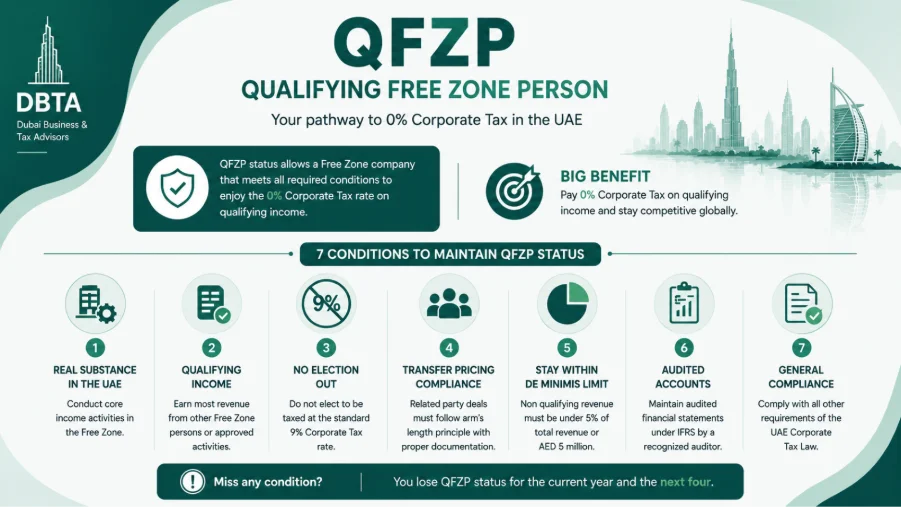
The Seven Conditions Behind QFZP Status
To count as a QFZP, your Free Zone entity needs to tick every one of these boxes throughout the tax year.
Real substance in the UAE: Your core income generating activities need to happen inside the Free Zone, backed by the right staff, assets, and spending.
Qualifying income: Most of your revenue needs to come from other Free Zone companies or from a short list of approved activities.
No election out: You must not have chosen to be taxed at the standard 9% rate instead.
Transfer pricing compliance: Deals with related parties need to be priced as if they were between strangers, and you need paperwork to back this up, following the same transfer pricing principles that apply across the UAE tax system.
Staying under the De Minimis limit: Your non qualifying revenue must stay below a set threshold, explained fully further down.
Audited accounts: You need financial statements prepared under international accounting standards (IFRS) and properly audited.
General compliance: You also need to follow every other rule set out in the Corporate Tax Law.
Why Nothing Here Is Guaranteed
These seven conditions work together, not apart. Proving you have real substance backs up your income claims. Your audited accounts back up your substance claims. It is a single, connected system, and slipping on any one piece can undo the rest.
Miss just one condition, and you lose the 0% Corporate Tax rate for the current year plus the next four. That is why ongoing monitoring matters so much. A business that qualified last year is not automatically safe this year.
Keeping Real Substance in the Free Zone
Substance rules exist to stop people from parking passive income in a Free Zone without doing any real work there. To pass, your company needs three things in place, all sized to match how big your operations are.
- Assets that match what your business needs to run
- Qualified, full-time staff who are physically based in the Free Zone
- Spending on operations that reasonably reflects the scale of the work
If part of your core activity is outsourced, you still need to show you are supervising and controlling it from the Free Zone. That means keeping records that prove key decisions are made locally, not just signed off from a distance.
Audited Accounts and Related Party Deals
Your company must prepare and keep audited financial statements, usually under IFRS. This is what proves, on paper, that your substance and your income are what you say they are.
You also need to follow the arm’s length principle for any deals with related parties and keep documentation ready to show it. This is one of the easier rules to overlook, and one the tax authority checks closely.
Keep Your Records for Seven Years
Whatever helps prove your QFZP status, from contracts to payroll records to audit reports, needs to be kept for seven years. This applies across the board, not just to financial statements.
What Counts as Qualifying Versus Excluded Activities
The law spells out which activities generate Qualifying Income and which ones automatically create what is called Non-Qualifying Revenue.
Activities That Usually Qualify
- Manufacturing or processing goods
- Holding shares or securities as an investment
- Owning or operating ships and aircraft, including related leasing and financing
- Regulated reinsurance and fund or wealth management
- Headquarters, treasury, or financing services provided to related companies
- Distributing goods from a Designated Zone
- Logistics work, such as warehousing and customs paperwork
- Income from qualifying intellectual property
Activities That Are Excluded
- Deals with individuals, with a few narrow exceptions
- Regulated banking, insurance, financing, and leasing services
- Owning non-commercial property, unless it is commercial property in a Free Zone leased to another Free Zone company
- Owning intellectual property that does not meet the definition of qualifying IP
Any income tied to a permanent establishment inside or outside the UAE is automatically taxed at 9% too, and it does not count as qualifying income.
The De Minimis Rule, and Where Companies Lose 0%
Even a well-run QFZP can pick up a small amount of non-qualifying income by accident. The De Minimis rule gives you some breathing room here, but the ceiling is tight.
Your non qualifying revenue must stay below whichever of these two numbers is lower.
- 5% of your total revenue for the year
- AED 5,000,000
If you go over that limit, even slightly, you lose QFZP status straight away, and you stay disqualified for five years in total.

Common Ways Companies Cross the Line
- Signing one new high value deal with a mainland individual without realising it counts as excluded income
- Missing non qualifying property income buried in the accounts
- Running accounting systems that cannot track non qualifying revenue in real time, so problems only surface at year end
Mixed Free Zone and Mainland Income
Plenty of Free Zone companies also want to sell into the mainland market. The rules allow this through something called a Domestic Permanent Establishment, or DPE.
If your company has a real presence on the mainland, perhaps through a branch, that presence is treated as a DPE. Income tied to it is taxed at 9%, but usefully, it does not count toward your De Minimis calculation. This means you can serve mainland clients through a proper DPE structure without putting your Free Zone tax status at risk.
Simply invoicing non qualifying mainland work directly from your Free Zone entity is riskier. That income does count toward the De Minimis test, and it is one of the easiest ways to trip the threshold by accident.
If mainland work is a small, occasional part of your business, keep it inside the Free Zone entity and monitor it closely. If it is becoming a bigger part of your revenue, a separate mainland branch or subsidiary is usually the safer route.
Filing Deadlines and Penalties
Registering with the FTA through the EmaraTax portal is required for every Free Zone company, no matter what your tax bill looks like. Missing the registration window can cost you AED 10,000.
Your return, and any tax owed, is due nine months after your financial year ends. For a business with a financial year ending 31 December 2025, that means filing by 30 September 2026.
Filing late costs AED 500 per month for the first 12 months, then AED 1,000 per month after that. These charges apply automatically, even if your company owes no tax at all. On top of this, unpaid tax now attracts interest of 14% a year, charged monthly, with no cap.
Every QFZP, including those paying 0% on all their income, still needs to file. Your return is the formal proof to the FTA that you meet the conditions and deserve the rate you are claiming.
Why Free Zone Companies Get Audited More Often
Free Zone companies tend to draw more attention from the FTA than standard mainland businesses. Part of the reason is simple. If a QFZP loses its status, the potential back tax recovery, going back over several years at 9% on worldwide income, can be significant.
Auditors tend to focus on a few things.
- Non qualifying revenue sitting close to the 5% or AED 5 million limit
- Low staffing or spending that does not match reported revenue
- Mismatches between what is reported for corporate tax, VAT, and in the audited accounts
- Late registration or late filing
Expect the FTA to ask for segregated accounting records, contracts, audit reports, payroll evidence, and transfer pricing documentation if they come knocking.
How to Protect Your 0% Status
Staying compliant is mostly about building good habits early, rather than scrambling at year end.
Structure mainland deals carefully. If a deal does not qualify, route it through a proper mainland branch or subsidiary rather than invoicing it straight from the Free Zone.
Tag every invoice. You do not need entirely separate financial statements for each income type, but your accounting system should let you sort qualifying from non-qualifying revenue easily and at any time.
Keep substance evidence current. Make sure your staffing and spending levels are documented and clearly match the scale of your income.
Check your numbers often. Review your De Minimis position every quarter rather than waiting until year end, so nothing sneaks up on you.
How DBTA Can Help
Given how much is riding on this, from a five-year lockout to real tax bills, getting expert advice early makes sense. Dubai Business & Tax Advisors helps Free Zone businesses work through the qualifying rules for their specific activities, structure mainland dealings properly, and keep the right paperwork ready for the FTA.
If you would rather not risk losing your 0% status over a small oversight, get in touch with our team for a full compliance and audit readiness review.
Conclusion
The days of assuming Free Zone status means automatic tax exemption are over. The 0% rate is still very much available, but it comes with real conditions attached: genuine substance, clean income tracking, careful management of the De Minimis limit, and mandatory annual filing.
The De Minimis rule is where most businesses slip, because it only takes one wrongly classified invoice to breach it, and the fallout runs for five years. Treat your non qualifying revenue and substance metrics as something to check every quarter, not something to think about once a year.
Frequently Asked Questions
Yes. Every Free Zone entity must file annually, even those paying 0%. Filing is how you prove you meet the qualifying rules.
Your non qualifying revenue must stay below whichever is lower, 5% of total revenue or AED 5 million. Going over either limit is the biggest risk to your 0% status.
You lose QFZP status immediately. The standard 9% rate applies to all your profits, retroactively, and you stay disqualified for five years.
Only if it comes from a non-qualifying activity, like general consulting or retail sales to individuals. That income also counts toward your De Minimis limit, so it is worth watching closely.
For businesses with a lot of non-qualifying income already, electing the 9% rate can be simpler and more stable than chasing QFZP conditions and risking a five-year disqualification.
Latest news & articles


About the Author:
AURANGZAIB CHAWLA
As CEO of DBTA, Aurangzaib Chawla advises globally mobile businesses and individuals on cross-border tax planning and structuring. With expertise spanning the UK, UAE, and wider GCC, Zaib helps clients minimise double taxation, protect assets, and achieve long-term financial efficiency while staying fully compliant.
Planning to launch in Dubai or the UAE?
Let’s talk about how to structure your business for growth the smart, compliant, and tax-efficient way

About the Author:
AURANGZAIB CHAWLA
As CEO of DBTA, Aurangzaib Chawla advises globally mobile businesses and individuals on cross-border tax planning and structuring. With expertise spanning the UK, UAE, and wider GCC, Zaib helps clients minimise double taxation, protect assets, and achieve long-term financial efficiency while staying fully compliant.
Planning to launch in Dubai or the UAE?
Let’s talk about how to structure your business for growth the smart, compliant, and tax-efficient way
About the Author:
AURANGZAIB CHAWLA

As CEO of DBTA, Aurangzaib Chawla advises globally mobile businesses
and individuals on cross-border tax planning and structuring. With expertise spanning the UK, UAE, and wider GCC, Zaib helps clients minimise double taxation, protect assets, and achieve long-term financial efficiency while staying fully compliant.
Planning to launch in Dubai or the UAE?
Let’s talk about how to structure your business for growth the smart, compliant, and tax-efficient way.
Connect with Reliable Dubai Business Consultants
Get in Touch