


Most people search for a UAE partnership agreement template to run into the same trap. They find articles still saying a UAE national must own 51% of your business. That rule is gone. It changed in 2021. Federal Decree-Law No. 32 of 2021 now allows full foreign ownership in most sectors. Some rare cases still limit this. But the old 51% rule no longer applies across the board.
Bad advice here causes real harm. People build their whole structure around a rule that no longer exists. They find out too late when a lawyer reviews the deal.
The Arabic Translation Requirement Nobody Mentions
There is a second thing most articles miss. Even a clean, well-written agreement may not hold up in the UAE. If the document is in English, it needs legal translation into Arabic. A certified legal translator must do this, not an app. The Arabic version is what UAE courts rely on. The English copy is a backup only.
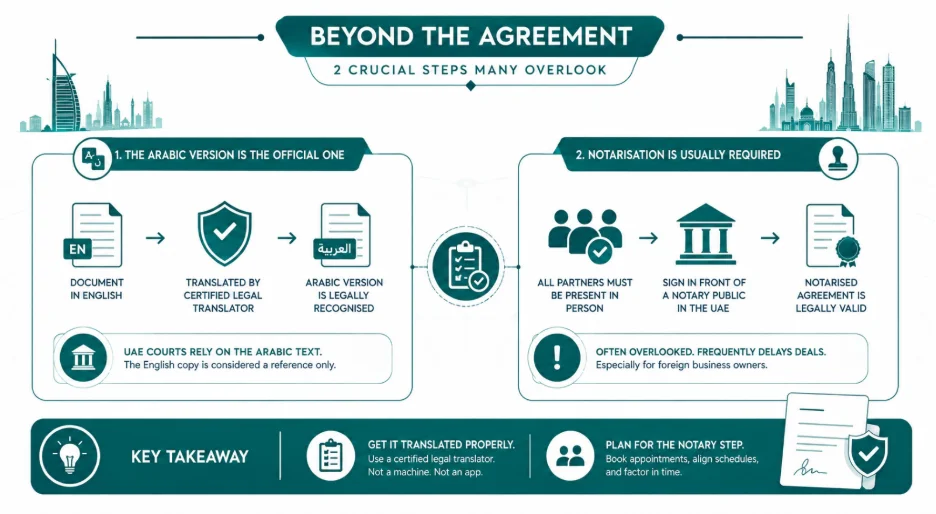
Most mainland agreements must also be signed before a notary. All partners need to attend in person. This step catches many people by surprise, mostly those running their business from overseas.
What a Partnership Agreement Actually Does
A partnership agreement is a binding contract between two or more people who agree to run a business together. It sets out who owns what, who decides what, and who gets paid for what. It also covers what happens if things go wrong or a partner wants to leave.
In the UAE, this document is not just smart practice. For most business types, you need it before you can get a trade license. The Department of Economic Development or the free zone body needs a notarized paper before it approves your filing.
If you are still working out which business type fits your goals, it helps to understand the full company formation and trade license management process before you draft anything.
UAE Law Changed. Your Template Probably Did Not.
The UAE has a clear legal setup for partnerships. Federal Decree-Law No. 32 of 2021 covers mainland firms. This law was updated again by Federal Decree-Law No. 20 of 2025. Free zones each run under their own rules. DIFC follows its own law. ADGM has its own company rules. A sample pulled from a UK or US legal site will almost never fit.
It is not just about having a form. You need the right form for your setup and your zone. A free zone firm’s agreement looks quite different from a mainland one. Getting them mixed up leads to delays and rejected filings. Banks in the UAE also check this document closely. A poorly drafted agreement can slow down or block your bank account opening.
Business Partnership Agreement Template Download
General Partnership vs. Limited Partnership
There are two core types of partnerships in the UAE.
The first is a general partnership. All partners share control and each is personally on the hook for what the business owes. If the firm has debts, those can come after personal savings.
The second is a limited partnership. One partner runs things and holds full personal risk. The others put in money but stay out of day-to-day choices. Their risk is capped at what they invest. Most small firms go with an LLC setup instead, which limits personal risk without the added steps.
Mainland Agreements: What the Rules Say Now
For mainland firms, the partnership agreement is often part of the Memorandum of Association, or MoA. This is true for LLCs in most cases. The MoA acts as the partnership agreement for these setups. It spells out shares, roles, and how the firm is run.
Since 2021, foreign investors can own 100% of a mainland firm in most sectors. A few fields, such as defense and certain energy trades, may still need a UAE partner. Your business type decides this. A firm doing general consulting or trading is most likely eligible for full foreign ownership. Always check your exact trade code before you assume.
Under Decree No. 13 of 2024, agreements must now be filed through a unified digital window. Notary signing is still required for most mainland setups.
If you are setting up on the mainland, learn how Dubai mainland company formation works before you prepare your MoA.
Free Zone Agreements: A Different Set of Rules
Free zone firms have their own rules. Each zone has its own body and its own requirements. The DMCC, DIFC, and Meydan Free Zone each operate differently. In free zones, 100% foreign ownership has always been the norm. You still need a formal written agreement between partners, and the zone body will ask for it.
The agreement must fit the rules of that exact zone. Some allow multi-owner FZCOs. Others have their own preferred forms. Never assume one free zone sample works for another zone. Each one is governed by a different set of rules.
Choosing the right zone matters. A full overview of Dubai free zone company formation can help you pick up the structure that fits your activity before you draft partner documents.
What Your Agreement Must Include
A legally sound UAE partnership agreement must cover several key items.
Partner Details and Capital
Start with full legal names, home countries, and passport numbers for each partner. Errors here will cause problems during the notary step.
State what each partner puts in: cash, assets, know-how, or skills. Also state how future funds will work if the firm needs more capital later.
Profit Splits and Management Rights
Set out how profits and losses are shared. Even if you agree on a 50/50 split, write it down. The split does not have to match the ownership’s share, but it must be clear. UAE law expects this to be written down even if partners have spoken about it.
Define who runs the firm day to day. Who signs contracts? Who can open a bank account? Who makes hiring calls? UAE banks will ask for this. Be exact about who has what power.
Decision-Making and Dispute Resolution
Set clear rules for decisions. What calls are needed for all partners to agree? What can one partner do by oneself? This stops the deadlock. Be clear about what triggers a vote and what the threshold is for big moves like taking on debt or bringing in a new partner.
Name how disputes are handled. UAE courts are one option. Many firms prefer a third-party process instead. The Dubai International Arbitration Centre is a common choice. Your agreement should name the forum and the law that governs.
Clauses That Are Often Left Out
Non-Compete and Secrecy Terms
Add a non-compete clause. This stops a partner who leaves from starting a rival firm right away. These terms are valid in the UAE when written in the right way. Generic forms often get this wrong.
Add a secrecy clause too. This protects business data if a partner walks away. Include it even if you trust your partners now. Things change.
Buyout Plans and Succession
Include a buyout plan. What happens when one partner wants to leave? How is their share valued? Who gets the right to buy it? Without a clear plan here, a messy fight over value is almost certain to follow.
Cover death and illness too. If a partner dies, what happens to their share? Can their family step into the role? Your agreement must answer this question. If it does not, UAE law decides for you, and that result may not be what any of you intended.
A business valuation done properly can make the buyout calculation far less contentious when the time comes.
How to Write a Partnership Agreement in the UAE
Start by listing your business activities. The agreement must name all approved activities. These must match the codes on your trade license. If an activity is not listed, it may not be covered under your license.
Next, confirm your zone type. Mainland or free zone? Each has different rules for notary signing, language, and filing. Getting this wrong early creates delays at every step that follows.
The Steps to Get It Done
Work with a lawyer or a qualified advisor before you finalize anything. This is not a form to download and fill in quickly. A mistake in the profit-split clause or the dispute section will cost you later.
Get the document translated if needed. Use a certified legal translator, not an app. The DED and UAE courts only accept certified translations.
Get the document signed before a notary. All partners must show up in person. Bring passports and any required company papers. This step cannot be skipped for most mainland setups.
Then submit the signed document to the DED or the free zone body as part of your filing. Proper licensing and PRO services support can make this submission stage much smoother, especially for overseas partners who are unfamiliar with the process.
What a Sample Partnership Agreement Format Looks Like
A basic UAE partnership agreement format has these parts in order:
- The opening, which names the parties and states the date
- Business details, including the trade name and approved activities
- What each partner contributes and what they own
- How profits and losses are split
- Who manages the firm and how decisions are made
- The rights and duties of each partner
- Secrecy and non-compete terms
- How a share is sold or handed on
- How disputes are handled
- How the firm closes down
- Which law governs, which is UAE federal law
You can find model sample forms online as a starting point. Always have one checked by a lawyer who knows UAE business law before you use it. Free forms are a draft, not a done deal. The clause missing from a free form is often the one that matters most to you.
When You Need to End a Partnership
A partnership closing agreement covers the end of a business. This can happen by choice or by court order. Building a close-down clause into your first agreement is the smartest move. It takes the guesswork out of things later.
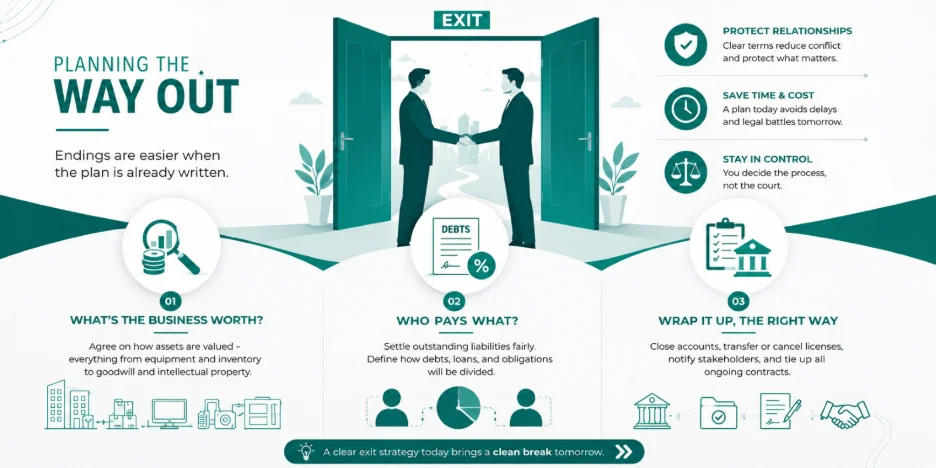
A solid close-down clause covers three things: how the firm’s assets are valued, how debts are split between the partners, and what happens to licenses, bank accounts, and open contracts. Skip this now and you will pay for it when things get tense and the firm is winding down.
Strategic Partnership Agreements Are a Different Thing
Some people looking for a strategic partnership agreement sample want something very different. This is a joint-work deal between two separate firms. It does not create shared ownership. It sets out how two firms will work together on a project or in a new market. The scope, the money split, and the exit terms all need to be clear. Do not leave these to a vague, one-page letter of intent.
These deals do not need the same notary process as a legal business partnership. But they still need careful drafting. Include the scope of the joint work, how any money is split, who owns any new ideas or products that come out of the work, and how the deal ends. Do not mix this up with a legal business partnership. They serve very different ends.
Getting the Right Help
If you are setting up a firm in the UAE or changing an existing one, the partnership agreement is the base everything else rests on. Getting it right from the start saves time, money, and conflict.
Dubai Business and Tax Advisors helps firms across mainland and free zone setups with company formation, MoA drafting, and the full licensing process. If you need a properly built agreement that fits UAE law, their team works through every detail with you. Their tax and compliance advisory services also ensure your structure holds up not just at formation, but as the business grows.
Frequently Asked Questions
Yes, for most mainland setups. Free zone rules vary by zone. Always check with the exact body that governs your zone.
In most sectors, yes. Federal Decree-Law No. 32 of 2021 allows full foreign ownership in many trade types. Some fields may still need local input.
No. The UAE requires the agreement to be written down for filing and legal use.
Use it as a starting point only. Do not submit it without review by a lawyer who knows UAE law. Free forms rarely meet the full language, format, and clause rules needed for notary approval.
Often one to three business days once all papers are in order and all partners can attend.
Your agreement should define this. If it does not, UAE law steps in, and that result may not match what you intended.
Not always. If your first agreement has a clear close-down clause, that is often enough. A separate closing paper is used when partners agree to end things and need to lock in the exact terms at that point.