
RAK ICC Compliance Made Simple: RBR, UBO and Renewals (2026 Guide)

Recent Insights
Table of Contents
RAK ICC Compliance Made Simple: RBR, UBO and Renewals (2026 Guide)
Why RAK ICC Compliance Matters in 2026
UAE rules are now tighter and more clear. Every RAK ICC company must meet set standards each year.
Signing up is not enough. You must stay active, keep records fresh, and follow UAE rules each year.
Staying on track helps your company in:
- Keeping bank accounts open
- Avoiding fines and legal issues
- Building trust with banks and regulators
- Protecting your assets and ownership
The UAE tax law now watches finances more closely. Companies that earn over AED 375,000 must file and keep clear records. The tax authority checks companies more than before.
Banks also check your status before they allow transfers. Old or missing records can block your account.
In 2026, staying on track keeps your company safe, trusted, and ready to grow.
2026 RAK ICC Compliance Snapshot
Here is a quick look at what every RAK ICC company must do in 2026.
| Area | What You Must Do | Due Date | Notes |
|---|---|---|---|
| Annual Renewal | Pay fees and update ID documents. | 30 days before expiry | Required each year |
| UBO Filing | Name the real owner of the company. | Within 30 days of setup or 15 days of any change | Must stay current |
| RBR Filing | File the register of all who own or control the company. | Within 30 days of setup or 15 days of any change | Agent handles this |
| Tax Filing | Sign up for UAE Federal Tax. | Per tax authority dates | Required if it applies |
| Account Records | Keep all finance records for 7 years. | At all times | Must be ready on request |
| ESR Filing | File your economic substance report. | 6 months (notice) and 12 months (report) after year end | Based on your activity |
Is Paying the Fee Enough to Keep Your Company Active?
Many owners think paying the renewal fee is all they need to do. It is not.
The fee is just one part of RAK ICC compliance. Each year, the authority also checks records, ownership, and company details.
Missing records can block your renewal and restrict your account.
Each year, your company must:
- Confirm it is still active
- Update who owns and controls the company
- Keep all records clear and up to date
- Follow all UAE rules
Skip any of these steps and your company may face delays or fines.
Why Does Your RAK ICC Renewal Get Delayed?
Renewal delays happen when checks are not done. Your agent must review the company before renewal can go through.
Your agent must:
- Hold your official address on file
- Keep ownership and legal records fresh
- Check ID and compliance documents
- Send in renewal and compliance filings
If any records are missing, renewal stops. Fix the gaps early to avoid hold-ups.
What Happens If You Skip RAK ICC Compliance?
Skipping compliance creates big risks. Banks may block your account or delay transfers. The authority may also charge fines or suspend your company.
Strong RAK ICC compliance helps you:
- Keep your company’s legal status active
- Use your bank account without delays
- Avoid fines and legal problems
- Protect your business and its good name
Good compliance keeps your company active, safe, and ready to work.
RBR and UBO: What Is the Difference?
Many people mix up theReal Beneficiary Register (RBR) and the Ultimate Beneficial Owner (UBO). Both track who owns a company, but they work differently.
What Is the Real Beneficiary Register (RBR)?
The RBR is a list your agent keeps. It shows everyone who owns, controls, or has power over the company. It is not just for shareholders.
The RBR covers people with:
- Direct or indirect ownership
- Voting rights or decision power
- Nominee ownership roles
- Power of attorney or legal control
- Influence through contracts
The RBR shows who has real control, not just who is named on paper.
What Is the Ultimate Beneficial Owner (UBO)?
The UBO is the real person who gains the most from the company. This person sits at the top of the ownership chain.
A UBO is someone who:
- Owns 25% or more of the shares
- Controls 25% or more of votes
- Has strong power over business decisions
Even in complex structures, the UBO is always the final person in charge.
Why Do These Records Matter?
Clear RBR and UBO records prove your company is open and honest. Banks and regulators need this data to verify who owns the company.
Good records help you:
- Keep your bank accounts active
- Avoid fines
- Meet legal rules
- Build trust with banks
RBR Compliance in 2026: A Simple Step-by-Step Guide
Every RAK ICC company must follow RBR rules. UAE law requires correct ownership records at all times. Your agent runs this process for you.
Step 1: Your Agent Checks Who Owns the Company
Your agent reviews the company each year. They find all real owners. Then they send a notice to confirm the details.
Step 2: Each Owner Confirms Their Details
Each owner must confirm their name, address, and share size. Correct data keeps your company on track. Missing data causes delays.
Step 3: Your Agent Updates the Register
Your agent adds all ownership details to the RBR. This includes start and end dates. Fresh records keep your company in good standing.
Step 4: Your Agent Files the Register with RAK ICC
Your agent sends the register to RAK ICC. This completes the RBR process and confirms your company follows UAE rules.
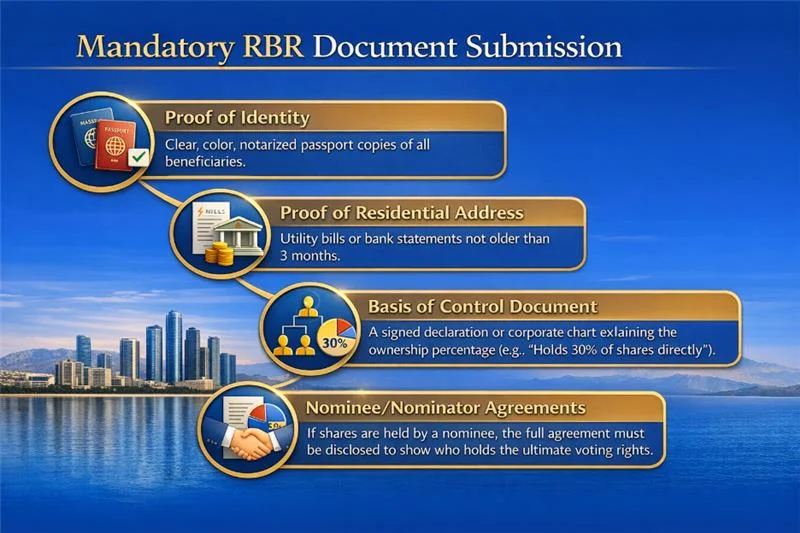
RBR Deadlines and the 15-Day Rule
New companies must file the RBR within 60 days of setup.
Existing companies must update the RBR within 15 days of any change. Changes include new owners, new addresses, or share transfers.
This is the 15-day rule. Your agent updates the record and tells RAK ICC. Stick to these dates to avoid fines.
UBO Compliance in 2026: A Simple Step-by-Step Guide
Every RAK ICC company must name its UBO. This applies to all companies, even complex ones. Your agent manages this for you.
Step 1: Find Anyone Who Owns 25% or More
Check who holds shares. Anyone with 25% or more is the UBO. This includes both direct and indirect ownership.
Step 2: Find the Person in Control
If no one holds 25%, the UBO is the person who makes key decisions. This may be someone who runs day-to-day operations.
Step 3: Use Senior Management if Needed
If no one qualifies above, the top manager steps in. The CEO or Managing Director becomes the UBO. Every company must have a named person on record.
What Data Does a UBO Registration Need?
Your agent needs the following for each UBO:
- Full name
- Nationality
- Date of birth
- Home address
- Copy of passport or ID
All details must be correct and complete.
Keeping UBO Records Up to Date
You must update UBO records when ownership changes. Tell your agent as soon as a change happens. RAK ICC checks records at set times. Late updates may lead to fines.
UAE Resident Contact Requirement
Every RAK ICC company must name a UAE resident contact. This person speaks to the authority on behalf of the company.
You must give a name and a valid Emirates ID copy. Without this, you may face fines. This is a key part of RAK ICC compliance.
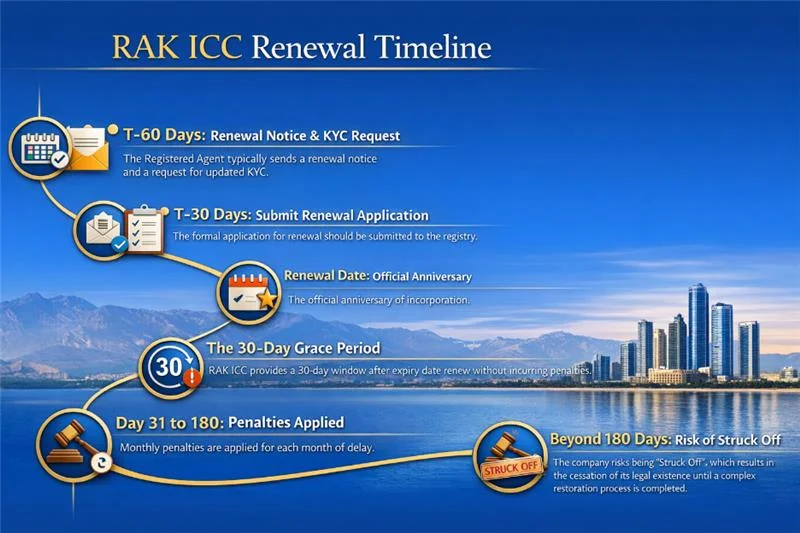
RAK ICC Renewal in 2026: Steps, Dates, and Documents
Renewal is the company’s yearly check-up. A company that does not renew loses its legal status and can no longer use its bank accounts.
Documents You Need for Renewal
What you need depends on your ownership setup. In most cases, you will need:
- Application Form: Signed by the named signatory.
- Updated ID Docs: Valid passport and proof of address (within the last 3 months) for all named people.
- Good Standing Letter: Needed if a corporate body owns the RAK ICC company. This proves that the owner of the company is still active in its home country.
- Board Resolution: A sign-off from the owning company approving the renewal (if the agent requires it).
Fines and Penalties for RAK ICC Non-Compliance
RAK ICC applies strict fines when companies break the rules. These fines protect the UAE financial system.
Common penalties include:
- Written warnings with a fix-by date
- Fines from AED 10,000 to AED 100,000
- Suspension of your company’s active status
Repeat breaches increase fines and risk.
What Happens If Your Company Gets Struck Off?
RAK ICC can strike off companies that do not renew or comply. This removes your company’s legal status.
But owners and directors stay legally responsible. To bring back a struck-off company, you must:
- Pay all missed renewal fees
- Pay fines and restore fees
This takes time and delays your operations.
Banking Blocks Can Happen Fast
Banks track the status of every RAK ICC company. They check compliance before they allow transactions. If your company falls out of line, banks may freeze your account. This can stop payments and block financial activity.
Good RAK ICC compliance helps you avoid fines, account blocks, and business disruptions.
RAK ICC Compliance Checklist for 2026
Use this checklist to keep your RAK ICC company on track all year.
Phase 1: Prep Work (90 Days Before Anniversary)
- Check ID Docs: Look at all shareholder and director passports. Flag any that expires within 6 months.
- Check Activities: Confirm the company activity in your MOA matches what you do in practice.
- Archive Records: Make sure all past-year transaction records are saved and backed up online.
Phase 2: RBR and UBO Review (60 Days Before Anniversary)
- Check UBO: Confirm that no one new has gained 25% or more control since the last review.
- Get Proof of Address: Collect a utility bill or bank statement dated within the last 60 days.
- Check UAE Contact: Make sure your UAE resident contact is still active, and their ID is valid.
Phase 3: Send in the Renewal (30 Days Before Anniversary)
- Instruct Your Agent: Send written approval to your agent to start the renewal.
- Pay Fees: Pay all registry and agent fees before the grace period ends.
- Check Tax Status: Confirm your corporate tax number (TRN) is active.
Phase 4: After Renewal
- Get a Good Standing Letter: Request a new one for your bank and suppliers.
- Tell Your Bank: Let your bank manager know renewal is done. This can stop auto-freeze actions.
Case Study: RAK ICC Compliance in 2026
The Situation
A RAK ICC holding company had a layered ownership setup and an active UAE bank account. It was due for renewal in 2026. The agent found gaps in the RBR and UBO records. The bank also asked for updated ownership proof.
What DBTA Did
Dubai Business and Tax Advisors reviewed the company’s setup and named the correct UBO. The team prepared clear ownership documents and worked with the agent to update the records. All ID and address docs were refreshed to meet both registry and bank needs before renewal.
The Result
The company was renewed on time. The RBR and UBO records passed review with no issues. Banking stayed open and undisturbed.

How DBTA Helps with RAK ICC Compliance
Managing RAK ICC compliance in 2026 takes more than a service provider. You need a partner who knows UAE rules well.
At Dubai Business and Tax Advisors (DBTA), we plan ahead for you. We catch issues before they become problems. That means smoother renewals, cleaner records, and fewer surprises at bank reviews.
FAQ's:
In 2026, RAK ICC compliance covers three main tasks: yearly renewal, keeping RBR and UBO records current, and annual KYC checks through your agent. It is an ongoing duty, not a one-time task.
The RBR process involves naming everyone who owns or controls the company, even if the control is indirect. Your agent keeps and updates this data at renewal or when changes occur.
Your renewal date is based on when your company was set up. Start the process a few weeks early to avoid hold-ups. Last-minute submissions often lead to problems.
Your agent handles all RBR filings. You do not file directly with the registry. The agent collects, checks, and keeps the register as part of your compliance records.
UBO rules focus on naming the real person who owns or controls the company, usually at or above the 25% mark. Even in layered structures, you must name the person at the top.
Review ownership regularly, not just at renewal time. Report any changes, share transfers, new directors, or restructures to your agent quickly, so records stay current.
Missing the date can mark your company as inactive. This can trigger reinstatement delays, extra fees, and closer bank scrutiny. Long delays can harm your company’s legal standing.
You will need: updated IDs for shareholders, directors, and owners; proof of address; and any documents needed for RBR or UBO updates. Extra documents may be required if changes occur during the year.
Late or incomplete RBR records can lead to delays and fines, depending on the case. The bigger risk is disruption. Renewals slow down, banks ask questions, and extra reviews are triggered.
Costs include the registry fee and the agent’s service fee. The total depends on whether updates or extra compliance work is needed. Companies with clean records tend to pay less.
UBO updates are made through the Registered Agent. Whenever there is a change in ownership or control, the updated details must be provided along with supporting documents so the records can be amended accurately.
In most cases, renewal will not be completed until RBR records are in order. The Registered Agent must be satisfied that all compliance requirements have been met before proceeding with the renewal submission.
In most cases, no. Renewal will not go through until RBR records are in order. Your agent must confirm that all compliance tasks are done before proceeding.
A simple checklist covers confirming renewal dates, reviewing ownership, updating KYC docs, checking RBR and UBO records, and keeping account records in order. Start early to avoid last-minute issues.
Failing to comply can lead to delayed renewals, fines, more scrutiny from the authority, and banking issues. Repeated failures can put the company’s future at risk.
Start by reviewing your company setup. Check whether any changes have happened in the past year. Gather your documents early and work with your agent well before the renewal date. Early planning leads to smooth outcomes.
Conclusion
In 2026, RAK ICC compliance is not a once-a-year task. Renewals, RBR records, and UBO filings all work together. They decide whether your company stays active, bankable, and legal.
Small gaps can quickly lead to delays or extra scrutiny. Companies that stay organised and act early face far fewer problems.
RAK ICC offers a strong base for global business. But it only works when you manage compliance with care. A steady, planned approach is the best way to protect your company and keep it running well.
Latest news & articles


About the Author:
AURANGZAIB CHAWLA
As CEO of DBTA, Aurangzaib Chawla advises globally mobile businesses and individuals on cross-border tax planning and structuring. With expertise spanning the UK, UAE, and wider GCC, Zaib helps clients minimise double taxation, protect assets, and achieve long-term financial efficiency while staying fully compliant.
Planning to launch in Dubai or the UAE?
Let’s talk about how to structure your business for growth the smart, compliant, and tax-efficient way

About the Author:
AURANGZAIB CHAWLA
As CEO of DBTA, Aurangzaib Chawla advises globally mobile businesses and individuals on cross-border tax planning and structuring. With expertise spanning the UK, UAE, and wider GCC, Zaib helps clients minimise double taxation, protect assets, and achieve long-term financial efficiency while staying fully compliant.
Planning to launch in Dubai or the UAE?
Let’s talk about how to structure your business for growth the smart, compliant, and tax-efficient way
About the Author:
AURANGZAIB CHAWLA

As CEO of DBTA, Aurangzaib Chawla advises globally mobile businesses
and individuals on cross-border tax planning and structuring. With expertise spanning the UK, UAE, and wider GCC, Zaib helps clients minimise double taxation, protect assets, and achieve long-term financial efficiency while staying fully compliant.
Planning to launch in Dubai or the UAE?
Let’s talk about how to structure your business for growth the smart, compliant, and tax-efficient way.
Connect with Reliable Dubai Business Consultants
Get in Touch