
RAK ICC Foundation vs Company: Which Wins for Succession Planning? (2026)

Recent Insights
Table of Contents
Introduction
For the wealthiest families and business owners across the UAE, the question of “what next” is now not only a deeply personal one but also a fundamentally important business consideration. Succession planning provides the means for your lifetime assets, corporate legacy and family treasures to pass on smoothly from one generation to another, without probate courts, feuding among family members, or the complexities of Sharia-based inheritance distribution (as the UAE does not impose estate or inheritance taxes). Within the Ras Al Khaimah International Corporate Centre (RAK ICC) landscape, there are two main vehicles of discussion, being the RAK ICC Foundation and the RAK ICC Holding Company.
Although both structures provide considerable advantages in terms of wealth management and tax efficiency, they are designed for two very different reasons. The correct selection involves parsing your family dynamics, the location of your global assets, and your long-term aims. Whether you wish to secure a family business or unify overseas investments, getting your head around these structures is the first step on the road to a future-proof legacy.
Quick Answer:
“For long-term governance and control, foundations usually win. For straightforward ownership of specific assets, a holding company is a better fit. Often, the best solution is a foundation owning a holding company, combining the governance of a foundation with the operational ease of a company.”
Understanding the Key Structures for Succession Planning
Before comparing the two, we must define what these legal entities are in the context of the UAE’s evolving regulatory environment in 2026.
What is the RAK ICC Foundation?
A RAK ICC Foundation is an independent legal entity; it acts on its own behalf and has no shareholders or owners. (Can.) It is governed by a Foundation Council (rather than a Board of Directors) and operates according to its Charter and By-laws.
It is designed specifically for governance-driven continuity. In the UAE, foundations are the “gold standard” for multigenerational ownership because they allow a founder to retain control during their lifetime while providing a clear, legally binding roadmap for how assets are managed after they pass away.
What is a RAK ICC Company?
A RAK ICC Company (specifically an International Business Company or IBC) is a more traditional vehicle. It serves as a holding company for shares, private equity, or real estate. Corporate succession is regulated in the Articles of Association and Shareholder Agreements.
While efficient for holding assets, a company can become a liability during succession if the shareholder dies, as shares may be subject to Sharia-governed “forced heirship” rules or lengthy probate, leading to potential freezes on bank accounts and operations.
Leading to potential freezes on bank accounts and operations.
Key Difference Between a Foundation and a Company
The fundamental distinction is their primary “why”:
- A company is primarily a commercial ownership vehicle. It exists to own things and distribute profits to owners.
- A foundation is a governance and continuity vehicle. It exists to ensure that the purpose of wealth, whether that is supporting a family or a charity, is maintained regardless of who is alive or in charge.
RAK ICC
Foundation vs Company (2026)
Watch this short video to see how RAK ICC Foundation vs Company (2026) explained simply in under 60 Second.
A Side-by-Side Comparison: RAK ICC Foundation vs Company
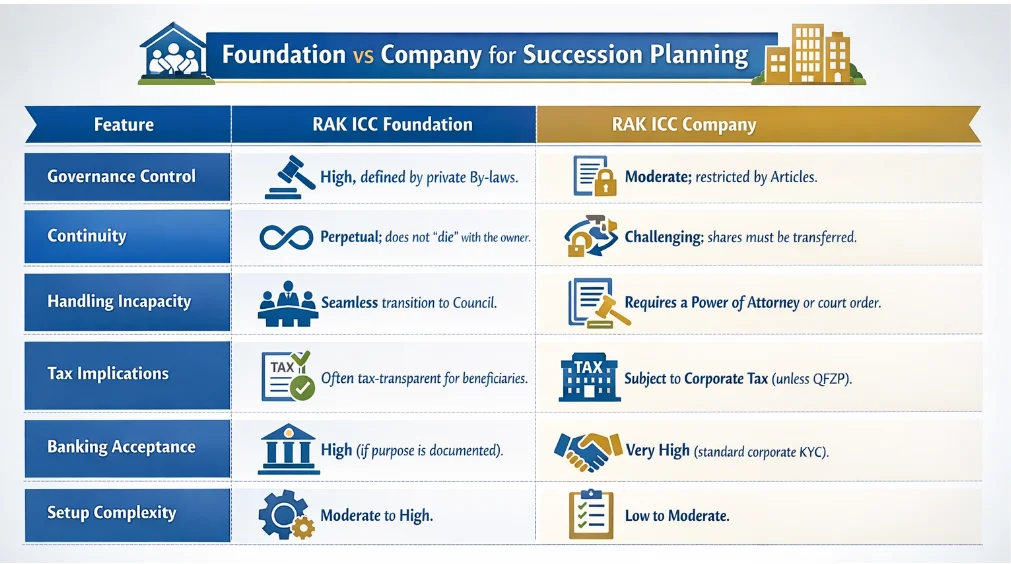
To help you decide, let’s look at how these two stack up against the most common succession planning hurdles.
Foundation vs Company for Succession Planning
| Feature | RAK ICC Foundation | RAK ICC Company |
|---|---|---|
| Governance Control | High, defined by private By-laws. | Moderate; restricted by Articles. |
| Continuity | Perpetual; does not “die” with the owner. | Challenging; shares must be transferred. |
| Handling Incapacity | Seamless transition to Council. | Requires a Power of Attorney or a court order. |
| Tax Implications | Often tax-transparent for beneficiaries. | Subject to Corporate Tax (unless QFZP). |
| Banking Acceptance | High (if purpose is documented). | Very High (standard corporate KYC). |
| Setup Complexity | Moderate to High. | Low to Moderate. |
Mini-table: What Each Structure is Not Ideal For
| Structure | Not Ideal For… |
|---|---|
| Foundation | Not a “quick tax hack” or a way to hide assets from legitimate creditors. |
| Company | Not a complete succession solution for complex family dynamics or blended families. |
How to Choose Between a Foundation and a Holding Company
The decision usually comes down to the complexity of your estate.
When a Foundation Makes More Sense
If you have multiple heirs, a large family business, or high-value assets that need to remain intact, a foundation is the superior choice. It allows you to set “rules of the game, for example, requiring that the family business cannot be sold for 20 years, or that heirs only receive distributions if they meet certain educational milestones. It effectively bypasses the UAE’s default inheritance laws, providing a “firewall” against foreign judgments and forced heirship.
When a Holding Company May Be Enough
A holding company is often sufficient for simpler scenarios, perhaps a single owner with one or two clear heirs and straightforward assets (like a single investment portfolio). If there is little need for complex governance or long-term “rule-setting,” the lower maintenance costs of a company might be more appealing.
The Best of Both Worlds: Foundation + Holding Company
In 2026, the most robust strategy used by Dubai Business and Tax Advisors (DBTA) is a hybrid structure. In this model, the Foundation acts as the ultimate owner (the “Grandparent” entity), and it holds 100% of the shares in a RAK ICC Holding Company.
The Successor Logic: Founder → Foundation (Governance/Legacy) → Holding Company (Asset Ownership) → Operating Companies
This provides the ultimate protection: the Foundation handles the “who and how” of succession. In contrast, the holding Company provides a clean, recognizable entity for banks and external business partners to interact with.
Case Study: The Multi-National Family Office
The Challenge: A founder with assets in the UK, UAE, and India wanted to ensure his three children (living in different time zones) wouldn’t fight over his 10-subidiary business empire.
The Solution: Dubai Business and Tax Advisors structured an RAK ICC Foundation to hold a central Holding Company. The By-laws established a “Family Council” where each child had a vote, but a professional Guardian was appointed to break ties.
The Outcome: The transition was “locked in.” Even if the founder became incapacitated tomorrow, the businesses would continue to run under the pre-agreed rules without a single day of bank account freezing.
Real-World Scenarios: Applying Foundations and Companies
Scenario 1: Family Business with Multiple Heirs
Problem: A founder of a successful logistics firm wants the business to stay in the family, but knows his children have different levels of interest and ability in running it.
Solution: By using a Foundation to own the Holding Company, the founder can appoint the most capable child as the “Managing Council Member” while the other children remain “Beneficiaries.”
Outcome: The business remains a single, unfragmented unit, preventing a “split” that could destroy its market value.
Scenario 2: Probate Disruption and “What Happens If I Die Tomorrow?”
Problem: A serial traveler with substantial real estate investments in Dubai fears that if they die, their holdings will get tied up in the UAE courts for years as part of an inheritance resolution process.
Solution: Moving the properties into an RAK ICC Foundation. Because the Foundation is its own legal person, it doesn’t “die”.
Outcome: The assets are never “part of the estate” for probate purposes, meaning the family maintains access to rental income and property rights immediately.
Scenario 3: Property and Investments with Blended Family Dynamics
Problem: A client has children from a first marriage and a second spouse with younger children. There is high potential for conflict regarding the distribution of a high-value investment portfolio.
Solution: A Foundation allows for rules-based allocation. For instance, the second spouse can be granted “life interest” (income) while the capital is preserved for all children equally later on.
Outcome: Fairness is mandated by the structure itself, reducing the likelihood of legal battles.
Banking and “Real-World Acceptance”
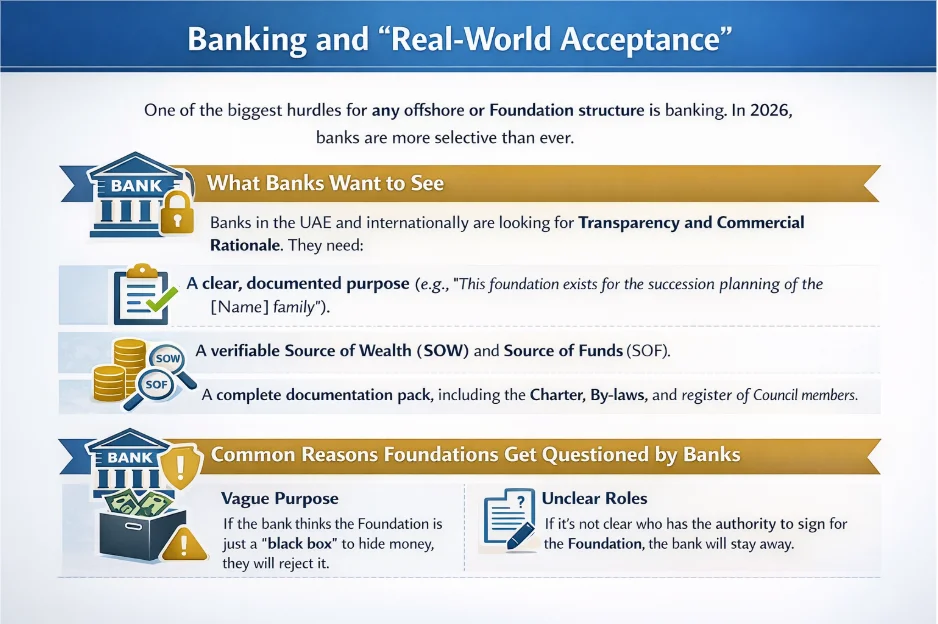
One of the biggest hurdles for any offshore or Foundation structure is banking. In 2026, banks are more selective than ever.
What Banks Want to See
Banks in the UAE and internationally are looking for Transparency and Commercial Rationale. They need:
- A clear, documented purpose (e.g., “This foundation exists for the succession of planning of the [Name] family”).
- A verifiable Source of Wealth (SOW) and Source of Funds (SOF).
- A complete documentation pack, including the Charter, By-laws, and register of Council members.
Common Reasons Foundations Get Questioned by Banks
- Vague Purpose: If the bank thinks the Foundation is just a “black box” to hide money, they will reject it.
- Unclear Roles: If it isn’t clear who has the authority to sign for the Foundation, the bank will stay away.
What’s Changed in Succession Planning in 2025 and 2026
The UAE is no longer a “no-tax, no questions” jurisdiction. The introduction of Corporate Tax and the 2025 amendments to RAK ICC regulations have changed the game.
Recent Changes Families Must Plan For
- Strengthened “Firewall” Provisions: As of 31 July 2025, RAK ICC Foundations have even stronger protections against foreign court orders.
- Three-Year Statute of Limitations: Claims in respect of assets transferred to a foundation are generally time-barred after three years, allowing the dust to settle.
- Corporate Tax Clarity: The Federal Tax Authority (FTA) in the UAE has issued guidance suggesting that foundations are often seen as “Unincorporated Partnerships” or tax-transparent structures (where it is not the trust itself that is subject to taxation but rather the beneficiaries).
What This Means for You
Governance clarity is no longer optional; it is a compliance requirement. Quality documentation is the difference between a structure that works and one that gets flagged by regulators.
Common Mistakes in Succession Planning and How to Avoid Them

Even with the best tools, many families fail due to these five common errors:
- No Governance Plan: Setting up a foundation without a “family constitution” or clear rules for the next generation.
- Undefined Roles: Failing to decide who makes the hard decisions (the Council) versus who just receives the benefits (the Beneficiaries).
- Mixing Personal and Entity Funds: Treating the Foundation’s bank account like a personal piggy bank, which can “pierce the corporate veil.”
- Poor Documentation: Not keeping the Charter and By-laws updated as family circumstances change.
- Set-and-Forget Mentality: Succession planning is a living process. It needs a professional review at least every two years.
Practical Checklists for Succession Planning
Foundation Readiness Checklist
- Comprehensive list of global assets and their current legal owners.
- Identified Council members (at least two) and a potential Guardian.
- Clear list of primary and secondary beneficiaries.
- Defined “Life Events” (e.g., what happens upon marriage, divorce, or the death of a beneficiary?).
- Verified Source of Wealth documents.
Company-Only Succession Checklist
- Updated Articles of Association with clear share transfer rules.
- A signed Shareholder Agreement addressing “deadlock” scenarios.
- Defined Director of succession (who takes over the board seat?).
- Updated Bank Mandates with alternate signatories.
Case Study: The “Blended Family” Real Estate Portfolio
The Challenge: A client with property in Dubai and London wanted to ensure his children from a previous marriage and his current wife were both protected fairly.
The Solution: DBTA established a RAK ICC Foundation with specific “Sub-Funds.” Each branch of the family had a dedicated sub-fund with its own distribution rules.
Outcome: Potential litigation was avoided because the rights of each party were legally carved out before any dispute could arise.
How DBTA Can Help?
Navigating the intersection of family legacy and UAE corporate law requires more than just filing paperwork; it requires a strategic partner who understands the high stakes of 2026’s regulatory environment. At Dubai Business and Tax Advisors (DBTA), we serve as the bridge between your family’s vision and a legal bulletproof structure.
Our expert team provides end-to-end support to ensure your succession plan is “bankable,” compliant, and future-proof:
- Strategic Structure Advisory: We don’t believe in one-size-fits-all. We analyze your global asset portfolio and family dynamics to recommend the optimal mix of RAK ICC Foundations and Holding Companies.
- Bespoke Drafting of Governance Documents: Our legal experts draft custom Charters and By-laws that act as your “Family Constitution,” defining exactly how wealth is managed, distributed, and protected across generations.
- Corporate Tax & VAT Optimization: We guide you through the 2026 tax landscape, helping your Foundation elect Vat Tax Transparency where applicable to ensure your wealth is preserved, not eroded by unnecessary fiscal burdens.
- Banking & KYC Readiness: One of the biggest hurdles in 2026 is account opening. We prepare comprehensive “Succession Packs” for banks, documenting your Source of Wealth and commercial rationale to ensure seamless banking acceptance.
- Registered Agent & Compliance Services: As your long-term partner, we handle all RAK ICC filings, AML compliance, and UBO registers, so you can focus on your legacy while we handle the administration.
- Independent Guardian & Council Support: For families seeking professional oversight, we can provide or help select independent Guardians to ensure the Council always acts in the best interest of the beneficiaries.
Conclusion
Choosing between a RAK ICC Foundation and a RAK ICC Company isn’t about finding a “winner”; it’s about finding the right tool for the job. While a company is an excellent vehicle for asset holding, the RAK ICC Foundation is the ultimate champion for succession planning and long-term family harmony.
In the complex regulatory world of 2026, “doing it yourself” is a risk you can’t afford. Whether you need a simple holding structure or a robust multigenerational foundation, the right advice makes all the difference.
Would you like Dubai Business and Tax Advisors to draft a custom “Succession Roadmap” based on your current family and asset structure?
FAQ's:
Both are tax-neutral, but a Foundation can elect Tax Transparency, meaning tax is assessed on beneficiaries, not the entity. A Company is a standard taxable entity, facing a 9% Corporate Tax unless eligible for specific exemptions.
Yes, but it doesn’t offer the same continuity as a Foundation. A Company’s shares can be caught in probate, while a Foundation provides seamless, ongoing control.
A Company is cheaper to set up, usually $2,000 to $2,500. A Foundation, with its custom Charter and By-laws, costs between $4,500 and $7,000.
A Company has a Board and Shareholders, while a Foundation is self-governed by a Council and may have a Guardian oversee its operations.
Yes, Foundations offer stronger protection, with a “Firewall” provision and a three-year statute of limitations on creditor claims. A Company’s shares are personal assets, more vulnerable to legal claims.
A Foundation avoids probate, as ownership doesn’t change upon death. Inheritance instructions are private and take effect immediately.
A Company takes 2 to 5 working days, while a Foundation takes 10 to 15 working days due to the detailed governance of document reviews.
Yes, but it cannot engage in active trading. It can own shares, real estate, and IP, often used as a parent to a subsidiary Company that handles daily operations.
A tailored Memorandum, Articles of Association, and Shareholder Agreement are needed to ensure smooth succession. Without these, banks may freeze the Company’s accounts.
Both offer privacy, but a Foundation’s By-laws are private and not filed publicly, while a Company’s Articles are more standardized and public.
A Foundation acts as a “Family Constitution,” ensuring wealth is passed on according to specific rules, protecting against dilution in future generations.
You can’t directly convert, but you can set up a Foundation and transfer the Company’s shares into it.
Both require a Registered Agent, UBO register, and AML compliance. Companies involved in specific relevant activities must adhere to Economic Substance Regulations (ESR), though foundations holding purely passive assets typically fall outside the scope of these requirements.
Latest news & articles

About the Author:
AURANGZAIB CHAWLA
As CEO of DBTA, Aurangzaib Chawla advises globally mobile businesses and individuals on cross-border tax planning and structuring. With expertise spanning the UK, UAE, and wider GCC, Zaib helps clients minimise double taxation, protect assets, and achieve long-term financial efficiency while staying fully compliant.
Planning to launch in Dubai or the UAE?
Let’s talk about how to structure your business for growth the smart, compliant, and tax-efficient way
About the Author:
AURANGZAIB CHAWLA
As CEO of DBTA, Aurangzaib Chawla advises globally mobile businesses and individuals on cross-border tax planning and structuring. With expertise spanning the UK, UAE, and wider GCC, Zaib helps clients minimise double taxation, protect assets, and achieve long-term financial efficiency while staying fully compliant.
Planning to launch in Dubai or the UAE?
Let’s talk about how to structure your business for growth the smart, compliant, and tax-efficient way
About the Author:
AURANGZAIB CHAWLA
As CEO of DBTA, Aurangzaib Chawla advises globally mobile businesses
and individuals on cross-border tax planning and structuring. With expertise spanning the UK, UAE, and wider GCC, Zaib helps clients minimise double taxation, protect assets, and achieve long-term financial efficiency while staying fully compliant.
Planning to launch in Dubai or the UAE?
Let’s talk about how to structure your business for growth the smart, compliant, and tax-efficient way.
Connect with Reliable Dubai Business Consultants
Get in Touch