
UID Number in the UAE: How to Find It, Where It Appears, and Why It Matters for Visas and Emirates ID

Recent Insights
Table of Contents
Introduction
If you plan to live, work, or visit the UAE, you will hear the term “Unified Number” (or UID) a lot. Think of it as your permanent file number in the UAE government system. You need this number when you open a bank account, get a driver’s license, or sort out your residency visa.
This guide shows you where to find your UID and how to fix common problems, like having multiple numbers, without stress.
What Is a UID Number in the UAE?
Imagine the UID as your passport for life in the UAE’s immigration system. This number remains with you even when your visa changes or your passport runs out of pages.
Definition of the UID (Unified Identification Number)
The UID number is a unique 9- to 15-digit number issued by the government. Unlike a visa number that expires, the UID is permanent. The government uses this number to track your complete history in the country. Every time you enter, leave, or change jobs, they link it to your UID.
Who Issues the UID Number?
The UID is a national identifier and not a local identifier alone. You may deal with different departments, such as GDRFA in Dubai or ICP in other Emirates, but the same number will follow you around in the UAE.
Who Gets a UID Number?
Everyone gets a UID:
- Tourists receive a UID when they land at an airport in the UAE on a visit visa.
- Residents have a UID for their work and life in the UAE.
- Dependents, including your spouse and children, each get their own UID.
When Is the UID Number Generated?
The system creates your UID the first time you enter the UAE or when someone applies for a visa in your name. You don’t apply for it separately. It just appears automatically.
What Does the UID Number Mean and Why Is It Important?
You might wonder why you need another number when you already have a passport and an Emirates ID. The UID number means continuity. It’s the link that holds your files together across the system.
Purpose of the UID Number in UAE Immigration
This is the number the UAE uses to ensure that your records are not confused with those of another person who may have the same name. This is how they know that the “John Smith” who came to visit as a tourist in 2020 is the same “John Smith” who is now applying for residency in 2026.
How Is the UID Number Used Across Government Systems?
The UID connects several important processes:
- Medical tests: When you go for your visa medical, they use your UID to upload your blood test results.
- Work permits: Your employer needs your UID to issue your official labour contract.
- Emirates ID: You can’t get your physical ID card unless your UID is valid in the system.
Why Does the UID Number Stay the Same When Passports Change?
When you renew your passport, your passport number changes. But your UID stays the same. You just updated your profile with the new passport details. This preserves your complete “history” in the UAE, like how many years you’ve lived here. That’s why writing down your UID and keeping it safe later helps.
UID Number vs Visa Number vs Emirates ID Number
This part confuses most people. Here’s a clear breakdown:
| Number Type | What Is It? | Does It Change? |
|---|---|---|
| UID Number | Your permanent federal file number. | No. |
| Visa File Number | The number for your current specific visa. | Yes, with each new visa. |
| Emirates ID Number | The 15-digit number on your physical card. | No. |
Key Differences Explained
Many people confuse the UID with the “File Number” on their visa. The File Number is much longer and includes codes for the year and emirate. The UID is usually just 9 digits.
Common Misconceptions Clarified
People often think the UID and Emirates ID numbers are the same. They aren’t. While they link in the database, the actual digits are completely different. Also, your UID is not your home country’s “UID.” It’s strictly an UAE immigration number.
Where Can You Find Your UID Number in the UAE?
Finding your UID is easy when you have your paperwork.
UID Number on UAE Visa
If you have an old visa sticker in your passport, look at the top. It’s usually labelled “Unified No.” This is your UID number on the UAE visa sticker. Remember, the UID works everywhere in the UAE. Even though local offices like GDRFA in Dubai and ICP in other emirates might operate differently, your number is valid across the country.
UID Number on E-Visas
Most people now get a digital “Entry Permit” as a PDF. Look at the top-right or top-left corner. Find the section labelled “Unified No.” That 9-digit number is your UID.
UID Number on Emirates ID
Here’s something surprising: the UID number isn’t printed on your Emirates ID card. You’ll see your 15-digit ID number, but not the UID. To find your UID using your Emirates ID, go online or check your original visa papers.
What If You Don’t Have a Copy of Your Visa?
If you lost your visa document and only have your passport, you can still find your UID. Many people wonder where to find their UID number when their company keeps physical records. The easiest way is to use the online portal explained in the next section.
How Do You Check Your UID Number Online in the UAE?
You don’t need to wait in line at a government office. You can search for your UID number from your phone or laptop.
UID Number Check Using Passport Details
This is the most common way to find your UID:
- Step 1: Visit the official ICP Smart Services website.
- Step 2: Click on “Find Unified Number.”
- Step 3: Enter your passport number and nationality.
- Step 4: Put your date of birth.
- Step 5: Click search.
This is how to find the UID number in UAE systems without any other documents. It’s fast and free.
How Do You Check Your Dubai UID Number?
If your visa was issued in Dubai, the UID number check on the GDRFA website works slightly differently. You can search with your “File Number” or passport details there, too. Both ICP and GDRFA systems link together, so the number should match on both.
UID Number Check for Other Emirates
For Abu Dhabi, Sharjah, or any other emirate, the ICP portal works best. Knowing how to check the UID number online in the UAE saves you time when you’re at a bank, and they ask for it unexpectedly.
How Can You Check UAE Visa Status Using Your UID Number?
Can you check visa status with just the UID number? Yes, but you usually need your passport number too.
Is the UID Alone Enough?
The system needs two pieces of information to confirm your identity. A UID plus passport number is the winning combination.
Step-by-Step Overview
- Visit the “File Validity” page on the ICP portal.
- Select “Search by Unified Number.”
- Enter your UID.
- Enter your nationality.
- The system shows if your visa is “Active” or “Expired.”
This helps when you change jobs or wait for a visa renewal.
How Do You Get a UID Number in the UAE?
Many people search for “how to get a UID number” as if it’s a separate application. It isn’t.
Automatic Generation
You don’t apply for a UID. The government gives it to you automatically. If you’re a tourist, your airline or travel agent gets it when they apply for your visit visa. If you’re an employee, your company’s HR department gets it when they start your entry permit.
First-Time Visitors vs Residents
If you were a tourist and later a resident, your UID would remain with you. Sometimes the system goes haywire and gives you a second number, which will cause a hitch you would like to remove. We will discuss that further below. For first-timers, the UID would be the number on your very first entry document.
Common UID Number Issues and How to Fix Them
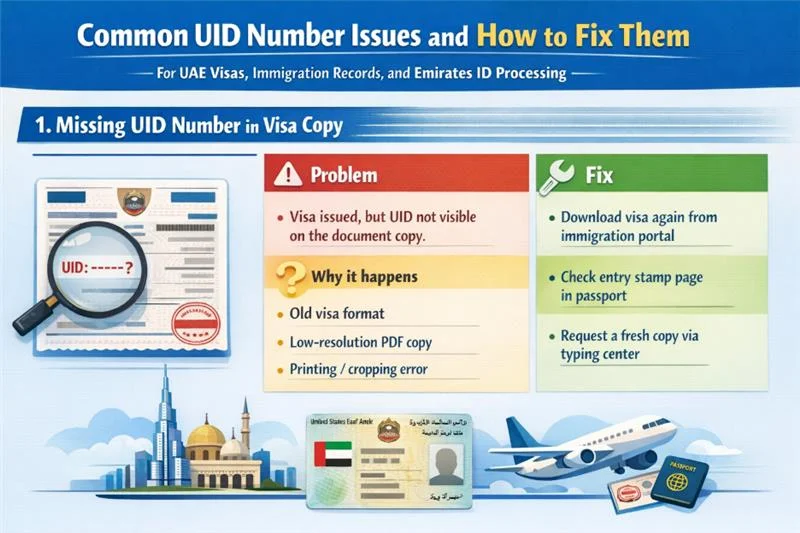
Sometimes things go wrong. Here are the most common problems people face.
UID Number Not Found Online
If you go online to search for your UID and an error message comes up, begin with your name. Many problems arise from a small typo or a variation in spelling (for example, “Mohammad” vs. “Mohammed”). If this doesn’t work, the system might just be lagging, give it a full day. If you have recently relocated to the country, wait 24 hours.
Duplicate UID Numbers
This is a huge problem. It happens when you have two different UIDs in the system.
Why it’s bad: It stops your Emirates ID from being printed.
The fix: Visit an immigration office, such as an AMER centre, and ask for a “UID Merger.” They delete the new number and link everything to your old one.
UID Missing on Visa
Sometimes a visa shows “0” or a blank space where the UID should be. This is usually a system glitch. Your PRO (Public Relations Officer) needs to contact immigration to obtain the generated number.
UID for Dependents and Family Members
When you sponsor your family, remember that your wife and each child get their own UID. Don’t use yours for their paperwork. You can check the UAE visa by UID number for each of them separately on the ICP website.
Case Study: The “Double Identity” Problem
Michael, a software engineer from Melbourne, thought he had finally hit the jackpot with a dream job opportunity in Dubai. He was no stranger to the UAE, having visited the country three times prior as a tourist, so he already had a presence in the country’s immigration system.
However, things took a turn for the worse when his new company tried to apply for his residency. The immigration system would not accept his previous record. Instead, it created a brand-new, second UID for him. Suddenly, Michael was not only a new employee but also a “duplicate” in the system, and his documents went into immigration limbo.
The Problem
Michael got stuck in bureaucratic limbo. He couldn’t complete his medical tests, apply for his Emirates ID, open a bank account, or sign a lease. The government system rejected his applications because it believed Michael was two different people due to duplicate records.
How DBTA Helped
Michael felt overwhelmed and contacted DBTA (Dubai Business & Tax Advisors). Instead of just giving advice, DBTA experts took charge:
- Investigation: They reviewed Michael’s passport stamps, old entry permits, and new visa documents to find the problem.
- Documentation: They prepared formal requests to prove to GDRFA that both files belonged to the same person.
Resolution: DBTA filed the “UID Merger” request and handled all follow-up with immigration officials. This lets Michael focus on his new job instead of spending days in queues.
The Result
Within 48 hours, DBTA confirmed that that the duplicate records had been merged into Michael’s original UID. His Emirates’ ID application got approved right away, and he settled into his new role and home successfully.
Testimonial
“I thought I had all my paperwork sorted, but this duplicate UID issue held everything up. DBTA helped me handle the documentation and merged my files at the GDRFA office without me having to take time off work.” — Michael R.
UID Number for Employment, Business, and Family Visas
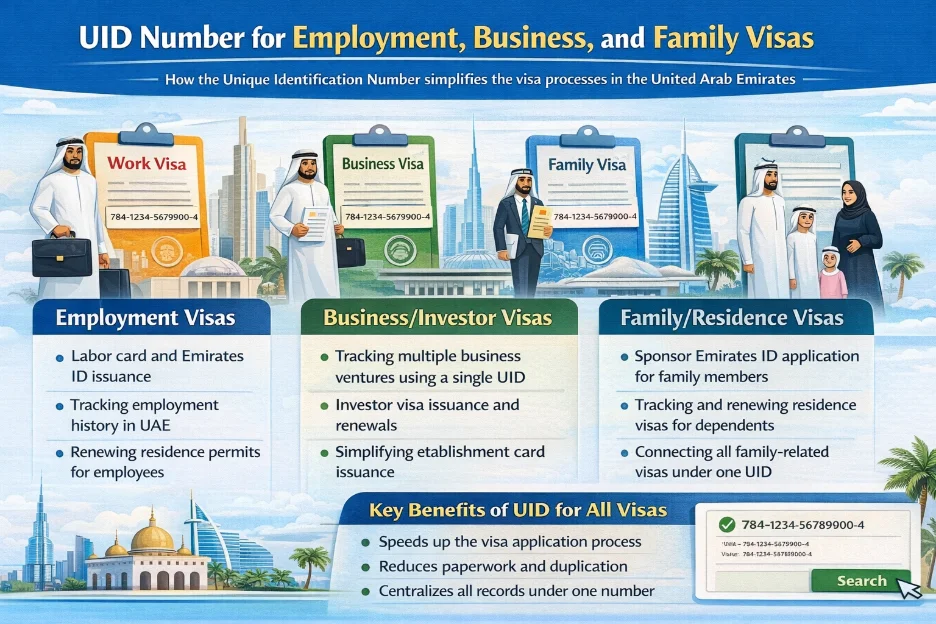
Whether you’re an employer or employee, the UID affects your daily life in the UAE.
UID Number for Employment Visas
Your employer needs your UID number to enroll you in insurance and the Wage Protection System (WPS). Without it, you can’t get paid legally.
UID Number for Company Immigration Records
Companies have their own “Establishment” records. When a company checks an employee’s Dubai visa status using their UID number, they’re ensuring the worker is legally under their sponsorship.
UID Number for Family and Dependent Visas
When you apply to enroll your kids in school, the school asks for their UID numbers and links to their Emirates IDs. They use this to register the child with the Ministry of Education.
How DBTA Can Help with UID Number and UAE Immigration
Immigration rules in the UAE change quickly. Sometimes, even a simple UID check reveals a fine or a duplicate file you didn’t know about.
Experts can help by:
- Finding “lost” UIDs that don’t show up online.
- Merging duplicate UIDs to get your Emirates ID.
- Checking your visa status if you’re outside the country.
- Helping with visa checks by UID number when websites aren’t working.
Getting professional help is often cheaper and faster than driving to different government offices yourself.
Conclusion
The UID is only one thread in the tapestry of life in the UAE, but its allure is hard to resist. It is like a magic key that unlocks your Emirates ID, your employment visa, and your health files. If there is one thing you take away from this guide, it is this: always have a photo of your UID on your phone. It will save you precious minutes at the bank, the hospital, or any government office.
Most problems with the UID can be ironed out if noticed in time. If you find a duplicate UID or your files are not showing, don’t wait. Get assistance from a professional or the immigration department so that your days in the UAE remain smooth and hassle-free.
Frequently Asked Questions (FAQs)
On old visa stickers, look for “Unified No.” in your passport. On e-visas (the A4 PDF), find it near the top under “Unified No.” Remember, it doesn’t print on your Emirates ID card.
Visit the ICP Smart Services website (for Federal Authority) or GDRFA website (for Dubai visas). Look for “Public Services,” then “File Validity.” Enter your passport number, nationality, and date of birth. Your UID appears instantly.
Not quite. You can’t just use your UID number. Government websites retrieve your immigration status by using both your UID and your passport number.
Nope, they aren’t the same thing at all. Your Emirates ID is that 15-digit number printed right on your plastic card, while the UID is a separate immigration file number. They’re definitely linked in the government’s database, but you won’t actually see the UID written on the card itself.
If you can’t find your UID online, check your spelling first. Even a tiny typo can throw the system off. If you just arrived or renewed your visa, the database might just be lagging. Give it a day or two to update. Still nothing? Just call the ICP at 600522222 and they’ll sort it out.
Yes. Everyone who goes through the UAE immigration system automatically gets assigned a UID number, whether you’re on a tourist visa, transit visa, or moving to the UAE on a residence visa.
Duplicates happen when a new residency visa doesn’t link correctly to an existing tourist visa, creating two files. Go to an AMER Centre (in Dubai) or ICP Customer Happiness Centre (in other emirates) and request a formal “UID Merger” with a passport copy and visa.
The UID is your immigration file number for the entire UAE. This 9 to 15-digit number is assigned when you first enter the country and never changes. It follows your history across all emirates. You need it for essential tasks like opening a bank account, getting a driving licence, or renewing your residency.
Latest news & articles


Visa-Free Countries for Emirates ID Holders (2026): Full List, Rules, and Travel Requirements
Read More »
About the Author:
AURANGZAIB CHAWLA
As CEO of DBTA, Aurangzaib Chawla advises globally mobile businesses and individuals on cross-border tax planning and structuring. With expertise spanning the UK, UAE, and wider GCC, Zaib helps clients minimise double taxation, protect assets, and achieve long-term financial efficiency while staying fully compliant.
Planning to launch in Dubai or the UAE?
Let’s talk about how to structure your business for growth the smart, compliant, and tax-efficient way
About the Author:
AURANGZAIB CHAWLA

As CEO of DBTA, Aurangzaib Chawla advises globally mobile businesses
and individuals on cross-border tax planning and structuring. With expertise spanning the UK, UAE, and wider GCC, Zaib helps clients minimise double taxation, protect assets, and achieve long-term financial efficiency while staying fully compliant.
Planning to launch in Dubai or the UAE?
Let’s talk about how to structure your business for growth the smart, compliant, and tax-efficient way.
