
How to Get a Real Estate License in Dubai (2026 Guide)

Recent Insights
Table of Contents
Introduction
Dubai’s property market moves fast. New towers go up every year, international buyers keep coming in, and agents who know what they’re doing can earn very well. If you’ve been thinking about starting a career in real estate here, the good news is that the path is clear.
The rules are strict, but they are fair, and once you follow them, you’re in a market full of real opportunity. This guide covers everything you need to know in plain, simple terms. We’ll walk through who can apply, what it costs, how long it takes, and what mistakes to avoid.
What Is a Real Estate License in Dubai?
A real estate license is the legal permission that lets you work in Dubai’s property market. Without it, you cannot show properties to buyers, list homes for sale, or collect a commission. It is not optional, and working without one can lead to serious consequences.
Two government bodies oversee this area. The Dubai Land Department (DLD) is the main authority for all property matters in the emirate. The Real Estate Regulatory Agency (RERA) works under the DLD and handles the day-to-day regulation of agents and brokerages. RERA runs the training, sets the rules, and issues the broker cards that all licensed agents must carry.
If you’re new to the market and want to understand how property investment and licensing work together, the team at DBTA’s real estate advisory service can walk you through the full picture before you commit to anything.
Types of Real Estate Licenses in Dubai
There are three types of licenses, and choosing the right one depends on what you want to do.
Real Estate Agent License
This is for people who want to work under an existing brokerage. You don’t own the company. You join an established firm, work under their trade license, and earn commission as a registered professional. You’ll get a RERA Broker Card, which is your official ID in the market.
Real Estate Broker License
This is often used to mean the same thing as the agent license. In technical terms, it refers to the individual certification that allows you to carry out brokerage activities in Dubai. For most people starting out, this is the license they’re after.
Real Estate Brokerage License
This is what you need if you want to open your own company, hire a team, and build your own brand. This is a trade license for a business, not just an individual. The cost is much higher, the paperwork is more involved, and you’ll need a proper office. Getting the structure right from day one is important, and working with a specialist in company formation and trade license management can save you a lot of time and money.
| Feature | Agent License | Brokerage License |
|---|---|---|
| Who it's for | Individuals working under a firm | Business owners who want their own agency |
| Cost range | AED 5,000 to 8,000 | AED 25,000 and above |
| Key requirement | Must be sponsored by a licensed firm | Must have an office and a trade license |
Who Can Apply for Real Estate License?
Before you start the process, check that you meet the basic requirements. These are RERA’s eligibility rules for 2026, and they haven’t changed much in recent years.
- Age: You must be at least 18 years old. In practice, most brokerages prefer to hire people who are 21 or older.
- Residency status: You need a valid UAE Residency Visa. A tourist visa won’t work. You must be a legal resident to hold a RERA card.
- Education: You need at least a high school diploma. A university degree is not required, but it does help when applying to better brokerages.
- Police clearance: You must provide a Good Conduct Certificate from Dubai Police. This is a standard background check that confirms you have no criminal record.
- Foreign nationals: There are no formal restrictions on nationalities. If you’re not from the UAE, you can still get licensed as long as you hold a valid residency visa sponsored either by an employer or through your own registered company.
How to Get a Real Estate License in Dubai: Step by Step
The process has been made easier through the Dubai REST app, but it still takes preparation and attention to detail. Here is what each step involves.
Step 1: Get Your Residency Visa Sorted
If you’re not already a UAE resident, this is where you start. You either need to be hired by a licensed brokerage, which will sponsor your visa, or you set up your own company and apply as an investor. Either way, you need the visa before anything else can move forward. DBTA’s visa processing and PRO services handle all the government liaison, document preparation, and coordination so the process doesn’t get held up on paperwork.
Step 2: Complete the RERA Training Course
You cannot skip the training. It’s a mandatory program, usually four days long, run by the Dubai Real Estate Institute (DREI) or one of their approved partners. The course covers UAE property law, the code of ethics, and practical market knowledge. It gives you the foundation you need for the exam.
Step 3: Pass the RERA Exam
After training, you sit for the qualifying exam. It’s a multiple-choice test, and it’s not there just for show. You need to study and prepare properly. The exam tests whether you actually understood the training material, so don’t take it lightly.
Step 4: Submit Your Application for the Broker Card
Once you pass, your brokerage uploads your documents to the Trakheesi system. This includes your exam certificate, your visa copy, your Emirates ID, and a few other items. Everything must be complete and correct, because missing documents are the most common cause of delays.
Step 5: Receive Your License
After approval from RERA, you’ll receive a digital Broker ID card. This is your official license. You are now legally allowed to list properties, conduct viewings, and earn commission in Dubai.
If you want expert support for the real estate advisory side of getting started, including understanding the market structure and positioning yourself correctly, DBTA’s real estate advisory team can help you build a solid foundation from the start.
What Documents Do You Need?
Missing or incorrect documents is the most common reason applications get delayed. Prepare everything on this list before you begin your application.
- A copy of your passport with at least six months of remaining validity.
- A copy of your UAE Residency Visa.
- Your Emirates ID, both the original and a copy.
- Recent passport-size photos with a white background.
- Attested educational certificates, if your qualifications were issued outside the UAE, they must be verified by the Ministry of Foreign Affairs in your home country and then in the UAE.
- Your RERA Training Certificate after you complete the course.
- A Good Conduct Certificate from Dubai Police.
The attestation of foreign qualifications takes the longest. Many applicants are caught off guard by how much time this step takes. Start it before you even book your training course.
How Much Does a Real Estate License Cost in Dubai?
Here is a clear breakdown of what you should expect to pay as an individual agent. There are no hidden extras in this list.
| Expense | Estimated Cost (AED) | Notes |
|---|---|---|
| RERA Training Course | AED 2,500 to 3,000 | Mandatory four-day course |
| RERA Exam Fee | AED 500 to 700 | Per attempt |
| Broker ID Issuance | AED 500 | Paid to the DLD |
| Police Clearance Certificate | AED 220 | For UAE residents |
| Government Knowledge Fees | AED 40 | Standard fee applied to all applications |
| Total Estimate | AED 4,000 to 4,500 | Does not include visa costs |
If you’re planning to open your own brokerage instead, the numbers are very different. Once you add a trade license, office rent, and initial deposits, the total cost regularly goes above AED 30,000. Some setups cost significantly more depending on your office location and business structure.
How Long Does the Whole Process Take?
The timeline depends mostly on how quickly you can book your training and how prepared your documents are when you start.
For most people, the training and exam take one to two weeks depending on availability. Government approvals after passing typically take three to five working days. From the day you start your training to the day you receive your Broker Card, the realistic timeline is three to four weeks.
However, if your residency visa hasn’t been issued yet when you begin, that can extend the whole process to around two months. Sorting out your visa first is always the smarter move.
What to Expect from the RERA Exam
This is where most people feel nervous, and it’s understandable. The exam is not a formality, but it’s also not impossibly hard if you put in the work during training.
The test consists of 50 to 60 multiple-choice questions. You need to score at least 75% to pass. Most people who pay genuine attention during the four-day course and spend a few extra hours reviewing the material are well prepared.
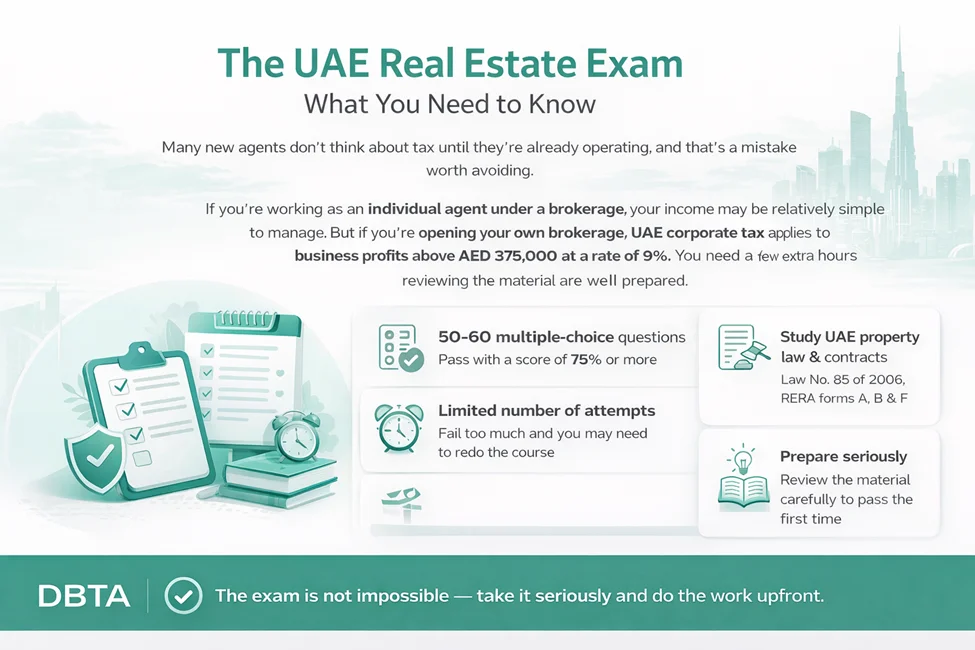
The topics covered include UAE property law (specifically Law No. 85 of 2006), the RERA Code of Ethics, commission calculations, and the main types of property contracts used in Dubai, including Form A, Form B, and Form F.
You have a limited number of attempts. If you fail multiple times, you may need to pay for the full training course again before retaking the exam. Study for the first time properly.
Case Study: Speeding Up the Brokerage Path
The Challenge: Marcus, an experienced broker from Singapore, wanted to launch his own boutique firm in Dubai. He spent two months struggling with the real estate license vs brokerage license distinction and was stuck in a loop of rejected trade name applications and office compliance issues.
DBTA Intervention: DBTA stepped in to audit Marcus’s corporate structure. They corrected his trade name registration to meet DLD standards and managed his document attestation via official channels.
The Result: Marcus secured his brokerage license in just 22 days, saving him an estimated AED 15,000 in redundant administrative fees and office holding costs.

Agent License vs. Brokerage License: What’s the Real Difference?
This question matters because the two paths are genuinely different in terms of what you earn, what you’re responsible for, and how your career develops.
As an agent working under a brokerage, you earn commission on every deal but split it with the company. A common split is 50/50. You don’t have to worry about office costs, staff salaries, or regulatory compliance for the business. You just focus on finding clients and closing deals.
As a brokerage owner, you keep a much larger share of the commission. But you’re also responsible for everything the business needs to run, rent, marketing, staff, and full RERA compliance for your entire operation. You’ll need a Dubai mainland company formation, since most Dubai real estate agencies are structured as mainland businesses. DBTA’s real estate advisory team helps brokerage founders choose the right structure before they sign anything.
One important thing to understand: you cannot operate as a completely independent broker in Dubai. Even if you want to work for yourself, RERA requires you to be registered under a licensed brokerage firm to hold an active broker card. If that firm loses its license, your individual card becomes inactive too.
License Renewal and Ongoing Requirements
Your real estate license lasts for one year. You need to renew it every year to stay active in the market.
The good news is that you don’t need to repeat the full training course every year. You just need to complete a Continuing Professional Development module online and pay the renewal fee, which is around AED 500 for the card itself, plus the CPD course fee.
Brokerages take this seriously because the penalties for letting agents operate on expired cards are steep. Fines for brokerages in this situation can reach AED 50,000.
The Real Risks You Should Know About
Income is unpredictable, especially at the start.
Almost all agents work entirely on commission. It is completely normal to go two or three months without closing a single deal in your first year. Without a brokerage that provides strong lead generation and training, this period can be very difficult financially.
The market is crowded.
There are more than 15,000 licensed brokers in Dubai. Having a license is the baseline, not the advantage. What separates successful agents from struggling ones is their niche, their network, and how consistently they show up and work. Getting sound real estate advisory guidance on which market segments to target can make a significant difference before you invest heavily in building your client base.
Legal mistakes have real consequences.
One error on a contract, or calling a number that’s registered on the Do Not Call list, can result in a personal fine. Understanding the rules fully before you start is not optional in this market.
What Can You Earn as a Licensed Agent?
The earning potential is one of the most common reasons people want to get into Dubai real estate, so let’s look at real numbers. Commission in Dubai is typically 2% of the sale price. This is usually split equally between the agent and their brokerage, so you receive 1% of the transaction value on most deals.
On a property sold for AED 2,000,000, the total commission is AED 40,000. After the brokerage split, you take home AED 20,000 from one deal.
In high-value areas like Palm Jumeirah, Dubai Hills, or Downtown Dubai, top-performing agents regularly earn AED 100,000 or more per month. Those numbers are real, but they take time, skill, and a strong database to reach.
As a brokerage owner, you need to think about this income differently. You’ll earn more per deal, but your expenses, staff costs, office rent, and marketing, come out first. Understanding how to manage your money properly from the start is important, and professional bookkeeping services tailored to real estate businesses can help you stay on top of your finances as things grow.
Tax Obligations for Real Estate Professionals in Dubai
Many new agents don’t think about tax until they’re already operating, and that’s a mistake worth avoiding.
If you’re working as an individual agent under a brokerage, your income may be relatively simple to manage. But if you’re opening your own brokerage, UAE corporate tax applies to business profits above AED 375,000 at a rate of 9%. You need to register, file returns, and maintain proper records from the start.
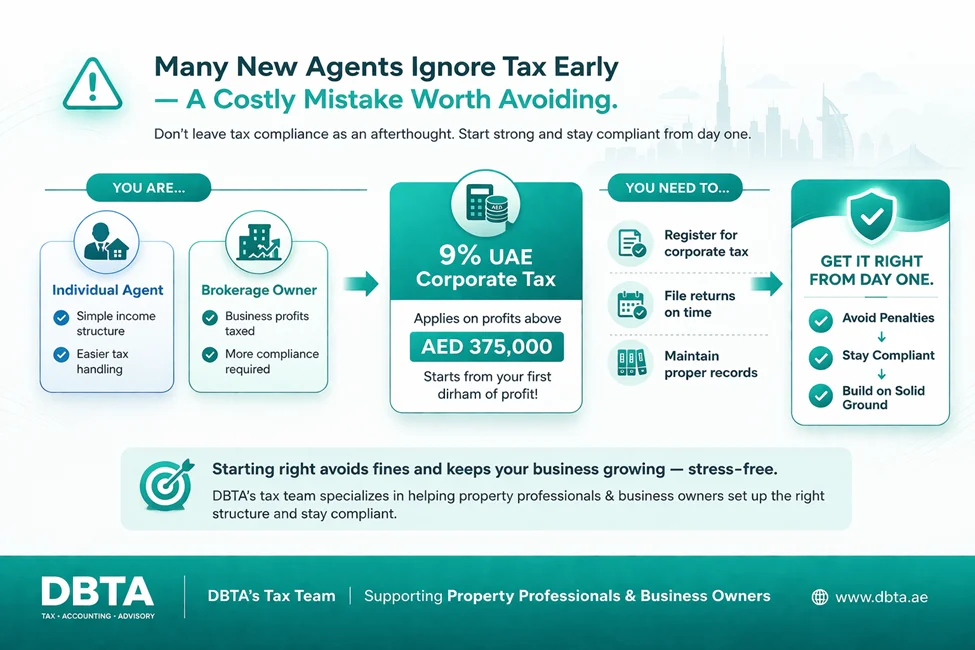
Getting this right from day one avoids penalties and keeps your business on solid ground. DBTA’s tax team works specifically with property professionals and business owners to set up the right structure and stay compliant.
Common Mistakes to Avoid
Not Attesting Your Documents Early Enough
This is the single most common reason people’s timelines get pushed back. If you earned your qualifications outside the UAE, start the attestation process immediately. Don’t wait until you’ve already booked your training course.
Choosing the Wrong Brokerage
The brokerage split is not the only thing that matters. A 70/30 split at a firm with no training, no leads, and no mentorship is worse than a 50/50 split at a firm that teaches you the market and feeds you qualified buyers. Choose the environment that will make you a better agent, not just the one that sounds most generous on paper.
Going Into the RERA Exam Underprepared
A lot of people treat it as a formality and are surprised by how specific the questions are. You have limited attempts, and failing costs you both time and money. Treat it seriously.
Skipping Proper Business Planning If You Want to Open a Brokerage
Many people rush into setting up their own firm without understanding the full cost structure, legal requirements, or tax obligations. Getting a clear picture through proper real estate advisory and business structuring before you commit can save you from expensive mistakes later.
Final Thoughts
Getting a real estate license in Dubai is a clear, achievable process for anyone who is organized and takes it seriously. The market is competitive, but it rewards people who know their stuff, build genuine relationships, and stay compliant.
Whether you’re starting as an agent under an established firm or planning to open your own brokerage one day, the steps are the same at the beginning. Get your visa, complete the training, pass the exam, and get your card.
If you want guidance on the property market itself, how to structure your earnings, or how to set up a brokerage the right way, DBTA’s real estate advisory team in Dubai is there to help you move forward with clarity and confidence.
Frequently Asked Questions (FAQs)
You need to be at least 18, hold a valid UAE residency visa, and have a high school diploma or above. A clean criminal record is also required, no exceptions.
Gather your passport, UAE residency visa, Emirates ID, passport photos, attested educational certificates, your RERA training certificate, and a Good Conduct Certificate from Dubai Police. Missing even one of these will delay your application.
Budget somewhere between AED 4,000 and AED 4,500 all in for the training, exam, and broker card. That figure doesn’t cover your residency visa if you still need one.
Absolutely, nationality isn’t a barrier here at all. The only firm requirement is that you hold a valid UAE residency visa before you apply.
If your visa and documents are already sorted, most people have their broker card within three to four weeks. Factor in extra time if you’re still waiting on attestations or your residency.
It’s a 50 to 60 question multiple-choice test, and you’ll need to score at least 75% to pass. It’s not impossible to study hard, but it’s not a formality either; study properly.
No, RERA is clear on this. Every licensed broker must be registered under an active brokerage, so going fully solo isn’t an option under the current rules.
Fines start at AED 50,000, and for expats, there’s also a real risk of deportation on top of that. It’s simply not worth it.
Just complete the annual CPD module online and pay roughly AED 500 for the card renewal, it’s a straightforward process once you’re already in the system.
Latest news & articles
About the Author:
AURANGZAIB CHAWLA
As CEO of DBTA, Aurangzaib Chawla advises globally mobile businesses and individuals on cross-border tax planning and structuring. With expertise spanning the UK, UAE, and wider GCC, Zaib helps clients minimise double taxation, protect assets, and achieve long-term financial efficiency while staying fully compliant.
Planning to launch in Dubai or the UAE?
Let’s talk about how to structure your business for growth the smart, compliant, and tax-efficient way
About the Author:
AURANGZAIB CHAWLA

As CEO of DBTA, Aurangzaib Chawla advises globally mobile businesses
and individuals on cross-border tax planning and structuring. With expertise spanning the UK, UAE, and wider GCC, Zaib helps clients minimise double taxation, protect assets, and achieve long-term financial efficiency while staying fully compliant.
Planning to launch in Dubai or the UAE?
Let’s talk about how to structure your business for growth the smart, compliant, and tax-efficient way.
