
RAK ICC SPC: 5 Real Use Cases and Portfolio Setup Guide (2026)

Recent Insights

Table of Contents
Introduction:
Most guides about UAE offshore structures stay stuck in legal definitions and don’t explain how these vehicles work in real life, especially when banking, governance, and compliance pressures are higher than ever. This guide is written for owners and advisors who want the operational truth about an RAK ICC SPC in 2026: when it genuinely beats the “multiple SPVs” approach, how to design portfolios that stay clean over time, and how to reduce friction during bank onboarding and ongoing reviews.
In practice, the success of a segregated portfolio company structure depends less on the incorporation step and more on the strength of the internal governance design. As the UAE continues aligning with global compliance expectations, the “offshore” label does not mean “hands-off.” RAK ICC has evolved into a serious platform used for wealth structuring, real estate holding, investment platforms, and institutional-style asset segregation. Hence, the standard is higher, and the scrutiny is real.
This guide covers five real-world structuring patterns, a six-step setup process, and the governance templates needed to preserve the firewall between portfolios. The aim is practical: combine regulatory structure with advisor-level discipline so your portfolios remain defensible under banking review, audit questions, and potential creditor challenges.
Key Takeaways for Structuring in 2026
| Takeaway | Operational Implication |
|---|---|
| Statutory Liability Protection | Assets in one portfolio are legally shielded from the creditors of another portfolio within the same SPC. |
| Regulation 142 Compliance | Directors must demonstrate specific “knowledge and expertise” to manage segregated portfolios, or the Registrar may reject the application. |
| Banking Strategy over Speed | Account opening for an SPC is relationship-driven; success in 2026 requires a 2-page “explanation memo” rather than just a license copy. |
| Accounting Precision | Maintaining a separate SPC accounting by portfolio is the primary defense against legal challenges seeking to “pierce the cell”. |
| Tax Residency Management | While 0% tax is a core benefit, 2026 rules mandate a clear distinction between international trade and local economic nexus. |
What is a RAK ICC SPC?
The segregated portfolio company UAE, often referred to as a protected cell company UAE, is a unique corporate architecture that allows a single legal person to operate multiple, internally ring-fenced “cells” or “portfolios”. To visualise this, consider a master vault. While the vault itself is a single building (the SPC), it contains multiple independent security boxes (the portfolios). Each box holds its own distinct assets, serves its own investors, and is exclusively responsible for its own liabilities.
In a standard SPC vs holding company comparison, the primary differentiator is the statutory “firewall.” In a traditional holding company, all assets are technically on the same balance sheet. If one subsidiary incurs a massive debt that the parent has guaranteed, or if the parent itself is sued, every asset in the group is potentially vulnerable. In contrast, the RAK ICC SPC is governed by regulations that explicitly bar the creditors of Portfolio A from seizing assets located in Portfolio B or the company’s general assets.
This structure is increasingly attractive for several specific groups of owners:
- Multi-Asset Owners: Individuals or families holding various high-value assets such as real estate, global stock portfolios, and private equity stakes.
- Multi-Project Groups: Developers or entrepreneurs running several distinct projects, each with different financing partners and risk profiles.
- Fund Managers: Asset managers who wish to launch multiple investment strategies (e.g., a “Tech Fund” and a “Real Estate Fund”) under one corporate roof to save on administrative overhead.
The most important caveat
Here is where many people get stuck: the SPC is legally a single entity despite its internal divisions. This means the company has one registration number, one board of directors, and one registered agent. The separation between portfolios is a “legal fiction” created by statute, which holds weight in courts but must be maintained by the directors’ actions.
The analysis indicates that the Registrar acts as a gatekeeper during the portfolio setup steps, SPC. Unlike a standard International Business Company (IBC), which can be set up in 48 hours with minimal scrutiny, an SPC requires the Registrar to be satisfied that the board possesses the requisite SPC director’s expertise requirement. If the directors cannot show a background in finance, law, or relevant asset management, the application will likely face significant delays or outright rejection.
The governance rules between portfolios must be clearly defined in the company’s Memorandum and Articles of Association. This includes:
- Documentation and Registers: The Registrar maintains a separate register of members for each portfolio. Every decision involving a portfolio’s assets must be backed by a board resolution identifying that specific portfolio.
- Cash Flow and Returns: Returns must be calculated and distributed on a portfolio-by-portfolio basis. Dividends can be declared for one portfolio even if another is currently experiencing losses.
- Compliance Across Portfolios: While the company files a single consolidated annual return, the underlying records must be capable of showing the financial position of each portfolio at any time to satisfy potential audit or creditor inquiries.
Liability segregation explained
To understand how an SPC ringfences liabilities, one must appreciate how the “firewall” operates during a crisis. In a typical corporate structure, if a company owns a yacht and the yacht crashes into a pier, the pier owner can sue the company and potentially seize the company’s other assets, like its bank accounts or real estate holdings. In a RAK ICC SPC, the yacht would be placed in “Portfolio Yachting”. If a claim arises from that portfolio, the claimant’s recourse is legally limited to the assets held.
Comparison table (SPC vs multiple SPVs)
| Feature | RAK ICC SPC | Multiple Standalone SPVs |
|---|---|---|
| Setup & Renewal Overhead | One license; up to 10 portfolios. | Multiple licenses; multiplied fees. |
| Banking Narrative Complexity | High; requires a sophisticated explanation of cells. | Low; one bank account for one clear project. |
| Ongoing Governance Load | Intense; must ledger all flows by portfolio. | Moderate; standard corporate governance. |
| Investor Reporting | Complex; requires portfolio-specific P&L. | Simple; accounts are naturally separated. |
| Cost Predictability | High; one consolidated SPC annual renewal cost. | Variable; depends on the number of entities. |
| Best Fit Scenarios | Family offices; Investment platforms; IP pools. | Single-asset exits; High-leverage projects. |
In practice, an SPC is not always the “better” option. Many people should use multiple SPVs because it’s a cleaner operationally, especially if you intend to sell the underlying assets to different buyers later. Buyers generally prefer to acquire a clean, standalone SPV rather than a “cell” within someone else’s SPC.
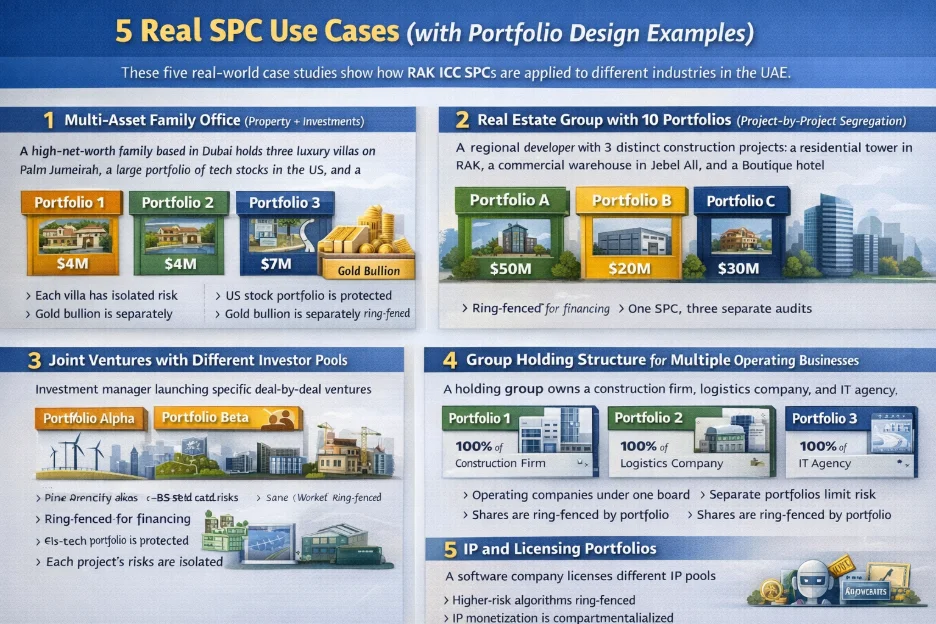
5 real SPC use cases (with portfolio design examples)
To move from theory to implementation, we must examine how the RAK ICC SPC requirements are applied to various industries in the UAE. These case studies represent the most robust structures we design for clients in 2026.
Use Case 1: Multi-asset family office (property + investments)
A high-net-worth family based in Dubai holds three luxury villas on Palm Jumeirah, a large portfolio of tech stocks in the US, and a collection of physical gold bullion. Under a standard holding company, a lawsuit involving a villa (e.g., a major accident during a tenant party) could potentially jeopardise the liquid stock portfolio.
Using the SPC use cases family office model:
- Portfolio 1-3: Dedicated to the Palm Jumeirah villa. Each portfolio holds the title deed and manages the rental revenue.
- Portfolio 4: Holds the US brokerage account for stocks and bonds.
- Portfolio 5: Holds the legal title to the physical gold assets.
This design isolates the “operating risk” of real estate (tenants, maintenance, accidents) from the “passive wealth” of investments. If one villa faces a legal claim, the tech stocks and gold remain behind a statutory firewall.
Use Case 2: Real estate group with 10 portfolios (project-by-project segregation)
A regional developer is managing three distinct construction projects: a residential tower in RAK, a commercial warehouse in Jebel Ali, and a boutique hotel in Sharjah. Each project has a different set of investors and unique bank financing terms. This is a primary driver for SPC use cases in real estate.
The structure allows:
- Portfolio A: Holds the tower project. Creditors here have no recourse to Portfolio B.
- Portfolio B: Holds the warehouse. Financing is ring-fenced from the hotel’s risks.
- Portfolio C: Holds the hotel project.
Instead of paying for three different company setups and three different audits, the developer pays one SPC setup cost in the UAE and manages all three projects through a single board of directors, while maintaining a strict statutory separation of risks.
Use Case 3: Joint ventures with different investor pools
An investment manager is launching several “deal-by-deal” ventures. They want to avoid the regulatory complexity of a massive “blind pool” fund but need to pool capital from different groups of investors for specific deals. This is the ideal scenario for SP Cuse cases in investment funds.
- Portfolio Alpha: Invests in European renewable energy. (Investor Group A).
- Portfolio Beta: Invests in GCC fintech startups. (Investor Group B).
The SPC issues different classes of “Participating Shares” for each portfolio. This allows the manager to tailor the fee structure, voting rights, and exit timelines for each deal independently. Because the portfolios are internally ring-fenced, the failure of a fintech startup in Portfolio Beta cannot trigger a liquidation of the energy assets in Portfolio Alpha.
Use Case 4: Group holding structure for multiple operating businesses
A holding group owns three operating businesses: a construction firm in Dubai, a logistics company in Abu Dhabi, and an IT agency in Riyadh. While these are separate legal entities in their own countries, the group needs a single, tax-neutral “Master Holdco.”
By using a RAK ICC SPC:
- Portfolio 1: Holds 100% of the shares of the construction firm.
- Portfolio 2: Holds 100% of the shares of the logistics company.
- Portfolio 3: Holds 100% of the shares of the IT agency.
If the construction firm enters a high-stakes litigation, the claimant’s reach is limited to the shares held in Portfolio 1. The logistics and IT companies, held in their respective portfolios, are protected from being seized to satisfy the construction firm’s debts.
Use Case 5: IP and licensing portfolios.
A software company owns multiple valuable trademarks, patents, and copyrights. They want to license different “IP pools” to different global regions while isolating the risks of potential infringement lawsuits. This is a common application of SPC use cases in licensing.
- Portfolio 1: High-risk, experimental AI algorithms.
- Portfolio 2: Stable, revenue-generating enterprise software patents.
- Portfolio 3: Branding and trademarks for international franchises.
If a patent troll sues the company over an AI algorithm in Portfolio 1, the royalty streams generated by the enterprise software in Portfolio 2 are legally shielded. This also makes it very easy to sell a specific “IP pool” later by simply transferring the shares of the relevant portfolio to a buyer.
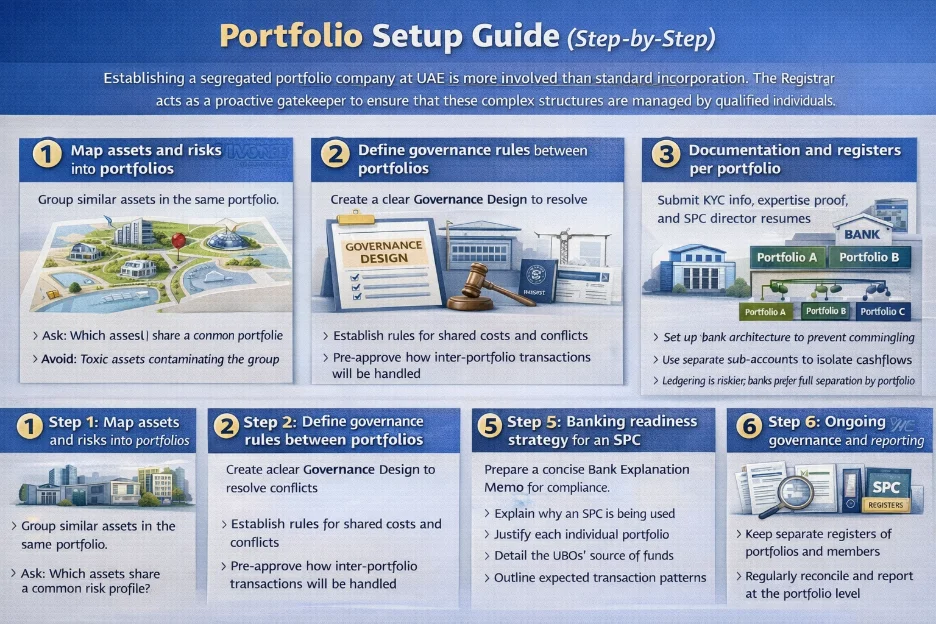
Portfolio setup guide (step-by-step)
Establishing a segregated portfolio company in the UAE is more involved than standard incorporation. The Registrar acts as a proactive gatekeeper to ensure that these complex structures are managed by qualified individuals.
Step 1: Map assets and risks into portfolios
The first part of the portfolio setup steps of SPC is purely strategic. Do not simply create ten portfolios because that is the legal limit. You must ask: “Which assets share a common risk profile?” If you have three apartments in the same building, they might belong to one portfolio. If you have a chemical factory and a florist, they require separate portfolios. The goal is to ensure that a single “toxic” asset cannot contaminate the entire group.
Step 2: Define governance rules between portfolios
In 2026, regulators expect a “Governance Design” document. You need to pre-define how the company will handle inter-portfolio transactions. You must establish a clear policy for how shared costs (like the registered agent fee) are split and how the board will resolve conflicts of interest if Portfolio A and Portfolio B are competing for the same investment opportunity.
Step 3: Documentation and registers per portfolio
The SPC required documents UAE list includes the standard KYC (passport, proof of address, CV) but adds a critical requirement: the SPC director’s expertise requirement. Under the RAK ICC Business Companies Regulations 2018 (as amended), you must provide resumes, professional certifications, or a record of experience that proves the directors understand how to manage segregated assets. The Registrar must be “satisfied” that the board is competent before approving the portfolios.
Step 4: Cashflow segregation design
You must determine your banking architecture early in the process. While you could technically use a single master account with complex internal ledgering, the 2026 banking climate makes SPC bank account opening in the UAE significantly easier if you commit to opening separate sub-accounts for each portfolio from day one. This prevents the “co-mingling that is the number one reason firewalls fail in court.
Step 5: Banking readiness strategy for an SPC
Banks view SPCs as “High Risk” due to their inherent complexity. To pass compliance, you need a 2-page “Bank Explanation Memo.” This document should clearly articulate:
- Why is an SPC being used instead of multiple simple companies?
- The commercial rationale for each individual portfolio.
- The source of wealth for the Ultimate Beneficial Owners (UBOs).
- The expected transaction patterns (who is paying whom and why).
Step 6: Ongoing governance and reporting
Once incorporated, the maintenance work begins. You must maintain meticulous SPC accounting with a portfolio. Your accountant should provide a trial balance for each portfolio separately. You must also maintain a Register of Portfolios and an independent Register of Members for each cell, as these are the definitive legal statements of ownership.
Case study: How DBTA made an SPC bankable and “portfolio-clean”
A UAE-based owner group came to us after setting up an RAK ICC SPC through a low-touch provider. On paper, the structure looked fine. In practice, it was already drifting: one main account was being used for everything; contracts weren’t clearly tied to specific portfolios, and there was no consistent approval trail. When they applied for an SPC bank account opening in the UAE, the bank’s compliance team pushed back with the same questions repeatedly: “Which portfolio owns this activity?” “How are liabilities segregated?”, and “How are payments controlled between portfolios?”
The problem
- Portfolios existed, but there was no operational evidence to support SPC ringfencing liabilities.
- Cashflows were mixed, and shared costs were not allocated consistently.
- Contract attribution was unclear (some agreements were signed at the umbrella level without portfolio reference).
- Banking onboarding stalled due to weak documentation and an unclear transaction profile.
What DBTA changed (the fix)
Dubai Business and Tax Advisors rebuilt the structure as an operating system, not just a registry entry:
- Designed a portfolio map aligned to assets, counterparties, and risk (not just “Portfolio 1, 2, 3”).
- Implemented a portfolio approval workflow (board resolutions + signing authority by portfolio).
- Created portfolio records: asset schedules, contract index, and a monthly reconciliation process to support SPC accounting by portfolio.
- Put in place segregated portfolio agreements for any inter-portfolio movement so transfers weren’t “informal.”
- Prepared a bank-facing “explanation memo” with an evidence index, expected activity by portfolio, and a clear SoF/SoW summary so that compliance could review fast.
The result
- The client was able to demonstrate clean attribution and controls, which reduced compliance follow-ups and made the structure easier to maintain.
- Banking onboarding moved from “unclear structure” to a documented, reviewable model with portfolio-level narrative and controls.
- Internally, the client gained a repeatable governance rhythm using a monthly SPC compliance checklist, UAE, and portfolio reconciliation.
Governance templates
Template 1: Portfolio creation resolution
This is the one-page board document you use every time you create a new portfolio or allocate a new asset/project into an existing one. In practice, it’s one of the strongest ways to evidence discipline behind SPC ringfencing liabilities,because it proves decisions weren’t informal or “made in chat.”
Your resolution should clearly capture:
- Portfolio designation and name (e.g., “Portfolio 8 – Azure Project”)
- Purpose and permitted activity (tight scope, not vague wording)
- Assets allocated to the portfolio (what exactly is inside this compartment)
- Associated obligations (where relevant: financing, guarantees, counterparties, or ongoing commitments)
- Share class/participation rights (if you’re issuing different rights to different stakeholders)
- Approved signatory and authority limits (who can sign and up to what threshold)
- Banking or ledger method (separate account/sub-account or a controlled ledger approach)
- Distribution approach (how payouts are approved, recorded, and linked to portfolio performance)
If you want SPC accounting by portfolio to stay clean, this document becomes your “source of truth” for how the finance team tags activity month after month.
Template 2: Inter-portfolio transaction policy
This policy exists to prevent the slow, silent problem that ruins many SPC structures: treating all portfolios like one blended wallet. The moment portfolios start paying each other’s bills without rules, it becomes harder to defend segregation if anyone challenges ringfenced portfolios’ creditor claims.
Your policy should set clear standards for:
- When inter-portfolio transactions are allowed (and when they’re prohibited)
- Who approves them, and what evidence is retained
- How pricing is determined in plain English (“fair and justifiable,” not “whatever is convenient”)
- What documents must exist before money moves
- How repayments and records are tracked
For loans or transfers, you should document terms in a segregated portfolio
agreements (even if they’re short), so the transaction looks and behaves like a real third-party arrangement.
Template 3: Portfolio cashflow segregation checklist (monthly)
This is a monthly control tool for your finance team. It’s simple, but it catches the exact operational issues that create future compliance questions, especially during banking reviews or due diligence updates.
Use this checklist every month:
- Do invoices, contracts, and receipts clearly reference the correct portfolio where applicable?
- Is every transaction tagged to the correct portfolio in the ledger (no “miscellaneous” or “company-level” dumping)?
- Have shared costs (agent fees, admin support, accounting work) been allocated using a consistent method?
- Were any cross-portfolio payments made, and if so, were they approved and recorded properly?
- Has reconciliation been completed for each portfolio (bank sub-accounts if used, or portfolio-level ledger reconciliation if not)?
- Are there any suspense items still open that hide which portfolio owns the transaction?
This sits neatly inside your broader SPC compliance checklist, UAE, and keeps separation defensible without turning governance into bureaucracy.
Template 4: “Bank explanation memo” structure
If you want SPC bank account opening UAE to be realistic (and not a months-long loop of follow-up questions), you need a short, clear memo that makes the structure easy for compliance teams to understand. Banks are not looking for legal theory. They want a clean story, clean documents, and predictable activity.
A bank memo should include:
- Executive summary: why an SPC structure fits the model (one paragraph)
- Ownership and control: UBO summary and who makes decisions
- Portfolio map: what each portfolio does and why it exists
- Expected activity profile: counterparties, jurisdictions, frequency, and typical transaction sizes
- Source of funds/source of wealth summary: short overview + evidence list
- Controls narrative: how segregation is maintained (approvals, ledger discipline, documentation)
- Evidence index: a numbered list of attachments, so review is faster
Done well, this memo reduces friction at onboarding and makes future reviews smoother when activity changes.
Common mistakes (and how to avoid them)
The analysis indicates that preventable errors often delay the RAK ICC SPC timeline for setup during the documentation phase.
- Vague Business Activities: Banks in 2026 will reject any application that says it does “investment holding” without specifics. You must describe exactly what assets you are holding and where the money comes from.
- Weak Director CVs: If your proposed directors have no history in high-level finance or legal structuring, the Registrar will reject the SPC application under Regulation 142. They want to see that the board is “adept”.
- Assuming “Offshore” means “Zero Compliance”: This is the most dangerous myth. In 2026, all RAK ICC entities must register for Corporate Tax. Depending on the nature of your activity, you may also need to comply with Economic Substance Regulations (ESR). ESR applicability is triggered by “Relevant Activities” (e.g., Holding Company, IP, Distribution & Service Centers), not by the amount of income. Assuming these don’t apply just because you are “offshore” is a major red flag for banks. As of 2026, even RAK ICC entities must file an annual Tax Return, even if they qualify for a 0% rate.
- Governance Fatigue: Owners often start with a clean separation but get lazy after six months, paying a Portfolio A invoice from a Portfolio B bank account “just this once.” In court, this single mistake can destroy the liability protection of the entire structure
How DBTA helps (so your SPC works in real life, not just on paper)
Dubai Business and Tax Advisors help you set up an RAK ICC spc in a way that works in real life, meaning portfolios are designed around real assets, risks, and cashflows, not just “Portfolio 1, 2, 3.” We advise on the right structure based on spc vs spv UAE and spc vs holding company, then build the governance layer that makes spc ringfencing liabilities defensible: clear approval rules, clean portfolio registers, and simple documentation standards (including segregated portfolio agreements where inter-portfolio movement is needed).
We also focus heavily on banking and long-term maintenance. For spc bank account opening in the UAE, we prepare a bank-ready structure explanation, portfolio activity narrative, and evidence pack so compliance teams can review quickly. Finally, we help clients maintain spc accounting by portfolio and follow a practical spc compliance checklist in the UAE, so segregation doesn’t degrade over time as portfolios grow, assets change, or counterparties ask tougher questions.
FAQ's:
An RAK ICC SPC is a corporate structure that lets one legal company operate multiple internally separated portfolios (cells). In simple terms, a segregated portfolio company in the UAE allows you to hold different assets or projects under one umbrella while keeping liabilities ring-fenced at the portfolio level, provided governance and records are maintained properly.
Segregation works through statutory ring-fencing: assets and liabilities are allocated to specific portfolios and are meant to remain isolated from other portfolios. This supports SPC ringfencing liabilities so that claims linked to one portfolio should not automatically expose the assets of another, assuming you maintain clean records, approvals, and cash flow segregation.
In an SPC vs holding company comparison, the biggest difference is the statutory “firewall.” A holding company can still face group-level exposure through guarantees, disputes, or the balance sheet. An SPC is designed so that each portfolio has its own asset-liability compartment, which can reduce cross-risk if the portfolios are operated separately in practice.
In SPC vs SPV, an SPV is a standalone company built around one asset or one project, simple for banks and clean for buyers. An SPC consolidates multiple projects into one entity with segregated portfolios, reducing multi-entity admin but increasing governance discipline. If you plan to sell assets individually, buyers often prefer a clean SPV.
Common use cases include SPC use cases family office (diverse assets under one structure), SPC use cases real estate (property-by-property segregation), SPC use cases investment funds (deal-by-deal portfolios with different investor pools), and SPC use cases IP licensing (isolating IP pools and litigation risk by portfolio).
The RAK ICC SPC requirements typically include standard incorporation of items plus stronger governance and competency expectations. In practice, RAK ICC pays close attention to the structure’s rationale, portfolio design, and the SPC director’s expertise requirement, meaning directors should be able to demonstrate relevant knowledge, experience, and capability to manage segregated assets.
The SPC required documents in the UAE package usually include standard KYC (passport, proof of address, CVs, UBO information) plus governance-related papers and supporting material to evidence director capability. In 2026, most RAK ICC-registered agents require a Business Plan or “Investment Mandate” for SPCs to satisfy Anti-Money Laundering (AML) and “Fitness and Propriety” standards, as well as a governance approach document to show how segregation will be maintained. and a governance approach document to show how segregation will be maintained.
The question of how many portfolios an SPC can have comes up often. While RAK ICC permits an unlimited number of portfolios, the standard fee structure typically covers up to 10 portfolios, with incremental government fees applying thereafter. The key point is not only the number, but whether you can maintain clean segregation across every portfolio with proper records, approvals, and accounting.
A practical version of portfolio setup steps SPC under an existing SPC usually looks like this:
Define the new portfolio’s purpose and permitted activity (tight scope).
- Identify the assets and liabilities allocated to the portfolio.
- Prepare a portfolio creation board resolution (portfolio-specific wording).
- Update internal registers (portfolio register and member/share register for that portfolio).
- Implement cashflow segregation (sub-account or dedicated ledger structure).
- Ensure contracts, invoices, and approvals reference the correct portfolio from day one.
Yes, keeping accounting records for 7 years is a legal mandate for both. While RAK ICC doesn’t usually require an audit for renewal, a JAFZA offshore audit requirement is more common. Regardless, your bank or the Tax Authority may request audited financials at any time.
Yes, this is one of the cleanest ways to defend spc ringfencing liabilities in practice. Contracts should be signed by the SPC “acting for and on behalf of Portfolio [X].” If contracts are signed only in the name of the company without portfolio identification, liabilities can drift into general exposure and weaken segregation.
Banks often prefer portfolio-level separation, such as sub-accounts, because it creates a clean trail. For SPC bank account opening UAE, banks typically want a clear explanation of the memo, portfolio rationale, ownership and control details, source of funds/wealth evidence, and expected transaction patterns. The goal is to make the structure easy for compliance reviewers to understand.
Costs vary depending on the number of portfolios, the registered agent, governance support, and banking complexity. When budgeting, separate the (1) base incorporation and licensing, (2) portfolio creation/admin charges, and (3) ongoing compliance and accounting. If you quote fees publicly, align them to the RAK ICC SPC fee 2026, the SPC setup cost in the UAE, and the SPC annual renewal cost, so readers see the full picture rather than only a headline license figure.
The RAK ICC SPC timeline depends heavily on the director’s documentation strength, the clarity of portfolio design, and banking readiness. Incorporation can be relatively quick once documents are complete, but bank onboarding often takes longer, especially for complex structures. A strong explanation of the memo and a clean portfolio governance plan usually reduces delays.
A practical rule is keeping records so each portfolio can be “stood up” financially at any time. Strong SPC accounting by portfolio means separate ledgers or reporting per portfolio, clear allocation of shared costs, and portfolio-level reconciliation. Depending on the structure and activity, SPC audit requirements in the UAE
may apply, and banks may request audited or reviewed financials even when not strictly mandatory.
The biggest risks are operational, not theoretical: commingling funds, vague contracts, missing portfolio approvals, unclear cost allocation, and undocumented inter-portfolio transfers. If Portfolio A routinely pays Portfolio B expenses “just once,” segregation becomes harder to defend. A strict policy supported by segregated portfolio agreements and an internal SPC compliance checklist in the UAE is the most practical way to keep the firewall defensible and protect against ringfenced portfolios’ creditor claims challenges.
Conclusion
An RAK ICC SPC can be a highly efficient way to structure multiple assets under one company while keeping liabilities separated through statutory segregation. But in 2026, the benefits only hold if the structure is run with discipline, clear portfolio resolutions, portfolio-level contracts, clean cashflow separation, and strict controls on any inter-portfolio movement backed by segregated portfolio agreements.
If your goals match SPCuse cases family office, SPC use cases real estate, SPC use cases investment funds, or SPC use cases IP licensing, an SPC can outperform multiple SPVs. The key is maintaining SPC accounting by portfolio and following a monthly SPC compliance checklist in the UAE, so the firewall stays defensible if ringfenced portfolios’ creditor claims ever arise.
Latest news & articles

Visa-Free Countries for Emirates ID Holders (2026): Full List, Rules, and Travel Requirements
Read More »

About the Author:
AURANGZAIB CHAWLA
As CEO of DBTA, Aurangzaib Chawla advises globally mobile businesses and individuals on cross-border tax planning and structuring. With expertise spanning the UK, UAE, and wider GCC, Zaib helps clients minimise double taxation, protect assets, and achieve long-term financial efficiency while staying fully compliant.
Planning to launch in Dubai or the UAE?
Let’s talk about how to structure your business for growth the smart, compliant, and tax-efficient way
About the Author:
AURANGZAIB CHAWLA

As CEO of DBTA, Aurangzaib Chawla advises globally mobile businesses
and individuals on cross-border tax planning and structuring. With expertise spanning the UK, UAE, and wider GCC, Zaib helps clients minimise double taxation, protect assets, and achieve long-term financial efficiency while staying fully compliant.
Planning to launch in Dubai or the UAE?
Let’s talk about how to structure your business for growth the smart, compliant, and tax-efficient way.
