
Strategic advisory report: Onshore Freezone Company formation in Dubai, UAE for a Compliance-oriented World

Recent Insights

Table of Contents
Introduction: The Strategic Argument for Offshoring in Dubai
The offshore company set up in Dubai is strategically becoming very popular among seasoned international investors and businesspeople. This trend is motivated by the strong legal environment, financial stability and global hub that is characteristic of the UAE. They are because an offshore company formation like International Business Companies (IBCs) provides such a power-packed benefit 100% foreign ownership and strong asset protection against personal liabilities, political or economic instability unleashed from outside.
Where before the UAE was known only as a low-tax area, now it’s acting as something of a cauldron in which an entirely new mode of thought for tax can emerge, indeed, where the tide is turning against pure extraction towards onshore, substance-aware products that support long-term wealth-migration and cross-border holding. Investors are looking for the legal certainty and international credibility of a formation in an internationally recognized and well-regulated hub, not just the company registration in Dubai with the lowest cost. Structures put in place today need to be able to withstand tough international tax scrutiny, which is why the regulation-abiding nature of the UAE’s offshores is so appealing.
Clarify terminology
It is very important to have an understanding and distinction when company in Dubai, UAE, because even slight mix-ups can lead to serious issues, both legal and financial.
Offshore Company Formation in Dubai, UAE: This phrase relates to companies registered within a free zone (mainly RAK International Corporate Centre (RAK ICC) or Jebel Ali Free Zone (JAFZA) Offshore). This business can be 100% internationally focused, with no physical entity or operation permitted onshore in the UAE.
Company Formation in Dubai UAE (General). Each of the three is are entirely different legal structure, and “Company Formation in Dubai UAE” (General) conveniently covers all of these. Their choice between the three options will determine what a company may do, its tax status and how it applies for UAE residence visa sponsorship.
Company Formation Services Dubai: You need professional guidance in order to pass through the formal application process, meet KYC requirements, open corporate bank accounts and comply with ongoing terms of local & federal regulatory authorities by the book.
What the reader will gain
This guide is a high-level advisory perspective, giving you the understanding of making your strategic decision for setup, what to expect working on cost to incorporate an offshore company in Dubai, UAE, a clear new step-by-step procedure guide and beyond an old business model with all depth as relevant today’s compliance in light of corporate tax registration and economic substance regulations. Its ultimate aim is to provide the investor with information on how not to make the common “teething” mistakes of offshore company formation in Dubai and to ensure he or she puts in place a legitimate and reasonable long-term legal structure.
Fast decision-tree preview: Is it for you?
Sea-bottom structures are very specialized and confined. The ultimate limitation of structure is range. If the investor’s objective is physical residency or hiring staff locally or trading directly in Dubai or onshore UAE, the answer is a big “No.” Offshore companies are only for two purposes: international trade invoicing and passive holding of assets. The ongoing compliance overhead to keep the option tax-neutral and banking credible must be justified by the structural validity of that offshore choice.
Company Formation Types & Definitions in Dubai
What is an offshore company (Dubai/UAE Definition)
A UAE offshore company is generally founded as an IBC in a jurisdiction such as RAK ICC or JAFZA Offshore. These are 100% foreign-owned companies, and the owners have limited liability. Importantly, they are required to equip all of their economic substance activities outside the UAE and therefore are non-resident for tax purposes in the jurisdiction. They enjoy relaxed regulatory conditions and are not required to have a physical office in the UAE.
What is Company Formation in Dubai (Mainland vs Free Zone vs Offshore)
The difference among the three different types of legal structures available for establishing a company in Dubai is based on control, regulation and market share:
Mainland Companies: They are controlled by the Department of Economic Development (DED) and offer complete market access, with the option to do business anywhere in the UAE. There are mandatory physical office space requirements (minimum 200 meters One hundred percent foreign ownership is currently possible in the economic zones. ft.) but are fully taxable at the regular 9% Corporate Tax charge on excess of the threshold. Free Zone Entities Registered in certain Free Zone Authorities giving 100% foreign ownership, potential 0% Corporate Tax for Qualifying Free Zone Persons (QFZPs) and the ability to apply for residence visas. Operational scope is generally confined to the Free Zone or overseas market.
Offshore Companies: They are non-resident (IBC) and hence cannot do business in the UAE or sponsor a visa, or have a physical office.
So, let us understand these 5 types of company formation in Dubai: Offshore entity, Free zone entity, Mainland Holding company, and Limited Liability Company formation in Dubai.
Vocabulary is confused with respect to the legal structure and functional roles:
Offshore/Free Zone/Mainland: Specify the regulatory regime and scope of operation. Dubai Limited Liability Company (LLC) formation: The most common form of business and also the cheapest in the mainland and free zone, the LLC can only conduct business inside the UAE (or for some companies, in a specific Emirate). Offshore companies are generally IBCs and also offer limited liability.
Holding Company: A functional term for any company (most commonly Free zone or Offshore) which is used to receive and manage passive assets (rental type investments, stocks/shares, intellectual property, real estate, etc). Main distinctions (jurisdiction, ownership, activity, cost).
We now summarize the differences by certain operational restrictions:
- Ownership: 100% foreign ownership is permissible for all three structures.
- Operation: Full Local Trading Rights are only available to Mainland entities. Offshore structures are limited in international activities.
- Presence and Visa: The Presence requirement is valid for Mainland & Free Zone entities. Offshore entities allow neither.
- Cost: Offshore setup is generally the lowest company formation in Dubai in the beginning, since you are cutting out office costs and visa-relatedfees fees.
Please note that the up-front cost saving of an offshore company is somewhat insignificant in comparison to the low-cost Free Zone structure (e.g., packages starting at AED 12,000–15,000). With flow through types of e) Overcoming lack of substance a b c d Pure Offshore No resident directors Free Zone resident directors Cross- Director In most instances, with the difficulty in opening bank accounts outside UAE for pure offshore entities, Panama being one such jurisdiction, the only additional position that can provide merit is our Free Zone Solutions, which are strategically advantageous unless the client demands 100% non-resident status.
Table 1: Comparison of UAE Corporate Structures
| Feature | Offshore Entity (RAK ICC) | Free Zone Entity (DMCC / IFZA) | Mainland Company (LLC) |
|---|---|---|---|
| Foreign Ownership | 100% allowed | 100% allowed | Up to 100% allowed |
| Local Trading Scope | International business only; no UAE local trading | Restricted to Free Zone; Mainland requires local agent | Full UAE market access |
| Physical Office Requirement | Not required; agent address used | Flexible (virtual/flexi-desk allowed) | Mandatory (Ejari required) |
| Visa Eligibility | None | Yes (depends on office size) | Yes (depends on office size) |
| Corporate Tax Rate | 0% (if QFZP criteria met) | 0% (if QFZP criteria met) | 9% on profits above AED 375,000 |
Common misconceptions clarified
A major misunderstanding is to assume that offshore means absolutely tax-free. Although the UAE is tax-neutral for them, such a structure needs to meet mandatory UAE Corporate Tax registration and Economic Substance Rules to safeguard the 0% rate. Another recurring error is that offshore registration provides you with residency in the UAE, but it does not get you a foothold on a visa to the country.
Pros & Cons of an Offshore Company Set Up in Dubai, UAE
Benefits
100% foreign ownership
Foreign shareholders can fully own offshore entities just freeing them from mandatory local partnership; thus, governance is simplified.
Offshore company Dubai tax benefits
This entity is not subject to the profit tax, individual income tax, tax on capital gains and inheritance tax, provided that its profits originate from abroad and that it meets some new compliance standard. When properly maintained, this zero-tax position is extremely beneficial for global tax planning purposes.
Asset protection, international trading and holding assets
The law is strong in the UAE, and there is nothing taking adage around owning assets abroad for asset protection or protecting your wealth from creditors, litigators, etc. They are structurally perfect for international trading (for instance, invoicing cross-border services or goods), holding passive assets like Intellectual Property (IP) or shares in other global companies.
Cost saving – Dubai offshore company formation cost benefits
The cost of set-up is inherently low as the two main costs associated with your Mainland and Free Zone business physical office space (including visas) are completely erased.
Limitations / “gotchas”
Limits on trade from the mainland UAE
Offshore entities are forbidden from earning income by doing business in the UAE or with its residents. Their activities have to be only of a structural and international nature.
Substance requirements/global tax changes
The “paper company” era is finished. As of 2019, with the establishment of ESR, any offshore entity carrying on a “Relevant Activity” (which includes holding companies, IP and financing) must show that it undertakes real economic activity in the UAE via sufficient office space, manpower and operational spending. Additionally, registration under the new Corporate Tax system is required to claim the new Corporate Tax (unless taxpayers become liable for LTC) and file returns accordingly to maintain the 0% rate.
Banking and compliance issues
One of the major points of friction is that high refuses rates are estimated to be higher than 50% for fasting blood banks. UAE Banks Compelled AML & KYC Compliance to International Standards (EU Directives, for Example). Offshore entities are subject to strict scrutiny by UAE banks because of their status as non-resident corporations in the absence of a local physical presence.
Visa/residency implications
As with most offshore incorporations, when you want local visas, this will need to be done through a parallel Free Zone or Mainland structure, as the shareholder of a UBO (Ultimate Beneficiary Owner) in an IBC is not entitled to UAE residency.
Continued compliance in Dubai for offshore companies
In addition the there are also obligations throughout the year irrespective of your annual renewal, such as mandatory UBO filings at token of detailed ESR reporting on a pro rata or full ESS cycle basis, and now Corporate Tax registration and filing with the FTA meaning you could get fined/prosecuted for even giving something away (oh that makes it hard to manage entity Balance sheet). Non-registration for CT by the due date, whether applied as zero-rated or not, will be penalized AED 10,000.
Focus on the pain-point: what people fear.
In terms of investor concerns, the biggest downside is surprise costs, I.E., heavy ‘minimum bank balance’ (typically AED 50,000-500,000), which will result in harsh penalty fees if found that you cannot maintain them. Considerations around bank delays from multi-layered KYC checks and the risks of selecting the ‘wrong’ structure, which cannot ultimately satisfy the underlying business need, are also major fears. Why offshore company formation in Dubai simply is not the match, there are lots of good reasons for performing business by way of a branch in another country, though, when that state is your UAE, consider. Should the business need to use UAE double taxation agreements (DTAs) (which are not typically available to offshore non-resident entities), employ local staff or sell goods or services in the UAE market, a Free Zone or Mainland entity will be necessary.
Jurisdiction and the Choice of Forum in the Court Structure: Which to Choose?
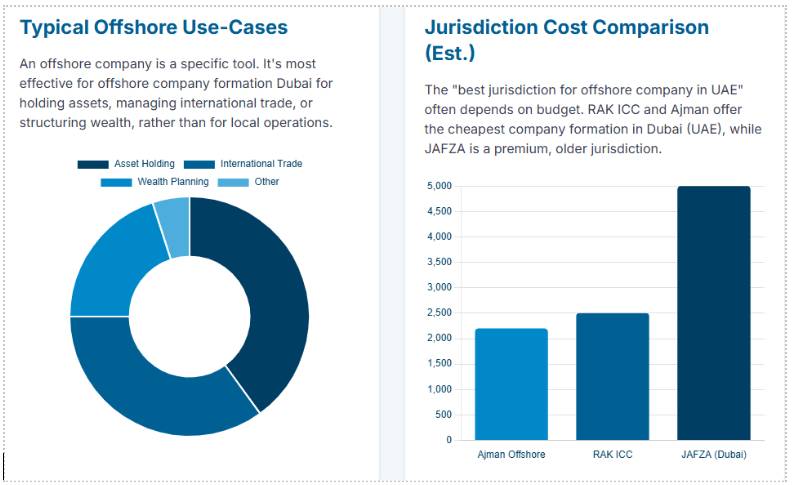
The best jurisdiction for an offshore company in the UAE is entirely dependent on the strategic function of the company. The first is whether there is a need for the LLC to have that particular ability of Dubai real estate ownership.
Dubai vs Ras Al Khaimah vs Ajman, other Offshore Jurisdictions
The UAE mainly provides three offshore jurisdictions:
JAFZA Offshore (Jebel Ali). This ranks as the best, highly reputed and widely accepted by UAE banks. JAFZA enjoys a unique exemption under which it is entitled that its offshore entities can legally own freehold property in certain limited areas of Dubai (such as Palm Jumeirah or Emirates Hills), subject to approval. This makes JAFZA indispensable for investors seeking offshore company registration in Dubai for owning property in local areas.
RAK ICC (Ras Al Khaimah International Corporate Centre): RAK ICC is the world’s fastest-growing corporate registry and our cost-effective offshore solution offering the most efficient registration process for a Dubai Offshore Company (7 business hours after KYC clearance). Perfect for easy international holding, share owning and int trade invoicing when speed and low offshore company in Dubai costs are important.
Ajman Offshore: Provides an easier and more cost-effective solution for simpler holding activities, with incorporation fees at the same level as RAK ICC.
Comparative table/scenarios
There is a small premium (both monetarily and time-wise: JAFZA takes less than four weeks while RAK ICC merely dedicates one week to checking) asked to owning Dubai real estate. It is this functional distinction that determines the strategic decision. In the case of basic global structures, RAK ICC would be fine; for real estate investors, it is JAfz.
Table 2: Comparison of UAE Offshore Jurisdictions
| Criteria | RAK ICC (Ras Al Khaimah) | JAFZA Offshore (Jebel Ali) | Ajman Offshore |
|---|---|---|---|
| Primary Use | International trade, holding, speed, cost efficiency | Holding (esp. Dubai property), strong bank acceptance | Simple holding, affordability |
| Property Ownership in Dubai | Generally Not Allowed | Allowed in approved areas (e.g., Palm Jumeirah) | Limited / Not Allowed |
| Reputation | Excellent, specialist offshore registry | Prestigious, strong bank acceptance | Good, highly affordable |
| Approximate Setup Cost (AED) | 12,000 – 18,000 | 15,000 – 20,000 | 13,000 – 17,000 |
| Incorporation Speed | Fastest (1–7 working days) | Swift (approx. 4 weeks) | Standard (7–14 days) |
BVI company setup in Dubai (or vs Dubai offshore)
The BVI is a powerhouse offshore jurisdiction and is known worldwide for providing strong privacy, confidentiality and neutrality. And, unlike their UAE counterparts registered offshore in the BVI, such structures typically have to comply with comparatively simple and lower-level compliance requirements on formation (especially for audit). Nevertheless, the UAE structure (RAK ICC or JAFZA) affords greater bankability and a sturdier international compliance profile, which is particularly important in today’s climate where BVI structures are subject to significant levels of scrutiny or ‘de-risking’ from international banks. For those seeking stability and a strong banking option in the UAE, the local one is better.
Step-by-Step Process: How to Set Up an Offshore Company in Dubai
Preparation studies: activities, choice of entity, place of incorporation and budgeting cost. What does the business process look like over there then? The first step is to establish what type of international business activity will be allowed and whether or not the chosen entity type (Offshore IBC) fits within those regulatory boundaries (i.e. no local trade, no visas). A reasonable investor will need to account not only for the costs of an initial establishment and capitalized as well as continuing yearly renewal charges, but also for possible high banking-related fees.
Paperwork requirements for setting up an offshore company in Dubai
How well documents are prepared is the most significant factor in a trademark’s registration pace. Completed documents for Offshore company incorporation in the UAE are:
Private Investors: Passport copies, a Recent utility bill (up to 3 months old), a CV/Business profile and an original bank reference letter.
Corporate Shareholder: Certificate of Incorporation, Memorandum and Articles of Association, Good Standing Certificate, and Board Resolution for the parent company, usually needing to be legally translated and attested by the UAE Embassy or Consulate.
All the foreign documentation must be notarized or apostilled, requiring additional red tape and expense.
Reservation of Name, Procedure for obtaining License/Registration, Position of an approved agent
You need to reserve the name of the company with an offshore jurisdiction. The new RAK offshore company formation application requirements in Dubai may only be submitted via an authorized Registered Agent. The representative is required by law to sign all submissions, provide the registered office, and be the principal contact with jurisdiction authorities. So, when it comes to setting up a business in Dubai, the first and foremost thing is the company formation timeline in Dubai or the process of company registration in Dubai, UAE.
RAK ICC Company setup time: Up to 1-7 working days for incorporation upon completion, depending on how fast the client is able to provide us with a signed, scanned copy of the passport received and returned RAKICC documents. The Dubai offshore company registration process duration depends on the readiness of our Clients, going from just one week, provided that they are prompt in giving us all accurate documentation. As it is a very strict onboarding process, checking with the bank account is the real bottleneck (often weeks to months).
Price details: cost of formation, renewal per year, hidden costs
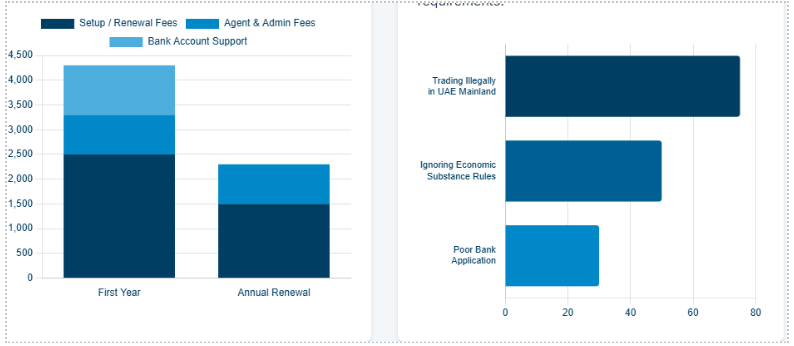
Preliminary set-up expenses also depend on jurisdiction (AED 12,000 to AED 20,000). Annual renewal fees (AED 10,000+) and agent fees (AED 2,000 – 5,000+) are also required. Important Costs Hidden Notarization/ COA Not for Dubai No Penalty for no registration fee if missed = AED10,000ickers: Cost of Bank support fees not included. Corporate lawyer’s Fee Not included.
Banking setup: opening a corporate bank account, common issues you may face at banks
The risk of corporate accounts being rejected is 50%, which remains high. Banks Page25of83 Demand for solid economic rationale, detailed origin of funds/wealth and transparent business model. The key is preparation and the utilization of professional company formers in Dubai that can support your application and provide an introduction to banks which are known to accept offshore structures.
Case Study 5.1 Risk Protection of Banking for an RAK ICC Offshore
Client requirements: Mr. K was an investor from Europe who required an RAK ICC entity for international IP licensing. He received a refusal from one of the primary UAE banks for his first application for a corporate bank account on the allegation of low local activity.
DBTA Intervention: DBTA reviewed the business plan and KYC documents; the source of recurring IP income was in doubt by the bank. A benchmarking report was restructured, highlighting an identified dedicated revenue, and the legal contrast of the holding structure. We were able to connect the client with a bank that had an international commerce division for specialized services.
Outcome: The account was opened with the bank in 4 weeks, thanks to the clear documentation and pre-screening of information.
Client Quote: “DBTA’s banking introduction strategy was the only thing that made this structure fit. They subjected the bank application to just as much scrutiny as the incorporation did, with full transparency.”
Post-formation: Registered agent, nominee services, office or substance (if any)
Post-Formation Once formed, the agent sees to the annual compliance and communication. While no physical premises are necessary, if the business carries on Relevant Activities, it has to demonstrate there is sufficient substance (e.g. outsourced core income-generating activities (CIGA), assets or staff) in order to meet ESR and justify a 0% Corporate Tax rate.
Continuous compliance: renewal audit filings, tax registrations
Continuing, Offshore companies in Dubai will be required to renew annually and keep record maintenance. Whilst audits are not compulsory for all offshore IBCs, all entities are required to formalize mandatory Corporate Tax registration with the FTA.
Use-Cases & Practical Considerations
When an offshore company in Dubai is the right tool:
Owning things (property, IP, shares)
Asset separation is something that offshore enjoys. For those considering offshore company formation in Dubai to hold assets, such as shares or intellectual property, this represents a robust legal climate. Importantly, the JAFZA allows and has a unique right to hold certain Dubai real estate. International trade outside the UAE. For companies engaging in significant cross-border trade (like commodities and technology licensing), the offshore structure serves as a tax-free, stable invoicing platform that can use the local banking system of the UAE.
Wealth planning/estate planning
Offshore structures make it possible for confidential and efficient wealth and estate planning, as well as predictable succession planning and the safeguarding of assets from personal legal risks.
Case Study 6.1 Designing for Succession and Real Estate
Client Requirement: The HNW clients wanted to give Dubai property (villas in Palm Jumeirah) to the next generation, not just for asset protection and estate planning, but also to have assurance that the continuance of their wishes is being protected.
DBTA Intervention: We recommended the creation of a JAFZA Offshore company, which is specifically authorized to own these assets. Ownership was formed through its JAFZA vehicle for the purposes of insulating the assets from immediate probate concerns and to ensure successful succession.
Outcome: The assets were protected within the corporate structure, thereby ensuring the family succession plan was also intact.
Client Quote:
“Selecting JAFZA was not an option under consideration with the guidance provided by DBTA. I highly recommend them if you need to ensure your Thailand assets are structured legally for Thai property ownership.”
When it does not make sense: UAE trading requires staff/local presence, visa aspirations.
For local market interaction, doing physical staff or sponsoring UAE residence visas, you cannot use the offshore structure.
Local Investor view (e.g Pakistan/South Asia), a few thoughts
How do South Asians benefit from the UAE? South Asian investors frequently use UAE offshore companies to take advantage of enhanced political stability, robust international banking facilities and a lack of exchange controls in the Emirates. However, these investors need to expect a tough KYC and AML process in banking, along with very high-quality documentation around the source of funds, as well as wealth.
Exit or restructuring planning: how to wind down or repurpose
Given the carve-out offshore vehicle, more sophisticated exit planning might be implemented. Pre-liquidation or sale, restructuring the entity also permits tax-efficient transfers of assets or spin-off (as well as shut-down) of active divisions, thus mitigating legal and financial risks during wind-down.
Costs & Upkeep: What You will Really Spend
Lowest cost business setup in Dubai, what “low” consists of and what it does not
The “cheap” price you see advertised is normally only for the government registration and basic agent fee. It conveniently leaves out significant unavoidable expenses such as document attestation, professional fees for compliance filings (ESR/CT) and not least the substantial but currently ongoing bank-related maintenance costs.
Pricing comparison by jurisdiction (Ajman vs RAK vs JAFZA)
Though RAK ICC’s minimum threshold to get started is also the lowest (AED 12,000–18,000), annual renewal rates do not differ all that much among those three, with RAK ICC from AED 10,000–12,000+. This marginal long-term cost differential implies that the decision should be system-driven (e.g., JAFZA for real estate) rather than additional implementation savings.
Breakdown: entry fee, annual renewal, banking fee and professional fees
The renewal fee that pays for the required registered agent service must be planned for in your annual operating budget. Rates for Bank service charges, as well as high minimum balance requirements (if they are not met, penalties will be charged), must be used to determine the operating budget.
Unforeseen/hidden expenses: bank account, translation/apostille, nominee services, tax registration
The most severe hidden cost is the AED 10,000 fine imposed on a transaction party who has failed to register for Corporate Tax, such is now compulsory across the UAE by way of circular from the Ministry of Finance dated March 2024. The other five-figure fees arise in respect of legal translation and attestation costs for foreign KYC.
Budget list of the establishment & maintenance for the offshore company
A full budget assumes: starting registration, compulsory annual renewal, banking maintenance (typically a no-interest deposit requirement), and mandatory compliance professional fees (CT reg/filing, ESR reporting).
Table 3: Offshore Company Cost Breakdown (Estimated)
| Cost Component | Description | Estimated Range (AED) | Risk Warning |
|---|---|---|---|
| Initial Registration / Licence | Registry fees, certificate of incorporation (Varies by jurisdiction) | 12,000 – 20,000 | Does not include compliance checks or bank fees. |
| Registered Agent Fee (Annual) | Mandatory official address and liaison service | 2,000 – 5,000+ | Essential; often bundled into setup cost. |
| Annual Renewal Fee | Required maintenance fee | 10,000 – 12,000+ | This is a minimum recurring expense. |
| Document Attestation / Legalization | Legalization of international KYC documents | 1,500 – 5,000 (one-time) | Unforeseen cost if originals require embassy approval. |
| Corporate Tax Registration Penalty | Penalty for failing mandatory registration (FTA) | AED 10,000 | Mandatory for ALL entities, even with 0% tax status. |
How To Choose the Best Company Formation Consultants / Services in Dubai
Why you may need a professional
Given the maze of which jurisdiction to choose, the onerous requirements for access and bank opening, and dealing with mandatory compliance (CT/ESR), it is imperative that one obtains professional guidance in order to safely navigate the risk while maintaining your structure.
What to track: experience, in-house banking support, substance/audit support, transparency around cost
While choosing company formation consultants in Dubai, the priority is not just registration swiftness but how they resolve the banking and compliance issues. Leading Dubai company formation consultants. The leading company formation consultants in Dubai not only have proven international tax structure experience, but also have internal banking support (pre-vetting KYC and bank introductions), and clear ESR and mandatory tax registration/filing obligation support. Transparency of fees is important, including the removal of any latent costs.
Questions to ask
Key questions that should be asked in order to determine the provider´s competence need to go below the paper layer of compliance: “What is your success rate when opening corporate bank accounts for non-resident offshore clients?” and “What is the exact process for handling mandatory UAE Corporate Tax registration of a zero-rated entity?”
Avoid these mistakes when contracting with a provider
Investors should steer clear of teams without notable value other than the very cheapest price for company formation in Dubai; these packages inevitably are missing required banking and compliance components, leaving clients with a non-compliant or non-functional structure, which is immediately subject to fines or refusal.
C A S E S T U D Y 8.1 Coping with Corporate Tax Registration of Zero-Rate Entities
Case Study: A large international conglomerate with a complex RAK ICC structure was primarily dealing with its global financial restructuring and missed the new deadline introduced in the UAE for mandatory Corporate Tax registration.
DBTA Intervention: We spotted there and then the danger of GCC VAT zone complicity with an AED 10,000 penalty (for all UAE entities). DBTA completed the expedited registration process with FTA and implemented internal procedures for filings, rendering the taxpayer compliant.
Outcome: Compliance was achieved, and the client had an instant view of the new regulatory horizon without paying a price.
Client Quote: “We did not know that zero-rated buildings needed to have an actively registered owner. DBTA not only took a proactive approach to identify and execute the FTA filing, but this was done on short notice, and ended up saving us a substantial financial penalty while keeping our compliance record clean in the UAE.
Compliance, Risk & Common Mistakes
Continuing compliance requirements highlighted (annual returns, substance, tax)
Compliance for offshore structures is now an annual and strict responsibility. This is everything from renewal of licenses and keeping UBO registers up to date, and complying with the UAE’s tax laws. For business with Relevant Activities, full ESR compliance is dependent on having sufficient assets and activities in the UAE to sustain the income earned.
Global tax & OECD/BEPS and the intangible risk of being found to be tax resident elsewhere
The introduction of its tax system is also in line with the OECD BEPS project to tax economic activity where it generates a return. The lacuna with respect to real economic substance in the UAE undermines the structure. If the directors or shareholders are tax residents in a high-tax country, that country’s tax authorities can potentially claim that the offshore company is managed and controlled from there, ie through its capital or revenue being generated in said location, and consider this income taxable at home. This is the distraction that is caused by a failure to think about what matters.
No bank account being rejected or de-risk – strategy & preparation
Preventing your application from getting rejected or your account from being derisked in the future requires you to be more prepared than just submitting documents. Investors shall need to show a clear, compelling story of their genuine international business presence, with pristine evidence papers concerning the source of the funds and wealth.
Common errors: Wrong Trading, using offshore to trade in the UAE,
The fatal error is to confuse the functions, trying to locally set up a company formation and business setup in Dubai, UAE, with the limited offshore licence. Additional common mistakes are the failure to observe the compulsory CT registration deadline and the lack of requisite proportionate economic substance for holding or IP business.
The mitigation action plan: what to do (and not do) to remain consistent and save the building
In order to continue with compliance and keep the offshore structure, investors need to make sure that: Corporate Tax registration takes place mandatory at the required time, UBO information is proper documented annual evaluation of ESR criteria must be done for the entity against activities, too, ensuring proportionality between income and local substance (personnel and cost).
Conclusion & Next Steps
Revisit and remember key points: when offshore company formation in Dubai is not appropriate.
Setting up an offshore company in Dubai is a powerful and discreet tool that should only be used for specific reasons: international business, wealth protection or passive holding of assets (especially property in Dubai with JAFZA). Not fit for local residents, employing people or doing business in the home country. Tax Benefits of an Offshore Company in the UAE Today, the truth is that the tax benefits of an offshore company in Dubai depend on strict compliance with the UAE Corporate Tax registration and Economic Substance conditions.
Checklist or summary of the steps and costs.
With Offshore structuring success in mind, one should plan for costs when it comes to transparency, concentrate section of law-based paperwork preparatory work involving offshore company formation in Dubai and engage professionals who are able to access the banking as well as the necessary tax registration areas.
Call to Action: Talk with your consultancy for advice on your particular situation.
With the harsh post-2023 compliant environment and the putative risk to open offshore company bank accounts in a corporate capacity, it is downright dangerous to try for general openings or negotiate on your own. Customized expert guidance is an indispensable investment to help ensure that your structure stands up to scrutiny for years under the strain of global tax enforcement.
How DBTA Can Help
DBTA serves as the custom compliance connection and registered agent with a laser focus on sustainable business architecture for complex international structures.
Strategic Structuring and Jurisdiction Matching
We offer professional advice that makes the distinction between the different types of company creation in Dubai and directs our clients to an appropriate authority for registering (JAFZA if a real estate holding and RAK ICC for international trade). We align the framing of our structure to that of the client’s global tax picture, putting in place measures to guard against the possibility of tax residence being found elsewhere.
Meticulous Compliance and Regulatory Assurance
We eradicate the possibility of serious compliance violations.” DBTA makes sure that all offshore company is registered for corporate tax, where registration of Corporate Tax is mandatory, and saves AED 10,000 against the fine. In addition, we offer full-spectrum assistance with ESR (Economic Substance Regime), including construction and documentation of the requisite substance to support the zero-tax status of the structure under QFZP rules.
Banking Facilitation and De-Risking
We know that the most challenging issue is banking. DBTA provides in-house banking facilitation, pre-vetting the client’s KYC and preparing a solid source of funds documentation, whilst also introducing the new vehicle to verified higher-level UAE bank partners wherein we are familiar with their policies on offshore structures. This knowledge is vital in overcoming the high rejection rates and will help you succeed with corporate bank account opening.
FAQs
Typically, offshore companies do not have to deposit any capital prior to being incorporated.
Time needed for the entity incorporation. With all documents already at hand, 1 – 7 working days (RAK ICC) can be quite enough for Incorporation. Provider groups need to act swiftly in engaging a bank, but the elapsed time until an active sponsor’s bank account can be opened can range from weeks to months.
No, it is limited to international trade, and the firm cannot trade with residents or a business operating in the UAE.
Well, offshore structures do not give you a visa for shareholders or directors.
Read on to know whether one also needs a Dubai offshore company tax resident or not.
The company is required to register for UAE Corporate Tax through the FTA. A failure to register incurs a penalty of AED 10,000. It may qualify for 0% CT rate if it satisfies the Qualifying Free Zone Person requirement and its income is foreign.
Starting a bank account involves careful planning, to provide accurate UBOs (Ultimate Beneficial Owners), proof of source of funds and often experts who will be able to introduce the entity to banks willing to onboard offshore structures.
There are ongoing requirements, which include the necessity to renew your annual fee with the registered agent every year and also maintain up-to-date UBO details on a register, as well as other compliance filings (which might include having to file corporate tax returns and economic substance reports).
Latest news & articles

LLC Trade License Cost in Dubai (2026): Full Breakdown of Fees, Approvals, and Renewal Charges
Read More »
Living Expenses in Dubai (2026): Real Monthly Budgets for Singles, Couples, and Families
Read More »
UID Number in the UAE: How to Find It, Where It Appears, and Why It Matters for Visas and Emirates ID
Read More »About the Author:
AURANGZAIB CHAWLA
As CEO of DBTA, Aurangzaib Chawla advises globally mobile businesses and individuals on cross-border tax planning and structuring. With expertise spanning the UK, UAE, and wider GCC, Zaib helps clients minimise double taxation, protect assets, and achieve long-term financial efficiency while staying fully compliant.
Planning to launch in Dubai or the UAE?
Let’s talk about how to structure your business for growth the smart, compliant, and tax-efficient way
About the Author:
AURANGZAIB CHAWLA

As CEO of DBTA, Aurangzaib Chawla advises globally mobile businesses
and individuals on cross-border tax planning and structuring. With expertise spanning the UK, UAE, and wider GCC, Zaib helps clients minimise double taxation, protect assets, and achieve long-term financial efficiency while staying fully compliant.
Planning to launch in Dubai or the UAE?
Let’s talk about how to structure your business for growth the smart, compliant, and tax-efficient way.
