
How to Protect Your Brand in the GCC: UAE Trademark & IP Strategy Explained

Recent Insights
Table of Contents
Expanding to the UAE? Don’t Risk Your Brand.
Download our free IP Protection Checklist for GCC Markets.

Introduction: The Imperative of Proactive Brand Protection in the GCC
Introduction: Why Brand Protection in the GCC Demands Urgency
The United Arab Emirates (UAE), along with its Gulf neighbors, has turned into one of the world’s busiest crossroads for business and innovation. It’s not just oil money anymore. Finance, tech, tourism, and even e-commerce startups are driving this shift. Governments in the region are deliberately pushing for knowledge-based economies, and that means protecting ideas and creativity has become just as important as building roads and skyscrapers. In this climate, intellectual property UAE rules are more than a formality; they’re a survival tool.
Ask any founder setting up in Dubai or Riyadh: the first question is not only how to scale, but also how to protect your brand before someone else takes it. Here, the law is crystal clear. The UAE follows a strict “first-to-file” system. Whoever files their UAE trademark first owns it period. Unlike in common law countries, prior use or “we used it first” won’t save you. That makes trademark registration in the UAE a race you can’t afford to lose.
This urgency is not theoretical. Recent changes to UAE trademark law, especially Federal Decree-Law No. 36 of 2021, cut through red tape and speed up the process. These updates are part of a bigger UAE IP law for businesses, designed to attract investors and reassure global companies that their brands are safe here. For anyone serious about growth in the Gulf, early UAE trademark protection is the baseline. Without it, a competitor or worse, a copycat can grab your name and lock you out. With it, you’re building the foundation of a long-term brand protection strategy UAE, not just for Dubai, but for the entire GCC.
Understanding Intellectual Property in the GCC: A Legal Foundation
If you’re building a company in the Gulf, you can’t afford to ignore intellectual property UAE rules. This isn’t just about ticking a legal box; it’s about protecting the very assets that give your business value. In today’s economy, a name, a design, or a clever invention can be worth more than the building you operate from. That’s why the UAE and its Gulf neighbors have tightened their systems to make sure brands and innovators get proper protection.
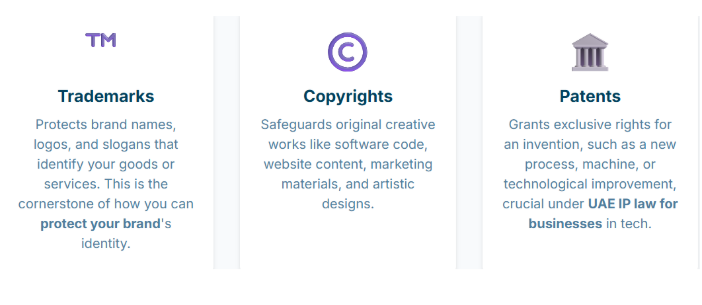
Take trademarks. They’re the most obvious and the most used. A registered UAE trademark covers the names, logos, or marks that make your business stand out. Without one, you’re exposed. Someone else could register the same mark and suddenly you’re the one facing a legal fight just to use your own brand.
Patents are different; they cover the groundbreaking stuff. A unique invention, whether it’s a new app feature, a medical device, or even a mechanical process, can be locked down for 20 years. For startups working on innovation, that’s essentially buying time to grow without being instantly copied.
Then there’s copyright, which most people forget about until it’s too late. The law already protects creative works books, software code, music, even architectural drawings from the moment they’re created. But smart companies weave this into a bigger IP strategy UAE, because it’s often the creative content (apps, media, campaigns) that gets stolen first.
Industrial designs might sound less glamorous but ask anyone in fashion or consumer goods and they’ll tell you it’s vital. It safeguards the look and feel of a product, the shape, pattern, or styling for ten years. Think of how easily packaging or a trendy design can be copied in today’s markets.
Big reforms in 2021 modernized all of this. The UAE passed Federal Decree-Law No. 36 of 2021 on Trademarks, Federal Decree-Law No. 38 of 2021 on Copyrights, and Federal Law No. 11 of 2021 on Industrial Property Rights. One of the most practical changes? Trademark cancellation cases were pulled out of the slow court system and handed to the Trademark Office, which now has to deliver a decision within 90 days. That kind of efficiency gives real confidence to brand owners. But here’s where many companies slip up: thinking protection in Dubai or Abu Dhabi is enough. It isn’t. A proper GCC intellectual property strategy means looking beyond one country. Yes, the Unified GCC Trademark Law of 2016 harmonized a lot of rules, but it didn’t create one single registration. To lock in GCC brand protection, you still need to register in each state Saudi Arabia, Kuwait, Qatar, Oman, Bahrain, and the UAE. Skipping this step leaves wide open gaps competitors can exploit. The reality is simple: companies that treat IP as central to their growth plan come out stronger. A solid brand protection strategy UAE backed by filings across the Gulf doesn’t just keep copycats away. It tells investors, partners, and customers that you’re serious about the future.
Why Trademarks Are the Cornerstone of Brand Protection
A trademark is more than a legal stamp; it is the signature of a brand, the element customers instantly recognize and trust. In crowded markets, a registered UAE trademark is what separates your products from competitors’ offerings and shields buyers from confusion. For businesses, securing trademark registration in the UAE is the first real step in answering the question of how to protect your brand. Without it, even the strongest identity is open to misuse, leaving a company with little ground to fight copycats or unauthorized sellers.
One striking example is the viral “Dubai Chocolate” story. A small UAE-based company created a pistachio-filled chocolate bar that exploded in popularity across social media. Almost overnight, similar products appeared worldwide, with several businesses racing to file trademark applications for the name. The problem was that “Dubai Chocolate” had quickly become a generic phrase in the eyes of consumers, making it nearly impossible to secure as a defensible mark. Some applications were rejected outright, while others were tied up in lengthy disputes across jurisdictions.
The lesson is simple: waiting until your product becomes famous to think about UAE trademark protection is often too late. Once the public adopts a name as a generic description, the legal ground becomes shaky even if the commercial success is huge. The case underscores why a smart brand protection strategy UAE starts early. A solid filing not only grants exclusive rights but also builds the foundation of a broader IP strategy UAE, giving companies the power to act against infringement before competitors or opportunists step in.
The Dubai Trademark Registration Process: Step-by-Step
The process for registering a trademark in UAE is handled by the Ministry of Economy (MoE). On paper, it looks straightforward, but in practice, each step requires care. A mistake at the start can push things back by months, so businesses aiming for solid UAE trademark protection need to approach it methodically.
- The Critical Trademark Search: Before submitting anything, the first move is to check whether the mark is already in use. This isn’t just a quick scan; you’ll need to search both the MoE’s database and the WIPO Global Brand Database. Many applicants rush this part, and that’s where trouble starts. A superficial search almost always leads to objections or outright rejection later.
- Preparing Your Application: Once the mark is confirmed as available, the application file needs to be prepared. The MoE requires a clean, high-quality version of the logo or wordmark, a copy of the company’s trade license, and, if you’re using an agent, a Power of Attorney. For overseas applicants or businesses without a local presence, working with an approved trademark registration UAE agent is compulsory.
- Filing the Application: Applications are filed through the MoE’s e-services portal. At this stage, the applicant also selects the classes of goods and services under the Nice Classification system. A welcome update in UAE trademark law now allows multiclass applications, which can save both money and time for brands that span multiple industries.
- Examination and Initial Approval: Once filed, the MoE examines the application. Officials look for similarities with existing trademarks and make sure the submission doesn’t include prohibited content such as religious symbols, flags, or misleading terms. If everything checks out, the initial decision is usually issued within 90 working days.
- Publication in the Official Bulletin: After approval, the mark is published in the MoE’s official bulletin and also in two Arabic-language newspapers. This is the public’s chance to review the application.
- The Objection Period: From the date of publication, there is a 30-day window where anyone with a valid claim can object. If no opposition comes through, the application moves to the final stage.
- Final Registration and Certification: The last step involves paying the registration fees. Once this is done, the MoE issues the official certificate, confirming that the owner now holds exclusive rights to the mark across the UAE.
As for timing, most applications take four to five months from start to finish. In terms of costs, businesses should expect to spend around AED 6,500, though the government may revise these fees over time.
| Phase | Fees (approx. in AED) | Timeline (approx. in Days) |
|---|---|---|
| Application & Filing Fees | 750 | Immediate |
| Ministry Review | Included | Up to 90 working days |
| Publication Fees | 750 | Following acceptance |
| Objection Period | Included | 30 days |
| Final Registration Fees | 5,000 | Following objection period |
| Total Estimated Cost | 6,500 | ~120–150 Days |
| Renewal Fees (before expiry) | 6,500 | N/A |
| Renewal Fees (grace period) | 7,250 | N/A |
| Late Publication Fees | 100 per month | N/A |
Common Mistakes and How to Avoid Them
Although the Dubai trademark registration process is clear in theory, in practice many applicants fall into the same traps. These errors are often simple, yet they can delay or even ruin a filing. Being aware of them early on can save both money and months of frustration.
- Failure to Conduct a Proper Search: One of the most frequent reasons for rejection is that the proposed mark is already in use. Businesses sometimes skip a serious search, assuming their idea is unique. When the Ministry of Economy checks and finds a conflict, the application gets thrown out. Taking time for a full review of both the MoE database and WIPO records should always be the first step in any brand protection strategy UAE.
- Choosing Non-Distinctive or Generic Marks: Trademarks are supposed to distinguish your products from everyone else’s. If the mark is too generic, for example, trying to trademark the word “Perfume” for a fragrance it will be rejected. A good mark should have character; it needs to stand out, not blend in with everyday descriptions.
- Using Prohibited Symbols and Words: The law is strict about what can’t be included. Flags, religious symbols, state emblems, or phrases like “registered” or “copyright” are off-limits. Including any of these is almost guaranteed to trigger a refusal.
- Filing with Incorrect Details or Documents: Small mistakes can create big problems. Missing paperwork, spelling errors, or ignoring follow-up notices from the MoE can stop an application in its tracks. Some applications even lapse entirely because the applicant didn’t respond in time. For reliable UAE trademark protection, precision in the filing process is just as important as the idea behind the brand itself.
Protecting Your Brand on a Broader Scale: GCC & E-Commerce
Registering a UAE trademark is the foundation, but it is not enough on its own. Brands that want long-term security need to think regionally. The Gulf may feel like a single market, yet every country still enforces its own system. The Unified GCC Trademark Law has brought consistency, but it is not a substitute for individual filings. If a company wants true GCC brand protection, it has to go the extra mile securing rights in Saudi Arabia, Qatar, Kuwait, Oman, and Bahrain alongside the UAE. Skipping these steps leaves space for others to claim the same mark.
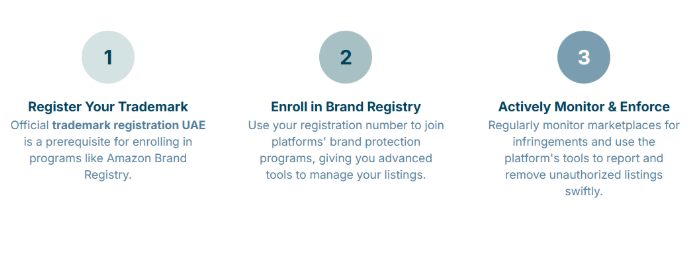
The online world raises even bigger challenges. For modern companies, whether tech startups, fashion houses, or digital-first sellers the real test is how to protect your brand on amazon and other global platforms. Counterfeits and unauthorized resellers thrive in online marketplaces, often damaging a reputation far faster than traditional competitors ever could. A registered UAE trademark is not just a local shield it opens doors to global protection tools. Amazon’s Brand Registry is the clearest example. Once enrolled, businesses can access automated, AI-driven systems that detect and remove infringing listings. But there’s a catch: you can’t join without proof of trademark registration in the UAE. That single certificate is what gives access to those protections.
For newer businesses still waiting on approval, Amazon’s IP Accelerator program fills the gap. It connects brands with vetted legal partners, allowing them to access Brand Registry benefits even while the application is pending. This link between local registration and international e-commerce protection shows why an IP strategy UAE should be built early. Filing on time in Dubai or Abu Dhabi doesn’t just secure rights locally, it creates leverage across the GCC and strengthens a brand’s hand in the global digital economy.
Not Sure If Your IP Is Safe in the UAE?
Let our international tax and IP advisors help assess your brand’s current protection and plan the right UAE filing strategy
Real-World Industry Case Studies
The importance of intellectual property protections in UAE isn’t theoretical, it shows up every day in how companies survive and grow. Different industries face different threats, and the way they use an IP strategy UAE can decide whether they succeed or get copied out of the market.
Tech Startups: For startups, the most valuable assets usually aren’t physical they’re ideas, code, or proprietary platforms. Copyright automatically protects software, but that alone isn’t always enough. Registering with the Ministry of Economy gives founders stronger enforcement rights and, just as importantly, reassures investors that the IP is secure. A complete strategy also means using contracts wisely clear non-disclosure agreements, clauses that assign rights from contractors, and safeguards for trade secrets. Without these measures, a tech startup can lose its edge before it even scales.
F&B Sector: The food and beverage market is notorious for imitation. The “Dubai Chocolate” story is a good reminder that a viral product can be copied quickly if it isn’t backed by UAE trademark protection. It’s not just about the brand name either. Companies in this sector should think about trademarking packaging, logos, and even taglines. That kind of layered protection makes it much harder for competitors to ride the wave of someone else’s creativity.
Fashion & E-Commerce: Few industries are hit harder by counterfeiting than fashion. A landmark ruling from the Abu Dhabi Commercial Court underscored this point. A local store was found to be using a well-known global brand’s trademark, and the court ordered all infringing activity to stop immediately. That included removing the name from registries, pulling it off shelves, and banning its use on social media. The ruling sent a strong message: infringement won’t be tolerated. Effective enforcement here doesn’t rely on one agency alone it requires a coordinated approach. Dubai Customs monitors goods at the border, while the Dubai Department of Economic Development (DED) tackles misuse in local markets. Together, they make brand protection strategy UAE a practical reality rather than just a legal theory.
Legal Steps for IP Protection in UAE: Beyond Registration
The reality is that a brand protection strategy UAE doesn’t end with a registration certificate. Getting the paperwork is just the first milestone. What truly matters is what happens afterward constant monitoring and taking action when someone tries to misuse the brand.
Proactive Monitoring: Once a trademark is registered, the job isn’t finished. Owners have to stay alert. New filings that look or sound similar can appear at any time, and if nobody notices, they may slip through. Many businesses rely on legal firms that provide watch services. These firms track new applications and flag anything that might become a problem. Early detection makes enforcement faster and far less expensive.
Filing a Complaint: When infringement does happen, speed matters. If counterfeit goods are being shipped in, Dubai Customs is the authority to approach they can seize items at the border or within free zones. For violations inside the market, the complaint usually goes to the Department of Economy and Tourism (DED) in Dubai. But authorities won’t move without proof. That means providing a valid UAE trademark registration certificate along with clear evidence of the violation. Without those documents, a case rarely goes anywhere.
Enforcement and Penalties: The UAE has little tolerance for IP violations. Fines can be severe, reaching up to AED 1,000,000, and in serious cases, imprisonment is possible. Alongside government penalties, brand owners also have the option to take matters to court by filing civil cases to recover damages and seek injunctions that force infringers to stop immediately. These tools make it clear: an IP strategy UAE is not just about registering a mark; it’s about actively defending it.
Future Outlook: Trends Shaping GCC IP Strategy
What we’re seeing now is that the UAE’s IP legal framework is no longer fixed or reactive, it’s evolving in real time. Lawmakers understand that technology is changing too quickly for old systems to cope. Federal Decree-Law No. 14 of 2023 on Trading by Modern Means is a clear example. By defining “modern technological means” to include digital tools, biometrics, artificial intelligence, blockchain, and beyond, the UAE has signaled its intent to build a system that can keep pace with innovation. It’s less about patching problems and more about designing rules that will still make sense ten years from now.
Another area that’s moving fast is intellectual property in the metaverse. As companies launch virtual goods or immersive digital services, a new set of legal challenges follows. Can you trademark a product that exists only online? Who actually owns something created by an AI engine? The high-profile dispute between Hermès and the creator of “MetaBirkins” NFTs shows how blurred the line between physical and digital rights can become.
By acting early, the UAE is putting itself ahead of the curve. Instead of waiting for disputes to stack up, it is reforming its laws now to give businesses clear protection later. This approach shows that IP strategy UAE is not just about today’s issues it’s about preparing for what’s next. For companies planning to expand across the Gulf, these reforms will help define the future of GCC intellectual property strategy, ensuring the region stays competitive in an economy that is becoming more digital by the day.
How DBTA Can Support Your Brand Protection Journey
The reality is that handling UAE trademark law and wider GCC intellectual property strategy can feel overwhelming. Deadlines are strict, forms are technical, and a small mistake can easily set a business back. At Dubai Business and Tax Advisors DBTA, we see this happen often and it’s exactly why we step in to make the process easier. We start with the basics: a full trademark search to check if your brand is clear. From there, we manage the filing with the Ministry of Economy and deal with any objections, renewals, or enforcement steps that follow. Clients don’t have to chase paperwork; we do that for them. But filing is only part of the story. Protecting a brand doesn’t end with registration. DBTA helps monitor the market, so clients know quickly if someone tries to misuse their mark. With a registered UAE trademark, we also guide businesses into programs like Amazon Brand Registry and IP Accelerator. These tools give e-commerce and digital brands real protection against counterfeiters and unauthorized sellers.
In our experience, every sector has its own risks. A startup may need an IP strategy UAE that covers software and founder contracts. A food brand often has to secure packaging designs or slogans. Fashion and retail companies fight counterfeits and require tougher enforcement. DBTA has worked across all these areas and builds strategies that fit the business, not just the law. For us, brand protection strategy UAE is about more than compliance. It’s about keeping your brand safe today and strong enough to grow tomorrow. If you want to protect your brand across the UAE and the GCC, DBTA is here to guide you through each step.
FAQs
The truth is, registering a trademark in the UAE is straightforward once you know the steps. You begin by checking whether the name or logo is already taken. This search is done through the Ministry of Economy system. If it’s clear, you’ll need to submit an online application, including your license details and the design of the mark. After review, it’s published for objections. If no one challenges it, you receive your official UAE trademark registration certificate.
Foreign companies are allowed to apply for trademark registration in the UAE, they can’t do it directly. In practice, the law requires them to appoint a local agent who is licensed to deal with the Ministry of Economy. That agent files the paperwork, tracks the deadlines, and handles any objections. Once registered, the protection is the same as for UAE firms, giving foreign businesses full rights to defend and enforce their brand in the market.
Once granted, a UAE trademark is valid for ten years from the date of filing. After that, it can be renewed for a further ten-year period as long as the renewal fees are paid. If the deadline is missed, there is a short grace period where you can still renew but with a penalty. If the renewal is not done at all, protection lapses, and competitors may step in to register a similar mark.
A UAE trademark only protects your brand inside the Emirates. It doesn’t automatically extend to the wider Gulf. Each GCC country Saudi Arabia, Qatar, Kuwait, Bahrain, and Oman requires a separate filing to secure rights there. While the Unified GCC Trademark Law brought some consistency, it didn’t create a single registration system. To build proper GCC brand protection, businesses need a plan that covers individual registrations in every target market rather than relying on one certificate.
To file for trademark registration in the UAE, you typically need a copy of your trade license, a clear image of the trademark logo, details of the goods or services under the Nice Classification, and a Power of Attorney if an agent is handling the process. Foreign businesses must appoint a local representative. Submitting the correct documents at the start reduces delays and ensures the Ministry of Economy accepts the application without unnecessary objections or rejections.
The government fees for UAE trademark registration are usually around AED 6,500, but the final cost may vary depending on the number of classes and whether legal agents are involved. Costs typically include filing, publication, and issuance of the certificate. If renewal deadlines are missed, late fees apply. Considering the value of brand protection, these costs are relatively small compared to the risks of infringement, counterfeiting, or losing rights to a competitor in the market.
If infringement occurs, the trademark owner can file a complaint with authorities such as Dubai Customs or the Department of Economy and Tourism (DED). Proof of a valid UAE trademark registration must be provided along with evidence of misuse. Penalties can be heavy, ranging from large fines to imprisonment in serious cases. Civil lawsuits are also an option, where owners may claim damages or seek injunctions to immediately stop the violation. Swift action strengthens enforcement.
Currently, there is no single GCC-wide trademark registration. The Unified GCC Trademark Law harmonized many rules, but businesses must still register separately in each country Saudi Arabia, Qatar, Kuwait, Bahrain, Oman, and the UAE. To achieve strong GCC brand protection, companies need to map out a filing strategy for all target markets. Ignoring this step can leave gaps that competitors exploit, making regional protection incomplete despite having a valid mark in one country.
The process of UAE trademark registration usually takes about four to five months if there are no objections. This timeline includes the initial filing, the Ministry’s review, publication in the official gazette and local newspapers, the 30-day opposition period, and finally, the issuance of the certificate. Delays can happen if documents are incomplete or if someone files an objection. Planning and filing early is the safest way to avoid unexpected complications or losses.
Conclusion: A Call to Action for Proactive IP Protection
The truth is, securing your brand in the GCC isn’t just about ticking a legal box, it’s a strategic investment in the future of your business. The UAE’s “first-to-file” system, together with its constantly evolving laws, makes one thing clear: brand owners have to move fast and act with intent. The first step in IP protection in UAE should always be a careful trademark search, followed by a timely application with the Ministry of Economy. This isn’t just about securing exclusive rights to your mark, it is also the key to unlocking tools like Amazon Brand Registry, which are becoming essential for survival in the global digital economy.
But filing once is not enough. A serious IP strategy UAE goes further. It means monitoring for misuse, understanding the different rules across the GCC, and being ready to enforce your rights when someone tries to take advantage of your brand. Put simply, your brand is your most valuable asset. And in a region as competitive as the Gulf, proactive intellectual property UAE protection is the only way to safeguard that asset, keep your edge, and build growth that lasts.
The UAE Trademark & IP Playbook
Learn about Madrid Protocol, UAE-specific registration, RAKICC structures for brand control, and GCC enforcement.

Latest news & articles


About the Author:
AURANGZAIB CHAWLA
As CEO of DBTA, Aurangzaib Chawla advises globally mobile businesses and individuals on cross-border tax planning and structuring. With expertise spanning the UK, UAE, and wider GCC, Zaib helps clients minimise double taxation, protect assets, and achieve long-term financial efficiency while staying fully compliant.
Planning to launch in Dubai or the UAE?
Let’s talk about how to structure your business for growth the smart, compliant, and tax-efficient way

About the Author:
AURANGZAIB CHAWLA

As CEO of DBTA, Aurangzaib Chawla advises globally mobile businesses
and individuals on cross-border tax planning and structuring. With expertise spanning the UK, UAE, and wider GCC, Zaib helps clients minimise double taxation, protect assets, and achieve long-term financial efficiency while staying fully compliant.
Planning to launch in Dubai or the UAE?
Let’s talk about how to structure your business for growth the smart, compliant, and tax-efficient way.
