
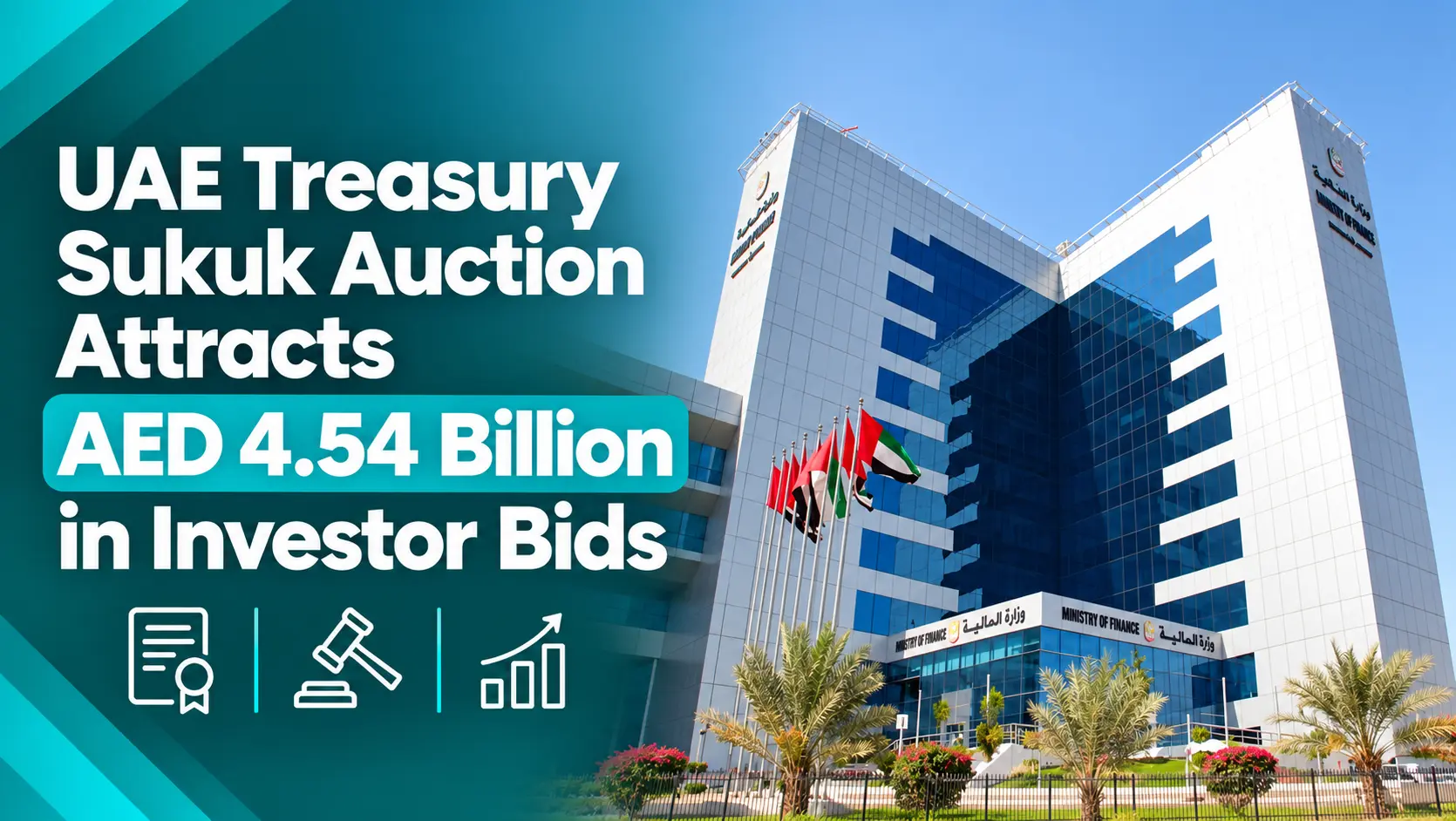
The UAE’s October 2026 Treasury Sukuk and Bond auction has attracted AED 4.54 billion in investor bids, highlighting strong demand for the country’s government securities. The Ministry of Finance announced the results on 31 October 2026. The total bids were around 4.1 times higher than the amount offered.
The government issued AED 1.1 billion through the auction. The offering included Islamic Treasury Sukuk (T-Sukuk) and conventional Treasury Bonds (T-Bonds), both issued in UAE dirhams.
The Ministry of Finance acted as the issuer, while the Central Bank of the UAE (CBUAE) served as the issuing and payment agent. The auction involved authorised primary dealers, which played a role in the initial distribution of the securities.
UAE Treasury Auction Includes Two Investment Tranches
The October auction included two securities with different maturity dates and yields.
The first was a new T-Sukuk tranche maturing in October 2029. It achieved a yield to maturity (YTM) of 4.95%. The second was a T-Bond tranche maturing in January 2031, with a YTM of 5.05%.
The T-Sukuk carried a spread of 19 basis points above comparable US Treasury yields, while the T-Bond had a spread of 26 basis points. One basis point equals 0.01 percentage points. These spreads show the difference between the yields offered by UAE securities and comparable US government debt.
The two instruments serve different investment needs. T-Sukuk follow an Islamic finance structure, while T-Bonds are conventional government securities. Their different maturity periods also give investors more choice when considering dirham-based investments.
AED 4.54 Billion in Bids Supports the UAE Debt Market
The key result of this auction is the strong difference between investor demand and the amount issued.
Investors submitted AED 4.54 billion in bids, while the government issued AED 1.1 billion. This resulted in an oversubscription of 4.1 times.
Strong demand supports the development of the UAE’s local debt market. Regular government Sukuk and Bond issuances help build a dirham-denominated yield curve. This provides pricing benchmarks across different maturity periods.
Banks, government-related entities and private companies can use these benchmarks when assessing the cost of raising funds. They also provide useful information for businesses reviewing financing options and long-term investment plans.
However, strong demand for government securities does not guarantee lower borrowing costs for private businesses. Companies still need to assess their own financial position, funding requirements and repayment capacity.
Nasdaq Dubai Listing Gives Investors Secondary Market Access
Both securities are listed on Nasdaq Dubai, allowing investors to trade them in the secondary market after their initial issuance.
This gives investors the option to sell their holdings before maturity, depending on market conditions and available buyers. However, listing does not guarantee constant trading activity or a fixed selling price.
The involvement of authorised primary dealers also supports the auction process by connecting the initial issuance with the wider investment market.
What UAE Businesses Should Consider Now
The latest auction results are relevant to businesses that are reviewing their financing needs, investment plans and financial performance.
Companies planning expansion or considering debt financing should monitor local market benchmarks when assessing their funding options. They should also maintain accurate accounting and bookkeeping records to understand their financial position.
Reliable budgeting and forecasting can help businesses estimate future expenses, manage cash flow and plan for funding requirements. Clear financial reporting also allows management to review performance and make better decisions.
Ignoring these areas can make it harder to identify financial pressure, control costs and assess whether a funding decision is suitable. Businesses should review their financial records and update their forecasts before making major financial commitments.
How Dubai Business and Tax Advisors Can Support Businesses
As the UAE’s financial market develops, businesses need reliable financial information to make informed decisions. Dubai Business and Tax Advisors (DBTA) supports companies through accounting and bookkeeping, budgeting and forecasting, financial reporting, audit support and business advisory services.
With an ACCA-qualified team, DBTA helps businesses organise financial records, monitor performance and improve financial planning. These services can support better financial control as companies assess their funding needs and future growth plans.
The October 2026 auction attracted AED 4.54 billion in investor bids against an issuance of AED 1.1 billion. The results highlight strong demand for UAE government securities and continued development of the country’s dirham-denominated debt market.