
RAK ICC RPC (Restricted Purpose Company): Deal-by-Deal Examples from Finance & Projects (2026 Guide)

Recent Insights
Table of Contents
Introduction
In the high-stakes landscape of UAE corporate finance, isolating risk is a prerequisite for professional deal-making. For institutional investors and project sponsors, the RAK ICC RPC(Restricted Purpose Company) has emerged as the premier vehicle for this exact requirement. Unlike a standard entity, an RPC is legally bound by its constitution to engage only in the specific activities defined at its creation, offering a level of certainty that general trading companies cannot match.
The primary utility of the RAK ICC RPC lies in its specialised capacity to ring-fence assets and liabilities on a deal-by-deal basis. Whether structuring a securitisation or an infrastructure project, this vehicle ensures “bankruptcy remoteness.
This guide provides a complete roadmap to the RPC, from navigating RAK ICC SPV setup and drafting precise RPC memorandum wording to satisfying stringent lenders’ SPV requirements in the UAE. We move beyond theory to cover what matters most in 2026: execution, banking readiness, and compliance.
Quick Answer (Decision Summary)
The Restricted Purpose Company is not a one-size-fits-all solution; it is a precision instrument for structured finance. In 2026, UAE regulators and financial institutions have shifted toward “substance-over-form,” meaning the rationale for your corporate vehicle must be watertight.
When RAK ICC RPC is a fit:
You are managing a project where debt must be non-recourse to a parent group. You are creating a “siloed” investment vehicle for a joint venture. You need to hold a single asset (like a vessel or a plot of land) and want to ensure that no other business activities can ever contaminate that asset’s legal standing.
When it is not a fit:
You are running a general trading business, an e-commerce platform, or any enterprise where the business model might pivot.
The Conversion Question:
Many founders ask, “Can I convert to RPC later if a lender demands it?” Under the RAK ICC Business Companies Regulations, a company that is not registered as an RPC at the time of its incorporation (or continuation/re-registration) cannot subsequently be registered as an RPC. You must incorporate an RPC from day one; conversion from a standard IBC is legally prohibited. It is significantly more efficient to include it as an RPC from day one to maintain a “clean” legal lineage.
Decision Framework:
Is the activity limited to one specific project?
→ Use RAK ICC RPC.
Is the vehicle meant to protect a parent company from project debt?
→ Use RAK ICC RPC.
Is this a multi-activity investment fund?
→ Use a standard SPV vs holding company UAE structure.
What is a RAK ICC RPC (Restricted Purpose Company)?
A Restricted Purpose Company is a specialised legal entity registered under the Ras Al Khaimah International Corporate Centre. While a standard company has “unrestricted objects, meaning it can do anything legal, the RAK ICC RPC is constitutionally prohibited from acting outside a narrow scope.
From a credit perspective, this is a powerful tool for ring-fencing assets and liabilities. It provides “certainty of objects” to lenders. If a parent company faces insolvency, the assets within the RAK ICC RPC are shielded because the RPC is never legally allowed to sign guarantees or take on debt unrelated to its core purpose.
Concept vs Legal Form
It is vital to distinguish between the restricted purpose company RPC vs SPV UAE concepts. In common parlance, an “SPV” is a general financial term for any vehicle used for a specific project. However, an “RPC” is a specific legal designation within the RAK ICC registry. A standard SPV can theoretically be repurposed by its directors.
An RPC, however, is legally “handcuffed” by its Memorandum of Association. If the directors attempt to engage in activities outside the RPC-allowed activities, those acts are often considered ultra vires (beyond their powers). Creditors or shareholders can challenge them.
RAK ICC
RPC (Restricted Purpose Company)
Watch this short video to see how RAK ICC RPC (Restricted Purpose Company) explained simply in under 60 Second.
How to Set Up a RAK ICC RPC (Step-by-Step)
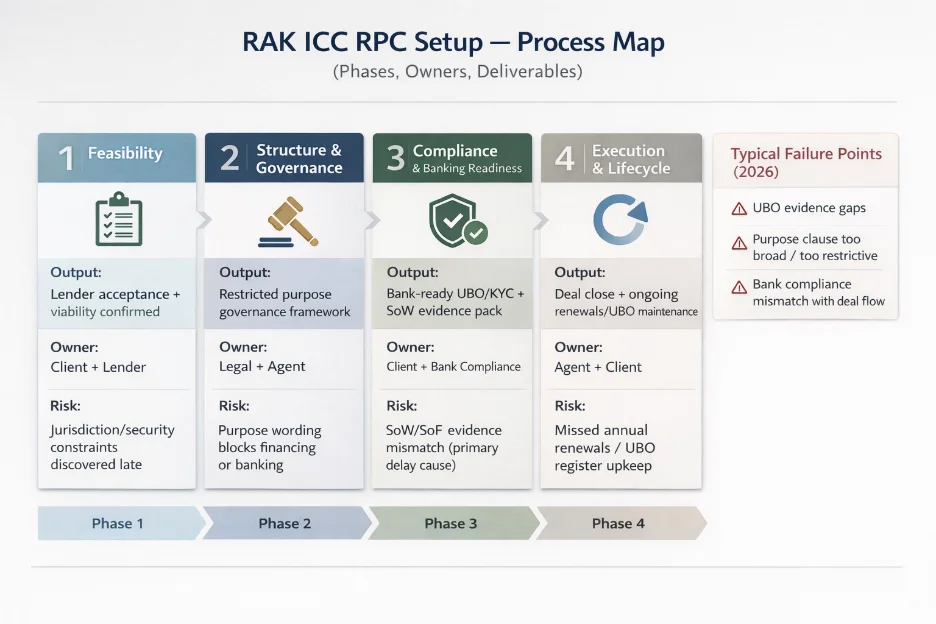
The RAK ICC SPV setup is a multi-phased process that requires coordination between legal, finance, and the registered Agent.
Step 0: Pre-check (confirm RPC is the right vehicle)
Confirm that your project’s financial modelling accounts for the restricted nature of the entity. Consult your Lender to ensure they accept RAK ICC as a jurisdiction for security registration.
Step 1: Define the restricted purpose
Draft the purpose statement that will be baked into the constitution. It must be specific (e.g., “to hold and manage Plot 452 in Dubai Maritime City”) but flexible enough to allow for financing and administration.
Step 2: Finalise structure
Identify Shareholders, Directors (at least one natural person), and the UBO. In 2026, the “transparency” of the UBO is the single biggest factor in the RPC incorporation timeline and banking success.
Step 3: Prepare the UBO/KYC pack
You must prepare a “Source of Wealth” narrative. Banks and registries now require documentary evidence (bank statements, audited accounts of parent firms) to support the capital injection. This is the stage where most “do-it-yourself” applications fail.
Step 4: Incorporation as RPC
Apply to a licensed RAK ICC agent. The registry will issue a Certificate of Incorporation specifically stating the company is a Restricted Purpose Company.
Step 5: Board approvals
Execute the RPC board resolutions checklist. This must cover the adoption of the MOA, the appointment of directors, and the specific authorisation to enter the “Deal” (e.g., signing a loan agreement).
Step 6: Bank account opening
Submit the RPC bank account documents to a UAE bank. In 2026, the “purpose” clause in the MOA is the first thing compliance officers check.
Step 7: Deal execution
The RPC enters the transaction. If there is debt involved, ensure the lenders’ SPV requirements in the UAE regarding security registration are met immediately.
Step 8: Renewal + ongoing compliance
Automate your RPC compliance checklist for 2026. This includes the annual renewal and the mandatory filing of the UBO register. Note that for financial years ending after 31 December 2022, ESR notifications and reports are no longer required in the UAE, as substance is now largely managed through the Corporate Tax regime.
RPC vs SPV UAE vs Holding Company (Comparison)
Understanding the SPV vs holding company UAE dynamic is essential for tax planning under the 2026 UAE Corporate Tax regime.
Decision Table: Corporate Structures
| Feature | RAK ICC RPC | DIFC / ADGM SPV | Standard Holding Co |
|---|---|---|---|
| Primary Use | Deal-by-deal ring-fencing | Institutional / DIFC assets | Long-term group ownership |
| Setup Speed | 3–5 Business Days | 2–3 Weeks | 1–2 Weeks |
| Objects | Strictly Restricted | Flexible | Unrestricted |
| Annual Audit | Varies by Lender | Usually Mandatory | Required only if taxable income exceeds AED 3,000,000 or if required by the Licensing Authority. |
| Bankability | High (if deal-specific) | Very High | Medium |
| Relative Cost | Low to Medium | High | Medium |
Case Study: Isolating Project Debt
A regional energy sponsor needed to secure non-recourse project finance for a waste-to-energy plant. The parent company had multiple other liabilities, and the lenders required a structure that ensured the plant’s revenue could not be used to settle the parent’s unrelated debts.
DUBAI Business and Tax Advisors structured a RAK ICC RPC that was legally barred from engaging in any business other than the operation of that specific plant. This provided the “bankruptcy remoteness” the bank demanded, allowing the project to reach financial close in record time.
RPC Allowed Activities and Purpose Restrictions
The RPC allowed activities are not a “menu” you pick from; they are a bespoke definition of what your company is allowed to do. In 2026, the RAK ICC registry scrutinises these clauses to ensure they do not overlap with activities requiring specialised UAE mainland licenses (like insurance or retail banking).
Typical Acceptable Purposes:
- “To act as a vehicle for the acquisition, financing, and management of [Specific Asset Name].”
- “To enter into a securitisation transaction involving [Specific Receivables Pool].”
- “To serve as a borrower under the [Project Name] Facility Agreement.”
Purpose Wording Red Flags:
Avoid “purpose creeps.” If your RPC memorandum wording says the company exists only to hold a villa in Palm Jumeirah, but you start using it to trade stocks, you are in breach of your own constitution. Banks will flag this during annual reviews as restricted-purpose company risks.
Deal-by-Deal Examples (Finance & Projects)
Example 1: Project Finance SPV UAE
- Purpose: To build and operate a waste-to-energy plant in Sharjah.
- Parties: Developer (Sponsor), Consortium of Banks (Lenders).
- Cashflows: Revenue from the utility company flows into an escrow account held by the RAK ICC RPC.
- Ring-fence mechanics: The RPC’s assets cannot be attached by creditors of the Developer if the Developer’s other projects fail.
- Key Documents: PPA Agreement, Facility Agreement, and Direct Agreement.
- Lender Focus: The Lender’s SPV requirements in the UAE will focus on “Non-Petition” clauses and step-in rights.
Example 2: Securitisation SPV UAE
- Purpose: To purchase a pool of auto loans and issue notes to investors.
- Parties: Originator bank and Institutional Investors.
- Cashflows: Interest and principal from auto-loans flow into the RPC and are redistributed to noteholders.
- Ring-fence mechanics: True sale of assets from the originator to the securitisationSPV UAE.
- Key Documents: Receivables Sale Agreement, Trust Deed.
- Lender Focus: Ensuring the “True Sale” legal opinion is robust.
Example 3: Single-Asset Acquisition SPV
- Purpose: Holding a 10% stake in a Pre-IPO tech firm.
- Parties: High-Net-Worth Individual (HNWI) and the Target Company.
- Cashflows: Dividend payments or exit proceeds.
- Ring-fence mechanics: Isolates this specific investment from the HNWI’s other personal assets.
- Key Documents: SHA (Shareholders Agreement).
- Lender Focus: Source of Funds for the initial investment.
Example 4: JV / Consortium Project SPV
- Purpose: Two construction firms are joining to bid on a Dubai Metro expansion.
- Parties: Partner A (50%) and Partner B (50%).
- Cashflows: Progress payments from the government body.
- Ring-fence mechanics: Prevents Partner A’s general creditors from seizing the JV’s equipment.
- Key Documents: JV Agreement, Management Agreement.
- Lender Focus: Governance and deadlock-breaking mechanisms.
RPC Company Requirements (Setup + Governance)
The RPC company requirements in 2026 are stricter due to UAE Corporate Tax and AML compliance.
Requirements Checklist Table
| Category | Requirement | 2026 Compliance Standard |
|---|---|---|
| Registered Agent | Mandatory | Must be a RAK ICC licensed agent in good standing. |
| Registered Office | Mandatory | Physical address in RAK (usually Agent’s office). |
| Director | Minimum 1 | Natural person preferred for banking; residency not required. |
| Shareholder | Minimum 1 | Can be a corporate or natural person. |
| UBO Disclosure | Mandatory | Private register maintained by Agent; accessible by Authorities. |
| Economic Substance | If applicable | A filing is required if “Relevant Activity” is conducted. |
Governance Discipline:
- Minutes: All board meetings regarding the “restricted purpose” must be minuted.
- Approvals: Any contract signed must be preceded by a board resolution.
- Signatory Controls: Usually tied to the RPC board resolutions checklist to ensure no single director can bypass the restricted purpose.
Case Study: Streamlining Multi-Investor KYC
An investment club with 15 UBOs across four continents wanted to acquire a distressed office building in Dubai. The sheer volume of KYC documentation was a major hurdle for UAE banks.
DUBAI Business and Tax Advisors pre-vetted all 15 UBOs, creating a unified “Investor Pack” that addressed the RPC company requirements before the bank even asked. We presented the bank with a clear narrative of the RPC deal-by-deal SPV strategy, resulting in a bank account approval in just 35 days.
RPC Memorandum Wording
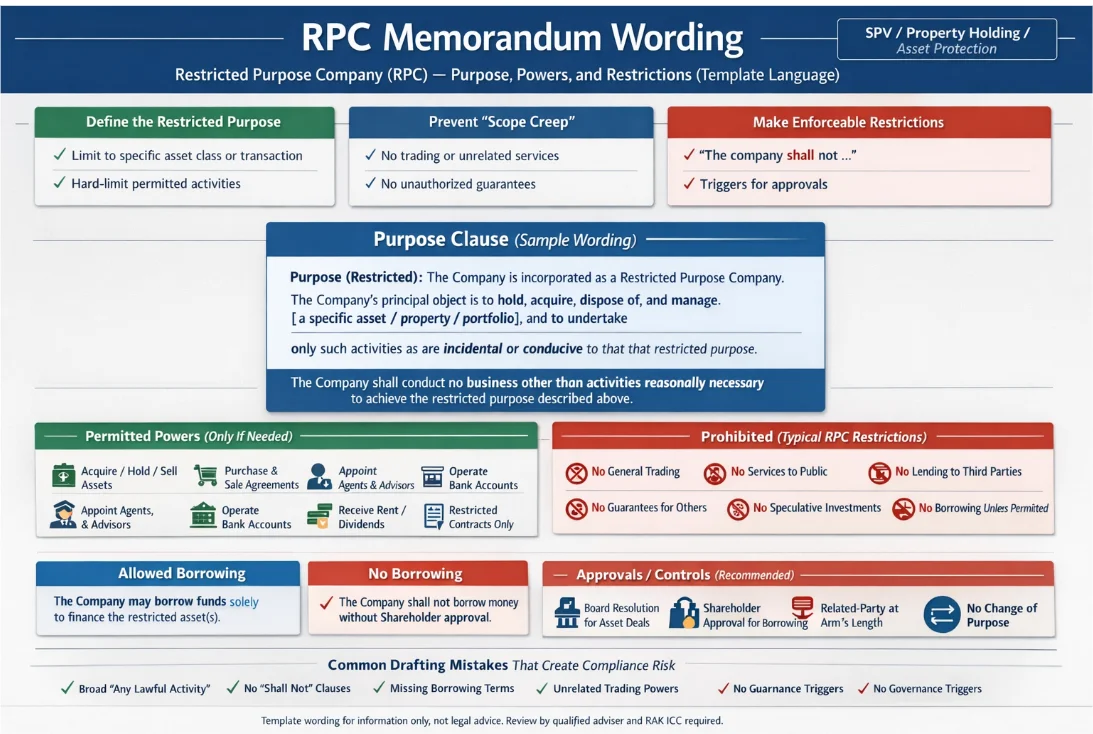
The RPC memorandum wording is the most critical document. It defines the “Restricted Purpose” and is the first thing a compliance officer at a bank will read.
- What to include: Specific references to the transaction (e.g., “The acquisition of the ship known as ‘X’ with IMO number ‘Y'”).
- What to avoid: Generic phrases like “and all other acts incidental thereto” unless carefully qualified. Do not use the word “Trading” unless it is “Trading of [Specific Asset].”
- How banks interpret it: If your MOA says you only hold real estate, and your bank statement shows payments for “Consultancy Services,” the bank will likely flag this as a suspicious activity or a breach of the RPC purpose restrictions.
Banking for SPV UAE (What Banks Ask For)
Opening a bank account for SPV UAE is notoriously challenging. Banks view SPVs as “high risk” because they often lack physical offices and employees (substance).
Bank-Ready Pack Table
| Document | Purpose |
|---|---|
| Certificate of Inc. | Proof of legal existence as an RPC. |
| MOA / AOA | Verifying the RPC purpose restrictions. |
| Register of UBOs | Identity of the ultimate controllers. |
| Source of Wealth | Narrative + evidence of where the UBO’s money came from. |
| Transaction Proof | Draft contracts or term sheets for the “Deal.” |
| Structure Chart | Visual map of all parent entities to the UBO. |
Common Rejection Reasons and Fixes
- EDD Triggers: UBO is from a high-risk jurisdiction. Fix:Appoint a UAE-resident director.
- Unclear Flows: No explanation of where money goes after it hits the SPV. Fix:Provide a transaction flow chart.
- Inconsistent Purpose: MOA says one thing; business plan says another. Fix: Align RPC memorandum wording exactly.
- Weak SoW/SoF: Vague bank statements. Fix: Provide audited personal or group financial statements.
- Missing Contracts: SPV is “shell-like” without a deal. Fix: Wait until a signed term sheet is available.
- Complex Layers: Too many intermediate holdings. Fix: Provide a legal opinion justifying the structure.
- No UAE Nexus: The Deal has nothing to do with the UAE. Fix: Explain why a UAE vehicle is chosen (e.g., neutral ground for JV).
- Signatory Mismatch: The person signing for the bank isn’t on the Register of Directors. Fix: Update the registry before applying.
Lenders’ SPV Requirements UAE (Security + Approvals
Lenders want control. For a project finance SPV UAE, the Lender will often require the RAK ICC RPC to pledge its shares and its bank accounts as security.
Typical Lender Requirements
- Negative Pledge: The RPC cannot take on other debt.
- Non-Petition: Creditors agree not to file for bankruptcy against the RPC.
- Step-in Rights: Lenders can take over the RPC if the project fails.
RPC Board Resolutions Checklist (Heading Examples)
- Approval of the Restricted Purpose and MOA adoption.
- Appointment of specialised Signatories for the Deal.
- Approval of the Bank Account opening.
- Authorisation to grant Security (Charges) to the Lender.
- Authorisation to sign the Facility Agreement.
Timeline and Costs (2026)
The RPC setup cost is approximately AED 12,000–18,000, and the RPC renewal fees are approximately AED 5,000–8,000 should be budgeted as a “cost of the deal.”
Timeline and Cost Table
| Item | Timeline | Cost (AED) – Indicative |
|---|---|---|
| RPC Incorporation | 3–5 Business Days | 12,000 – 18,000 (Base) |
| Professional Agent Fees | 1–2 Weeks | 15,000 – 25,000 |
| Bank Account Opening | 4–12 Weeks | N/A (Admin time) |
| Annual Registry Renewal | Yearly | 5,000 – 8,000 |
| Annual Agent Renewal | Yearly | 10,000 – 15,000 |
Note: Total RPC setup cost AED for a bank-ready vehicle typically averages 35,000 – 45,000 AED in the first year.
RPC Compliance Checklist 2026
In 2026, compliance is not optional. Failure to maintain the RPC compliance checklist 2026 results in heavy fines and potential bank account closure.
Annual Compliance Calendar
| Timing | Action | Owner | Evidence |
|---|---|---|---|
| Q1 | Annual Board Meeting Minutes | Director | Signed Minutes |
| Q2 | RPC renewal fees AED Payment | Agent | Certificate of Good Standing |
| Q3 | Corporate Tax Return Filing | Tax Advisor | Filing Receipt |
| Q4 | ESR Notification / Filing | Agent / Client | ESR Confirmation |
| Ongoing | UBO Register Refresh | Agent | Updated UBO Register |
Regarding SPV audit requirements in the UAE, while RAK ICC doesn’t mandate audits for all IBCs, lenders almost always require audited financials for any project finance SPV in the UAE.
Case Study: Managing a “Purpose Breach”
A tech-holding RPC accidentally received a consulting fee from a third party, an activity not permitted in its MOA. The bank immediately flagged the transaction as “suspicious” due to the restricted nature of the entity.
DUBAI Business and Tax Advisors intervened, explaining the clerical error to the bank and drafting a corrective board resolution to return the funds. By maintaining the integrity of the RPC memorandum wording, we prevented the bank from closing the account and kept the core project financing intact.
Restricted Purpose Company Risks
Operating an RPC carries specific restricted-purposecompany risks:
- Purpose Breach Risk: If the company performs an act outside its MOA, that act might be legally void, creating massive liability for directors.
- Banking Friction Risk: Banks are quick to freeze SPV accounts if they suspect “Scope Creep.”
- Deal-change/restructuring risk: If the project evolves (e.g., adding a second vessel to a single-vessel RPC), the can I convert to RPC or “can I amend the RPC” question becomes legally and administratively expensive.
Mitigation Playbook:
- Conduct a “Pre-check” with your registered Agent before signing any new contract.
- Maintain “AML file hygiene” by keeping all invoices and contracts matched to bank transfers.
- Appoint a professional corporate director to ensure governance is followed.
How DBTA Helps
DUBAI Business and Tax Advisors (DBTA) acts as the bridge between complex legal structures and functional banking outcomes. We help by:
- Fit/no-fit structuring review: Determining if the RPC is the optimal vehicle for your specific project.
- Purpose/memorandum support: Drafting the RPC memorandum wording to be both restrictive and bank approved.
- Bank-ready KYC pack preparation: Building the “Source of Wealth” files that satisfy 2026 AML standards.
- Lender/banking documentation + resolutions pack: Ensuring all corporate actions align with the Lender’s SPV requirements in the UAE.
- Renewals and compliance management: Handling the RPC compliance checklist 2026 so you can focus on the Deal.
Conclusion
The RAK ICC RPC has solidified its position as the workhorse of the UAE’s structured finance sector in 2026. By providing a robust legal framework to ring-fenceassets and liabilities, it offers the “bankruptcy remoteness” that institutional lenders and project sponsors demand. However, as this guide has highlighted, the success of an RPC structure is not determined at the point of incorporation, but through the precision of its RPC memorandum wording and the quality of its UBO KYC RPC company documentation.
In an era of heightened regulatory scrutiny and the implementation of UAE Corporate Tax, the “cleanliness” of your deal vehicle is your greatest asset. Whether you are navigating a securitization SPV UAE or a complex project finance SPV UAE, the Restricted Purpose Company provides the necessary guardrails to ensure that one project’s failure does not become a systemic risk for your entire portfolio. To move forward, ensure your governance is documented, your purpose is clear, and your banking pack is institutional-grade.
Book a structuring call today to request our bank-ready checklist and start your RAK ICC RPC journey.
FAQ's:
It is a specialized legal entity in the Ras Al Khaimah International Corporate Centre designed to limit the company’s legal capacity to a specific, pre-defined transaction or project.
You use an RPC when you need a legally binding “restricted objects” clause to satisfy lenders or JV partners who require asset-level risk isolation.
Large infrastructure projects, real estate developments, private equity “buy-outs,” and securitization of receivables.
absolutely. It is the preferred offshore vehicle for project finance SPV UAE structures because of its bankruptcy-remote features.
Yes, it is frequently used to hold a single plot or building, ensuring that any liabilities related to that property do not leak to the rest of the investor’s portfolio.
Only those specifically listed in its Memorandum. These usually involve holding, financing, and managing a specific asset or contract.
The RPC memorandum wording must state that “The Company is a Restricted Purpose Company” and list the specific, exclusive acts it is authorized to perform.
Technically, yes, by amending the MOA/AOA, but it is often simpler and cleaner for banking purposes to incorporate a new RAK ICC RPC.
Incorporation takes under a week; however, becoming “bank-ready” and opening the account takes between 2 and 4 months.
Yes, keeping accounting records for 7 years is a legal mandate for both. While RAK ICC doesn’t usually require an audit for renewal, a JAFZA offshore audit requirement is more common. Regardless, your bank or the Tax Authority may request audited financials at any time.
First-year setup is roughly 35,000-45,000 AED; annual renewals (fees + Agent) are approximately 15,000-20,000 AED.
Passport, utility bill, CV, and a comprehensive “Source of Wealth” file for any individual owning more than 25%.
The full corporate pack, proof of a live transaction (contracts), and a clear rationale for the RPC structure.
Vague purpose wording, lack of a clear “UAE nexus,” and insufficient documentation regarding the source of the initial investment funds.
Annual renewals, maintaining a UBO register, UAE Corporate Tax registration/filing, and ESR compliance.
The main risk is an ultra vires act (acting outside the MOA). Mitigation involves strict board governance and professional advisory oversight.
Latest news & articles


About the Author:
AURANGZAIB CHAWLA
As CEO of DBTA, Aurangzaib Chawla advises globally mobile businesses and individuals on cross-border tax planning and structuring. With expertise spanning the UK, UAE, and wider GCC, Zaib helps clients minimise double taxation, protect assets, and achieve long-term financial efficiency while staying fully compliant.
Planning to launch in Dubai or the UAE?
Let’s talk about how to structure your business for growth the smart, compliant, and tax-efficient way

About the Author:
AURANGZAIB CHAWLA
As CEO of DBTA, Aurangzaib Chawla advises globally mobile businesses and individuals on cross-border tax planning and structuring. With expertise spanning the UK, UAE, and wider GCC, Zaib helps clients minimise double taxation, protect assets, and achieve long-term financial efficiency while staying fully compliant.
Planning to launch in Dubai or the UAE?
Let’s talk about how to structure your business for growth the smart, compliant, and tax-efficient way
About the Author:
AURANGZAIB CHAWLA
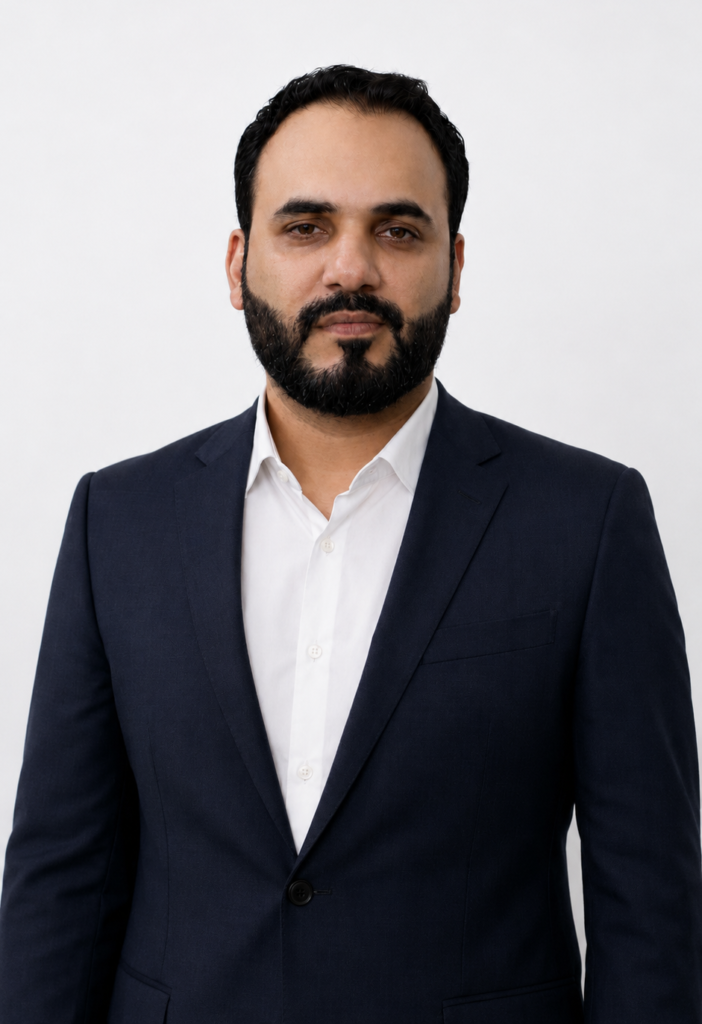
As CEO of DBTA, Aurangzaib Chawla advises globally mobile businesses
and individuals on cross-border tax planning and structuring. With expertise spanning the UK, UAE, and wider GCC, Zaib helps clients minimise double taxation, protect assets, and achieve long-term financial efficiency while staying fully compliant.
Planning to launch in Dubai or the UAE?
Let’s talk about how to structure your business for growth the smart, compliant, and tax-efficient way.
Connect with Reliable Dubai Business Consultants
Get in Touch