
RAK ICC Vs JAFZA Offshore: 2026 Head-to-Head (Costs, Banking, Compliance)

Recent Insights
Table of Contents
Introduction:
The UAE’s offshore landscape has undergone a tectonic shift as we move through 2026. For years, international investors viewed offshore entities as simple, “set-and-forget” vehicles. However, with the full implementation of the UAE Corporate Tax regime and global transparency standards, the choice between RAK ICC Vs JAFZA offshore is no longer just about the initial price tag; it is about long-term institutional viability, banking success, and regulatory peace of mind.
At Dubai Business and Tax Advisors (DBTA), we have observed that the 2026 landscape demands a “compliance-first” approach. Whether you are a high-net-worth individual (HNWI) protecting global assets or a multinational group structuring a regional subsidiary, choosing between the Ras Al Khaimah International Corporate Centre (RAK ICC) and the Jebel Ali Free Zone Authority (JAFZA) requires a surgical understanding of their differences.
Quick Answer: 2026 Expert Snapshot
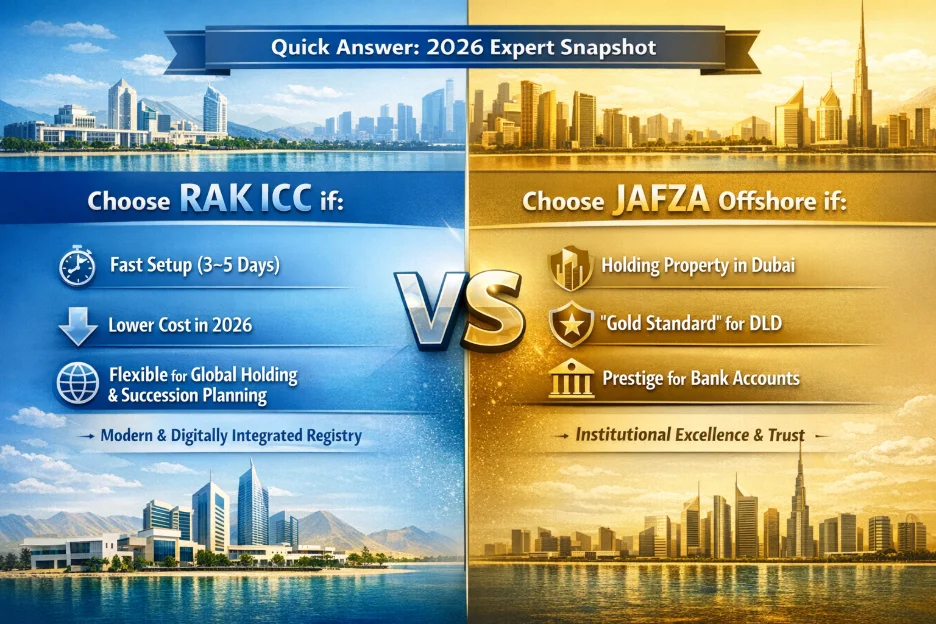
If you are looking for an immediate direction, here is the “Quick Answer” for the RAK ICC Vs JAFZA offshore debate:
- Choose RAK ICC if: You need the fastest RAK ICC setup timeline (3–5 days), lower RAK ICC offshore cost 2026, and a flexible vehicle for international holding or global succession planning. It is the most modern, digitally integrated registry in the region.
- Choose JAFZA Offshore if: Your primary objective is to hold freehold property in Dubai. JAFZA is the “gold standard” for the Dubai Land Department (DLD). It carries higher JAFZA offshore renewal fees but offers unmatched institutional prestige for JAFZA offshore bank account application.
What Each One Is
To choose the right one, you first need to understand their “personality.” Neither of these is a traditional company that you would use to open a physical shop or office in the UAE.
What is RAK ICC used for?
Think of RAK ICC as a flexible “safe box” for your international business. It is most used as a holding company to own shares in other companies globally, protect intellectual property (like brands or software), or manage family wealth. It is also excellent for setting up Special Purpose Vehicles (SPVs),small, single-purpose companies created for a specific investment or a single deal.
What is JAFZA Offshore used for?
JAFZA Offshore is a premium holding vehicle with one specific “superpower”: it is the most widely accepted company type for owning Dubai real estate. If you want to put your Dubai villas or apartments into a company name for protection or inheritance planning, JAFZA is usually the standard choice. It is also used by larger enterprises that want the prestige of a Dubai-based legal address for their global assets.
What are NOT
It is vital to remember that neither of these is an “operating license.” Unlike a Free Zone or Mainland company, you cannot use an offshore license to trade goods inside the UAE, rent a physical office, or provide services to local customers. They are strictly for holding and managing assets, not for day-to-day “on the ground” business operations.
Setup Comparison (Cost & Timeline)
In 2026, entry costs remain a primary differentiator. While both jurisdictions allow for 100% foreign ownership and do not require a physical office, their fee structures reflect their different market positions.
RAK ICC Setup Costs in 2026
RAK ICC remains the most cost-effective premium offshore jurisdiction. The RAK ICC offshore cost in 2026 typically ranges between $3,500 and $4,500 for the first year. This includes the registry fees and the mandatory registered agent fee.
The RAK ICC renewal fees 2026 are equally competitive, usually staying under $3,000. Unlike “onshore” free zones, there are no mandatory office lease costs, though we often advise clients to maintain a professional mailing address for banking credibility.
JAFZA Offshore Setup Costs in 2026
JAFZA is the “blue-chip” offshore jurisdiction. Consequently, the JAFZA offshore cost 2026 is significantly higher, often starting at $5,500 to $6,500. This reflects its prestige and its unique legal standing within Dubai.
For ongoing maintenance, JAFZA offshore renewal fees average around $4,500 to $5,000. JAFZA’s administrative requirements are more rigorous, which often leads to higher professional fees from agents who must manage manual paperwork and physical filings.
RAK ICC Vs JAFZA Offshore Setup Timeline
Speed is often the deciding factor for time-sensitive acquisitions. The RAK ICC setup timeline is remarkably efficient, typically taking 3 to 5 working days once the KYC documents are cleared. In some “Express” cases, it can be completed in 48 hours.
Conversely, the JAFZA offshore setup timeline is more deliberate, usually spanning 2 to 4 weeks. JAFZA’s vetting process, especially for complex corporate shareholders, is manual and detailed, often requiring more “back-and-forth” with the registry.
DBTA Case Study: The Fast-Moving Tech Acquisition
Scenario: A Silicon Valley venture capital firm needed to set up a holding entity within 10 days to facilitate an acquisition of a MENA-based startup.
Solution: DBTA recommended RAK ICC due to its rapid turnaround. We managed the entire RAK ICC setup timeline by pre-verifying the client’s KYC before submission.
Outcome: The company was incorporated in 4 days, allowing the client to meet their closing deadline.
Banking & Operational Access
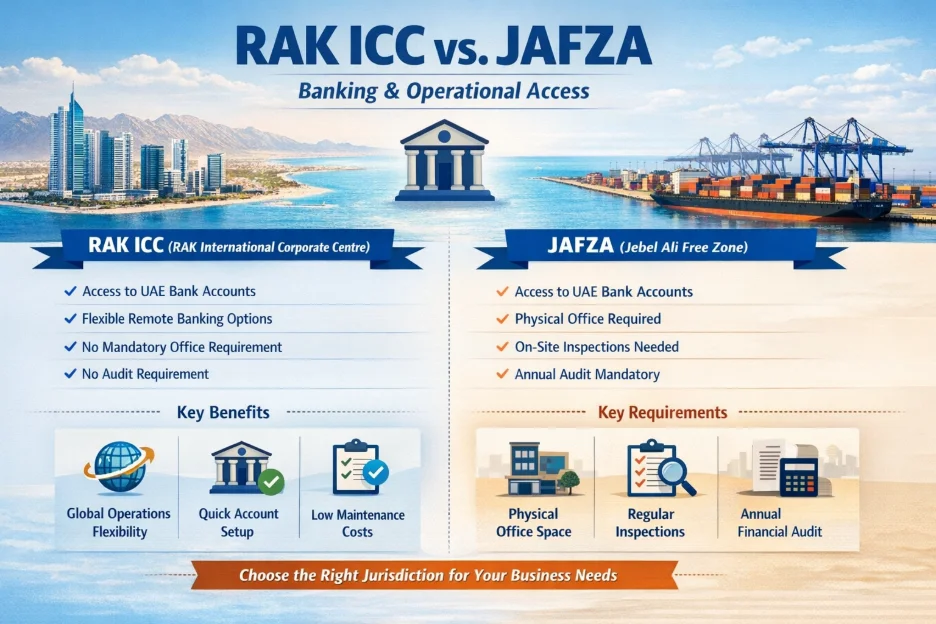
In 2026, the question is not “Can I open a company?” but “Can I open a bank account?” Offshore bank rejection in the UAE remains a high risk for those who do not present a solid commercial rationale.
RAK ICC Bank Account Setup
The RAK ICC bank account process is robust but requires a “face-to-face” meeting with a banker in most cases. Banks in the UAE treat RAK ICC entities as investment or holding vehicles. To succeed, you must demonstrate a clear source of wealth and a logical link to the UAE.
JAFZA Offshore Bank Account Setup
A JAFZA offshore bank account often has a slightly higher success rate at tier-1 banks like Emirates NBD or FAB. This is because JAFZA’s reputation is synonymous with Dubai’s growth. Banks often view JAFZA entities as “lower risk,” particularly if the company is used to hold Dubai property.
Banking Comparison: RAK ICC Vs JAFZA Offshore
When looking at RAK ICC Vs JAFZA banking, the choice depends on your profile. If you are an SME with limited UAE ties, RAK ICC is fine, but expect heavy scrutiny. If you are an institutional investor, JAFZA is the preferred path.
Top Reasons for Offshore Bank Rejection in UAE
In 2026, the primary reasons for offshore bank rejection UAE are:
- Opaque Ownership: Inability to provide clear RAK ICC ubo requirements or JAFZA offshore UBO requirements.
- No “Nexus”: The bank asks, “Why the UAE?” and the client has no answer.
- High-Risk Activities: Engaging in unregulated financial services without specific licensing.
Compliance & Regulatory Requirements
Compliance in 2026 is no longer optional; it is the “governance tax” you pay for operating in a white-listed jurisdiction.
RAK ICC Compliance Requirements
The RAK ICC compliance requirements are modern. Every entity must maintain an updated UBO register. While there is no RAK ICC audit requirement for filing with the registry, you are legally mandated to keep accounting records for 7 years. Failure to do so can lead to massive fines under the UAE’s federal AML (Anti-Money Laundering) framework.
JAFZA Offshore Compliance Requirements
JAFZA offshore compliance is traditionally more manual. There is a clear JAFZA offshore UBO requirements framework that necessitates disclosure of the entire ownership chain. Furthermore, a JAFZA offshore audit requirement is often requested by banks or when transferring property titles between owners.
Offshore Substance Requirements in UAE
The offshore substance requirements UAE have evolved. While the standalone ESR filing has been merged into the Corporate Tax reporting process for many, the principle remains: you must show that your “Core Income Generating Activities” (CIGA) have a connection to the UAE if you seek specific tax benefits.
Corporate Tax & Other Obligations
The introduction of the 9% federal tax has redefined the RAK ICC vs JAFZA offshore debate.
RAK ICC Corporate Tax in 2026
Under the current law, the RAK ICC corporate tax UAE applies to all entities. Most RAK ICC companies must register for Corporate Tax. However, if the company’s income is below AED 375,000, it effectively pays 0%. Proactive tax registration is mandatory to avoid late-filing penalties.
JAFZA Offshore Corporate Tax in 2026
Similarly, JAFZA offshore corporate tax is a reality. JAFZA entities holding real estate in Dubai may face specific rules regarding “immovable property income.” Navigating the JAFZAoffshore corporate tax landscape requires expert advice to ensure you aren’t paying 9% on passive income that could otherwise be optimised.
Tax Residency Certificate & Visa Eligibility
A common question is: Can an offshore company get a visa? In 2026, the answer is still No. Neither RAK ICC nor JAFZA Offshore entities can sponsor UAE residence visas for staff or owners.
Furthermore, getting a tax residency certificate offshore is difficult. Without an offshore company office requirement (offshore companies by definition have no physical office), most do not meet the “Resident” criteria for many Double Tax Treaties.
DBTA Case Study: The Property Holding Tax Trap
Scenario: A client held $10M in Dubai real estate through a JAFZA entity and was worried about the 9% tax on rental income.
Solution: DBTA analysed the JAFZA offshore corporate tax implications and helped the client register correctly with the FTA.
Outcome: The client stayed compliant while minimising their tax leakage.
Allowed Activities & Use Cases
RAK ICC Allowed Activities
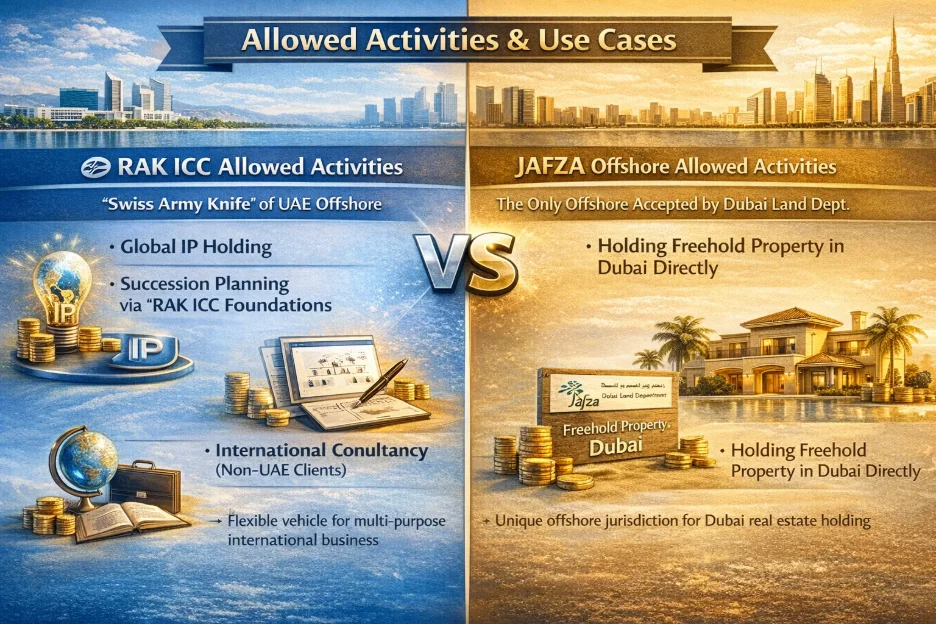
The RAK ICC allowed activities are broad, making it the “Swiss Army Knife” of UAE offshore. It is ideal for:
- Global Intellectual Property (IP) holding.
- Succession planning via “RAK ICC Foundations.”
- International consultancy (where no UAE clients are involved).
JAFZA Offshore Allowed Activities
While JAFZA offshore allowed activities also cover holding and trading, JAFZA is the only offshore jurisdiction that is natively and seamlessly accepted by the Dubai Land Department (DLD) for holding freehold property in Dubai directly.
RAK ICC Vs JAFZA Offshore (12-Point Comparison Matrix)
As an expert consultant, I’ve developed this 12-point matrix to serve as your ultimate decision-making tool for 2026. This comparison highlights the technical nuances that define these two jurisdictions.
| # | Feature / Factor | RAK ICC Offshore | JAFZA Offshore |
|---|---|---|---|
| 1 | Jurisdiction Base | Ras Al Khaimah (RAK) | Dubai (Jebel Ali) |
| 2 | DLD Property Holding | Possible (via MOU) | Best-in-Class (Direct) |
| 3 | Initial Setup Cost | Lower (approx. $3,500+) | Higher (approx. $5,500+) |
| 4 | Renewal Fees | Lower(approx. $2,500+) | Higher (approx. $4,000+) |
| 5 | Setup Timeline | Fast (3–5 Working Days) | Moderate (2–4 Weeks) |
| 6 | Audit Requirement | Not for registry (but for Tax) | Often required for renewals |
| 7 | UBO Privacy | Private (Registry only) | Private (Registry only) |
| 8 | Bank Account Ease | Moderate / Good | High (Superior Prestige)/span> |
| 9 | Visa Eligibility | No | No |
| 10 | Office Requirement | None (Virtual only) | None (Virtual only) |
| 11 | Redomiciliation | Yes (High Flexibility) | Yes |
| 12 | Corporate Tax Reg. | Mandatory | Mandatory |
Migration Guide (RAK ICC ↔ JAFZA Offshore)
In our experience helping clients navigate the RAK ICC Vs JAFZA compliance landscape, I’ve found that many reach a point where their original structure no longer fits. Perhaps they started in RAK ICC for the RAK ICC setup timeline, but now need JAFZA to buy a penthouse in Downtown Dubai.
Let’s be honest: migrations are usually not “one-click.“ They require surgical precision to avoid losing your bank account or triggering a tax audit.
First, define what you mean by “migrate”
There are three different things people call “migration” in the UAE offshore world:
- Move the entity itself: This is known as continuation or redomiciliation.
- Create a new entity and transfer assets/shares: Dissolving the old and starting fresh.
- Insert a new holding company: Restructuring the ownership without moving the old entity.
Option A: Continuation/Redomiciliation (Only if allowed)
This is the cleanest route on paper, but it depends heavily on current registry rules and case facts. If allowed, the steps typically include:
- Drafting formal board approvals and shareholder resolutions.
- Obtaining clearance letters from the current registrar.
- Updating registers and performing a full KYC refresh.
- Crucially: Bank notifications. You must tell your bank before you change jurisdictions, or they will freeze your funds.
Option B: NewCo + Asset/Share Transfer (Most common in practice)
When a direct move is too complex, we usually recommend this step-by-step approach:
- Form the new offshore entity: Set up your RAK ICC or JAFZA entity first.
- Build the banking plan early: Do not transfer assets first and then get stuck. Secure a “pre-approval” from a bank for the new entity.
- Transfer shares/assets: Execute the assignment, novation, or share transfer forms.
- Update counterparties: Notify your tenants, suppliers, or partners of the new entity details.
- Handle bank account transition: Move funds and close the old account.
- Close or maintain the old entity: Depending on remaining risk and practicality.
Option C: HoldCo Insertion (Low disruption route)
If you want to move from RAK ICC to JAFZA compliance standards but don’t want to move the assets, you can set up a new holding company (e.g., a JAFZA Offshore) above an existing RAK ICC entity. This is useful when you want governance changes (like JAFZA’s prestige) without the headache of moving property titles.
Decision-Making Criteria
In 2026, the RAK ICC Vs JAFZA compliance comparison shows that both registries are world-class. However, the decision usually breaks down as follows:
- Startups & SMEs: Prioritise RAK ICC to save on RAK ICC offshore cost 2026 while benefiting from the flexible RAK ICC allowed activities.
- Property Investors: Always choose JAFZA Offshore to avoid the “workarounds” required for other jurisdictions at the Dubai Land Department.
- HNWIs: Often choose RAK ICC Foundations for asset protection due to their superior common-law-based regulations.
How DBTA Helps: Your Strategic Partner
At Dubai Business and Tax Advisors (DBTA), we move beyond basic registration to ensure your entity is fully “future-proofed” for 2026.
- Banking Success: We pre-vet your KYC and Source of Wealth to bypass the common offshore bank rejection UAE.
- Tax & Compliance Mastery: We manage your Corporate Tax registration (TRN) and ensure you meet all UBO and AML reporting standards.
- Seamless Migration: We handle the technical “heavy lifting” of moving entities between jurisdictions without disrupting your assets.
- Strategic Advocacy: Our team acts as your expert liaison with RAK ICC, JAFZA, and the Federal Tax Authority.
Conclusion
Choosing between RAK ICC Vs JAFZA offshore in 2026 is a decision that impacts your tax liability, your banking success, and your regulatory standing. RAK ICC remains the champion of agility and value, while JAFZA Offshore stands as the pillar of Dubai-centric prestige and real estate holding.
Don’t leave your corporate structure to chance. At DBTA, we ensure your UAE offshore journey is efficient, compliant, and positioned for growth.
FAQ's:
RAK ICC is the better choice for cost-efficiency, speed, and holding international assets or IP. JAFZA Offshore is the superior choice specifically for holding freehold property in Dubai, as it has a direct, seamless integration with the Dubai Land Department (DLD).
The RAK ICC offshore cost 2026 typically ranges from $3,500 to $4,500. The JAFZA offshore cost 2026 is more expensive, generally falling between $5,500 and $6,500. These estimates include government registration fees and mandatory registered agent charges for the first year.
The RAK ICC renewal fees 2026 are approximately $3,000. For JAFZA offshore renewal fees, expect to pay around $4,500. These annual costs cover the registry of renewal and the maintenance of your mandatory registered office and agent in the UAE.
The RAK ICC setup timeline is very fast, usually taking 3 to 5 working days once KYC is approved. The JAFZA offshore setup timeline is longer, typically taking 2 to 4 weeks due to more manual vetting processes and stricter document requirements for corporate shareholders.
JAFZA is often viewed more favorably by tier-1 UAE banks due to its long-standing prestige. However, a RAK ICC bank account UAE is highly viable in 2026 if the applicant provides a strong business case, a clear source of wealth, and a logical reason for operating in the region.
What are the top bank rejection reasons for RAK ICC and JAFZA offshore?
Banks require certified passport copies, proof of residential address (utility bills), a detailed professional CV, and 6 months of personal bank statements. To verify the Source of Wealth, they may request property deeds, investment statements, or audited accounts from existing businesses.
Both jurisdictions require full disclosure of the Ultimate Beneficial Owner (UBO). Per RAK ICC UBO requirements and JAFZA offshore UBO requirements, you must identify any individual owning 25% or more of the entity. This data is held privately by the registry and shared only with regulators.
While technically possible, nominees are discouraged in 2026. Global transparency standards make it difficult to maintain “hidden“ ownership. Using nominees significantly increases the risk of offshore bank rejection UAE, as banks view these structures as high-risk for money laundering.
Yes, keeping accounting records for 7 years is a legal mandate for both. While RAK ICC doesn’t usually require an audit for renewal, a JAFZA offshore audit requirement is more common. Regardless, your bank or the Tax Authority may request audited financials at any time.
All offshore entities must register for Corporate Tax. A 9% tax rate applies to taxable income exceeding AED 375,000. While holding companies may qualify for exemptions on specific passive income, they must still fulfil annual filing and registration obligations.
Usually, no. A TRC typically requires a physical office and a minimum period of residency. Since there is no offshore company office requirement (offshore companies cannot lease local office space), they generally do not qualify as “Tax Residents“ for treaty purposes.
No. To the question “Can an offshore company get a visa?“, the answer is always no. Offshore companies are non-resident vehicles and do not have the right to sponsor employees or owners for UAE residency visas. You would need a Free Zone or Mainland company for this.
Offshore companies do not need a physical lease for registration. However, to satisfy the offshore substance requirements UAE for banking, you must prove the company is managed from the UAE. This often involves showing a local “nexus“ and transparent transaction history rather than a physical desk.
Liquidation typically takes 2 to 4 months. Costs range from $2,000 to $4,500, covering the liquidator’s fee, government de-registration charges, and the mandatory public notices in local newspapers.
Latest news & articles


About the Author:
AURANGZAIB CHAWLA
As CEO of DBTA, Aurangzaib Chawla advises globally mobile businesses and individuals on cross-border tax planning and structuring. With expertise spanning the UK, UAE, and wider GCC, Zaib helps clients minimise double taxation, protect assets, and achieve long-term financial efficiency while staying fully compliant.
Planning to launch in Dubai or the UAE?
Let’s talk about how to structure your business for growth the smart, compliant, and tax-efficient way

About the Author:
AURANGZAIB CHAWLA
As CEO of DBTA, Aurangzaib Chawla advises globally mobile businesses and individuals on cross-border tax planning and structuring. With expertise spanning the UK, UAE, and wider GCC, Zaib helps clients minimise double taxation, protect assets, and achieve long-term financial efficiency while staying fully compliant.
Planning to launch in Dubai or the UAE?
Let’s talk about how to structure your business for growth the smart, compliant, and tax-efficient way
About the Author:
AURANGZAIB CHAWLA

As CEO of DBTA, Aurangzaib Chawla advises globally mobile businesses
and individuals on cross-border tax planning and structuring. With expertise spanning the UK, UAE, and wider GCC, Zaib helps clients minimise double taxation, protect assets, and achieve long-term financial efficiency while staying fully compliant.
Planning to launch in Dubai or the UAE?
Let’s talk about how to structure your business for growth the smart, compliant, and tax-efficient way.
Connect with Reliable Dubai Business Consultants
Get in Touch